Quick answer
A bounced check demand letter in California is a written demand sent by certified mail under Civil Code section 1719. It must explain the statute, state the check amount and the service charge. The writer then has 30 days from mailing to pay the check, the service charge and the mailing cost. If not, they can owe the check plus damages of three times its amount, between $100 and $1,500.
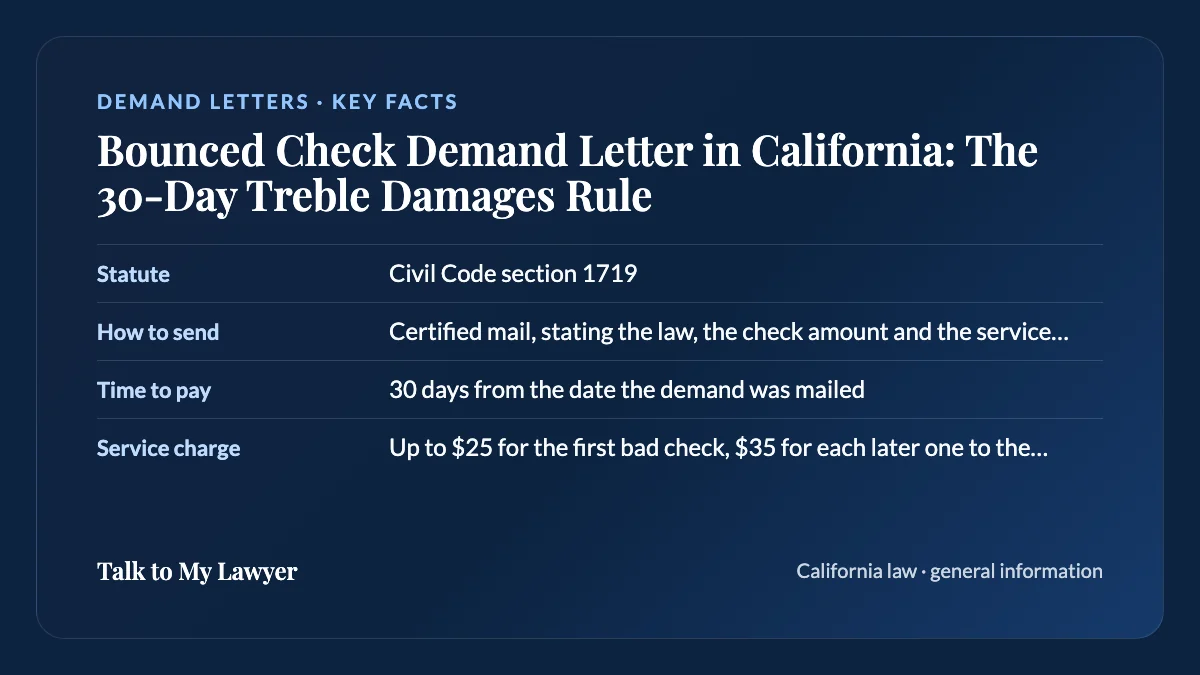
At a glance
- Statute
- Civil Code section 1719
- How to send
- Certified mail, stating the law, the check amount and the service charge
- Time to pay
- 30 days from the date the demand was mailed
- Service charge
- Up to $25 for the first bad check, $35 for each later one to the same payee
- Treble damages
- Three times the unpaid check amount, at least $100 and at most $1,500
- Where to sue
- Small claims up to $12,500 for individuals, $6,250 for businesses
What can you recover for a bounced check in California?
Under Civil Code section 1719, a person who passes a check on insufficient funds owes the payee the amount of the check plus a service charge of up to $25 for the first such check and up to $35 for each later one to the same payee. That much applies whether or not you send a letter.
The demand letter opens a second tier. If you mail a proper written demand by certified mail and the check writer does not pay within 30 days, they become liable instead for the check amount plus damages of three times that amount, with a floor of $100 and a ceiling of $1,500.
The statute covers more than an empty account. A check counts as passed on insufficient funds when the bank refuses it for lack of funds or credit, because the writer has no account there, or because the writer told the bank to stop payment. Stop-payment checks follow extra rules, covered below.
What must a California bounced check demand letter include?
Section 1719(a)(2) sets out how the demand must be sent and what it must tell the check writer, and section 1719(j)(1) makes the writer liable for damages and costs only if all of the section's requirements are met. The first four items below come from the statute; the last two are practical details that make the demand easy to act on.
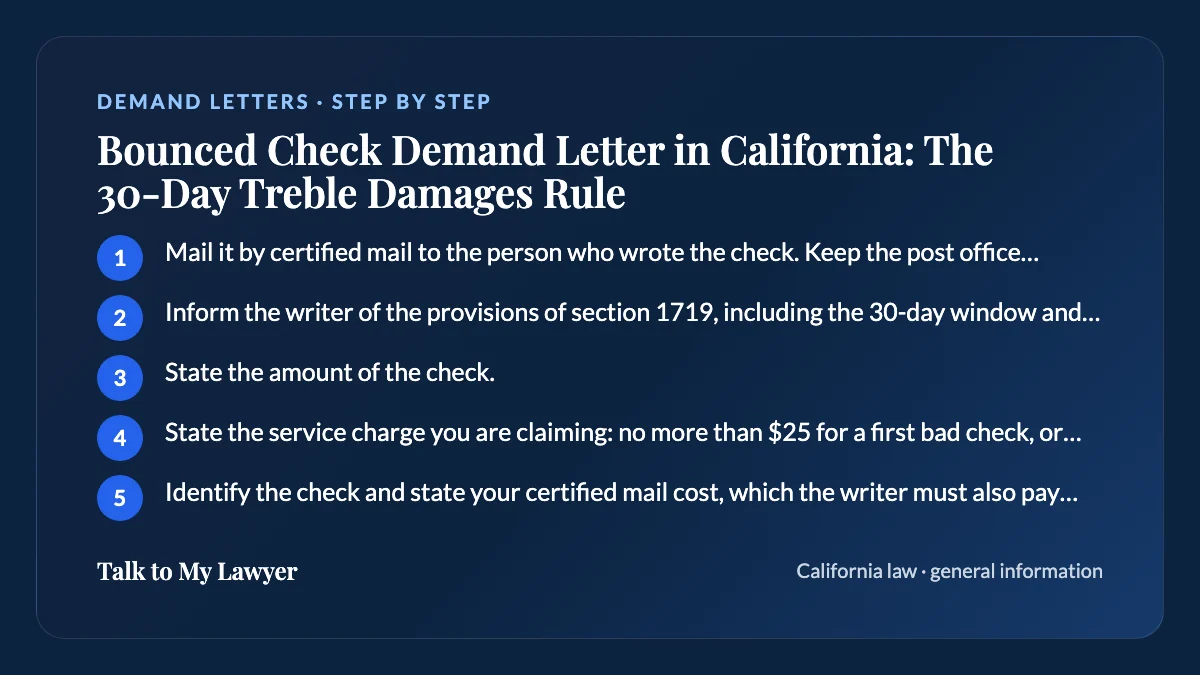
- Mail it by certified mail to the person who wrote the check. Keep the post office receipt and the delivery record.
- Inform the writer of the provisions of section 1719, including the 30-day window and the damages that follow if they do not pay in full.
- State the amount of the check.
- State the service charge you are claiming: no more than $25 for a first bad check, or $35 for each later one to you.
- Identify the check (number, date, return date) and state your certified mail cost, which the writer must also pay within the 30 days to avoid damages.
- Say where and how to pay you, so the writer can pay in full within 30 days of the mailing date.
The California Courts self-help site offers a sample bad check demand letter and a separate stop-payment letter, linked from its page on asking for the money before small claims. Read them alongside the statute, which controls.
Example: how treble damages are calculated
Treble damages are figured on the unpaid check amount, then held between $100 and $1,500. Once treble damages apply, the service charge and mailing cost drop out, because the statute replaces them. These hypothetical checks show the math.
| Check amount | Three times the check | Damages after the limits | Total claim (check plus damages) |
|---|---|---|---|
| $30 | $90 | $100 (minimum applies) | $130 |
| $250 | $750 | $750 | $1,000 |
| $700 | $2,100 | $1,500 (maximum applies) | $2,200 |
Partial payments within the 30 days reduce the base. Example (hypothetical): on a $250 check, the writer pays $100 on day 20 and nothing more. The remaining $150 is the base, damages are $450, and the claim becomes $600. The writer can be liable for damages only once on each check (section 1719(j)(2)).
What if the check writer stopped payment?
A stopped check is treated differently because the writer may have a reason. No service charge, mailing cost or treble damages are owed if the writer stopped payment to resolve a good faith dispute with you, and you must prove by clear and convincing evidence that there was none (section 1719(a)(3)).
A good faith dispute is one where the writer reasonably believed they were entitled to withhold payment, for example because goods were not delivered, services were not performed, the work was faulty or not as promised, or there was an overcharge (section 1719(b)).
- Use the notice in section 1719(c). The statute sets out the wording to follow substantially, which tells the writer they may have a good faith dispute and gives your contact details.
- Keep a copy of the notice and a signed certified mail receipt showing delivery, or attempted delivery if refused, to the writer's last known address. A court cannot award damages on a stopped check without them (section 1719(d)).
- Before suing, make and document a reasonable effort to resolve the dispute (section 1719(e)).
Sample wording for an insufficient funds demand
Keep the tone plain and the numbers exact. A demand of this kind is a notice of a civil right, so it reads best when it simply states the facts and the statute.
Your check number 1043, dated May 2 and payable to me for $250, was returned unpaid by your bank on May 6 for insufficient funds. Under California Civil Code section 1719, you have 30 days from the date this letter was mailed to pay $250 for the check, a $25 service charge and $9.12 for the cost of sending this letter by certified mail, a total of $284.12. If full payment is not received within 30 days, you may be liable instead for the amount of the check and damages of three times that amount, which by law are not less than $100 nor more than $1,500, and a claim may be filed in small claims court.
The figures above are hypothetical. Use your actual check details and your actual certified mail cost from the post office receipt.
Can you mention criminal charges in a bad check letter?
Leave criminal charges out of your demand. Section 1719 is a civil remedy, and its damages apply regardless of any criminal case. Writing a bad check is a crime in California only when it is done willfully, with intent to defraud, and with knowledge that the funds are not there (Penal Code section 476a).
Pairing a demand for money with a threat to report someone for a crime can create legal problems for the sender. California's extortion law lists a threat to accuse someone of a crime as one way of inducing the fear that can constitute extortion (Penal Code section 519). If you believe a check was written to defraud you, you can contact law enforcement separately, but do not make that report a bargaining point in your letter.
What happens if they still do not pay after 30 days?
Section 1719(e) lets the original payee bring the claim in small claims court if it fits within that court's limit. Individuals can claim up to $12,500 (Code of Civil Procedure section 116.221) and businesses up to $6,250 (section 116.220). No person may file more than two small claims cases over $2,500 anywhere in California in a calendar year (section 116.231).
- Start the case on form SC-100, Plaintiff's Claim and ORDER to Go to Small Claims Court.
- Bring the returned check, the bank's return notice, a copy of your demand and the certified mail receipt.
- Bring a simple calculation showing the check amount, any partial payments and the damages figure.
- Expect a filing fee between $30 and $100 unless you qualify for a fee waiver.
Filed outside small claims, a case under section 1719 is a limited civil case (section 1719(f)). For the general filing steps, see our guide to a demand letter before small claims in California. If a client paid an invoice with the bad check, our unpaid invoice demand letter guide covers the underlying debt.
When an attorney-written bounced check letter makes sense
Section 1719 is precise, and a demand that misses a required element can cost you the treble damages. You may want an attorney to write it when the check is large, when the writer stopped payment and claims a dispute, when several checks from the same writer bounced, or when the check was part of a larger unpaid account.
Through Talk to My Lawyer, a licensed California attorney writes your letter from the returned check, the bank notice and your records, includes the statutory content section 1719 calls for, and sends it on your behalf by the required method. For advice on filing or on a criminal report, speak with a lawyer about your situation.
Frequently asked questions
How much can you charge for a bounced check in California?
Under Civil Code section 1719, the payee can collect the check amount plus a service charge of up to $25 for the first check passed on insufficient funds and up to $35 for each later one to that payee. If a proper certified-mail demand goes unpaid for 30 days, the writer can owe the check plus damages of three times its amount, from $100 to $1,500.
Does a bounced check demand letter have to be sent by certified mail?
Yes, to qualify for treble damages. Section 1719(a)(2) requires the written demand to be mailed by certified mail. For stop-payment checks, a court cannot award damages unless it receives a copy of the demand and a signed certified mail receipt showing delivery, or attempted delivery if refused, to the writer's last known address.
When does the 30-day period start for a bad check demand?
The 30 days run from the date the written demand was mailed, not the date it was received. Within that time, the writer can avoid treble damages by paying the check amount, the service charge and your certified mail cost in full. Keep the dated post office receipt as proof of the mailing date.
Is writing a bad check a crime in California?
It can be, but only in limited circumstances. Penal Code section 476a applies when a person willfully writes a check with intent to defraud, knowing the funds or credit are not there. An honest mistake does not fit that description. Keep criminal matters out of your demand letter and raise any concerns with law enforcement directly.
Can a business use small claims court for a bounced check?
Yes. Civil Code section 1719(e) allows the original payee to sue in small claims court if the claim is within its limit. For a business or other entity, the limit is $6,250, while individuals can claim up to $12,500. Lawyers cannot represent either side at a small claims hearing, though you can get advice beforehand.
Sources
Checked against these official sources on October 17, 2026.
- California Civil Code section 1719 (California Legislative Information)
- Ask for the money (with sample bad check and stop payment letters) (California Courts Self-Help Guide)
- California Penal Code section 476a (California Legislative Information)
- California Penal Code section 519 (California Legislative Information)
- California Code of Civil Procedure section 116.221 (California Legislative Information)
- Small claims in California (California Courts Self-Help Guide)
This guide explains California law in general terms as of October 2026. It is general information, not legal advice for your situation, and local rules can add to it.
Join the email list and get a lawyer letter started
With Talk to My Lawyer, a licensed California attorney writes your letter from your facts and documents and sends it on your behalf. Join the Talk to My Lawyer email list for letter checklists, document prompts, and reminders before you start your letter.