Quick answer
To find the legal name of a business in California, search the Secretary of State's bizfile Online for corporations, LLCs and limited partnerships, and the county clerk's fictitious business name records for DBAs. Licensed businesses can be checked through the CSLB or DCA license lookups. California's small claims rules require the defendant's exact legal name, plus an agent for service of process for a corporation or LLC.
At a glance
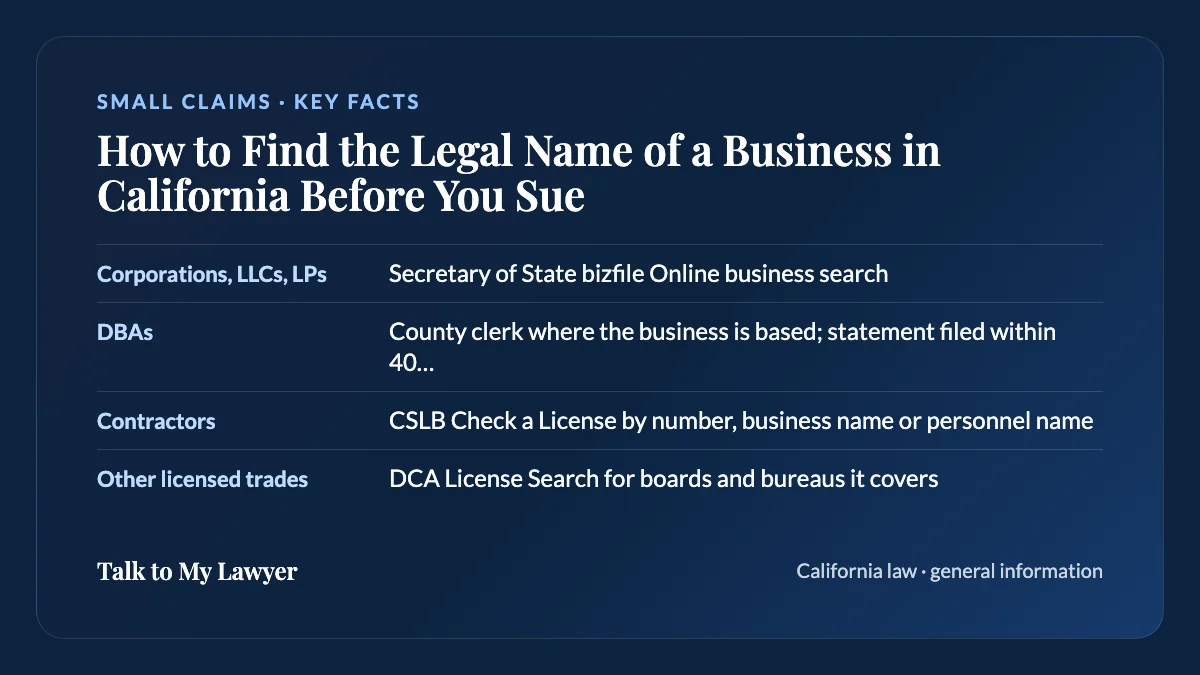
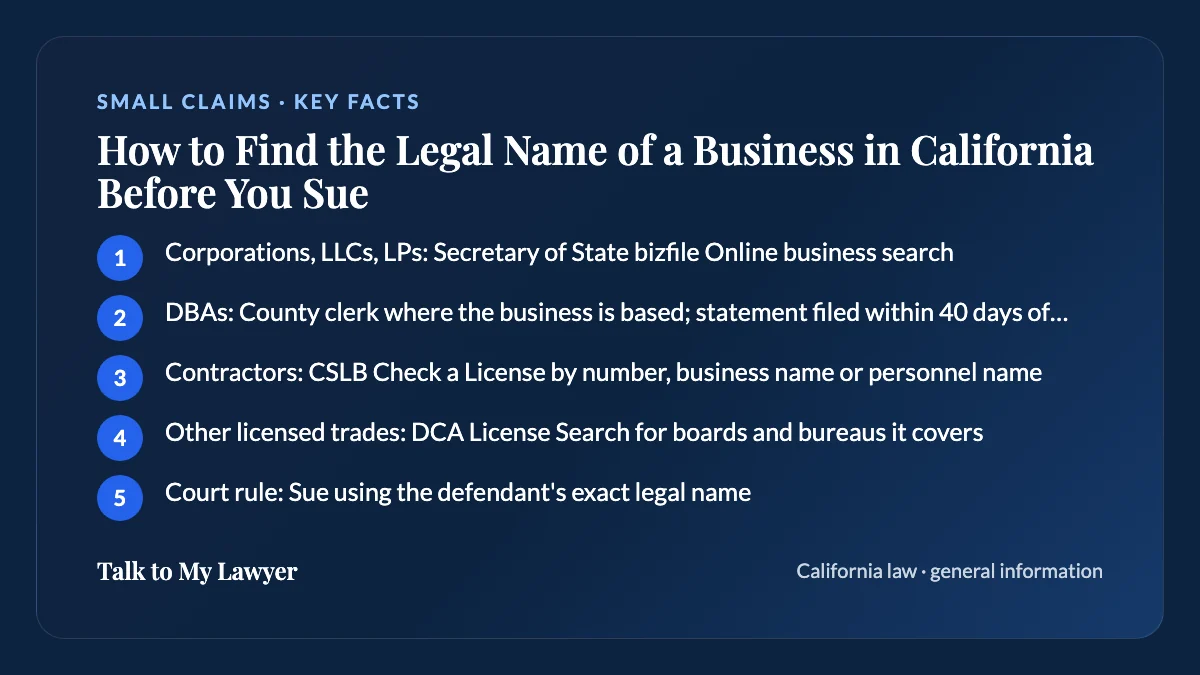
- Corporations, LLCs, LPs
- Secretary of State bizfile Online business search
- DBAs
- County clerk where the business is based; statement filed within 40 days of starting (B&P 17910)
- Contractors
- CSLB Check a License by number, business name or personnel name
- Other licensed trades
- DCA License Search for boards and bureaus it covers
- Court rule
- Sue using the defendant's exact legal name (SC-100-INFO)
Why does a business's legal name matter for a demand letter or small claims?
The legal name is the name of the person or entity that actually owes you, and a court judgment is only as useful as the name on it. The Judicial Council's information sheet for small claims plaintiffs (form SC-100-INFO) says you must sue using the defendant's exact legal name. The California Courts self-help guide warns that a wrong name could stop you from collecting if you win.
The same research improves your demand letter. A letter addressed to the right owner, and copied to the entity's agent for service of process, reaches the party that owes you. It also creates a record that you asked the right party, which matters because small claims rules ask you to demand payment before you file, if possible.
SC-100-INFO also notes that if you do not use the exact legal name, the court may be able to correct it at the hearing or after judgment. That is a fallback, not a plan.
Checklist: where the legal name may already be hiding
Before searching any database, look at what the business gave you. The legal name can appear only in small print.
- The contract, estimate or work order, especially the signature block and the fine print at the bottom.
- Invoices and receipts, which may show a name followed by Inc., LLC, Corp. or LP.
- Your card or bank statement, which may show a merchant name that differs from the sign.
- A contractor's license number, which must appear on contracts, bids and ads (Business and Professions Code section 7030.5).
- Your lease, a warranty card, a website's terms of service page or its footer.
- Emails and text messages, including signatures and the domain the emails came from.
Write down every name variation you find. Each one is a search term for the steps below.
How do you look up a corporation or LLC in California?
Search the California Secretary of State's bizfile Online business search. It covers corporations, limited liability companies and limited partnerships formed in California, plus out-of-state entities registered to do business here. The Secretary of State says plain copies of filed documents are available online free.
A business record shows the entity's exact name, file number and status, and lets you view its filings. The most useful filing is the Statement of Information. Corporations file one every year (Corporations Code section 1502) and LLCs every two years (section 17702.09). It lists the principal office address, officers or managers, and the agent for service of process.
- Search a distinctive word from the name rather than the full name, then scan the results.
- Check the status. A business record that is not active is a sign to dig further before you name it.
- Note the agent for service of process. It must be a California resident or a registered corporate agent, and the business cannot act as its own agent.
How do you find out who owns a DBA in California?
Check the fictitious business name records at the county clerk's office in the county where the business has its principal place of business in California (a business with no California location files in Sacramento County). Fictitious business names, often called DBAs (doing business as), are filed with the county, not the Secretary of State (Business and Professions Code section 17915).
Under Business and Professions Code section 17900, a name is fictitious if it does not include the owner's surname, suggests extra owners ("& Associates", "Brothers"), or, for a corporation or LLC, differs from the name on file with the Secretary of State. Anyone regularly doing business under such a name must file a statement within 40 days of starting (section 17910).
That statement is where the owner appears. Section 17913 requires it to list an individual owner's full name, each general partner's name, or the corporation's or LLC's name exactly as filed with the Secretary of State. A statement generally expires five years after it was filed (section 17920), so check the filing date. Section 17926 sets a $2 fee for a certified copy (your county's fee schedule may differ), and a certified copy creates a rebuttable presumption that the information in it is true.
Using license lookups for contractors and other licensed businesses
For contractors, use the Contractors State License Board's Check a License tool. You can search by license number, business name or personnel name. CSLB says a lookup gives the contractor's address of record, and its search tips suggest typing only the first 10 to 15 letters of a business name.
Look at the entity type on the license. If the license belongs to an LLC or corporation, take that exact name to bizfile Online to find the agent for service of process. CSLB also says licensed contractors must carry a $25,000 license bond, which can matter for a later claim; see our guide to a contractor refund demand letter.
For many other licensed trades and professions, use the Department of Consumer Affairs DCA License Search. It covers many DCA boards and bureaus and shows whether a license is current or has been disciplined. Contractors are not in it; they are on the CSLB site.
How to name each type of business
The right format depends on who owns the business. The first three rows follow the California Courts self-help guidance on naming defendants; the last two apply the same rule, the exact legal name, to common harder cases.
| Owner type | Where to confirm it | How the name is written |
|---|---|---|
| Sole proprietor using a trade name | County DBA records; license lookups | The owner individually and DBA the business name, for example: Dana Ruiz, individually and DBA Ruiz Mobile Detailing |
| Partnership not registered with the state | County DBA records | Each partner individually, plus the business name |
| Corporation or LLC | bizfile Online | Exact entity name, plus DBA and the trade name if it uses one; agent for service listed separately |
| Franchise location | Receipt, county DBA records, bizfile Online | The local owner entity, which can differ from the brand on the sign |
| Out-of-state company | bizfile Online registration | Exact name as registered in California, with its California agent |
Out-of-state corporations must qualify with the Secretary of State and name a California agent before doing intrastate business (Corporations Code section 2105). SC-100-INFO notes that, with very limited exceptions, the defendant must be served in California, so a company with no California presence may need a different approach. Ask a small claims advisor or a lawyer.
How to name a business in your demand letter and on form SC-100
Use the same name in both places. Item 2 of form SC-100 (revised January 1, 2026) asks for the defendant's name and address and, if the defendant is a corporation, LLC or public entity, the person or agent authorized to accept service. Use form SC-100A if you are suing more than one defendant, such as an owner and the owner's company.
Example (hypothetical): a roofing invoice says "Summit Roofing." The CSLB lookup on the license number printed on the contract shows the license belongs to Summit Roof Works LLC. bizfile Online shows that LLC as active and lists its agent for service. The letter goes to Summit Roof Works LLC, DBA Summit Roofing, at its principal office, with a copy to the agent.
To: Summit Roof Works LLC, doing business as Summit Roofing, 2200 Alder Avenue, Fresno, California. Copy to: its agent for service of process, as listed with the California Secretary of State. Re: Contract dated March 3, 2026, for roof replacement at 41 Birch Lane. This letter requests a refund of the $4,800 deposit paid for work that was not started.
Form SC-103 is a different form. It is for a plaintiff suing on behalf of its own business under a fictitious name, and a business that has not filed and published its DBA statement cannot sue on contracts made under that name until it does (Business and Professions Code section 17918).
For the steps after the letter, see our small claims demand letter template guide and our guide to demand letters before small claims in California.
When an attorney-written letter makes sense
The searches in this guide are public and you can run them yourself. An attorney-written letter is worth considering when the records conflict, when ownership runs through several entities or a franchise, when the business is based outside California, or when the amount is too large for small claims.
Through Talk to My Lawyer, a licensed California attorney writes your letter from your contract, receipts and the business details you found, addresses it to the legal owner, and sends it on your behalf. For advice on whom to sue and where, talk to a lawyer about your facts.
Frequently asked questions
Is a California business entity search free?
Searching bizfile Online is open to the public, and the California Secretary of State says plain copies of filed business documents are available online for free. Certified copies and certificates of status are ordered separately through bizfile Online. County fictitious business name records are public too; Business and Professions Code section 17926 sets a $2 fee for a certified copy of a statement, though your county's fee schedule may differ.
What if the business only has a DBA and no LLC or corporation?
Then a person or partnership owns it directly. The county fictitious business name statement should list the owner's full name or each general partner's name. In small claims, the courts' guidance is to name the owner individually and also as doing business under the trade name, so the judgment attaches to the person who owns the business.
Where do I find a company's agent for service of process?
On the company's record in the Secretary of State's bizfile Online search. Corporations and LLCs list the agent in their Statement of Information. The agent must be a California resident or a registered corporate agent, and the business cannot serve as its own agent. Form SC-100 asks for this person or agent when you sue a corporation or LLC.
What happens if I sue under the wrong business name?
You may struggle to collect. The courts' self-help guide warns that a wrong name could prevent you from collecting even after you win. Form SC-100-INFO says the court may be able to correct the name at the hearing or after judgment, but checking state and county records first avoids relying on that.
How do I find the owner of a franchise store?
Start with your receipt and any contract, which may name the local operator. Then search the county fictitious business name records for the store's trade name and bizfile Online for the operating company. The brand on the sign may belong to the franchisor, while the store you dealt with may be owned by a separate local business.
Sources
Checked against these official sources on October 17, 2026.
- How to name a defendant in your forms (California Courts Self-Help Guide)
- Information for the Small Claims Plaintiff (SC-100-INFO) (Judicial Council of California)
- Plaintiff's Claim and ORDER to Go to Small Claims Court (SC-100) (California Courts Self-Help Guide)
- Business Entities Frequently Asked Questions (California Secretary of State)
- Business and Professions Code section 17913 (California Legislative Information)
- How do I find the right licensed contractor? (Contractors State License Board)
This guide explains California law in general terms as of October 2026. It is general information, not legal advice for your situation, and local rules can add to it.
Join the email list and get a lawyer letter started
With Talk to My Lawyer, a licensed California attorney writes your letter from your facts and documents and sends it on your behalf. Join the Talk to My Lawyer email list for letter checklists, document prompts, and reminders before you start your letter.