Quick answer
An HOA dispute in California is governed by the Davis-Stirling Act (Civil Code section 4000 and following). Current-year records are due within 10 business days of a request. As of October 2026, most fines are capped at $100 per violation. Before certain superior court suits, the owner or association must offer alternative dispute resolution, such as mediation, through a Request for Resolution; the other side has 30 days to accept.
At a glance
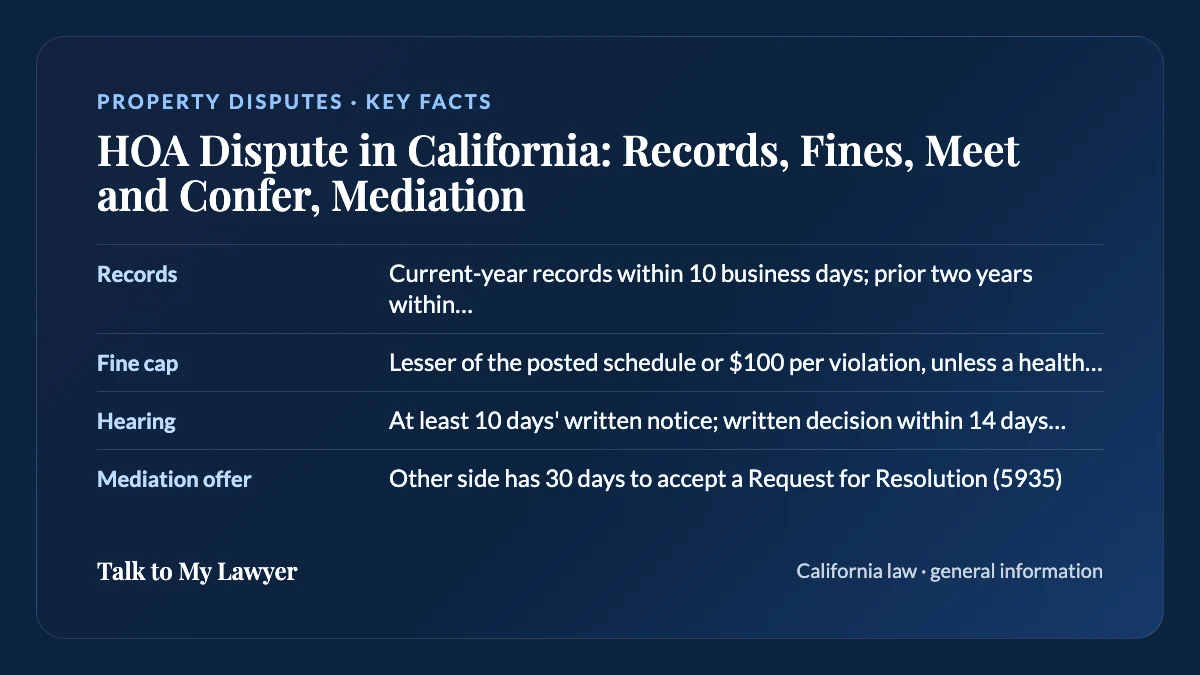
- Records
- Current-year records within 10 business days; prior two years within 30 calendar days (Civil Code 5210)
- Fine cap
- Lesser of the posted schedule or $100 per violation, unless a health or safety finding (5850)
- Hearing
- At least 10 days' written notice; written decision within 14 days (5855)
- Mediation offer
- Other side has 30 days to accept a Request for Resolution (5935)
- Late assessments
- Late charge up to 10% or $10, whichever is greater; interest up to 12% (5650)
- Small claims
- Up to $12,500 for individuals, no mediation step required (CCP 116.221; Civil Code 5930)
What law governs an HOA dispute in California?
The Davis-Stirling Common Interest Development Act, found at Civil Code section 4000 and following, governs California homeowners associations. Its internal dispute resolution rules apply to disputes between an association and an owner over the act itself, the Nonprofit Mutual Benefit Corporation Law, and the association's governing documents, such as the CC&Rs, bylaws and rules (Civil Code section 5900).
Four parts of the act cover the disputes in this guide:
| Problem | Where the rule lives | What it controls |
|---|---|---|
| Records request ignored or refused | Civil Code 5200 to 5240 | What you can see, how fast, and at what cost |
| Fine or penalty | Civil Code 5850 to 5855 | Fine limits, hearing notice and the written decision |
| Late assessments, liens | Civil Code 5650 to 5740 | Late charges, interest, lien notices and foreclosure limits |
| Any dispute heading to court | Civil Code 5900 to 5965 | Meet and confer, then mediation before most lawsuits |
Your CC&Rs and rules add detail of their own, so read them alongside the statute.
How fast must a California HOA produce its records?
A California HOA must give access to current-fiscal-year records within 10 business days of receiving your request, and to records from the previous two fiscal years within 30 calendar days (Civil Code section 5210). Minutes of board and member meetings stay open to inspection permanently.
Inspectable records include budgets and financial statements, the general ledger, executed contracts, check registers, tax returns, reserve records, minutes, and "enhanced" records such as invoices and bank statements (section 5200). Since January 1, 2026, inspector reports on balconies, decks and other exterior elevated elements (Civil Code section 5551) are included too (SB 410).
- Ask in writing and list the specific records you want. You can name someone else to inspect for you, also in writing (section 5205).
- The association can bill the actual cost of copying and mailing, and up to $10 an hour, capped at $200 per request, to redact enhanced records. It must tell you the cost first.
- If records are withheld or redacted, you can ask for a written explanation of the legal basis (section 5215).
- If a court finds access was unreasonably withheld, it must award costs and attorney's fees and may add a civil penalty of up to $500 for each separate written request. That claim can go to small claims court (section 5235).
What are the limits on HOA fines in California?
As of October 2026, an HOA fine for violating the governing documents cannot exceed the lesser of the amount in the association's published penalty schedule or $100 per violation (Civil Code section 5850(c)). The cap took effect June 30, 2025, through AB 130.
A board may impose a higher scheduled penalty only when the violation may harm health or safety in the common area or another owner's property, and only after a written finding to that effect at a board meeting open to members. The association also may not charge late fees or interest on a fine (section 5850(e)).
The hearing rules in section 5855 apply before any discipline:
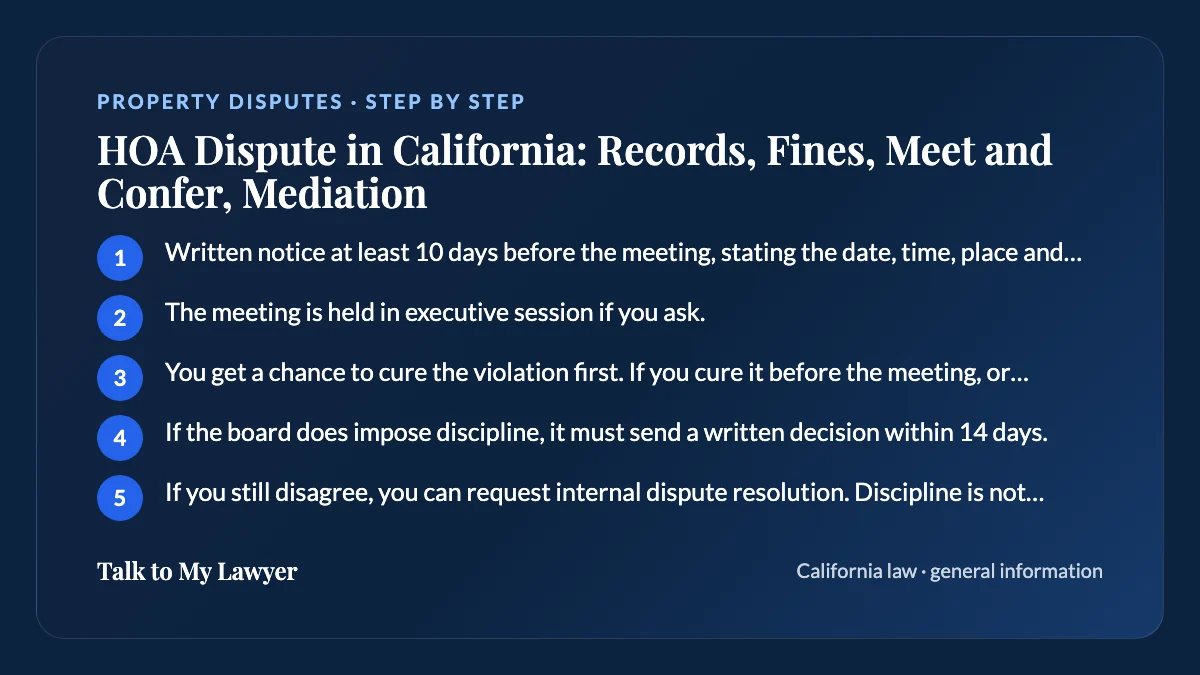
- Written notice at least 10 days before the meeting, stating the date, time, place and the alleged violation, and your right to attend and speak.
- The meeting is held in executive session if you ask.
- You get a chance to cure the violation first. If you cure it before the meeting, or commit financially to a cure that takes longer, the board cannot impose discipline.
- If the board does impose discipline, it must send a written decision within 14 days.
- If you still disagree, you can request internal dispute resolution. Discipline is not effective unless the board follows these steps.
What can an HOA charge when assessments are late?
Assessments become delinquent 15 days after they are due, unless the declaration gives longer. The association can then add a late charge of up to 10 percent or $10, whichever is greater, interest of up to 12 percent a year starting 30 days after the due date, and reasonable collection costs (Civil Code section 5650). Your payments go to the assessments first, then to fees and interest (section 5655).
- At least 30 days before recording a lien, the association must send a certified-mail notice with an itemized statement and your dispute rights (section 5660).
- You can ask in writing to meet the board about a payment plan. If you mail the request within 15 days of the notice's postmark, the board (or a committee of directors, if no regular board meeting falls in that window) must meet you within 45 days of your request's postmark (section 5665).
- Only the board can decide to record a lien, by majority vote in an open meeting (section 5673).
- The association cannot foreclose to collect less than $1,800 in delinquent assessments, unless they are more than 12 months overdue (section 5720).
- If you dispute a charge within the small claims limit, you can pay it under protest and sue in small claims court (section 5658).
How does meet and confer work with an HOA?
Meet and confer is the internal dispute resolution step: you ask in writing, and the association must take part. Every association needs a fair, reasonable and expeditious procedure, and if it has none, the default process in Civil Code section 5915 applies.
- Either side can start it with a written request. An owner may refuse a request from the association, but the association cannot refuse an owner's request.
- The board names a director to meet with you, and both sides explain their positions in good faith. You can bring an attorney or another helper at your own cost.
- You cannot be charged a fee to take part (sections 5910 and 5915).
- A written agreement signed by both sides is binding and enforceable in court if it does not conflict with the law or governing documents and is within the director's authority or ratified by the board (section 5915).
Do you have to try mediation before suing an HOA in California?
For some superior court lawsuits, yes. Before filing an action to enforce the act or the governing documents that seeks only declaratory relief, an injunction or a writ, or that relief plus damages no larger than the small claims limits, the owner or the association must first try alternative dispute resolution, such as mediation (Civil Code section 5930). The rule does not apply to small claims cases, and generally not to assessment disputes.
- Serve a Request for Resolution on the other side. It must briefly describe the dispute, request alternative dispute resolution, and state that the recipient must respond within 30 days or the request is deemed rejected (section 5935).
- The other side has 30 days after service to accept. Silence counts as a rejection.
- If accepted, the process must be finished within 90 days after the requesting side receives the acceptance, unless both sides agree in writing to extend it (section 5940). The parties bear the cost.
- The deadline to sue pauses while the request is pending and during the process (section 5945).
- When you file suit, you attach a certificate stating that alternative dispute resolution was completed, that the other side did not accept it, or that preliminary or temporary injunctive relief is needed (section 5950).
This step can also affect fees. In a suit to enforce the governing documents, the prevailing party is awarded reasonable attorney's fees and costs (section 5975), and a court may consider whether a refusal to take part in alternative dispute resolution was reasonable when setting the amount (section 5960).
What to put in an HOA dispute letter to the board
A clear letter is short, dated and tied to specific sections. Gather the CC&Rs and rules, the annual policy statement with the fine schedule, every notice and decision, your account ledger and photos. Our demand letter evidence checklist covers how to organize them.
Example (hypothetical): an owner gets a $250 fine for a kayak stored on a patio, then a $25 late charge when the fine goes unpaid. The board made no health or safety finding. Under section 5850, the fine cannot exceed $100 and the $25 late charge is not allowed, so the owner asks for $175 to be removed.
I own 18 Larkspur Court and am a member of the Willow Ridge Homeowners Association. On August 4, 2026, the board imposed a $250 fine for a patio item and later added a $25 late charge. Civil Code section 5850 limits a fine to the lesser of the posted schedule or $100 per violation, absent a written health or safety finding at an open meeting, and bars late charges on penalties. Please reduce the fine to no more than $100, remove the late charge, and confirm in writing by September 15, 2026. I also request to meet and confer under the association's internal dispute resolution procedure (Civil Code sections 5910 and 5915).
Set a realistic response date; our guide to demand letter response deadlines explains the trade-offs.
If the board does not respond, an individual owner's money claim of up to $12,500 can go to small claims court (Code of Civil Procedure section 116.221), as our guide to demand letters before small claims explains. A claim for an order requiring the board to act may first require a Request for Resolution (section 5930).
When an attorney-written HOA letter makes sense
You can send a records request or a meet-and-confer request yourself, since the statute spells out both. An attorney-written letter is worth considering when the board has a management company and its own lawyer, when a lien or foreclosure notice is in play, when repair or common-area damage exceeds the small claims limit, or when you want a Request for Resolution that meets section 5935.
Through Talk to My Lawyer, a licensed California attorney writes your letter from your CC&Rs, notices and account records, cites the Davis-Stirling sections that fit your facts, and sends it on your behalf. Local rules and your own governing documents can change the analysis, so talk to a lawyer about your facts before deciding whether to sue.
Frequently asked questions
Can a California HOA fine me more than $100?
Only in narrow cases. As of October 2026, Civil Code section 5850 caps a fine at the lesser of the published schedule or $100 per violation. A higher scheduled amount is allowed only if the violation may harm health or safety in the common area or another owner's property, and only after a written finding at an open board meeting. Late charges and interest on fines are not allowed.
How long does my HOA have to let me see its records?
Ten business days for records prepared during the current fiscal year, and 30 calendar days for records from the previous two fiscal years, counted from when the association receives your request (Civil Code section 5210). Meeting minutes have their own timelines. If access is unreasonably withheld, a court can award your costs and fees plus a civil penalty of up to $500 per written request.
Do I need mediation before taking my HOA to small claims court?
No. The alternative dispute resolution requirement in Civil Code section 5930 applies to certain superior court enforcement actions, and the statute says it does not apply to small claims cases. You still need to ask for payment before filing in small claims, and the court's form SC-100 asks whether you did. Individuals can claim up to $12,500 there.
Can my HOA foreclose on my home over unpaid dues?
There are limits. An association cannot use foreclosure to collect delinquent regular or special assessments under $1,800, not counting late charges, fees and interest, unless the assessments are more than 12 months delinquent (Civil Code section 5720). At least 30 days before recording a lien, it must send a certified-mail notice that itemizes the charges and explains your right to meet and confer and to request alternative dispute resolution (section 5660).
Sources
Checked against these official sources on October 17, 2026.
- California Civil Code section 5850 (monetary penalties) (California Legislative Information)
- AB 130 Housing (Chapter 22, Statutes of 2025) (California Legislative Information)
- Civil Code Article 5, Record Inspection (sections 5200 to 5240) (California Legislative Information)
- Civil Code Article 2, Assessment Payment and Delinquency (sections 5650 to 5690) (California Legislative Information)
- Civil Code Article 3, Alternative Dispute Resolution Prerequisite to Civil Action (sections 5925 to 5965) (California Legislative Information)
- California Code of Civil Procedure section 116.221 (California Legislative Information)
This guide explains California law in general terms as of October 2026. It is general information, not legal advice for your situation, and local rules can add to it.
Join the email list and get a lawyer letter started
With Talk to My Lawyer, a licensed California attorney writes your letter from your facts and documents and sends it on your behalf. Join the Talk to My Lawyer email list for letter checklists, document prompts, and reminders before you start your letter.