Quick answer
If your home warranty claim was denied in California, ask for the denial reason in writing and compare it with the contract. Home warranties are regulated by the California Department of Insurance as home protection contracts, and each must state all exclusions and limitations in clear and conspicuous terms (Insurance Code section 12762). If an appeal fails, the Department accepts Requests for Assistance.
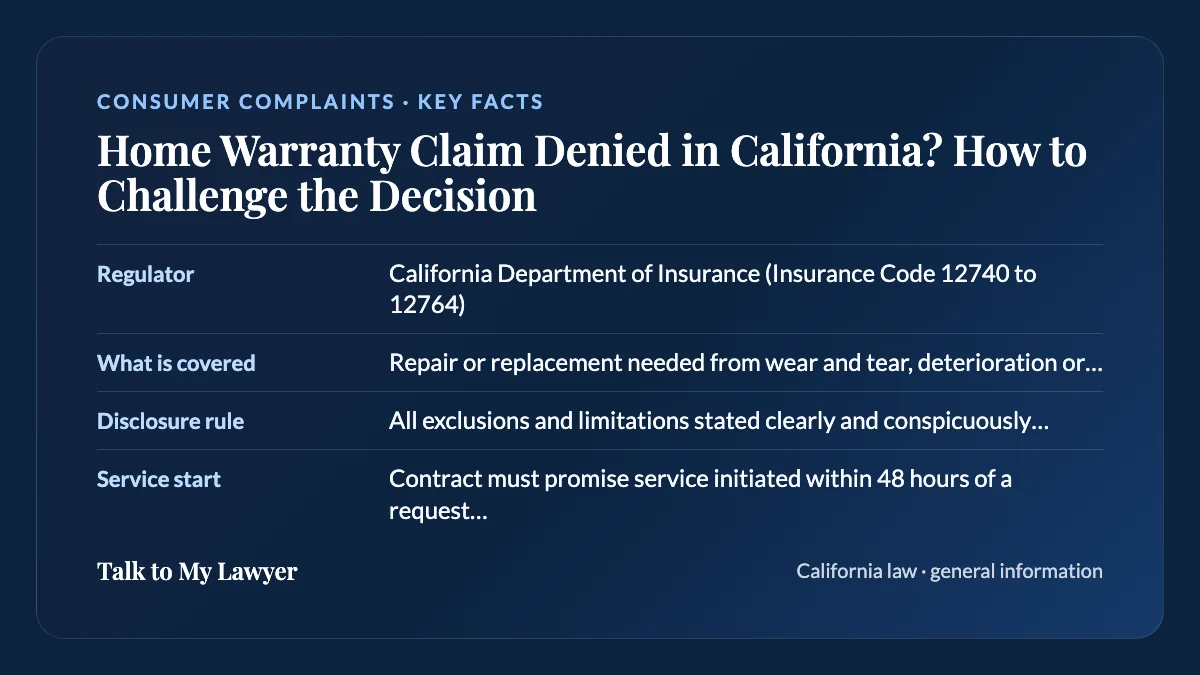
At a glance
- Regulator
- California Department of Insurance (Insurance Code 12740 to 12764)
- What is covered
- Repair or replacement needed from wear and tear, deterioration or inherent defect (12740)
- Disclosure rule
- All exclusions and limitations stated clearly and conspicuously (12762)
- Service start
- Contract must promise service initiated within 48 hours of a request (12762(a)(4)(E))
- Help line
- CDI Consumer Hotline 1-800-927-4357 or an online Request for Assistance
Who regulates home warranty companies in California?
The California Department of Insurance (CDI). State law calls home warranties home protection contracts, and a company may not issue or offer them without a home protection company license from the Department (Insurance Code section 12744). Each contract form must be filed with the Insurance Commissioner before it is used (section 12763).
A home warranty is a promise, for a set period and a set fee, to repair or replace covered components, systems or appliances when the work is needed because of wear and tear, deterioration or inherent defect arising during the contract (section 12740(a)). It is not homeowners insurance. CDI explains that a homeowners policy covers damage from major events such as wildfires, while a warranty covers breakdowns, and the two do not overlap.
The Insurance Code's unfair practices article, which begins at section 790, also applies to home protection companies, along with other listed parts of the code (section 12743).
What must a California home warranty contract spell out?
Section 12762 requires every home protection contract to state, in clear and conspicuous terms:
- Each appliance, system and component covered.
- All exclusions and limitations on coverage.
- The contract period, the fee and any renewal terms.
- The services the company will perform and the conditions for performing them.
- Any service fee charged per visit.
- Limits on when or where service may be requested or performed.
- A statement that service will be performed on a telephone request, without first filing claim forms.
- A representation that service will be initiated within 48 hours after a request.
A contract must also leave out coverage for consequential damage from a failure (section 12740(a)). A leaking water heater may be covered; the ruined flooring around it falls outside the warranty and may be a question for your homeowners policy.
Why was the claim denied, and does the reason hold up?
Start with the exact words of the denial, then hold them against the exact words of the contract. CDI notes that every home warranty contains dozens of exclusions, and many buyers first read them when a claim is turned down.
| Denial reason | Question to ask | Where to look |
|---|---|---|
| Pre-existing condition | What evidence shows the failure began before coverage started? | Technician's report, any inspection, the contract's definition |
| Not a covered item | Is the part listed, or excluded by name? | Coverage list and exclusions page |
| Improper maintenance | What maintenance step was missing, and does the contract require it? | Contract terms, your service records |
| Code violation or permit issue | Does the contract exclude code upgrades, and is there a dollar cap instead? | Limitations section |
| Coverage cap reached | What is the cap, and how was it applied? | Limits table, prior claim history |
Ask the company for the technician's written findings and photos. A vague phrase such as lack of maintenance is far easier to answer once you see what the technician actually recorded.
Can a home warranty deny a claim as a pre-existing condition?
It can if the contract excludes pre-existing conditions and the facts support it. The statute frames coverage around failures arising during the effective period of the contract, so the key question is when the breakdown arose, not how old the equipment is (section 12740(a)). Wear and tear and deterioration are exactly what the statute says the contract covers. CDI's consumer page goes further, describing home warranties as covering wear and tear, deterioration, or defects that existed when you bought or leased your home.
Inspections change the picture. A company may require an onsite inspection before issuing a contract (section 12761(b)), and the statutory definition of a home protection contract includes covering a failure that the inspection did not detect. If your home passed the company's own inspection, say so in your appeal.
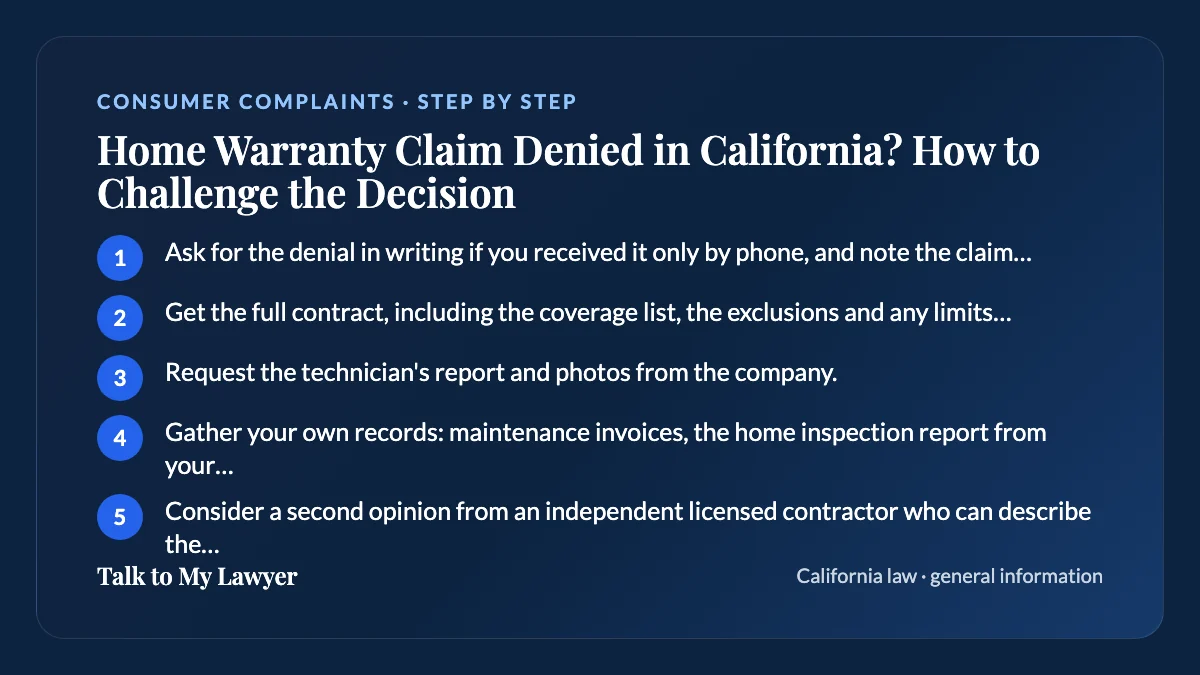
Steps to take before you write the appeal
- Ask for the denial in writing if you received it only by phone, and note the claim number.
- Get the full contract, including the coverage list, the exclusions and any limits table, from the version in force on your claim date.
- Request the technician's report and photos from the company.
- Gather your own records: maintenance invoices, the home inspection report from your purchase, and photos of the failed equipment.
- Consider a second opinion from an independent licensed contractor who can describe the cause of failure in writing.
- Use the company's internal appeal process and keep copies of everything you send.
How to write a demand letter for a denied home warranty claim
Keep the letter factual. Quote the denial, quote the contract language that covers the item, and explain why the exclusion does not fit, with documents attached. Then ask for a specific remedy: authorization of the repair, payment of a stated amount, or reimbursement of a repair you paid for after the denial.
Your letter of July 22 denied claim 4419-08 for our central air conditioner as a pre-existing condition. The unit was inspected by your representative on April 28 before the contract began on May 1 and was found operating. It ran without issue until July 18. The attached report from a licensed HVAC contractor identifies a failed compressor capacitor, a component listed as covered on page 3 of the contract. Please authorize the repair or reimburse the $1,280 invoice within 14 days.
If the warranty came from a manufacturer or a seller rather than a home protection company, a different law applies; see our guide to answering a product warranty denial. For a repair contractor who took payment and did poor work, see contractor refund demand letters.
What can you do if the company still says no?
CDI says that if a home protection company denies your appeal, you may ask the Department for help by calling the Consumer Hotline at 1-800-927-4357, using the chat on its Getting Help page, or filing an online Request for Assistance. Its website also lists licensed home protection companies and a summary of complaints it has investigated.
The small claims ceiling for an individual's money claim is $12,500, set by CCP section 116.221. If your homeowners insurer also turned down a related claim, insurance claim denial letters covers the parallel steps.
When to have an attorney write to the warranty company
Big-system denials (a roof, an HVAC unit, a main plumbing line) turn on the exact contract language and the technician's findings. Having an attorney write the letter can help when the denied repair is expensive, when the company relies on an exclusion the contract does not clearly state, or when a failure left related damage that your homeowners insurer and the warranty company each say belongs to the other.
Through Talk to My Lawyer, a licensed California attorney writes your letter from your facts and documents (the contract, the denial letter, your repair records) and sends it on your behalf, pointing to the Insurance Code provisions that apply. Before filing suit, get advice from a lawyer on your situation.
Frequently asked questions
Are home warranties regulated in California?
Yes. The Insurance Code regulates them as home protection contracts, and the California Department of Insurance licenses home warranty companies and investigates complaints. A company must hold a home protection company license to offer contracts, and each contract form must be filed with the Insurance Commissioner. CDI suggests checking a company's license status before buying.
Can a home warranty company cancel my contract after I file a claim?
During the initial term, a California home protection contract is noncancellable except for nonpayment of fees, fraud or misrepresentation of facts material to issuing the contract, or a pre-sale contract where the home sale does not happen (Insurance Code section 12764). The statute does not give you a right to renewal, so the company may decline to renew.
How fast does a home warranty company have to send someone?
California law requires the contract to represent that service will be initiated by or under the direction of the company within 48 hours after a request. It also requires that service be performed on a telephone request without first filing claim forms. Check your contract for its own response times and any limits on where or when service is available.
Does a home warranty cover water damage from a broken pipe?
A California home protection contract cannot include coverage for consequential damage from a failed component, system or appliance. The warranty may cover repairing the pipe or the water heater if it is a covered item, while damage to floors, walls and belongings is generally a homeowners insurance question. Read both your contract and your policy.
Where do I complain about a home warranty company in California?
The California Department of Insurance takes complaints about home warranty companies. CDI says you can seek help after the company denies your appeal by calling 1-800-927-4357, using the chat on its Getting Help page or submitting a Request for Assistance online. Have your contract, denial letters and receipts ready.
Sources
Checked against these official sources on October 18, 2026.
- California Insurance Code section 12740 (California Legislative Information)
- California Insurance Code sections 12760 to 12764 (California Legislative Information)
- California Insurance Code sections 12741 to 12745 (California Legislative Information)
- Home Protection Contracts (California Department of Insurance)
- California Code of Civil Procedure section 116.221 (California Legislative Information)
This guide explains California law in general terms as of October 2026. It is general information, not legal advice for your situation, and local rules can add to it.
Join the email list and get a lawyer letter started
With Talk to My Lawyer, a licensed California attorney writes your letter from your facts and documents and sends it on your behalf. Join the Talk to My Lawyer email list for letter checklists, document prompts, and reminders before you start your letter.