Quick answer
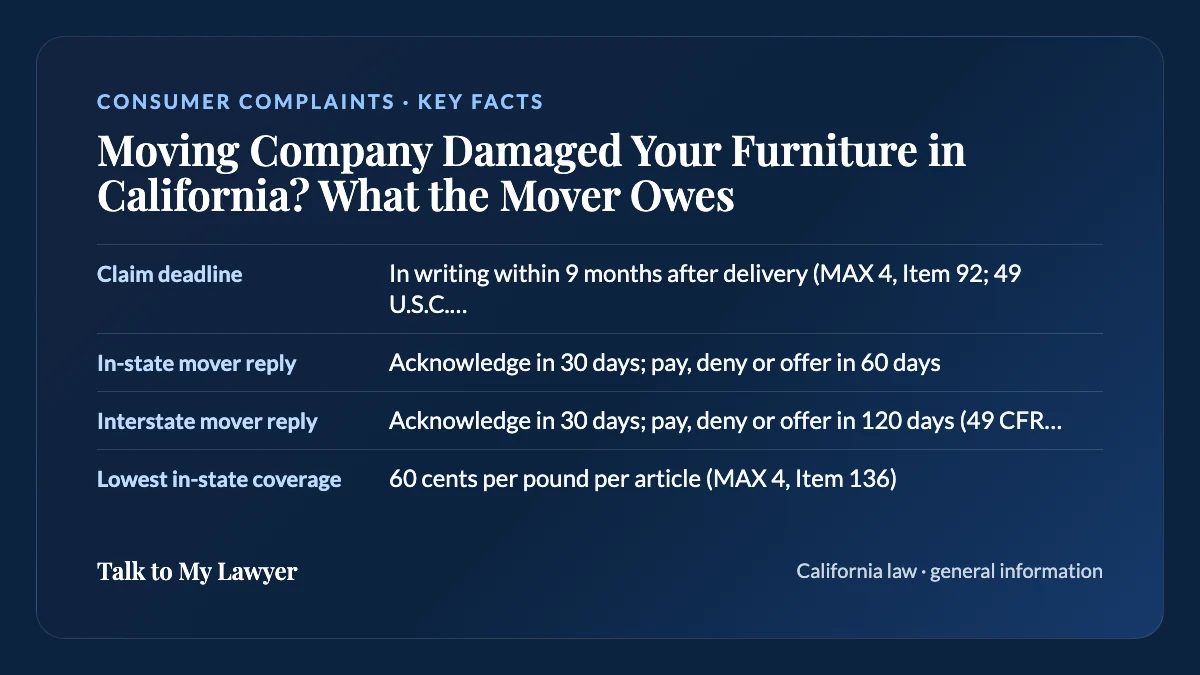
If a moving company damaged your furniture in California, file a written claim with the mover within nine months of delivery. For moves within California, the mover must acknowledge the claim within 30 days and pay, deny or make an offer within 60 days (Maximum Rate Tariff 4, Item 92). How much it owes depends on the valuation level on your moving agreement.
At a glance
- Claim deadline
- In writing within 9 months after delivery (MAX 4, Item 92; 49 U.S.C. 14706 for interstate)
- In-state mover reply
- Acknowledge in 30 days; pay, deny or offer in 60 days
- Interstate mover reply
- Acknowledge in 30 days; pay, deny or offer in 120 days (49 CFR 370.5, 370.9)
- Lowest in-state coverage
- 60 cents per pound per article (MAX 4, Item 136)
- Regulator
- Bureau of Household Goods and Services for moves within, into or out of California
Who regulates moving companies in California?
The Bureau of Household Goods and Services (BHGS), part of the Department of Consumer Affairs, licenses household movers and investigates violations of the Household Movers Act (Business and Professions Code section 19225 and following) and the state's Maximum Rate Tariff. A mover needs a BHGS permit to move household goods within California, and interstate movers also need federal operating authority (section 19237).
| Your move | Rules that apply | Where complaints go |
|---|---|---|
| Within California | Household Movers Act and Maximum Rate Tariff 4 (effective January 1, 2026) | BHGS |
| Into or out of California | Federal Motor Carrier Safety Administration rules (49 CFR parts 370 and 375) and 49 U.S.C. section 14706 | BHGS and FMCSA |
| International move or storage only | Outside BHGS jurisdiction | Depends on the contract and carrier |
BHGS lists failure to respond to damage claims among the most common complaints it receives. FMCSA, by contrast, says it has no authority to resolve claims against an interstate mover, so your claim and any demand letter go to the mover itself.
How much does a mover have to pay for damaged furniture?
The payout depends on the valuation, or declared value, on your Agreement for Moving Services. For moves within California, the 2026 Maximum Rate Tariff 4 (Item 136) sets these levels:
| Level | What the mover owes | Maximum charge to you |
|---|---|---|
| Base valuation | 60 cents per pound per article | Built into the transportation rates |
| Actual Cash Value | Actual cash value of lost or damaged articles, up to the declared value | $1.12 per $100 of declared value |
| Full Value | Repair, replacement or reimbursement of full replacement cost, up to the declared value | $2.20 per $100 ($0.67 with a $250 deductible, $0.38 with $500) |
Two tariff rules matter if your paperwork is thin. Unless you expressly declared another value, the mover's maximum liability is up to $20,000 of actual cash value. And if the mover failed to state valuation rates on the agreement, the valuation charge defaults to zero.
Interstate moves work differently. The mover is liable for full value, measured by replacement value up to the declared value of the shipment, unless you waive that in writing. A written waiver limits the mover to the much lower released rate set by the Surface Transportation Board (49 CFR section 375.201).
Example: one dresser, three possible payouts
Example (hypothetical): an 80-pound solid wood dresser arrives with a cracked top. It cost $1,400 four years ago, a comparable new one costs $1,600, and a furniture repair shop quotes $450.
| Valuation on the agreement | How the claim is measured | Likely ceiling |
|---|---|---|
| 60 cents per pound | 80 pounds x $0.60 | $48 |
| Actual Cash Value | Actual cash value of the dresser at the time of damage, allowing for its age | That value, capped by the declared value |
| Full Value | Repair, replacement or full replacement cost | $450 repair, or up to $1,600 if it cannot be fixed |
The difference between $48 and $450 is the reason to dig out the signed agreement before writing anything. Under the tariff, the mover may also choose to repair or replace an item with one of like kind and quality instead of paying cash, and for matched sets it owes only for the damaged piece.
How long do you have to file a moving damage claim?
- Moves within California: a written claim within nine months after delivery, and any lawsuit within two years and one day after the mover gives written notice that it disallowed the claim (MAX 4, Item 92, paragraph 14).
- Interstate moves: a mover cannot give you less than nine months to file a claim or less than two years to sue, counted from its written disallowance (49 U.S.C. section 14706(e)).
- Concealed damage: tell the mover promptly once you discover it and give it a chance to inspect.
- Not noted at delivery: under the California tariff, a claim cannot be denied solely because the damage was not written on the delivery receipt.
The claim must be in writing. A note on the delivery receipt or an inspection report supports a claim but does not replace one.
How to file a claim with a California mover
Under the tariff, a written claim counts if it identifies the shipment, says the mover is liable for the loss or damage, and asks for a specific or determinable amount of money.
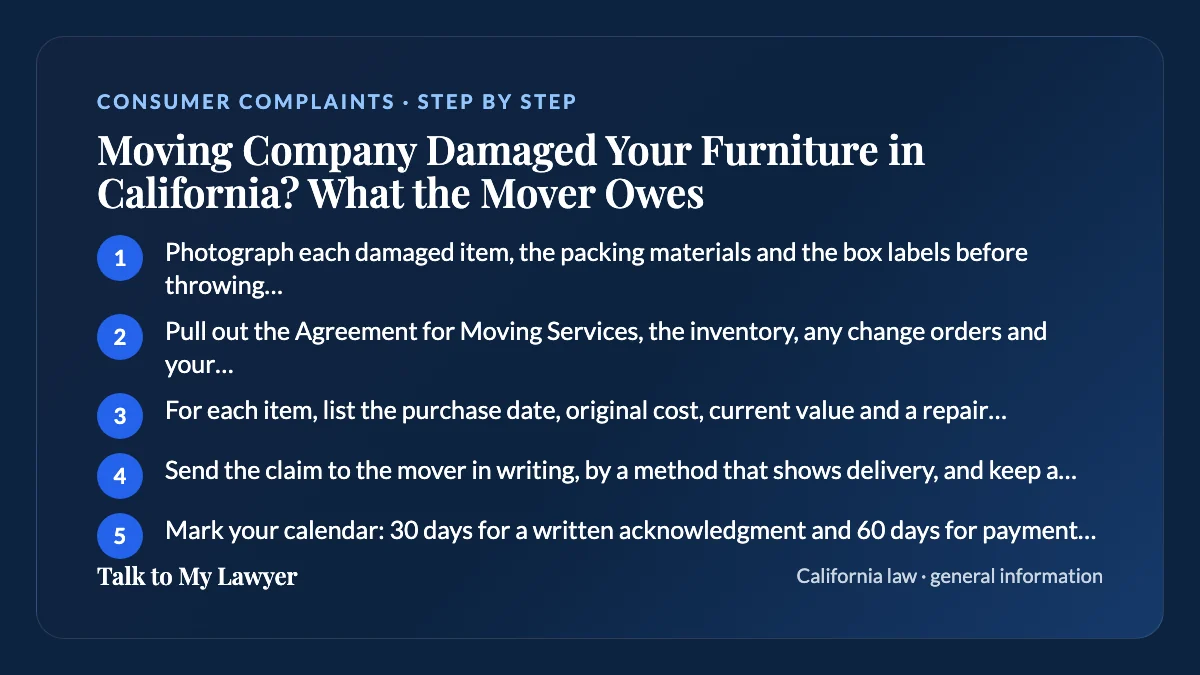
- Photograph each damaged item, the packing materials and the box labels before throwing anything away.
- Pull out the Agreement for Moving Services, the inventory, any change orders and your final bill.
- For each item, list the purchase date, original cost, current value and a repair estimate, which the tariff names as supporting documents.
- Send the claim to the mover in writing, by a method that shows delivery, and keep a copy.
- Mark your calendar: 30 days for a written acknowledgment and 60 days for payment, denial or a firm offer on an in-state move.
- If the mover cannot decide within 60 days, it must update you in writing every 30 days and copy BHGS.
Writing a demand letter when the mover stalls or lowballs
A demand letter follows the claim; it does not replace it. It points to the agreement, the claim date and the response the tariff required, then asks for a specific amount. If the mover denied the claim or offered less, it must explain in writing why, and your letter can answer that reason directly.
On June 12 your crew moved our household from Fresno to Sacramento under Agreement No. 22817, which shows Full Value protection with a declared value of $40,000. On June 20 I filed a written claim for $2,150 covering a dining table, a dresser and a mirror, with photos and repair estimates. It has now been 75 days. I have received neither an acknowledgment nor a decision as Maximum Rate Tariff 4, Item 92 requires. Please pay $2,150 or provide a written decision with reasons by September 30.
For a broader look at organizing proof, see our demand letter evidence checklist. If your own homeowner's or renter's policy may cover the loss, the steps in our guide to property damage insurance claims can run alongside the mover claim.
What if the mover still refuses to pay?
For moves within, into or out of California, you can file a complaint with BHGS. Interstate movers must offer a neutral arbitration program for loss and damage disputes and tell you about it before you sign the bill of lading (49 CFR section 375.211).
In California small claims, an individual can claim up to $12,500 (CCP section 116.221), and demand letters before small claims in California explains how filing works.
When to have an attorney write to the mover
A mover claim rests on two documents: the signed agreement that sets the valuation, and the written claim you filed. Having an attorney write the follow-up letter can help when the loss is large, when the mover disputes which valuation level applies, when goods are missing rather than damaged, or when the time to sue has started to run after a written denial.
Through Talk to My Lawyer, a licensed California attorney writes your letter from your facts and documents (the moving agreement, inventory, photos and claim history) and sends it on your behalf, relying on the tariff or the federal rules that govern your move. A lawyer can advise you on arbitration or a lawsuit.
Frequently asked questions
Is a moving company responsible for damaged furniture in California?
Yes, for loss or damage while your goods are in its custody, up to the valuation level on your agreement. That may be as little as 60 cents per pound per article, actual cash value, or full value protection. The mover is not liable after delivery is receipted, and it may repair or replace an item instead of paying cash.
What is 60 cents per pound valuation?
It is the lowest level of mover liability: the mover pays 60 cents for each pound of the damaged article, no matter what it cost. A 50-pound television would bring $30. In California it is the base value built into the tariff rates. For interstate moves, a lower released rate applies only if you waived full value protection in writing.
How long does a mover have to respond to a damage claim?
For moves within California, the mover must acknowledge your written claim within 30 days and pay, decline or make a firm settlement offer in writing within 60 days. For interstate moves, federal rules allow 30 days to acknowledge and 120 days to decide. In both cases, a mover that needs more time must send written status updates.
Can I file a complaint against a moving company in California?
Yes. The Bureau of Household Goods and Services takes complaints about moves within California and moves into or out of the state, including unlicensed movers and failure to respond to damage claims. It does not regulate storage facilities, international moves, or moves that neither begin nor end in California.
Can I sue a moving company in small claims court?
Yes. An individual in California can bring a small claims case for up to $12,500. File after the mover has denied your claim or failed to respond, and within the suit deadline: for in-state moves, two years and one day after the mover's written denial. Bring the agreement, your claim and every response with you.
Sources
Checked against these official sources on October 18, 2026.
- Maximum Rate Tariff 4, effective January 1, 2026 (Items 92 and 136) (Bureau of Household Goods and Services)
- Household Movers (Bureau of Household Goods and Services)
- 49 CFR part 370, Principles and Practices for the Investigation and Voluntary Disposition of Loss and Damage Claims (eCFR)
- 49 U.S. Code section 14706 (Legal Information Institute, Cornell Law School)
- 49 CFR part 375, Transportation of Household Goods in Interstate Commerce (Electronic Code of Federal Regulations)
- Protect Your Move (Federal Motor Carrier Safety Administration)
This guide explains California law in general terms as of October 2026. It is general information, not legal advice for your situation, and local rules can add to it.
Join the email list and get a lawyer letter started
With Talk to My Lawyer, a licensed California attorney writes your letter from your facts and documents and sends it on your behalf. Join the Talk to My Lawyer email list for letter checklists, document prompts, and reminders before you start your letter.