Quick answer
If an online order never arrives, check whether the seller shipped within the time it promised or, if it gave none, within 30 days. The FTC's Mail, Internet, or Telephone Order Merchandise Rule (16 CFR 435) requires sellers who cannot ship on time to offer a delay or cancellation with a prompt refund. California adds a parallel 30-day rule in Business and Professions Code section 17538.
At a glance
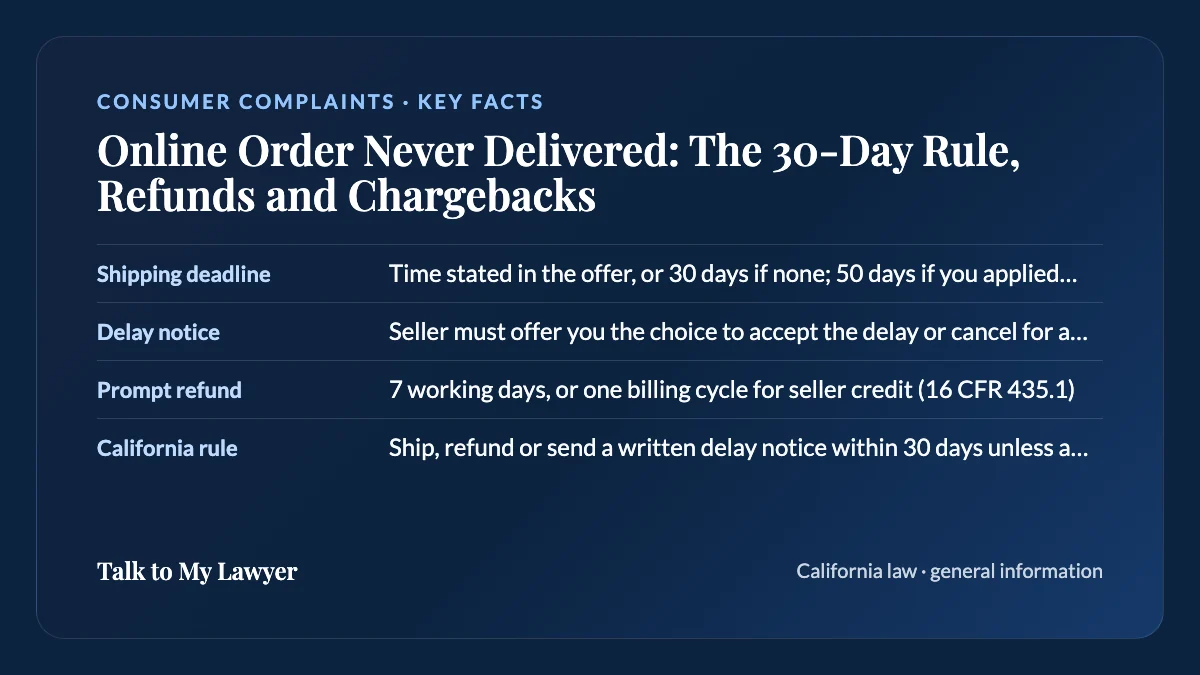
- Shipping deadline
- Time stated in the offer, or 30 days if none; 50 days if you applied for seller credit (16 CFR 435.2)
- Delay notice
- Seller must offer you the choice to accept the delay or cancel for a prompt refund
- Prompt refund
- 7 working days, or one billing cycle for seller credit (16 CFR 435.1)
- California rule
- Ship, refund or send a written delay notice within 30 days unless a time is stated (B&P 17538)
- Credit card dispute
- Written notice within 60 days of the first statement showing the charge (Reg Z 1026.13)
How long does a seller have to ship an online order?
A seller must ship within the time it stated when you ordered. If the offer gave no time, the federal deadline is 30 days after the seller receives a properly completed order, or 50 days if you applied for credit from the seller as part of the order (16 CFR 435.2). The FTC rule covers orders placed by mail, phone and internet.
When the seller learns it cannot meet the deadline, it must contact you, without being asked, and offer two choices: accept a delay or cancel for a prompt refund.
- The notice must give a definite revised shipping date, or say the seller cannot estimate one.
- If the new date is 30 days or less past the original deadline, staying silent counts as accepting the delay.
- If the delay is longer, or indefinite, the order is treated as cancelled unless you agree to wait or the seller ships within 30 days of the original deadline.
- If the seller never sent a delay notice and missed the deadline, the order must be treated as cancelled and refunded.
A prompt refund means within seven working days for card, cash, check or money order payments, or within one billing cycle when the seller itself extended the credit (16 CFR 435.1).
What does California law add for undelivered orders?
Section 17538 of the Business and Professions Code covers anyone in California selling goods or services by phone, internet, mail order or catalog. Once a seller accepts your payment, it cannot let 30 days pass (or the time it conspicuously stated, if different) without doing one of these things:
- Shipping or providing what you ordered.
- Mailing a full refund, or crediting your account for the full amount.
- Sending a written notice giving the expected delay in days or weeks, or proposing a substitute of equal or better quality, and offering a full refund within one week if you ask. The notice must include a toll-free number or other cost-free way to ask for the refund.
- Shipping a substitute of equal or better quality, with the right to return it at the seller's cost for a full refund.
If you applied for the seller's credit plan with the order, the California period is 50 days. Online sellers must also show you, before taking payment, their return and refund policy, their legal business name and the street address they operate from (section 17538(d)). That address is where a written demand belongs. Whichever rule fits your order, the practical point is the same: after the deadline passes with no shipment and no proper notice, you can ask for your money back in writing and cite both.
What if tracking says delivered but you never got the package?
That is a different problem. The FTC rule treats an order as shipped when the seller places it in the carrier's possession, so its deadlines may already be met. Who bears the loss of a missing package then depends on the terms of sale and California's Commercial Code.
Under Commercial Code section 2509, if the contract requires the seller to deliver to a particular destination, the risk of loss passes to you when the goods are properly tendered there. If it only requires shipment by carrier, risk passes when the goods are delivered to the carrier. Those default rules can be changed by agreement, and a retailer's own terms or buyer protection policy may go further than the statute.
- Ask the seller for the carrier's proof of delivery, including any GPS scan or photo.
- Check with neighbors, building staff and the carrier's local office.
- Read the seller's or marketplace's policy for packages marked delivered but not received, and file within its window.
- If the item was stolen from your porch, a police report gives you a dated record.
Can you get a chargeback for an order that never arrived?
For a credit card, federal law gives you a formal dispute right. Under the Fair Credit Billing Act and Regulation Z, a charge for property not delivered as agreed is a billing error (12 CFR 1026.13). The card issuer must receive your written notice within 60 days after it sent the first statement showing the charge.
- The issuer must acknowledge your dispute within 30 days, unless it resolves it sooner.
- It must resolve the dispute within two complete billing cycles, and no later than 90 days.
- While the dispute is open, you do not have to pay the disputed amount or related finance charges, the issuer may not try to collect them, and it may not report that amount as delinquent.
Debit cards and payment apps work under different rules and the provider's own policies. For a side-by-side look, see chargeback versus demand letter.
Steps to get your money back for an order that never came
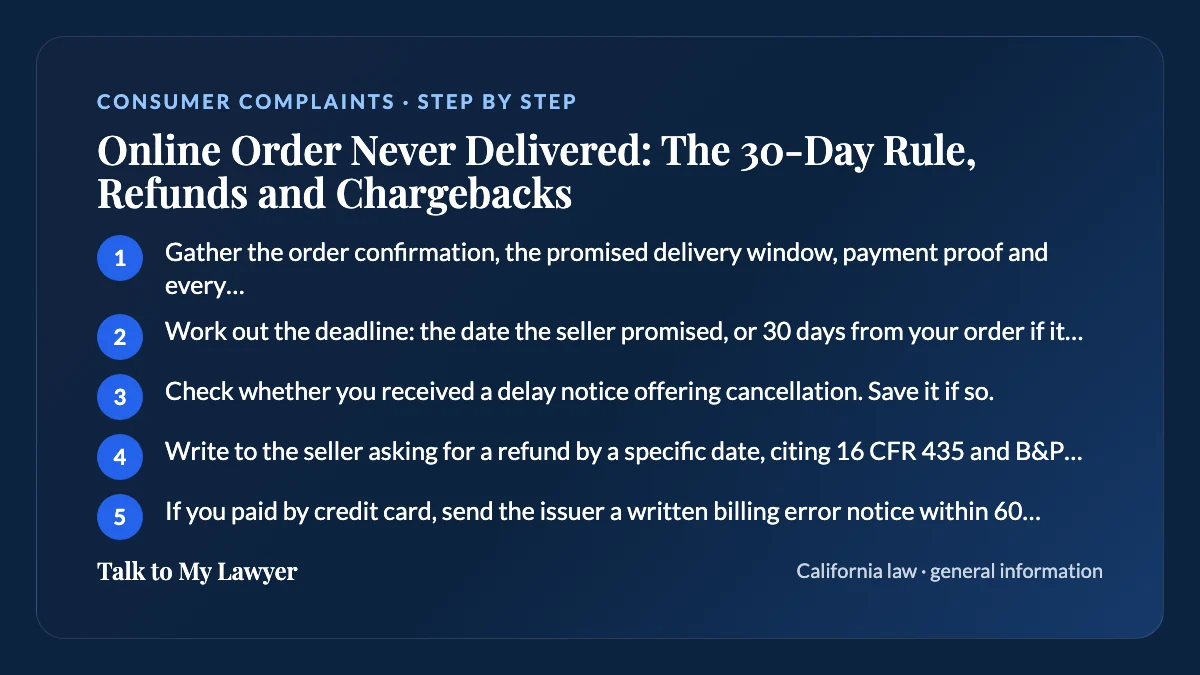
- Gather the order confirmation, the promised delivery window, payment proof and every tracking update.
- Work out the deadline: the date the seller promised, or 30 days from your order if it promised none.
- Check whether you received a delay notice offering cancellation. Save it if so.
- Write to the seller asking for a refund by a specific date, citing 16 CFR 435 and B&P section 17538.
- If you paid by credit card, send the issuer a written billing error notice within 60 days of the statement, whether or not the seller has answered.
- If the seller is a marketplace vendor, open a claim under the platform's buyer protection process as well.
- If the seller still refuses, a formal demand letter is the next step, followed by small claims court if needed (up to $12,500 for an individual).
I placed order 48817 on your website on August 2 and paid $612. Your site promised shipment within five business days. As of September 15, the order has not shipped, and I have received no notice offering me the option to cancel. Under the FTC's Mail, Internet, or Telephone Order Merchandise Rule (16 CFR 435.2) and California Business and Professions Code section 17538, the order must be treated as cancelled and refunded. Please refund $612 to my original payment method by September 25.
| Date (hypothetical) | Event | What it means |
|---|---|---|
| August 2 | Order placed and paid | Seller's stated window: ship within 5 business days |
| August 9 | Shipping deadline passes, no notice | Seller should have offered delay or cancellation by now |
| September 4 | Card statement shows the $612 charge | 60-day dispute window runs from this statement |
| September 15 | Written refund demand sent | Cites the federal and California rules |
| November 3 | Last day for the card dispute | Written notice must reach the issuer by now |
When an attorney-written refund letter makes sense
Your own written request and a card dispute are built for a single missed order. Larger stakes change the picture: a custom or high-priced order, a business purchase without consumer card protections, a seller that keeps promising shipment without delivering, or a pattern across several orders. Our guide to a refund demand letter for bad service covers related problems once an order does arrive.
For orders like those, Talk to My Lawyer works this way: a licensed California attorney writes your letter from your order records and messages, cites the shipping and refund rules that apply, and sends it on your behalf. If small claims court is on the table, a lawyer can advise on the strength of your records.
Frequently asked questions
How long should I wait before asking for a refund on an undelivered order?
Start with the seller's promised shipping time. If it gave none, the FTC rule allows 30 days from a properly completed order, and California's section 17538 sets a similar 30-day period. Once that deadline passes with no shipment and no delay notice offering cancellation, you can ask in writing for a refund. Do not let a credit card's 60-day dispute window lapse while you wait.
Does the 30-day rule mean the item must arrive within 30 days?
No. The FTC rule is about shipment, which it defines as placing the merchandise in the carrier's possession. A seller that ships on day 29 meets the federal deadline even if the package arrives later. A missing package after shipment raises different questions about the terms of sale, the carrier and the seller's delivery policy.
Can a seller give me store credit instead of a refund?
Under the FTC rule, a refund for a cancelled order means returning the amount you paid, for example by cash, check or money order if you paid that way, or by a credit for a credit purchase. California's section 17538 also refers to a full refund or account credit for the full amount. You can choose to accept store credit, but the rules speak of refunds.
What if the seller is overseas or on a marketplace?
Collecting from a seller outside the United States may be difficult in practice. Use the marketplace's buyer protection claim and your card issuer's billing error process, which do not depend on reaching the seller. Keep every message and screenshot, since the platform and the issuer will each want to see what the seller promised and when.
Sources
Checked against these official sources on October 18, 2026.
- 16 CFR 435.2 Mail, internet, or telephone order merchandise (Legal Information Institute, Cornell Law School)
- 16 CFR 435.1 Definitions (Legal Information Institute, Cornell Law School)
- Business and Professions Code section 17538 (California Legislative Information)
- Commercial Code section 2509 (California Legislative Information)
- Regulation Z section 1026.13 Billing error resolution (Consumer Financial Protection Bureau)
- Code of Civil Procedure section 116.221 (California Legislative Information)
This guide explains California law in general terms as of October 2026. It is general information, not legal advice for your situation, and local rules can add to it.
Join the email list and get a lawyer letter started
With Talk to My Lawyer, a licensed California attorney writes your letter from your facts and documents and sends it on your behalf. Join the Talk to My Lawyer email list for letter checklists, document prompts, and reminders before you start your letter.