Quick answer
A personal injury demand letter in California is a written claim to the at-fault person or their insurer that sets out how the injury happened, your treatment, your bills and lost income, and the amount you ask to settle for. Lawsuits for personal injury generally must be filed within two years (Code of Civil Procedure section 335.1), and claims against a public entity must be presented within six months.
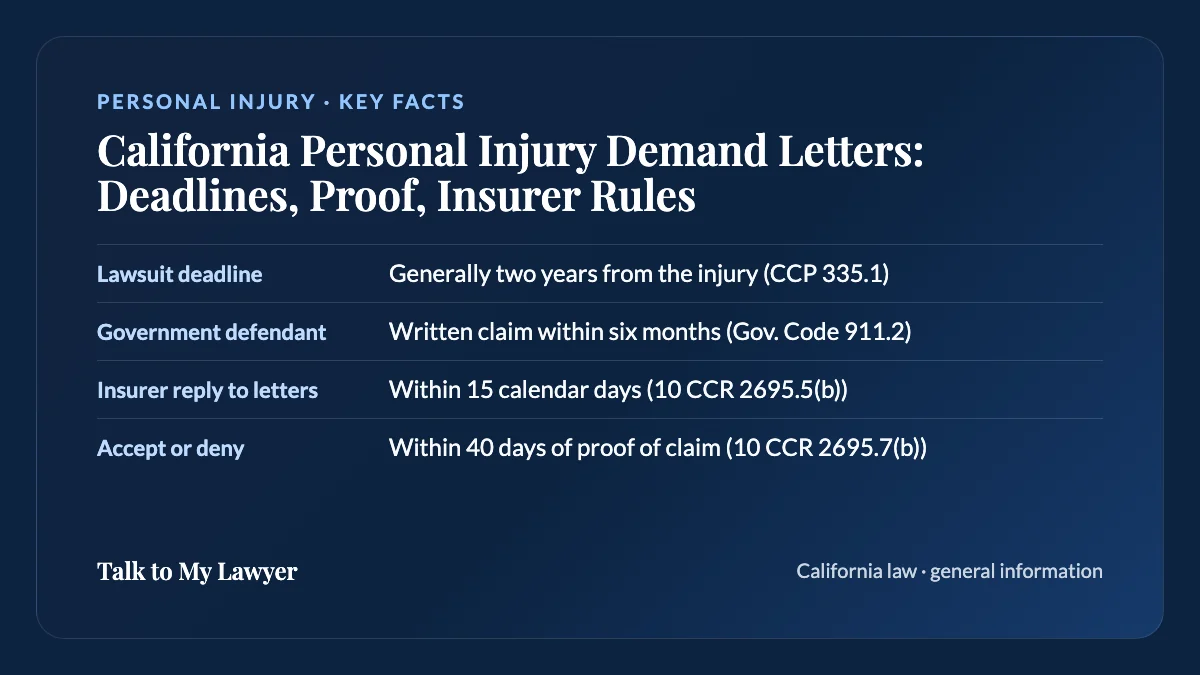
At a glance
- Lawsuit deadline
- Generally two years from the injury (CCP 335.1)
- Government defendant
- Written claim within six months (Gov. Code 911.2)
- Insurer reply to letters
- Within 15 calendar days (10 CCR 2695.5(b))
- Accept or deny
- Within 40 days of proof of claim (10 CCR 2695.7(b))
- Time-limited demand
- At least 30 days to accept, 33 if sent by regular mail (CCP 999.1)
What does a personal injury demand letter do in California?
A personal injury demand letter tells the person who caused your injury, or their liability insurer, what happened, what it cost you and what you are asking for to resolve the claim. The adjuster reads it alongside the claim file, so every number in it should point to a record you can attach.
If the at-fault person carries liability insurance, the letter goes to the adjuster handling the claim under that policy: an auto policy after a crash, a homeowner policy after a dog bite, a business policy after a fall in a store.
Sending one does not oblige the insurer to pay a particular amount. It does put your account and your evidence on the record, and California's claims regulations set deadlines for the insurer's response (covered below).
How long do you have to bring an injury claim in California?
For an injury caused by someone's wrongful act or neglect, a lawsuit must be filed within two years (Code of Civil Procedure section 335.1). A demand letter does not pause that clock. If talks are still going when the deadline approaches, the deadline still controls.
| Situation | Deadline | Source |
|---|---|---|
| Injury from negligence or a wrongful act | Lawsuit within two years | CCP 335.1 |
| Damage to your car or other property | Lawsuit within three years | CCP 338(c)(1) |
| Injury involving a city, county, state agency or other public entity | Written government claim within six months | Gov. Code 911.2 |
| Missed the six-month government deadline | Written application to the agency for leave to present a late claim, within a reasonable time and no later than one year | Gov. Code 911.4 |
| Government claim rejected in writing | Lawsuit generally within six months of the notice | Gov. Code 945.6 |
| Professional negligence (malpractice) by a doctor or other health care provider | Lawsuit within three years of the injury or one year after you discover it (or should have), whichever comes first | CCP 340.5 |
What to include in a personal injury demand letter
An injury demand covers four subjects: why the other party is responsible, what treatment you received, what money you lost and how the injury still affects you. For general record keeping, see our demand letter evidence checklist. For an injury claim, gather:
- Liability facts: the date, time and place, a short description of what happened, the police or incident report number, photos of the scene and any witness names.
- Treatment: each provider, the dates you were seen, what was diagnosed and what was prescribed, from the first visit to the most recent.
- Medical bills: itemized bills for each provider, plus what your health plan paid, so the amounts can be matched to records.
- Lost income: a letter from your employer or pay records showing hours missed and your rate of pay, or invoices and calendars if you are self-employed.
- Ongoing effects: work restrictions, a doctor's note on future care, and a short, factual description of the activities you cannot do or now do with pain.
One rule can shape a car-accident claim from the start. Under Civil Code section 3333.4, an injured person generally cannot recover non-economic damages, such as pain and suffering, if they were driving under the influence and were convicted for it, or if they owned or drove a vehicle in the accident without the insurance or financial responsibility the law requires. An uninsured owner injured by a driver convicted of DUI keeps that right. Medical bills and other economic losses are not affected.
Should you send a demand before your treatment ends?
One reason to hold a final settlement demand until a doctor says you have recovered, or that your condition has stabilized: settling generally means signing a release of all claims from the accident. Once you sign it, you generally cannot go back for care you did not yet know you needed.
Waiting has its own limit: the two-year filing deadline keeps running. If treatment may continue near that deadline, talk to a lawyer about your facts well before it arrives. Meanwhile, you can send the insurer records and bills as they arrive without making a settlement demand.
Example (hypothetical): a cyclist hit by a car has $6,280 in medical bills after five months (a $3,850 emergency visit and $2,430 of physical therapy) plus $1,920 in missed wages, and her surgeon has not ruled out a second procedure. A letter that lists these losses and asks the insurer to keep the file open differs sharply from one offering a full release.
What does the insurer have to do after it gets your letter?
California's Fair Claims Settlement Practices Regulations set response times for insurers, including on claims by people who are not the insurer's own customer (California Code of Regulations, title 10, section 2695.1 and following).
- 15 days to acknowledge: after notice of a claim, the insurer must acknowledge it, provide the forms and instructions you need and begin investigating within 15 calendar days (section 2695.5(e)).
- 15 days to answer your letters: a communication that reasonably suggests a reply is expected must receive a complete response within 15 calendar days (section 2695.5(b)). This duty ends once you give notice of legal action.
- 40 days to decide: after receiving proof of claim, the insurer must accept or deny it, in whole or in part, within 40 calendar days. If it needs more time, it must say so in writing and update you every 30 days (section 2695.7(b) and (c)). A denial of a claim by someone other than the policyholder, or a dispute over liability or damages, must be in writing (section 2695.7(b)(1)).
- Deadline warning: unless you have a lawyer, the insurer must tell you in writing about any filing deadline it may rely on to deny the claim, at least 60 days before it runs out (section 2695.7(f)).
- No lowball offers: an insurer may not try to settle with an unreasonably low offer (section 2695.7(g)).
- 30 days to pay: after it accepts a claim and receives any required release, payment is due within 30 calendar days (section 2695.7(h)).
If an insurer misses these timelines, you can point that out in writing and file a complaint with the California Department of Insurance. If your own insurer denies a claim, see our guide to an insurance claim denial demand letter.
What is a time-limited demand, and can you ask about policy limits?
A time-limited demand is a pre-lawsuit offer to settle an injury or property claim within the at-fault party's policy limits, open for acceptance until a set date. Since January 1, 2023, Code of Civil Procedure sections 999 to 999.5 set formal rules for these offers under auto, homeowner and commercial premises liability policies.
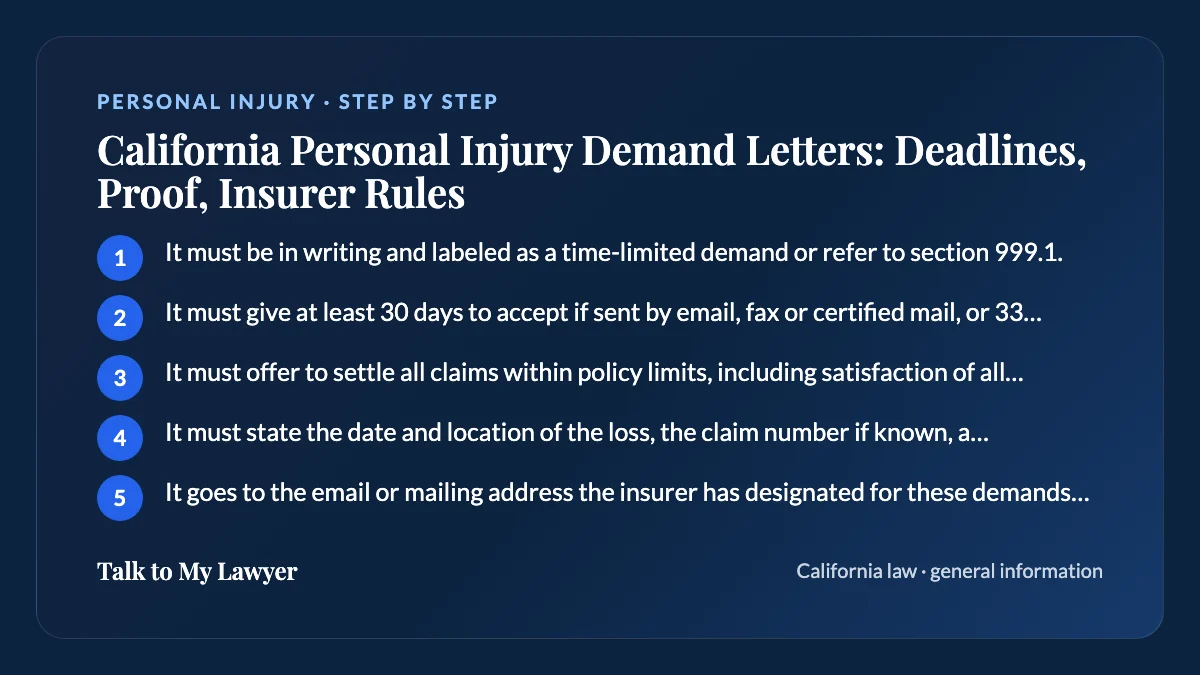
- It must be in writing and labeled as a time-limited demand or refer to section 999.1.
- It must give at least 30 days to accept if sent by email, fax or certified mail, or 33 days if sent by regular mail.
- It must offer to settle all claims within policy limits, including satisfaction of all liens, in exchange for a complete release of the insured.
- It must state the date and location of the loss, the claim number if known, a description of all known injuries, and reasonable proof such as medical records or bills.
- It goes to the email or mailing address the insurer has designated for these demands, as posted by the Department of Insurance, or to the adjuster handling the claim (section 999.2).
If the insurer does not accept, it must explain its decision in writing before the demand expires (section 999.3(c)). A request for clarification, more information or an extension to investigate, made within the acceptance period, is not by itself a counteroffer or rejection (section 999.3(b)). The rule in section 999.4, that a noncompliant demand is not treated as a reasonable offer in a later suit against the insurer, applies only to claimants with a lawyer.
You can ask the adjuster in your letter to disclose the policy limits, and the insurer may or may not agree before a lawsuit. After a case is filed, the existence of insurance and the limits of coverage are discoverable (Code of Civil Procedure section 2017.210).
How do medical liens and records requests affect your demand?
A hospital that treated you after an accident has a lien on your recovery for its reasonable and necessary charges (Civil Code section 3045.1). An insurer that pays you after receiving the hospital's lien notice, without paying the lien, can be liable to the hospital for it, to the extent the lien could be paid from 50 percent of the settlement after any prior liens (section 3045.4). Health plans and government programs may also claim reimbursement, so list every payer in your demand.
If an adjuster asks you to sign a medical authorization, know what a valid one looks like. In California, it must state the specific uses and limits on the information, name who may receive it, carry an expiration date or event (generally one year or less unless you choose otherwise) and tell you that you can have a copy (Civil Code section 56.11). You can also choose to send the accident-related records yourself, which keeps the file focused on the injury at issue.
Enclosed are the records and itemized bills from the three providers who treated me for injuries from the April 9 collision on Mission Street, claim number 24-118803. These total $6,280 in medical charges and $1,920 in documented lost wages. I am still treating and will send updated records as I receive them. Please confirm in writing that you have received this package and tell me what, if anything, you need to complete your evaluation.
When an attorney-written injury demand makes sense
A sprained wrist, one urgent-care visit and an adjuster who answers your calls may need nothing more than your own clear letter. An attorney-written demand is worth considering when the injuries are ongoing, when a public entity may be involved, when liens from a hospital or health plan need to be addressed, when the insurer disputes fault, or when a time-limited demand under section 999.1 is on the table.
Through Talk to My Lawyer, a licensed California attorney writes your letter from your accident details, records and bills, cites the rules that apply to your claim, and sends it on your behalf. Questions about what your claim is worth, or whether to sue, are best answered by a lawyer who knows your facts.
Frequently asked questions
How long does an insurance company have to respond to a demand letter in California?
Under the Fair Claims Settlement Practices Regulations, an insurer must give a complete response within 15 calendar days to a communication that reasonably calls for one (10 CCR 2695.5(b)). Once it has proof of the claim, it has 40 calendar days to accept or deny it in whole or part, and must send written updates every 30 days if it needs more time.
Does sending a demand letter stop the statute of limitations?
No. Sending a demand letter or negotiating with an adjuster does not by itself extend the two-year deadline in Code of Civil Procedure section 335.1. If the claim has not settled as the deadline approaches, a lawsuit generally has to be filed to protect it. A lawyer can tell you whether any exception applies to your facts.
What is the deadline for an injury claim against a California city or county?
A claim for personal injury against a public entity must be presented within six months after the injury (Government Code section 911.2). If you miss that window, you can apply for leave to present a late claim within a reasonable time not exceeding one year. After a written rejection, the lawsuit deadline is generally six months from the notice.
Can I write my own personal injury demand letter in California?
Yes. You can send an injury demand to an insurer yourself. Keep it factual, attach records and itemized bills, and track the two-year filing deadline on your own calendar. Formal time-limited demands under Code of Civil Procedure section 999.1 have strict content rules, and the consequences in section 999.4 apply only when the claimant has a lawyer.
Sources
Checked against these official sources on October 17, 2026.
- California Code of Civil Procedure section 335.1 (California Legislative Information)
- California Government Code section 911.2 (California Legislative Information)
- Fair Claims Settlement Practices Regulations (10 CCR 2695.1 to 2695.14) (California Department of Insurance)
- California Code of Civil Procedure section 999.1 (time-limited demands) (California Legislative Information)
- California Civil Code section 3045.1 (hospital liens) (California Legislative Information)
- California Civil Code section 56.11 (California Legislative Information)
This guide explains California law in general terms as of October 2026. It is general information, not legal advice for your situation, and local rules can add to it.
Join the email list and get a lawyer letter started
With Talk to My Lawyer, a licensed California attorney writes your letter from your facts and documents and sends it on your behalf. Join the Talk to My Lawyer email list for letter checklists, document prompts, and reminders before you start your letter.