Quick answer
To stop spam texts from a company, reply STOP, QUIT, END, REVOKE, OPT OUT, CANCEL or UNSUBSCRIBE, or use the opt-out method the text names. Under the FCC's rule (47 CFR 64.1200(a)(10)), the company must honor the request within 10 business days. If texts continue, keep screenshots, send a written revocation and report it. The TCPA allows $500 per violation, up to $1,500 if willful.
At a glance
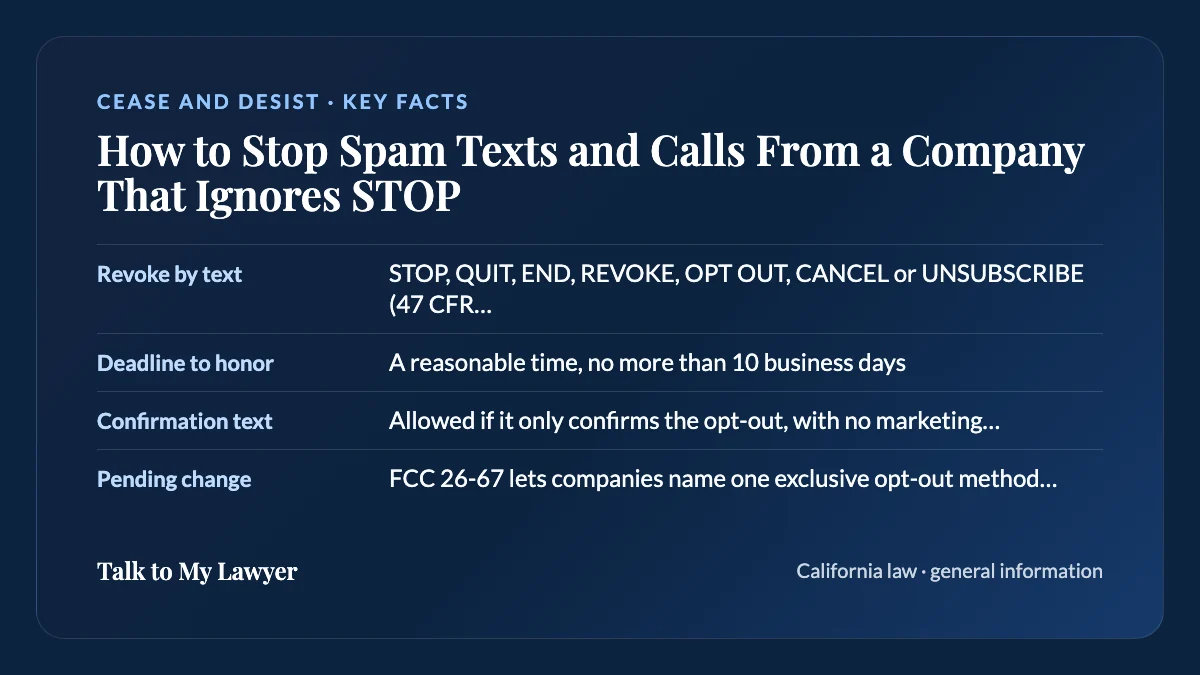
- Revoke by text
- STOP, QUIT, END, REVOKE, OPT OUT, CANCEL or UNSUBSCRIBE (47 CFR 64.1200(a)(10))
- Deadline to honor
- A reasonable time, no more than 10 business days
- Confirmation text
- Allowed if it only confirms the opt-out, with no marketing (64.1200(a)(12))
- Pending change
- FCC 26-67 lets companies name one exclusive opt-out method, effective 30 days after Federal Register publication
- Damages
- $500 per violation or actual loss, up to 3 times if willful (47 U.S.C. 227(b)(3))
- Do Not Call
- Private claim after more than one call in 12 months (47 U.S.C. 227(c)(5))
What is the fastest way to stop spam texts from a company?
Reply with one of the words the FCC treats as a revocation: STOP, QUIT, END, REVOKE, OPT OUT, CANCEL or UNSUBSCRIBE. Under 47 CFR 64.1200(a)(10), using any of those words in reply to a text is a reasonable means to revoke consent by definition, and that consent is then treated as definitively revoked.
Under the rule in force as of October 2026, other words work too. If you reply "please stop texting me" or "take me off your list," the company must treat it as a revocation if a reasonable person would understand it that way, and it may not designate one exclusive opt-out method. That second point is about to change, as the callout below explains.
- The company must honor your request within a reasonable time, no more than 10 business days after receiving it.
- It may send a confirmation text that only confirms the opt-out and contains no marketing. A confirmation sent within five minutes is presumed acceptable (64.1200(a)(12)).
- If the company texts from a number that cannot receive replies, each text must say so and give another clear way to opt out.
What the TCPA covers, and what it pays
The federal Telephone Consumer Protection Act (47 U.S.C. 227) restricts calls and texts made with an automatic telephone dialing system or an artificial or prerecorded voice to cell phones, unless the call is for an emergency or made with the called party's prior express consent. It also restricts telemarketing to numbers on the national Do Not Call registry.
| Violation | Who can sue | Amount |
|---|---|---|
| Autodialed or prerecorded calls or texts without required consent, or in violation of the FCC's rules under that part | The person called | Actual loss or $500 per violation, whichever is greater; the court may award up to three times that if willful or knowing (227(b)(3)) |
| Telemarketing in violation of the Do Not Call rules | A person who got more than one call within 12 months from or for the same entity | Up to $500 per violation or actual loss; up to three times if willful or knowing (227(c)(5)) |
The Do Not Call claim has a built-in defense: a company that shows it set up and followed reasonable practices to prevent violations, with due care, can defeat it. Telemarketing calls to homes are also limited to between 8 a.m. and 9 p.m. local time (64.1200(c)(1)).
Whether a particular system counts as an automatic telephone dialing system is a technical, fact-heavy question. That is one reason a log of every text matters more than an assumption about how it was sent.
Does the Do Not Call registry stop company texts?
It helps with sales calls, but it is not a complete fix. The FTC says your number should appear on the registry the next day, and it can take up to 31 days for sales calls to stop. Registration never expires. Register at donotcall.gov or by calling 1-888-382-1222.
According to the FTC, the registry does not stop political calls, charity calls, debt collection calls, purely informational calls or surveys. Companies you recently did business with or that have your written permission can still call, but if you ask one to stop, it must.
California adds its own rules. Business and Professions Code section 17592 bars telephone solicitors from calling California numbers on the national list for sales, credit offers and similar pitches. Section 17538.41 restricts sending text message advertisements to California residents' mobile numbers, with exceptions for businesses that have an existing relationship with you and offer a way to opt out.
Steps when a company keeps texting after you reply STOP
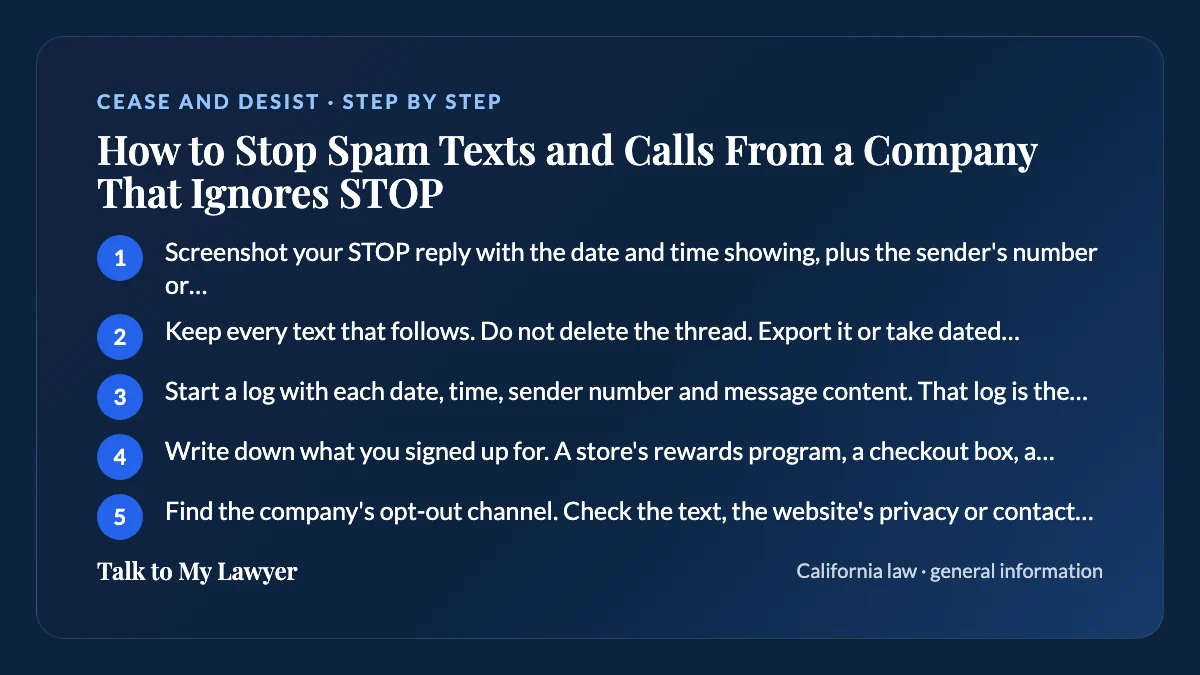
- Screenshot your STOP reply with the date and time showing, plus the sender's number or short code.
- Keep every text that follows. Do not delete the thread. Export it or take dated screenshots of each message.
- Start a log with each date, time, sender number and message content. That log is the first thing a lawyer would ask to see.
- Write down what you signed up for. A store's rewards program, a checkout box, a contest. Revocation works even if you once agreed.
- Find the company's opt-out channel. Check the text, the website's privacy or contact page, and any number it lists for opt-outs.
- Use the designated channel, then put it in writing. Opt out through any website or phone number the text names, and send a written revocation to the company's mailing address as a record. Keep proof of both.
- Register your number on the Do Not Call registry if the messages are sales pitches.
- Report it. The FTC takes reports of unwanted sales calls at DoNotCall.gov, and reports from people who lost money or know who is behind the messages at ReportFraud.ftc.gov. Keep a copy of your report with your log.
Sample letter revoking consent to calls and texts
Keep the letter short and plain. Name the number, revoke consent for every purpose, and ask the company to confirm and keep its records.
I revoke any consent I may have given for calls or text messages to (555) 010-0142, for any purpose. I replied STOP to your text on September 3, and I have received 11 marketing texts since then, copies enclosed. Under 47 CFR 64.1200(a)(10), you must honor this revocation within 10 business days. Please add this number to your internal do-not-call list, confirm in writing that you have done so, and preserve all records of messages sent to this number, including the consent record you rely on.
Leave out threats and dollar figures in a first letter unless you have spoken with a lawyer. The facts and the dates do the work.
Example: counting texts after a STOP reply
Example (hypothetical): a shopper in Fresno replies STOP to a furniture retailer's promotional text on June 2. Ten business days later is June 16. The shopper's log shows 2 texts between June 3 and June 16, then 7 more between June 17 and August 1.
| Period | Texts | How the rule reads |
|---|---|---|
| Within 10 business days | 2 | The company had up to 10 business days, so these may fall inside the allowed time |
| After 10 business days | 7 | Sent after the deadline to honor revocation |
| Statutory measure | 7 x $500 = $3,500 | The TCPA sets $500 per violation; a court may raise it up to three times if it finds the violation willful or knowing |
Whether each text is a violation depends on how it was sent and what consent applied, which only a court can decide. The table shows how the statute counts, not what anyone would recover.
Texts from debt collectors follow different rules
Debt collection messages are not stopped by the Do Not Call registry, and collectors have separate federal and California rules on how and when they may contact you. If the texts are about a debt, our guide to a cease-contact letter to a debt collector explains that process.
For harassing messages from a person rather than a business, see our guide to harassment cease and desist letters.
When the texts outlast every STOP you send
A company that keeps texting after a clear revocation has a record problem, and your log is the record. A revocation written by a lawyer fits situations where the messages continue past 10 business days, when several numbers or brands are texting you for the same company, or when you want the revocation and a preservation request on file before deciding whether to pursue a claim.
Through Talk to My Lawyer, a licensed California attorney writes your letter from your facts and documents, including your screenshots and message log, and sends it on your behalf to the company's legal address. For advice on a TCPA claim, talk to a lawyer about your facts.
Frequently asked questions
Can I sue a company for texting me after I said STOP?
Possibly. The TCPA lets a person sue for actual loss or $500 per violation, whichever is greater, for calls and texts that violate its consent rules or the FCC's regulations, and a court may increase that up to three times for willful or knowing violations. Whether the texts qualify depends on how they were sent and what consent existed. Keep screenshots of your STOP reply and every later text.
How long does a company have to stop texting me?
Under 47 CFR 64.1200(a)(10), a company must honor a revocation made in any reasonable way within a reasonable time not to exceed 10 business days from receipt. It may send a confirmation text that does not include marketing, and a confirmation sent within five minutes is presumed to fall within your prior consent. Those limits stay the same under the FCC's September 2026 revisions.
Does the Do Not Call list work for text messages?
The FTC's registry information focuses on sales calls. The FCC's revocation rule separately covers both calls and texts that need consent, so replying STOP is the more direct step for marketing texts. California's Business and Professions Code section 17538.41 also restricts text message advertisements to California mobile numbers, with exceptions for businesses you have an existing relationship with that offer an opt-out.
What if a company says I agreed to texts in its terms?
Consent can be revoked. The FCC's rule lets you revoke prior express consent, including prior express written consent, and if you once agreed in a checkout box or rewards program, a clear STOP reply still ends that consent going forward. Once the FCC's September 2026 changes take effect, a company that clearly discloses one exclusive opt-out method may require you to use it, so use the method the message names.
Is replying STOP to a spam text safe?
For texts from a real business you know, such as a retailer you shopped with, replying STOP is the method the FCC's rule recognizes. Texts from unknown numbers that look like scams are a different matter: do not click links or share personal information, and report them to the FTC at ReportFraud.ftc.gov.
Sources
Checked against these official sources on October 18, 2026.
- 47 CFR 64.1200 Delivery restrictions (Electronic Code of Federal Regulations)
- FCC 26-67 Report and Order on TCPA revocation of consent (adopted September 30, 2026) (Federal Communications Commission)
- 47 U.S. Code section 227: Restrictions on use of telephone equipment (Legal Information Institute, Cornell Law School)
- National Do Not Call Registry FAQs (Federal Trade Commission)
- California Business and Professions Code section 17538.41 (California Legislative Information)
- California Business and Professions Code section 17592 (California Legislative Information)
This guide explains California law in general terms as of October 2026. It is general information, not legal advice for your situation, and local rules can add to it.
Join the email list and get a lawyer letter started
With Talk to My Lawyer, a licensed California attorney writes your letter from your facts and documents and sends it on your behalf. Join the Talk to My Lawyer email list for letter checklists, document prompts, and reminders before you start your letter.