Quick answer
Car dealer fraud in California includes misrepresenting the price, financing terms, add-ons or whether a contract is a lease or a sale. As of October 1, 2026, the CARS Act (Civil Code section 1784.20 and following) bans those practices, outlaws add-ons that give you no benefit, and gives buyers of used vehicles priced at $50,000 or less a 3-day right to cancel.
At a glance
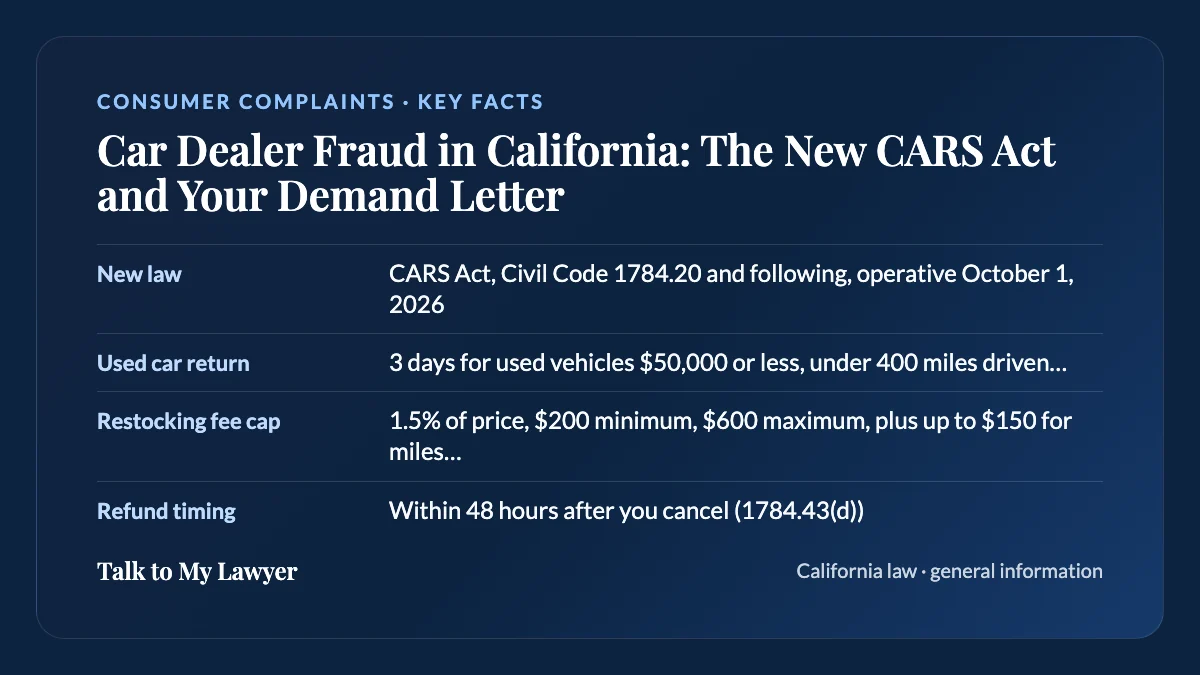
- New law
- CARS Act, Civil Code 1784.20 and following, operative October 1, 2026
- Used car return
- 3 days for used vehicles $50,000 or less, under 400 miles driven (1784.43)
- Restocking fee cap
- 1.5% of price, $200 minimum, $600 maximum, plus up to $150 for miles over 250
- Refund timing
- Within 48 hours after you cancel (1784.43(d))
- Pre-suit notice
- CLRA letter 30 days before a damages claim, certified or registered mail (Civil Code 1782)
What counts as car dealer fraud in California?
Under the CARS Act, a dealer violates the law by misrepresenting material information about the deal (Civil Code section 1784.40). Material means likely to affect your choice. The Act lists the topics where a misstatement counts, including:
- The costs or terms of buying, financing or leasing the vehicle.
- The cost, limits or benefits of any add-on product or service.
- Whether the final contract is a lease or a sale.
- Whether a vehicle is really available at the total price the dealer advertised or quoted.
- Whether you have been preapproved or are assured any product, service or term.
- What your credit application says.
- Whether the dealer will keep your cash down payment or trade-in, charge fees or start legal action if the deal is not finalized.
- Whether and when the dealer will pay off the loan or lease on your trade-in.
Older laws still apply alongside the new one. The Consumers Legal Remedies Act (CLRA) prohibits a list of deceptive practices in consumer sales, and the CARS Act says its remedies are in addition to remedies under other law (section 1784.22). A dealer also cannot get you to sign away CARS Act protections: any waiver is void (section 1784.21).
What changed for California car buyers on October 1, 2026?
Senate Bill 766 (Chapter 354, Statutes of 2025) created the CARS Act and replaced the old used car contract cancellation option in Vehicle Code section 11713.21, which was repealed as of October 1, 2026. Which rule applies depends on your purchase date.
| Topic | Purchases before October 1, 2026 | Purchases on or after October 1, 2026 |
|---|---|---|
| Used car return | Dealer had to offer a paid cancellation option on used cars under $40,000 | 3-day right to cancel on used cars priced at $50,000 or less, subject to a restocking fee |
| Return window | At least until the dealer's close of business on the second day after delivery | Three calendar days, counted from the day after signing, through the dealer's close of business |
| Mileage limit | Dealer could set a limit of 250 miles or more | Right lost only after more than 400 miles |
| Price advertising | Vehicle Code advertising rules | Total price must appear in ads for a specific vehicle and in the dealer's first written reply about it |
| Monthly payment quotes | No CARS Act requirement | A written monthly payment quote must show the total you will pay at that payment |
Dealers must also keep records showing compliance for two years, including written complaints from buyers (section 1784.44). A complaint you put in writing becomes part of the file the dealer is required to keep.
Can you return a used car in California within 3 days?
Yes, for most used vehicles bought or leased from a dealer on or after October 1, 2026 at a price of $50,000 or less. Motorcycles are excluded, and the right ends if the car has been driven more than 400 miles since signing (section 1784.43). There is no cooling-off period for new vehicles, and the contract's first page must say so.
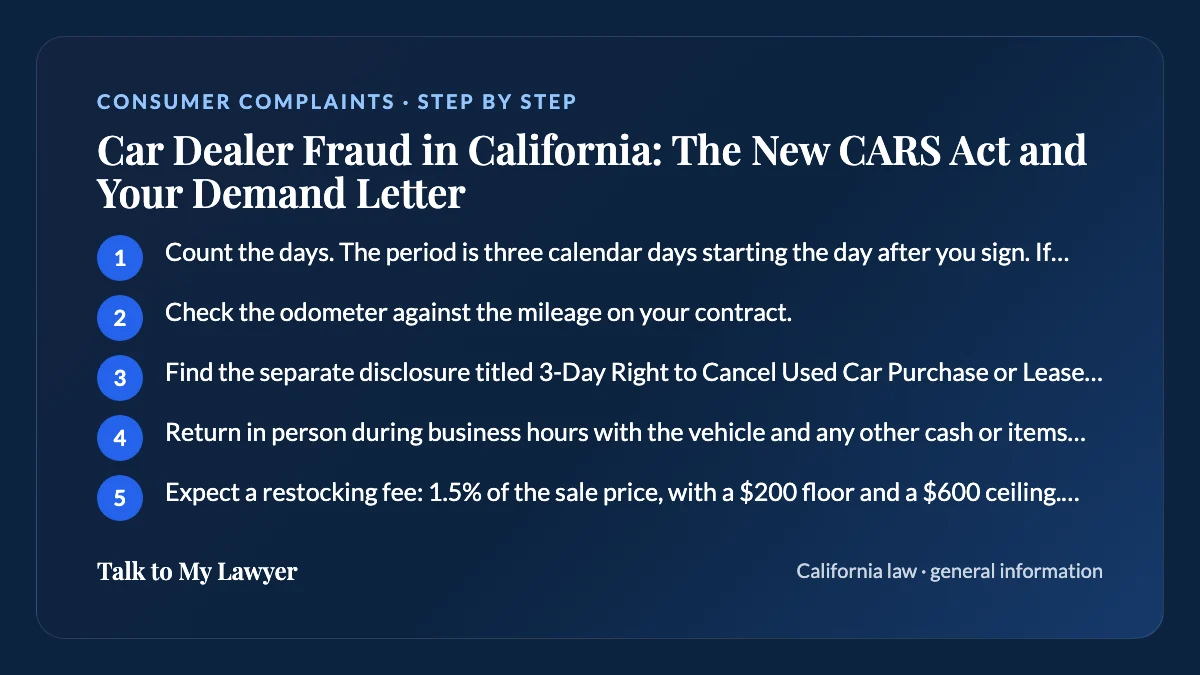
- Count the days. The period is three calendar days starting the day after you sign. If day three falls on a day the dealership is closed, it runs to the next day it is open.
- Check the odometer against the mileage on your contract.
- Find the separate disclosure titled 3-Day Right to Cancel Used Car Purchase or Lease, which explains the restocking fee.
- Return in person during business hours with the vehicle and any other cash or items you received in the deal.
- Expect a restocking fee: 1.5% of the sale price, with a $200 floor and a $600 ceiling. If the car has gone more than 250 miles, the dealer may add $1 for each extra mile, up to $150. The fee is taken out of any refund.
- Ask for the cancellation receipt, which must itemize every deduction and show the date and time you cancelled.
The dealer must cancel the contract and refund you within 48 hours, minus allowed deductions, although payments by check can wait until two business days after the funds are verified. Your trade-in must be returned. If it has already been sold or the title transfer started, you are owed the greatest of the agreed trade-in value, the price the dealer got, or fair market value.
Which dealer add-ons can you challenge?
A dealer may not charge for an add-on that gives you no benefit (section 1784.42). The statute names examples:
- Nitrogen tire fills with less than 95% nitrogen purity.
- Products that do not cover the vehicle, you or the transaction.
- GAP agreements that do not comply with the Automobile Sales Finance Act.
- A service contract that is void because of prior crash or flood damage or existing mechanical problems.
- Oil changes sold with an electric vehicle.
- Catalytic converter markings on a car that has no catalytic converter.
- A surface protection product that voids the paint warranty.
When a dealer describes an add-on in writing during negotiation, it must also state at least once, in writing, that the add-on is not required and that you can buy or lease the car without it (section 1784.41(b)). If you never received that disclosure, say so in your letter.
What if the dealer says your financing fell through?
Say the dealer calls a few days after you drive home: the loan was not approved, and you need to sign a new contract at a higher rate. The CARS Act makes it a violation to misrepresent whether the dealer will keep your down payment or trade-in, charge fees, or take legal action if the deal is not finalized (section 1784.40(g)).
A separate older rule covers buyers who arranged their own loan. If the dealer knew you planned to get financing from a third party without the dealer's help and you could not get it, the contract is treated as rescinded and each side returns what it received (Civil Code section 2982.9).
How to write a demand letter to a car dealer
If you plan to seek damages under the CLRA, the law requires written notice at least 30 days before suing. The notice must name the specific violations, demand that the dealer correct them, and go by certified or registered mail, return receipt requested, addressed to the place of the sale or the dealer's principal place of business in California (Civil Code section 1782). A demand letter can serve as that notice.
- Identify the vehicle by year, make, model and VIN, and give the contract date.
- Quote or attach the advertisement, text or worksheet showing the price or payment you were promised.
- List each charge you dispute, with its line number and amount.
- Name the rules involved: the CARS Act sections and Civil Code section 1770.
- State the fix you want: a refund of a specific add-on, a corrected contract, or cancellation and return of your trade-in.
- Give a response date at least 30 days out if the letter doubles as CLRA notice.
On October 9, I bought a 2022 sedan, VIN ending 4471, from your dealership. Your written quote of October 6 listed a total price of $24,800. The retail installment contract adds a $1,895 appearance package that I did not request and was never told was optional, as Civil Code section 1784.41(b) requires. Please remove the charge and refund it, with any finance charge on it, within 30 days. This letter is my notice under Civil Code section 1782.
Where else can you report a California car dealer?
The DMV Investigations Division enforces the laws, rules and regulations that apply to new and used vehicle dealers. If you believe a dealer broke those laws, you can file a complaint with the division, which has offices around the state.
Individuals can sue for up to $12,500 in small claims under section 116.221 of the Code of Civil Procedure, and sending a demand letter before small claims in California walks through filing. If the problem is a defect the dealer cannot fix rather than a sales practice, the California lemon law guide may fit better, and repair-shop billing fights are covered in car repair disputes.
When to have an attorney write to the dealer
A dealer dispute lives in the paperwork: the buyer's order, the finance contract, the add-on forms and the texts with a salesperson. Having an attorney write the letter can help when the amount is large, when your trade-in has already been sold, when you want the letter to serve as CLRA notice, or when the dealer has stopped answering.
Through Talk to My Lawyer, a licensed California attorney writes your letter from your facts and documents (the contract, the quotes, the messages) and sends it on your behalf, citing the CARS Act or the older rules depending on when you bought the car. If you are weighing a lawsuit, get advice from a lawyer on your own facts.
Frequently asked questions
Is there a 3-day cooling-off period for new cars in California?
No. The CARS Act requires the first page of the purchase or lease agreement to state that California has no cooling-off period for new vehicles. The 3-day right to cancel applies only to used vehicles priced at $50,000 or less, bought or leased from a dealer on or after October 1, 2026. Other legal rights to cancel, such as fraud claims, are not affected.
Can a dealer charge me to return a used car?
Under the CARS Act, the dealer cannot charge for the right to cancel itself but may charge a restocking fee: 1.5% of the sale price, no less than $200 and no more than $600. If you drove more than 250 miles, the dealer may add $1 per extra mile, up to $150. The fee is deducted from any refund you are owed.
What can I do if a dealer added products I did not want?
Write to the dealer, identify each add-on by contract line and price, and ask for its removal and a refund. California now bars charges for add-ons that give the buyer no benefit and requires a written statement that add-ons are optional. If you want to preserve a CLRA damages claim, send the letter by certified mail at least 30 days before filing.
Who do I complain to about a car dealer in California?
The DMV Investigations Division handles complaints against licensed car dealers and enforces the laws that govern them. You can also bring a claim in small claims court for up to $12,500 as an individual. A written demand to the dealer documents the dispute and gives the dealer a chance to correct it.
Does the CARS Act apply to cars bought before October 1, 2026?
The Act becomes operative on October 1, 2026, so purchases before that date fall under the earlier rules, including the paid contract cancellation option for used cars under $40,000. Misrepresentation and deceptive sales practices were already unlawful under the Consumers Legal Remedies Act, so older purchases still have remedies. A lawyer can tell you which rules fit your dates.
Sources
Checked against these official sources on October 18, 2026.
- SB 766 California Combating Auto Retail Scams (CARS) Act (Chapter 354, Statutes of 2025) (California Legislative Information)
- California Vehicle Code section 11713.21 (California Legislative Information)
- California Civil Code section 1782 (California Legislative Information)
- California Civil Code section 2982.9 (California Legislative Information)
- Investigations Offices (California Department of Motor Vehicles)
- California Code of Civil Procedure section 116.221 (California Legislative Information)
This guide explains California law in general terms as of October 2026. It is general information, not legal advice for your situation, and local rules can add to it.
Join the email list and get a lawyer letter started
With Talk to My Lawyer, a licensed California attorney writes your letter from your facts and documents and sends it on your behalf. Join the Talk to My Lawyer email list for letter checklists, document prompts, and reminders before you start your letter.