Quick answer
Under California lemon law, a manufacturer that cannot fix a new vehicle's warranty defect after a reasonable number of attempts must replace it or refund it, and you choose the refund (Civil Code section 1793.2(d)(2)). A car is presumed a lemon if, within 18 months or 18,000 miles, a serious safety defect was repaired twice, the same defect four times, or the car was out of service over 30 days.
At a glance
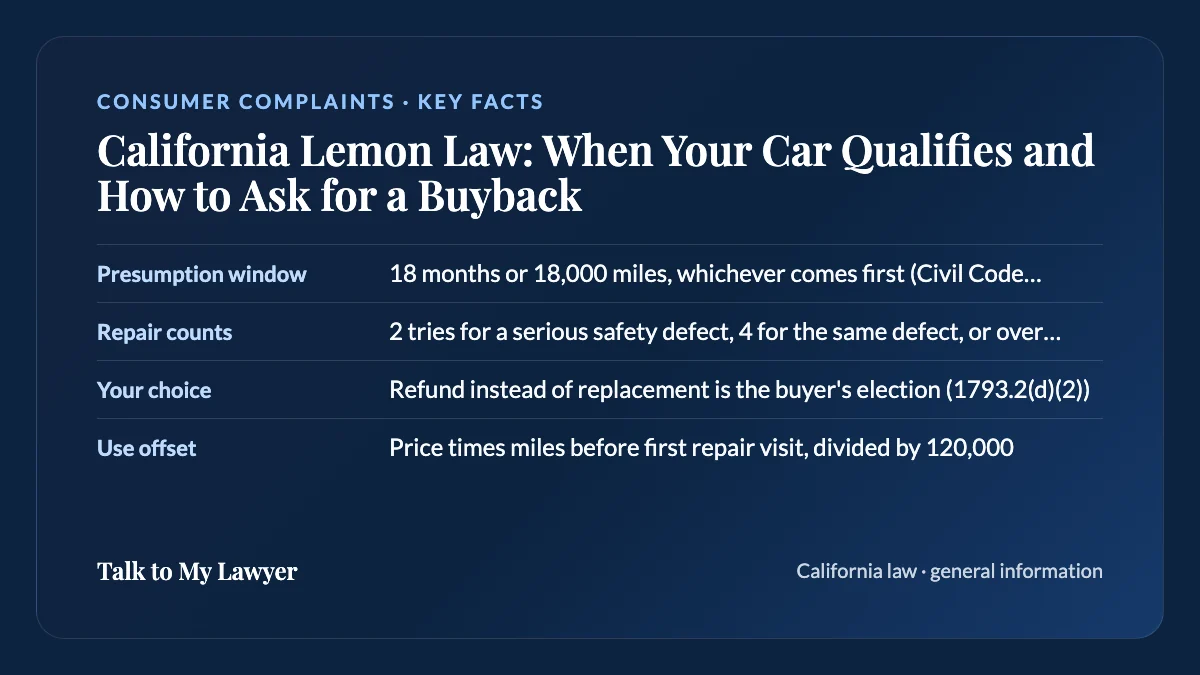
- Presumption window
- 18 months or 18,000 miles, whichever comes first (Civil Code 1793.22(b))
- Repair counts
- 2 tries for a serious safety defect, 4 for the same defect, or over 30 days in the shop
- Your choice
- Refund instead of replacement is the buyer's election (1793.2(d)(2))
- Use offset
- Price times miles before first repair visit, divided by 120,000
- Opt-in manufacturers
- Written repurchase demand 30 days before seeking civil penalties (CCP 871.24)
What does the California lemon law cover?
The lemon law is part of the Song-Beverly Consumer Warranty Act. Its car rules cover a new motor vehicle bought or used mainly for personal, family or household purposes, including a dealer demonstrator sold with a new car warranty (Civil Code section 1793.22(e)). Leased vehicles count too.
Some business vehicles qualify: those under 10,000 pounds gross vehicle weight owned by a business with no more than five vehicles registered in California. Motorcycles and off-road-only vehicles are excluded, as is the living area of a motor home.
The defect has to be a nonconformity, meaning a problem covered by the warranty that substantially impairs the vehicle's use, value or safety. The test is the effect on the car, not how irritating the problem is: does it substantially impair use, value or safety?
When is a car presumed to be a lemon in California?
The Tanner Consumer Protection Act creates a presumption that the manufacturer has had a reasonable number of repair attempts if one of three things happens within 18 months of delivery or 18,000 miles, whichever comes first (Civil Code section 1793.22(b)).
| Path | What must happen | Direct notice to manufacturer |
|---|---|---|
| Serious safety defect | The same defect, likely to cause death or serious injury, was repaired 2 or more times | At least once, if the warranty or owner's manual required it |
| Repeated defect | The same defect was repaired 4 or more times | At least once, if the warranty or owner's manual required it |
| Days out of service | The car was in the shop for warranty repairs more than 30 calendar days in total | Not required for this path |
The presumption is a starting point, not the only way in. A car that misses these numbers can still qualify if the manufacturer had a reasonable number of chances. The statute also lets you raise the presumption in any civil action, including small claims.
What does a lemon law buyback include?
Restitution is the actual price paid or payable, including transportation charges and manufacturer-installed options, plus sales tax, license and registration fees and other official fees, plus incidental damages such as reasonable repair, towing and rental car costs you actually paid (Civil Code section 1793.2(d)(2)(B)). Items a dealer or you installed that did not come from the manufacturer are excluded.
The manufacturer may subtract an amount for your use before the first repair visit for the defect. The formula: the price multiplied by the miles driven before that visit, divided by 120,000.
If the manufacturer's refusal was willful, a court may add a civil penalty of up to twice the actual damages, and a buyer who wins recovers reasonable attorney's fees and costs (Civil Code section 1794).
What did the 2025 lemon law changes do?
Assembly Bill 1755 (2024) and Senate Bill 26 (2025) added Code of Civil Procedure sections 871.20 to 871.30. These procedures apply only to manufacturers that elect them by written notice to the Department of Consumer Affairs' Arbitration Certification Program, which must publish a list of those manufacturers by December 15 each year (section 871.29). Check the list before you write.
If your manufacturer has opted in, these rules apply:
- To seek civil penalties, you must send a written notice at least 30 days before suing, with your name, the correct VIN, a brief summary of the repair history and problems, and a demand to repurchase or replace (section 871.24, operative July 1, 2025).
- When a vehicle is sold new, the manufacturer must tell the buyer which set of procedures governs it (section 871.29(d)).
- The notice goes by email to the address the manufacturer posts on its website for this purpose, or by certified or registered mail, return receipt requested, to the address in the owner's manual or warranty booklet.
- You must have the vehicle when you send the notice and keep it for at least 30 days after the manufacturer receives it. If the manufacturer offers restitution or replacement within 30 days and completes it within 60 days of receiving your notice, civil penalties are off the table, and you keep the car for the full 60 days while that happens.
- If no offer comes within 30 days, you may sell the vehicle and still pursue remedies, provided you give the buyer written notice of your claim.
- A lawsuit must be filed within one year after the warranty expires and no later than six years after original delivery, with time paused while the car is in for repair and for up to 60 days after notice (section 871.21).
- A settlement cannot require any release other than the standardized release written into section 871.25.
For manufacturers that have not opted in, the older Song-Beverly rules continue to govern. Under those rules, a buyer seeking the civil penalty for a failure to replace or refund generally serves written notice first, and a manufacturer that complies within 30 days avoids that penalty. That penalty route is also unavailable when the manufacturer maintains a qualified dispute resolution program that substantially complies with the law (Civil Code section 1794(e)).
Do you have to use the manufacturer's arbitration program first?
Sometimes. If the manufacturer runs a qualified, state-certified dispute resolution program and told you about it in writing in time, you must try it before relying on the presumption (Civil Code section 1793.22(c)). Decisions bind the manufacturer only if you accept them, and an accepted decision must be carried out within 30 days.
The Arbitration Certification Program says state-certified arbitration is free for consumers. Not every manufacturer has a certified program; for those that do not, the program points buyers to the New Motor Vehicle Board's consumer mediation service.
The direct-notice step also matters. If your warranty booklet or owner's manual tells you to notify the manufacturer directly, a letter to the address it lists is part of meeting the two-repair or four-repair path.
How to write a California lemon law demand letter
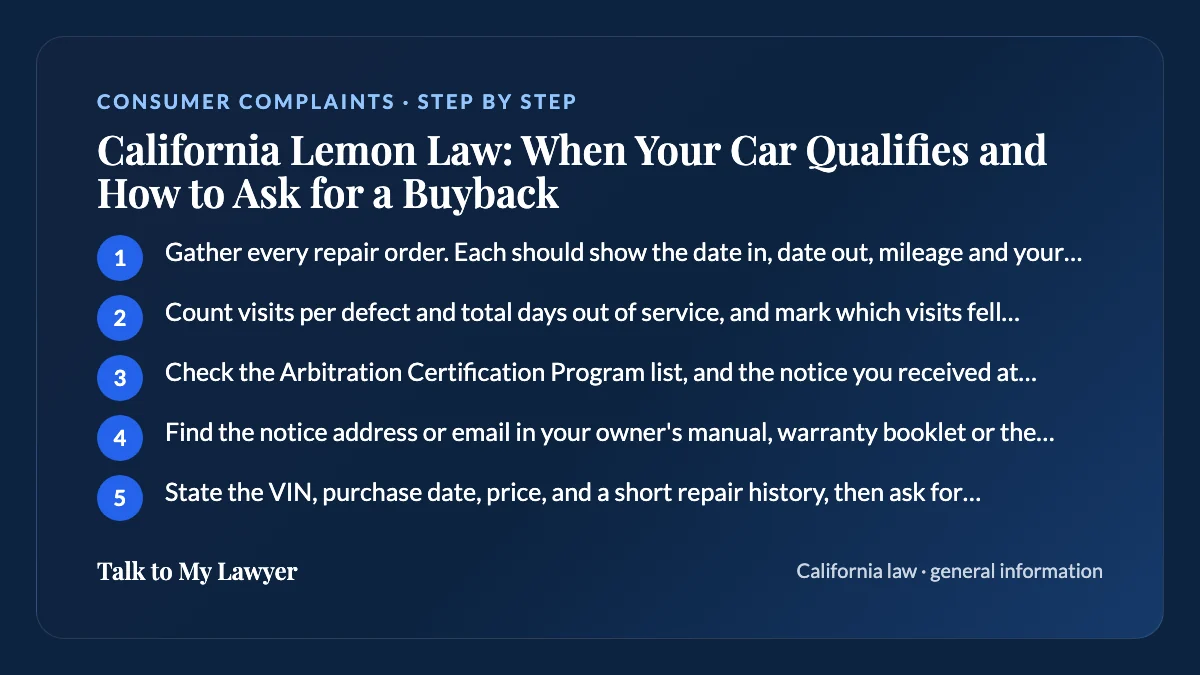
- Gather every repair order. Each should show the date in, date out, mileage and your complaint in your words.
- Count visits per defect and total days out of service, and mark which visits fell within 18 months or 18,000 miles.
- Check the Arbitration Certification Program list, and the notice you received at purchase, to see whether your manufacturer opted into the 2025 procedures.
- Find the notice address or email in your owner's manual, warranty booklet or the manufacturer's website.
- State the VIN, purchase date, price, and a short repair history, then ask for repurchase or replacement and say which you prefer.
- Send it by the method the statute requires, keep proof of delivery, and keep the car until the waiting period ends.
I am the owner of a 2025 crossover, VIN 1ABCD23E45F678901, delivered new on March 14, 2025. The vehicle has been repaired four times for the same loss of power while accelerating, on May 2, June 19, August 30 and October 7, at mileages between 3,200 and 11,900. It has been out of service a total of 34 days. I request that you repurchase the vehicle under Civil Code section 1793.2(d)(2). Copies of all repair orders are enclosed.
Leave out estimates of what a court might award. A factual history with documents attached tells the manufacturer what it needs to evaluate the request.
Checklist: records a lemon law claim depends on
- The purchase or lease contract and the window sticker.
- Every repair order, including visits where the dealer said it could not reproduce the problem.
- The warranty booklet and owner's manual pages on notice and arbitration.
- Receipts for towing, rentals and repairs you paid for.
- Photos or video of the defect happening, with dates.
- Letters, emails and case numbers from the manufacturer's customer line.
- A current loan or lease payoff statement.
If the problem is with a product other than a car, or the warrantor denied coverage outright, see our guide to answering a warranty denial. Sales-floor problems such as misquoted prices belong in the car dealer fraud guide.
When to have an attorney write your lemon law demand
Under the 2025 procedures, the first letter carries real weight: what it says, where it goes and when it is sent can decide whether civil penalties stay available. Having an attorney write it can help if your manufacturer opted in, if the repair history is long, or if you are deciding whether to keep or sell the car while the claim is pending.
Through Talk to My Lawyer, a licensed California attorney writes your letter from your facts and documents (repair orders, purchase papers, warranty booklet) and sends it on your behalf to the notice address your manufacturer designates. Song-Beverly also lets a buyer who prevails recover attorney's fees and costs (Civil Code section 1794(d)); a lawyer can explain how that and the other remedies apply to your car.
Frequently asked questions
How many repair attempts make a car a lemon in California?
The presumption applies when, within 18 months or 18,000 miles, a defect likely to cause death or serious injury was repaired two or more times, the same defect was repaired four or more times, or the car spent more than 30 days in the shop. For the first two paths, you must also have notified the manufacturer directly at least once if your warranty materials required it.
Does the California lemon law apply to used cars?
The statute's motor vehicle rules are written for new vehicles, including dealer-owned vehicles and demonstrators sold with a new car warranty. Whether a used car bought with part of the factory warranty left fits that definition depends on how it was sold and what warranty came with it. A lawyer can tell you whether your car qualifies.
What is deducted from a lemon law refund?
The manufacturer may deduct an amount for use before your first repair visit for the defect: the price multiplied by the miles driven before that visit, divided by 120,000. For manufacturers that opted into the 2025 procedures, third-party add-ons and negative equity from a prior car may also be offset under Code of Civil Procedure section 871.27.
Do I have to send a letter before suing under the lemon law?
If your manufacturer opted into the 2025 procedures and you want civil penalties, yes: a written repurchase or replacement demand at least 30 days before filing, sent to the address or email the manufacturer designates. You may sue for restitution or replacement without it, but you then give up civil penalties. Older rules also tie some penalties to written notice.
How do I know if my manufacturer opted into AB 1755?
The Department of Consumer Affairs' Arbitration Certification Program must publish, by December 15 each year, a list of manufacturers that elected the procedures in Code of Civil Procedure sections 871.20 to 871.30 for the following year. The election lasts five calendar years. Check the list on the program's website before sending your letter.
Sources
Checked against these official sources on October 18, 2026.
- California Civil Code section 1793.22 (Tanner Consumer Protection Act) (California Legislative Information)
- California Civil Code section 1793.2 (California Legislative Information)
- California Civil Code section 1794 (California Legislative Information)
- Code of Civil Procedure sections 871.20 to 871.30 (California Legislative Information)
- New Lemon Law changes per AB 1755 and SB 26 (California Department of Consumer Affairs, Arbitration Certification Program)
- Arbitration Certification Program (California Department of Consumer Affairs)
This guide explains California law in general terms as of October 2026. It is general information, not legal advice for your situation, and local rules can add to it.
Join the email list and get a lawyer letter started
With Talk to My Lawyer, a licensed California attorney writes your letter from your facts and documents and sends it on your behalf. Join the Talk to My Lawyer email list for letter checklists, document prompts, and reminders before you start your letter.