Quick answer
A cease and desist letter template has seven parts: your details and date, the recipient, a description of the conduct with dates, the legal basis, the specific actions you want (stop, remove, return), a deadline, and a request to preserve records. Keep it factual. In California, threatening criminal accusations or exposure to force payment can be extortion (Penal Code section 519), so limit the consequences to lawful civil steps.
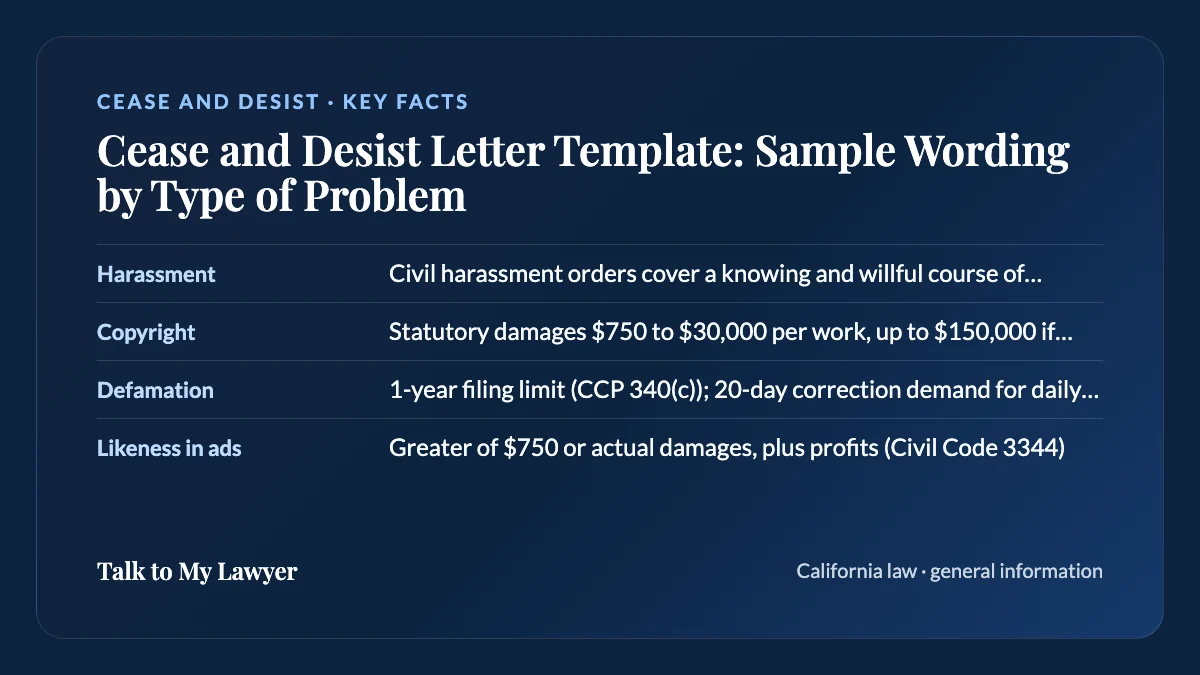
At a glance
- Harassment
- Civil harassment orders cover a knowing and willful course of conduct with no legitimate purpose (CCP 527.6)
- Copyright
- Statutory damages $750 to $30,000 per work, up to $150,000 if willful (17 U.S.C. 504(c))
- Defamation
- 1-year filing limit (CCP 340(c)); 20-day correction demand for daily or weekly news publications (Civil Code 48a)
- Likeness in ads
- Greater of $750 or actual damages, plus profits (Civil Code 3344)
- Off limits
- Threats to accuse of a crime or expose a secret (Penal Code 519)
What are the parts of a cease and desist letter template?
Seven parts, in order. A demand letter asks for money; a cease and desist letter wants behavior to end, so the center of gravity is the description of what is happening and the specific actions you want.
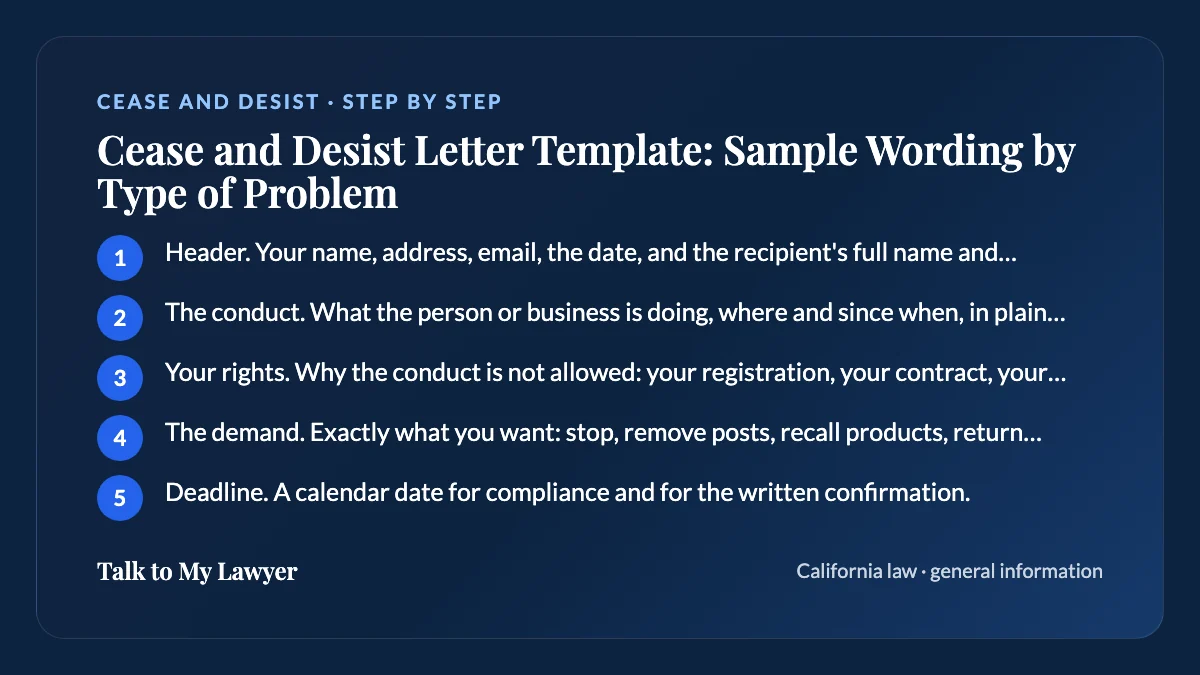
- Header. Your name, address, email, the date, and the recipient's full name and address. Add a subject line such as "Re: Demand to stop use of the Bright Harbor name."
- The conduct. What the person or business is doing, where and since when, in plain dated sentences.
- Your rights. Why the conduct is not allowed: your registration, your contract, your ownership of the photo, or the statute involved.
- The demand. Exactly what you want: stop, remove posts, recall products, return materials, confirm in writing.
- Deadline. A calendar date for compliance and for the written confirmation.
- Preservation request. Ask them to keep all records related to the conduct, including messages, files and sales data.
- Close. Say you are open to resolving it directly, and reserve your rights without listing threats.
Not sure which kind of letter fits? Our plain-language explainer on cease and desist letters sets out how they differ from demand letters.
Sample wording for harassment
Describe the pattern and ask for no further contact. Under California's civil harassment statute, a knowing and willful course of conduct aimed at one person can qualify when it seriously alarms, annoys or harasses that person, serves no legitimate purpose, would cause a reasonable person substantial emotional distress, and actually causes it (CCP 527.6(b)(3)). A letter does not create a restraining order, but it documents that you asked.
Since July 8, you have called my cell phone 41 times and sent 23 text messages, including messages at 2:14 a.m. on August 2 and 3:40 a.m. on August 9, after I asked you in writing on July 20 to stop. I am asking you again to stop all contact with me by phone, text, email, social media or in person, effective immediately. I am keeping a record of every message.
If you fear for your safety, a letter is not the right tool. Contact law enforcement or ask the court about a restraining order. Our harassment cease and desist guide covers this in more depth.
Sample wording for copyright and trademark
Identify the work or mark, prove it is yours, and point to the exact copies. Statutory damages for copyright run from $750 to $30,000 for each work infringed, and as high as $150,000 when the infringement is willful (17 U.S.C. 504(c)), but mentioning numbers in a first letter can look like an opening bid. Statutory damages and attorney's fees are generally unavailable for infringement that began before registration, unless a published work was registered within three months of first publication (17 U.S.C. 412), so check your registration dates before citing them.
I am the photographer and copyright owner of the image titled "Fog on Ocean Beach," first published on my website on May 4, 2025. Your company's website displays this image on its homepage and on the page at the address listed in Exhibit A, without a license. Please remove the image from all websites and social media accounts you control by October 31, then tell me in writing once that is done.
Since 2019, my bakery has sold goods under the name Bright Harbor in San Mateo County. Your new shop opened in August 2026 under the name Bright Harbor Bakes, two miles away, and customers have contacted us about your orders. Please stop using Bright Harbor in your shop's name, signs and online listings by November 30, and tell me in writing how you will transition.
Sample wording for defamation
Quote the exact statement, say why it is false, and ask for removal or a correction. Truth and opinion are defenses, so a letter aimed at a negative opinion ("worst service ever") stands on weaker ground than one aimed at a false fact ("they were arrested for fraud").
On September 12, you posted on your public Facebook page that I "stole a client's deposit and was sued for it." That statement is false. I have never been sued by any client, and the client you refer to received a full refund on June 3, as the enclosed bank record shows. Please delete the post and any copies by October 20 and post a correction stating the statement was inaccurate.
Two timing rules matter. A libel or slander lawsuit must generally be filed within one year (CCP 340(c)). For libel in a daily or weekly news publication, or slander by radio broadcast, Civil Code section 48a limits you to special damages (provable financial losses) unless you serve a written correction demand within 20 days after you learn of the statement. See also our defamation cease and desist guide.
Sample wording for a contract breach
Name the agreement, quote the clause, and describe the conduct that breaks it. The same approach works for confidentiality, non-solicitation and exclusivity clauses. Employee non-compete clauses follow separate California rules; our non-compete guide covers them.
Section 6 of the Consulting Agreement you signed on January 10, 2025 prohibits disclosure of our client list and pricing for two years after termination. On September 25, three of our clients forwarded us emails from you offering our current pricing minus 15 percent. Please stop using our confidential information immediately, return or destroy all copies by October 15, and send me written confirmation once that is complete.
What should a cease and desist letter not say?
It should not threaten anything you cannot lawfully do, and it should not claim more than you can prove.
| Avoid | Why |
|---|---|
| "Stop, or I will report you to the police" tied to payment | Using a threatened criminal accusation or a revealed secret to get something can amount to extortion (Penal Code 519) |
| Claiming a trademark or copyright you do not have | The reply will ask for the registration or proof, and the letter loses credibility |
| Demanding someone stop truthful reviews or criticism | Speech claims can invite an anti-SLAPP motion with attorney's fees to a winning defendant (CCP 425.16) |
| Threats of a lawsuit you have no plan to file | A threat you do not carry out can weaken later letters |
| Insults and guesses about motives | The letter may be read by a judge, and tone becomes evidence |
One more caution: a letter that clearly threatens a lawsuit can give the recipient grounds to ask a court for a declaration of its rights first (CCP 1060). Firm and specific is better than loud.
When the conduct involves your brand, your work or your name
Trademark, copyright, defamation and confidentiality letters each turn on technical points: registration dates, the line between fact and opinion, whether a clause is enforceable in California. A lawyer can be worth involving when the recipient is a business with counsel, when your livelihood rests on the name or creative work involved, or when the conduct could lead to a lawsuit in either direction.
Through Talk to My Lawyer, a licensed California attorney writes your cease and desist letter from your facts and documents, including screenshots, registrations and contracts, and sends it on your behalf. For advice on a lawsuit or a restraining order, talk to a lawyer about your facts.
Frequently asked questions
Do I need a lawyer to send a cease and desist letter?
No. Anyone can send a cease and desist letter, and no legal form is required. A self-written letter should describe the conduct with dates, explain your rights, list the actions you want and set a deadline. Keep it factual and avoid threats. Letters involving trademarks, defamation or contracts often raise legal questions worth discussing with a lawyer before sending.
Does a cease and desist letter need to be notarized?
No. California law does not require a notary for a private letter like this one. What matters more is proof of sending: certified mail with return receipt, a courier with tracking, or email to an address the recipient uses. Keep a copy of the letter and the proof together.
What if the recipient ignores my cease and desist letter?
The letter carries no automatic consequence, since no court issued it. The sender then decides whether to take further steps, such as a lawsuit for damages or an injunction, a civil harassment restraining order, or a platform takedown request. The letter itself becomes part of the record showing the recipient was told about the problem.
Should a cease and desist letter mention damages?
It can, but it does not have to. You can leave a dollar figure out of a letter whose aim is stopping conduct. If you mention statutory damages, such as copyright's $750 to $30,000 range, make sure they actually apply to you, since copyright statutory damages depend on when the work was registered. An overstated remedy is easy for the recipient to rebut.
What deadline should a cease and desist letter set?
No statute sets a deadline for a private letter. For removing posts or stopping contact, a date 7 to 14 days out gives a clear window; a change such as a business rename may reasonably need longer. Pick a specific calendar date and ask for written confirmation by that date. For ongoing harassment, you can ask that contact stop immediately.
Sources
Checked against these official sources on October 18, 2026.
- California Code of Civil Procedure section 527.6 (California Legislative Information)
- California Civil Code section 48a (California Legislative Information)
- California Penal Code section 519 (California Legislative Information)
- 17 U.S. Code section 412: Registration as prerequisite to certain remedies (Legal Information Institute, Cornell Law School)
- 17 U.S. Code section 504: Remedies for infringement (Legal Information Institute, Cornell Law School)
- California Code of Civil Procedure section 340 (California Legislative Information)
This guide explains California law in general terms as of October 2026. It is general information, not legal advice for your situation, and local rules can add to it.
Join the email list and get a lawyer letter started
With Talk to My Lawyer, a licensed California attorney writes your letter from your facts and documents and sends it on your behalf. Join the Talk to My Lawyer email list for letter checklists, document prompts, and reminders before you start your letter.