Quick answer
A non-compete agreement in California is generally void. Business and Professions Code section 16600 voids any contract that restrains someone from a lawful profession, trade or business, unless a statutory exception applies, such as the sale of a business. Since January 1, 2024, employers cannot include or try to enforce void non-competes, even ones signed outside California, and a worker can sue for an injunction, damages and attorney's fees.
At a glance
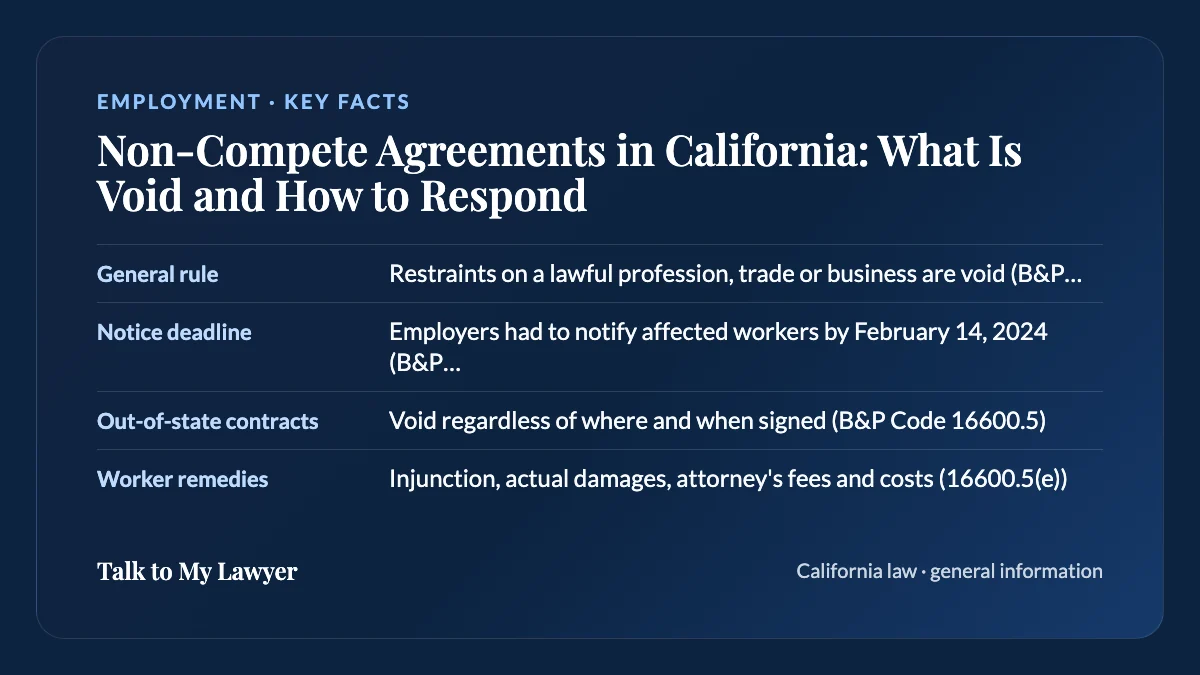
- General rule
- Restraints on a lawful profession, trade or business are void (B&P Code 16600)
- Notice deadline
- Employers had to notify affected workers by February 14, 2024 (B&P Code 16600.1)
- Out-of-state contracts
- Void regardless of where and when signed (B&P Code 16600.5)
- Worker remedies
- Injunction, actual damages, attorney's fees and costs (16600.5(e))
- Main exceptions
- Sale of a business, partnership or LLC exit (16601 to 16602.5)
- Federal FTC rule
- Not in effect and not enforceable, as of October 2026
Is a non-compete agreement enforceable in California?
Generally, no. Business and Professions Code section 16600 says that, except as the chapter provides, every contract by which anyone is restrained from engaging in a lawful profession, trade or business of any kind is "to that extent void."
Language that took effect on January 1, 2024 (AB 1076) tells courts to read the section broadly, following the California Supreme Court's decision in Edwards v. Arthur Andersen LLP (2008). The statute now voids any non-compete agreement in an employment context, or non-compete clause in an employment contract, however narrowly it is drawn, unless it fits an exception in the chapter.
Courts in some states ask whether a non-compete is reasonable in time and distance. For employment non-competes, California's statute rules that test out. A one-year, ten-mile clause gets the same treatment as a five-year, statewide one.
Section 16600 also reaches contracts where the restrained person is not a party (section 16600(c)), and its text applies to "anyone", not only employees.
What changed in California non-compete law in 2024?
Two bills that took effect on January 1, 2024, AB 1076 and SB 699, added duties for employers and gave workers a right to sue when an employer uses a void clause.
| Rule | What the statute says | Source |
|---|---|---|
| No void clauses | Unlawful to include a non-compete in an employment contract, or require one, unless an exception applies | B&P Code 16600.1(a) (AB 1076) |
| Notice to workers | For current employees, and former employees employed after January 1, 2022, the employer had to send an individualized written notice that the clause is void by February 14, 2024, to the last known mailing address and email | B&P Code 16600.1(b) |
| Unfair competition | A violation of 16600.1 is an act of unfair competition under section 17200 | B&P Code 16600.1(c) |
| Signed elsewhere | A void contract is unenforceable regardless of where and when it was signed, and an employer may not try to enforce it even if the job was outside California | B&P Code 16600.5(a), (b) (SB 699) |
| Private lawsuit | An employee, former employee or prospective employee may sue for an injunction, actual damages or both, and a prevailing worker recovers reasonable attorney's fees and costs | B&P Code 16600.5(e) |
If you were employed after January 1, 2022, never received a notice by February 14, 2024, and your contract still contains a non-compete, that is a fact you can raise in a letter.
When can a California non-compete still be valid?
The exceptions are tied to selling or leaving an ownership stake, and the restriction must stay within the area where the business operated.
- Sale of a business (16601): a person who sells the goodwill of a business, an owner who sells all of their ownership interest in a business entity, or an owner of a business entity that sells all or substantially all of its operating assets together with goodwill, may agree with the buyer not to carry on a similar business in a specified geographic area where the business was carried on, as long as the buyer carries on a like business there.
- Partnership dissolution or dissociation (16602): a partner may agree not to compete in a specified area where the partnership did business.
- LLC dissolution or exit (16602.5): a member may agree to the same kind of restriction when the company dissolves or the member's interest ends.
Job titles do not create an exception. Being a senior executive, a top salesperson or a highly paid engineer does not, by itself, make an employment non-compete valid in California.
Contracts can also try to move disputes elsewhere. Labor Code section 925 says an employer cannot require an employee who primarily resides and works in California, as a condition of employment, to resolve a California claim outside the state (in court or in arbitration) or to give up the protection of California law. Such a clause is voidable by the employee, unless the employee was individually represented by a lawyer in negotiating the forum or choice-of-law terms. Section 925 covers contracts entered into, modified or extended on or after January 1, 2017.
What can an employer still protect?
Trade secrets. California's Uniform Trade Secrets Act (Civil Code section 3426 and following) protects information that has economic value because it is not generally known and that the owner takes reasonable steps to keep secret (Civil Code section 3426.1(d)).
The distinction is between working and taking. Joining a competitor is protected by section 16600. Downloading a confidential customer database, pricing models or source code on your way out is a different question, and a court can enjoin actual or threatened misappropriation (Civil Code section 3426.2).
Customer non-solicitation clauses sit in the middle. A clause that stops you from doing business with former clients restrains your trade, so section 16600 applies to it. Whether a particular clause survives, and whether your conduct involves trade secrets, depends on the wording and the facts, so this is a point to raise with a lawyer.
- Return company devices, files and passwords, and keep a record that you did.
- Do not keep copies of customer lists, pricing or internal documents on personal accounts.
- Note what you know from general skill and experience versus what came from confidential files.
What to do if your former employer sends a non-compete cease and desist
Read it closely before you reply, and answer in writing without admitting facts you have not checked. A warning letter is a demand, not a court order. Our guide on what a cease and desist letter means explains the difference.
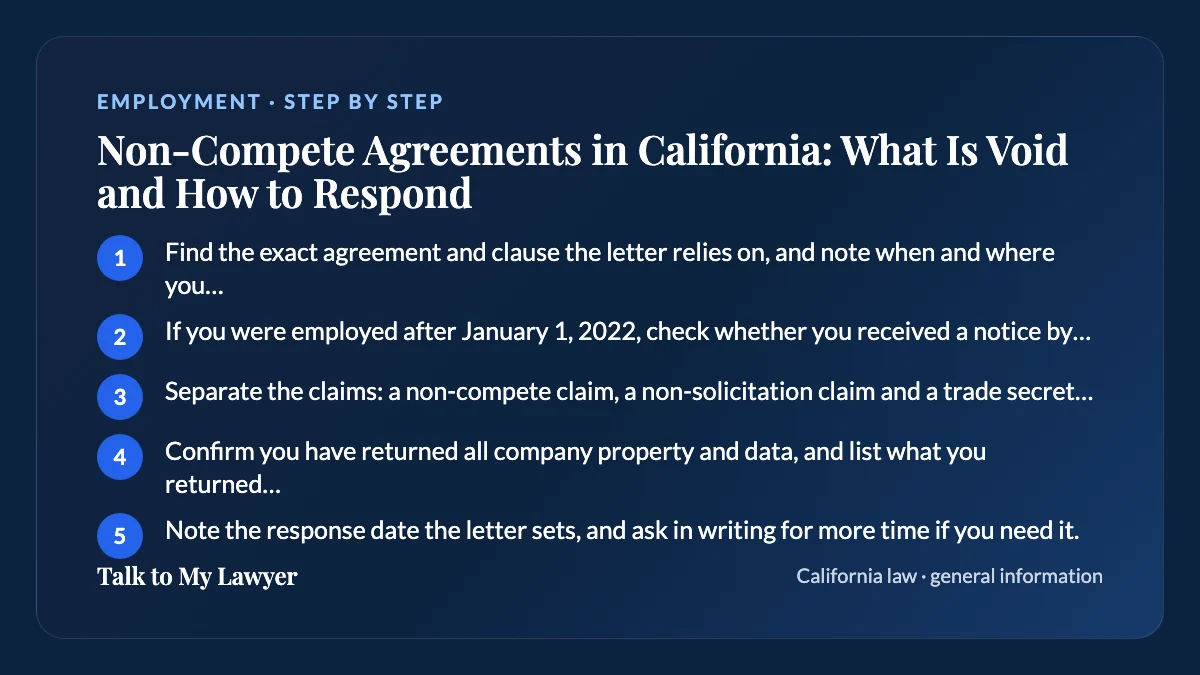
- Find the exact agreement and clause the letter relies on, and note when and where you signed it.
- If you were employed after January 1, 2022, check whether you received a notice by February 14, 2024 that the clause was void.
- Separate the claims: a non-compete claim, a non-solicitation claim and a trade secret claim are analysed differently.
- Confirm you have returned all company property and data, and list what you returned and when.
- Note the response date the letter sets, and ask in writing for more time if you need it.
- If the letter was also sent to your new employer, keep them informed.
If the letter threatens a lawsuit, our guide on how to respond to a demand letter covers deadlines and tone in more detail.
What a letter to your employer about a non-compete can say
A letter from the worker's side usually asks the employer to confirm in writing that it will not enforce the clause, to withdraw any demand made to a new employer, and to stop contacting customers or colleagues about it.
Section 7 of my March 2021 employment agreement restricts me from working for a competitor for 12 months. Under California Business and Professions Code sections 16600 and 16600.5, that clause is void and may not be enforced, wherever it was signed. I did not receive the notice required by section 16600.1. I have returned all company property and retained no confidential information. Please confirm in writing by November 14 that the company will not seek to enforce section 7 and that it has withdrawn its October 30 letter to my new employer.
Example (hypothetical): in 2022, a sales manager living and working in Sacramento signed a two-year non-compete with a Texas choice-of-law clause as a condition of the job. After she joins a rival, her former employer writes to her new company. Her letter can point to section 16600.5(b), which bars enforcement regardless of where the contract was signed or the employment was maintained, and to Labor Code section 925, which lets a California employee void an out-of-state law clause imposed as a condition of employment.
The letter can also note, in neutral terms, that section 16600.5(e) gives a prevailing worker a claim for actual damages and attorney's fees. Stated as the law, it is information, not a threat.
Did the federal FTC non-compete ban take effect?
No. As of October 2026, the Federal Trade Commission's website states that its Noncompete Rule is not in effect and is not enforceable.
A federal district court stopped enforcement on August 20, 2024. The FTC appealed on October 18, 2024, took steps to dismiss that appeal on September 5, 2025, and published a Federal Register notice dated February 12, 2026 removing the Non-Compete Rule. For California workers, state law under section 16600 remains the main source of protection.
When an attorney-written non-compete letter makes sense
A former employer's reminder about a plain employment non-compete is something you may choose to answer yourself, with a short letter citing section 16600. An attorney's letter is worth considering when the employer has contacted your new company, when trade secret or customer claims are mixed in, when the contract points to another state's law or courts, or when you want to preserve a claim under section 16600.5.
With Talk to My Lawyer, a licensed California attorney writes your letter from your agreement, the employer's correspondence and your timeline, and sends it on your behalf. For advice on a lawsuit or on whether a specific clause falls within an exception, talk to a lawyer about your facts.
Frequently asked questions
Can my employer sue me for breaking a non-compete in California?
An employer can file a lawsuit, but section 16600 makes an employment non-compete void unless a statutory exception applies, and section 16600.5 bars an employer from trying to enforce a void contract. A lawsuit may instead focus on trade secrets or other conduct, such as taking confidential files, which California law still protects. A lawyer can tell you which claims fit your facts.
Is a non-compete signed in another state valid if I now work in California?
Section 16600.5 says a contract that is void under California's chapter is unenforceable regardless of where and when it was signed, and an employer may not attempt to enforce it even if the contract was signed and the job was held outside California. Labor Code section 925 separately limits out-of-state law and forum clauses for employees who primarily live and work in California.
What if I never got the February 2024 non-compete notice?
Section 16600.1 required employers to send current employees, and former employees employed after January 1, 2022, an individualized written notice by February 14, 2024 that a void non-compete was void. The statute treats a violation as unfair competition under section 17200. A missing notice does not make the clause valid. It is a fact you can raise in a letter, alongside sections 16600 and 16600.5.
Are customer non-solicitation clauses enforceable in California?
A clause that stops you from doing business with former customers restrains your trade, so it is measured against section 16600, which the Legislature says must be read broadly. Separately, using a former employer's confidential customer list can be trade secret misappropriation under Civil Code section 3426.1. Because the outcome turns on the clause's wording and your conduct, get advice on your specific agreement.
Does selling my business let the buyer stop me from competing?
Yes, within limits. Section 16601 allows a seller of a business's goodwill, or an owner selling all of their ownership interest, to agree not to carry on a similar business in a specified area where the business operated, as long as the buyer carries on a like business there. Partners and LLC members have similar exceptions in sections 16602 and 16602.5.
Sources
Checked against these official sources on October 17, 2026.
- California Business and Professions Code section 16600 (California Legislative Information)
- Business and Professions Code, Division 7, Part 2, Chapter 1: Contracts in Restraint of Trade (sections 16600 to 16608) (California Legislative Information)
- California Labor Code section 925 (California Legislative Information)
- California Civil Code, Uniform Trade Secrets Act (sections 3426 to 3426.11) (California Legislative Information)
- Noncompete Rule (Federal Trade Commission)
This guide explains California law in general terms as of October 2026. It is general information, not legal advice for your situation, and local rules can add to it.
Join the email list and get a lawyer letter started
With Talk to My Lawyer, a licensed California attorney writes your letter from your facts and documents and sends it on your behalf. Join the Talk to My Lawyer email list for letter checklists, document prompts, and reminders before you start your letter.