Quick answer
To respond to a demand letter, read it closely, note any deadline, keep every related document, and check whether an insurance policy may cover the claim. Then decide whether to pay, negotiate, dispute or decline, and answer in writing. In California, settlement offers and statements made while negotiating are generally not admissible to prove liability (Evidence Code sections 1152 and 1154).
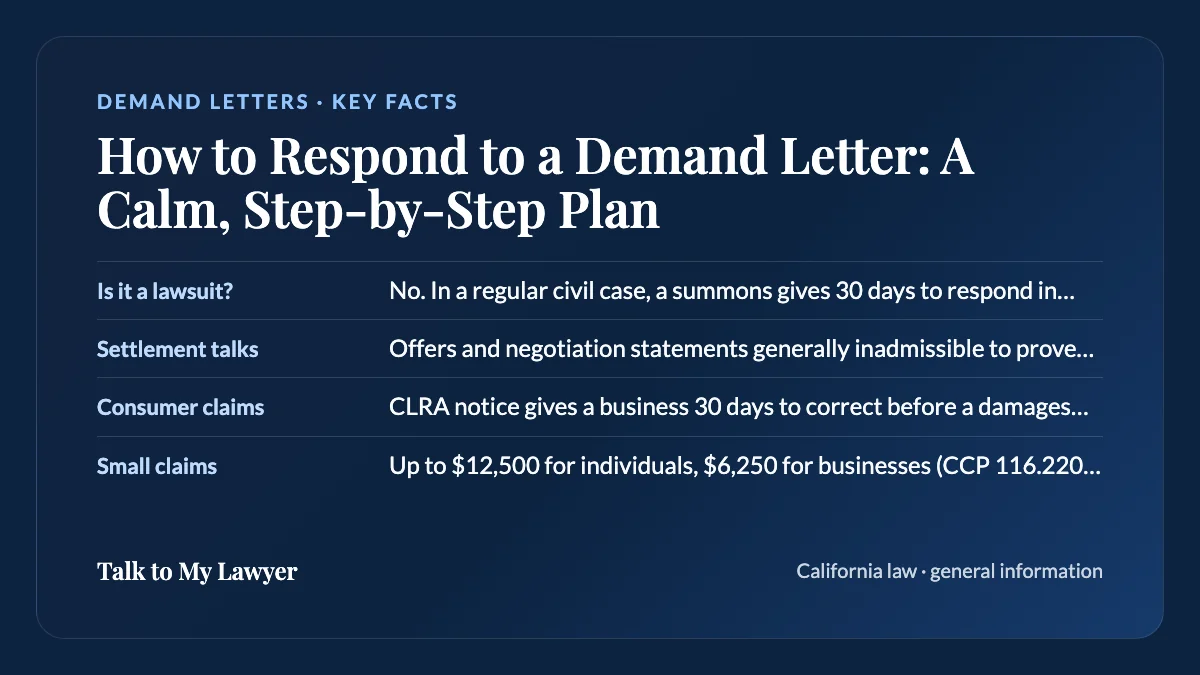
At a glance
- Is it a lawsuit?
- No. In a regular civil case, a summons gives 30 days to respond in writing (CCP 412.20)
- Settlement talks
- Offers and negotiation statements generally inadmissible to prove liability (Evid. Code 1152)
- Consumer claims
- CLRA notice gives a business 30 days to correct before a damages suit (Civ. Code 1782)
- Small claims
- Up to $12,500 for individuals, $6,250 for businesses (CCP 116.220, 116.221)
- Insurance
- Check homeowner, renter, auto and business policies for notice conditions
What should you do first when you receive a demand letter?
Read the whole letter once without replying, then write down three things: who sent it, what they say you owe or must do, and the date they want an answer by. Those three facts decide everything that follows.
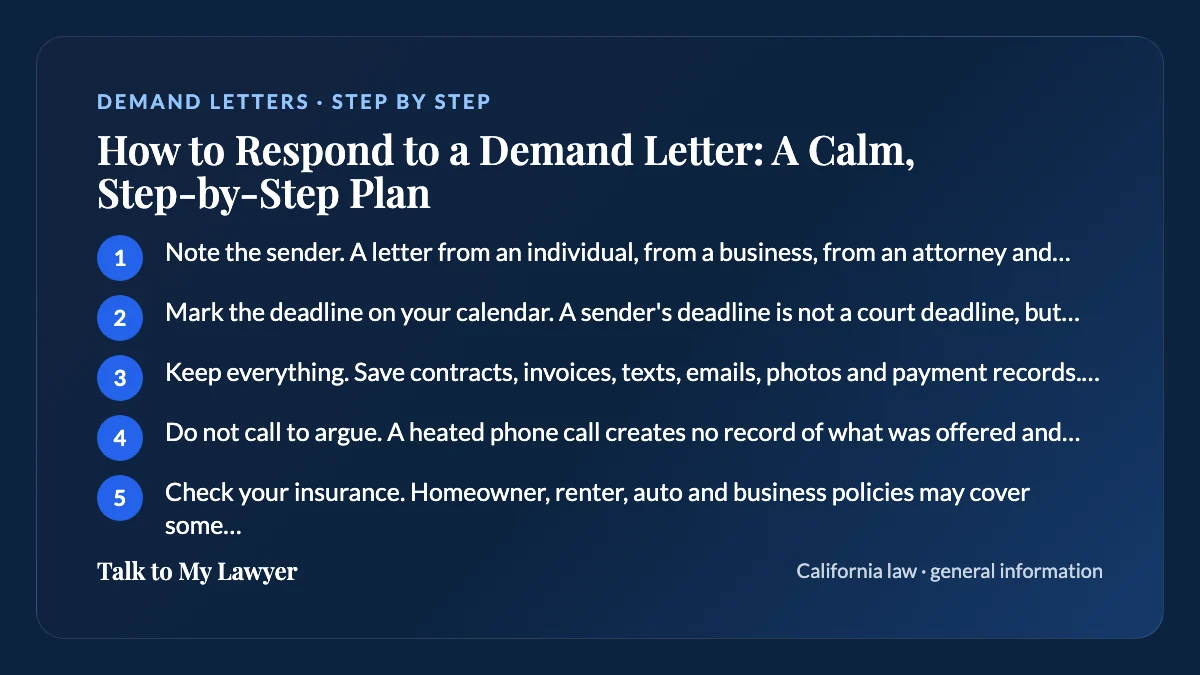
- Note the sender. A letter from an individual, from a business, from an attorney and from a debt collector each call for slightly different handling.
- Mark the deadline on your calendar. A sender's deadline is not a court deadline, but missing it can lead the sender to file.
- Keep everything. Save contracts, invoices, texts, emails, photos and payment records. Turn off any auto-delete settings on messages that touch the dispute.
- Do not call to argue. A heated phone call creates no record of what was offered and can produce statements you later regret.
- Check your insurance. Homeowner, renter, auto and business policies may cover some claims, as explained below.
- Decide on a response date. Even a short note saying you are reviewing the letter and will reply by a set date keeps the conversation in writing.
If the letter comes from a collection agency, federal and state debt collection laws give you extra rights. Our guide on how to respond to a collection letter covers those.
Is a demand letter the same as being sued?
No. A demand letter is a private request. A regular civil lawsuit starts when a complaint is filed with a court and you are served with a summons, which directs you to file a written response within 30 days after service (Code of Civil Procedure section 412.20). Some cases run on other clocks: an eviction summons allows 10 court days (section 1167), and a small claims case gives you a trial date rather than a written-response deadline. Once you are served, the court's timeline controls, whatever any letter says.
Some letters still carry legal weight. In a few situations, a written demand is a step the sender takes before suing, or one that sets up extra damages or special rules:
| Type of letter | Why it matters | Rule |
|---|---|---|
| Consumer complaint naming the CLRA | A business that corrects the problem within 30 days of receiving the notice can avoid an individual damages suit under the act | Civil Code 1782 |
| Bounced check demand by certified mail | Unpaid after 30 days, the writer can owe the check plus damages of three times its amount, from $100 to $1,500 | Civil Code 1719 |
| Request to pay before small claims | The courts' self-help guide tells plaintiffs to ask for the money before filing | California Courts self-help guide |
| Pre-lawsuit offer within insurance limits | Formal time-limited demands have their own rules under auto, homeowner and premises policies | CCP 999 to 999.5 |
For a sense of how senders choose their deadlines, see how long a demand letter deadline should be.
Could your insurance cover the claim?
Possibly, so check before you reply. Claims about injuries at your home, a car accident, damage you caused to someone's property or, for a business, an injured customer can fall within liability coverage. Sending the claim to your insurer and asking it to respond is called tendering the claim.
- Find every policy that might apply: homeowner or renter, auto, umbrella, commercial general liability and professional liability.
- Read each policy's conditions for any requirement to give prompt notice of a claim and any limit on payments or promises you make without the insurer's consent.
- Send the insurer a copy of the demand letter in writing and keep proof of when you sent it.
- Ask for a claim number and the name of the adjuster, and tell the sender who is handling the claim.
A demand about unpaid invoices or a broken contract may fall outside liability coverage, but the policy language decides that, not the label on the letter.
How do you decide whether the demand is valid?
Test the letter against your own records, line by line. A useful working file answers these questions:
- Does the sender have the facts right: dates, amounts, what was promised and what was delivered?
- Does a contract or invoice support the amount, including any interest, late fees or attorney fee clause?
- Do you have your own claim against the sender, such as defective work, overbilling or an unpaid refund?
- Is the claim old? Lawsuits have filing deadlines, and a claim past its deadline may be defensible on that ground alone.
- Is part of the claim fair even if the total is not?
Example (hypothetical): a homeowner receives a $4,800 demand from a painter for the balance of a job. She has photos showing two rooms were never finished and a text from the painter promising to return. Her records point to a partial dispute: she owes something, but not the full balance. That conclusion shapes a response offering a specific lower amount with the photos attached.
What are your options for responding?
You have four realistic choices, and each has trade-offs you should weigh against your facts.
| Option | When it fits | What to watch |
|---|---|---|
| Pay in full | The claim is correct and the amount is right | Get a written release or receipt stating the matter is resolved |
| Negotiate | Part of the claim is valid, or you need a payment plan | Put any agreement in writing before paying |
| Dispute | Your records contradict the claim | Explain the key facts calmly and attach proof; keep it short |
| Do not respond | You are confident the claim has no basis | The sender may file suit or a small claims case; silence gives up the chance to correct the record early |
If you pay anything, use a traceable method and write on the payment, or in a cover letter, what it is for. If a lawyer prepared the release, read it fully before signing, and consider having your own lawyer look at it.
Can your settlement offer be used against you?
Generally not to prove liability. California Evidence Code section 1152 makes an offer to compromise, and statements made while negotiating it, inadmissible to prove that you are liable for the loss. Section 1154 gives the same protection to the other side: their offer to accept less cannot be used to prove their claim is invalid.
The protection has limits. Section 1152 does not cover partial payment of a claim without disputing it, and a debtor's payment or promise to pay a preexisting debt can be used to show a new or revived duty to pay. Statements made outside settlement negotiations, such as an earlier text admitting a mistake, are not covered by section 1152. Labeling a letter as a settlement communication signals your intent, but the statute, not the label, decides what is protected.
If you run a business: the CLRA 30-day correction window
A consumer who plans to sue for damages under the Consumers Legal Remedies Act must first send the business a written notice, by certified or registered mail, describing the alleged violations and demanding a fix, at least 30 days before filing (Civil Code section 1782(a)).
If the business gives, or agrees to give within a reasonable time, an appropriate correction, repair, replacement or other remedy within 30 days after receiving the notice, the consumer cannot maintain an individual damages action under the act (section 1782(b)). Class actions follow separate conditions in section 1782(c), and a claim for injunctive relief can be filed without the notice.
Section 1782(e) adds a useful protection: attempts to comply are treated as an offer to compromise under Evidence Code section 1152, and are not an admission that the business broke the law. Count the 30 days from the date the notice arrived.
What to say, and not say, in your written response
Keep the reply to one page where you can. State your position, the facts that support it and what you propose. Leave out insults, guesses about the sender's motives and threats of your own.
I received your letter dated March 3 regarding the painting work at 18 Cedar Lane. I agree that a balance is owed for the exterior work, which was completed. The two interior rooms listed in our contract were not finished, as shown in the enclosed photos dated February 11. I am prepared to pay $2,900 as full settlement of this matter, upon a signed release from you. This offer is made for settlement purposes under California Evidence Code section 1152.
- Do confirm the deadline you are working to, or propose a new one.
- Do attach the key documents rather than describing them.
- Do not admit facts you have not checked against your records.
- Do not promise payment you cannot make on time.
When an attorney-written response makes sense
If the amount is modest and your records answer the claim point by point, a short reply in your own words may be all the situation needs. An attorney-written response is worth considering when the demand comes from a lawyer, cites statutes you are unsure about, involves a large amount or a consumer law notice, or when you want your settlement offer framed so it stays protected.
Through Talk to My Lawyer, a licensed California attorney writes your response letter from the demand you received and your own documents, sets out your position and any offer, and sends it on your behalf. To decide whether to pay, fight or settle, talk to a lawyer about your facts.
Frequently asked questions
What happens if I ignore a demand letter?
Nothing happens automatically, because a demand letter is not a court order. The sender may then file a lawsuit or a small claims case, and some statutes, such as California's bounced check law, attach extra damages when a proper written demand goes unanswered. If you are later served with a summons in a regular civil case, you generally have 30 days to file a written response; eviction and small claims cases run on different timelines.
Do I have to respond to a demand letter by the deadline in it?
No law requires you to meet a deadline set by the sender. The date is the sender's choice and signals when they may take the next step. Answering in writing before it passes, even to say you need more time, keeps a clear record of your position and shows you took the letter seriously.
Should I call the person who sent the demand letter?
A written reply creates a record of exactly what you said and offered. Phone calls can lead to misunderstandings about what was agreed. If you do talk, follow up the same day with an email or letter summarizing the conversation and any terms discussed.
Can I negotiate a lower amount after getting a demand letter?
Yes. You can propose a lower figure, a payment plan or a different remedy. In California, an offer to compromise and statements made while negotiating are generally inadmissible to prove liability under Evidence Code section 1152. Put any final agreement in writing and get a release before you pay the agreed amount.
Can a demand letter from a lawyer be ignored?
No law requires you to answer it, but a letter on law firm letterhead shows the sender already has a lawyer involved. Read it for any statute it cites, check your insurance, and decide on a response before the date given. If the claim is significant or you do not understand the legal points raised, talk to a lawyer about your facts.
Sources
Checked against these official sources on October 17, 2026.
- California Evidence Code section 1152 (California Legislative Information)
- California Evidence Code section 1154 (California Legislative Information)
- California Civil Code section 1782 (California Legislative Information)
- California Code of Civil Procedure section 412.20 (California Legislative Information)
- Ask for the money (California Courts Self-Help Guide)
- Small claims in California (California Courts Self-Help Guide)
This guide explains California law in general terms as of October 2026. It is general information, not legal advice for your situation, and local rules can add to it.
Join the email list and get a lawyer letter started
With Talk to My Lawyer, a licensed California attorney writes your letter from your facts and documents and sends it on your behalf. Join the Talk to My Lawyer email list for letter checklists, document prompts, and reminders before you start your letter.