Quick answer
If a company is using your photo without permission in California to advertise or sell something, Civil Code section 3344 makes it liable for the greater of $750 or your actual damages, plus profits from the use, and possibly punitive damages and attorney's fees. News, public affairs, sports and political campaign uses are exempt. A cease and desist letter can demand removal, an accounting of the use and compensation.
At a glance
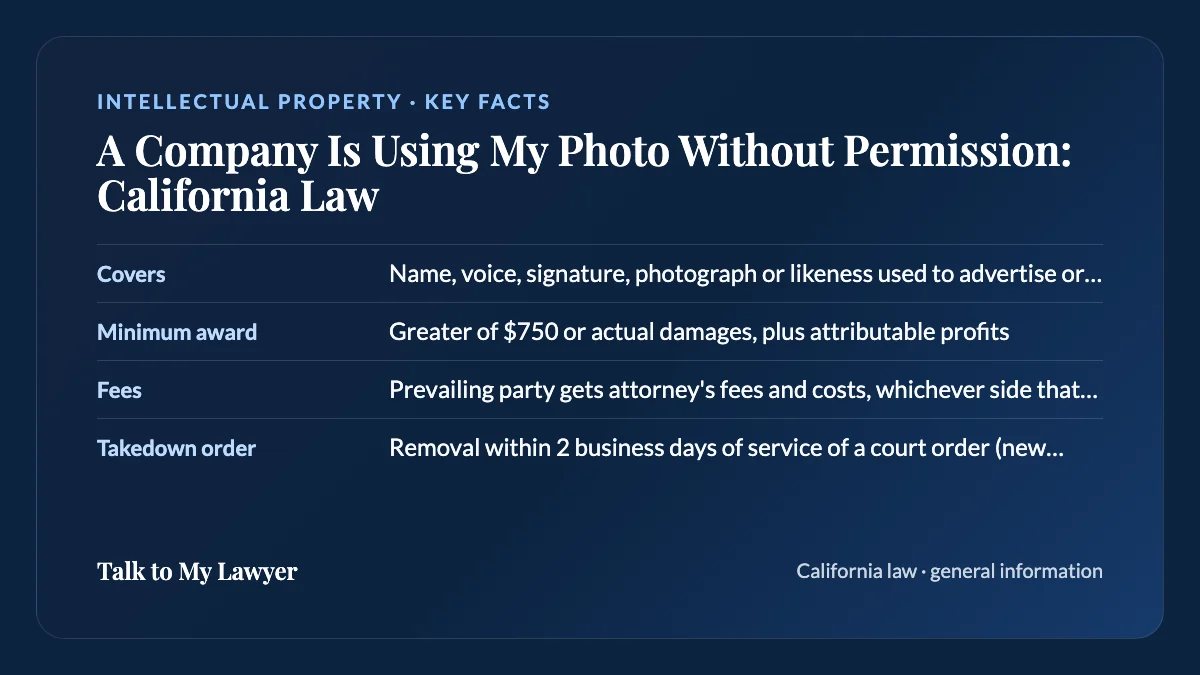
- Covers
- Name, voice, signature, photograph or likeness used to advertise or sell (Civil Code 3344(a))
- Minimum award
- Greater of $750 or actual damages, plus attributable profits
- Fees
- Prevailing party gets attorney's fees and costs, whichever side that is
- Takedown order
- Removal within 2 business days of service of a court order (new 3344(a)(2), from January 1, 2026)
- After death
- Rights last 70 years after death (Civil Code 3344.1(g))
Can a company use your photo without permission in California?
Not to sell things. Civil Code section 3344(a) makes a person or business liable for knowingly using another person's name, voice, signature, photograph or likeness on products, or to advertise, sell or solicit purchases, without that person's prior consent. For a minor, the consent must come from a parent or legal guardian.
Three features of the statute shape a claim:
- Readily identifiable. A photograph counts when someone looking at it with the naked eye can reasonably tell it is you (section 3344(b)(1)). Still images, video and live broadcasts are all included.
- Commercial purpose. The use has to be on goods or for advertising or selling. A blog post about you is different from an ad that uses your face.
- Knowing use. The statute applies to a business that knowingly uses your identity, so evidence of what it knew about the image and its source matters.
California courts also recognize a common law claim for misappropriation of identity, and section 3344(g) says the statute's remedies are in addition to any others the law provides.
What can you recover under Civil Code 3344?
The statute sets a floor and adds to it. The business is liable for the greater of $750 or your actual damages, plus any profits from the use that were not already counted in your damages.
| Remedy | What the statute says |
|---|---|
| Statutory minimum | $750, or actual damages if greater |
| Profits | You prove only the gross revenue tied to the use; the business must prove its deductible expenses |
| Punitive damages | May be awarded |
| Attorney's fees and costs | Awarded to the prevailing party, which cuts both ways if a claim fails |
| Court-ordered removal | An injunction or temporary restraining order under CCP 527; once served, the business must remove or stop distributing the content within two business days unless the order says otherwise |
When is consent not required?
Before you write, check whether the use falls into one of the statute's exceptions. A letter that ignores an obvious exception loses credibility quickly.
| Situation | Rule in section 3344 |
|---|---|
| News, public affairs or sports coverage, or a political campaign | No consent required (subdivision (d)) |
| Paid ads appear next to an article or video about you | Not automatically a violation; whether the use is tied to the advertising is a question of fact (subdivision (e)) |
| You appear as part of a crowd, team or audience | You must be singled out as an individual, not shown only as a member of a definable group (subdivision (b)(2) and (3)) |
| An employer's ad where an employee appears only incidentally | A rebuttable presumption that the use was not knowing (subdivision (c)) |
| The newspaper, billboard company or TV station that ran the ad | Not liable unless it knew of the unauthorized use (subdivision (f)) |
Then look for consent you may have given. Model releases, event registration forms, salon or gym photo waivers, and contest or review terms sometimes grant permission to use your image. Read the exact words before sending a demand.
Who took the photo matters too
The right of publicity protects your identity. Copyright protects the photo itself, and it generally belongs to the person who took it. If you shot the selfie the business lifted from your Instagram, you may have a copyright claim as well as a section 3344 claim.
If a professional photographer took it, the photographer holds the copyright, and the business may even have licensed it legally from the photographer. That license covers the photo, not your face in an ad. Our guides on photo use demand letters and copyright infringement cease and desist letters cover the copyright side.
What about computer-generated replicas of your face or voice?
California passed two digital replica laws that took effect January 1, 2025. Both define a digital replica as a computer-generated, highly realistic representation that is readily identifiable as a person's voice or visual likeness.
- Contracts (AB 2602, Labor Code section 927). A clause in a contract for personal or professional services that lets a company create a digital replica to replace work you would have performed in person is unenforceable for new performances fixed on or after January 1, 2025, if it lacks a reasonably specific description of intended uses and you were not represented by a lawyer or a union, as the statute details.
- Deceased people (AB 1836, Civil Code section 3344.1). Producing or distributing a digital replica of a deceased personality in an expressive audiovisual work or sound recording without consent from the rights holders brings liability for the greater of $10,000 or actual damages, with exceptions for news, commentary, parody, documentary and fleeting uses.
For a living person, section 3344 already covers use of your voice or likeness "in any manner" to advertise or sell. Whether a particular replica in a particular ad qualifies is a question to raise with a lawyer.
Steps before you send a likeness cease and desist
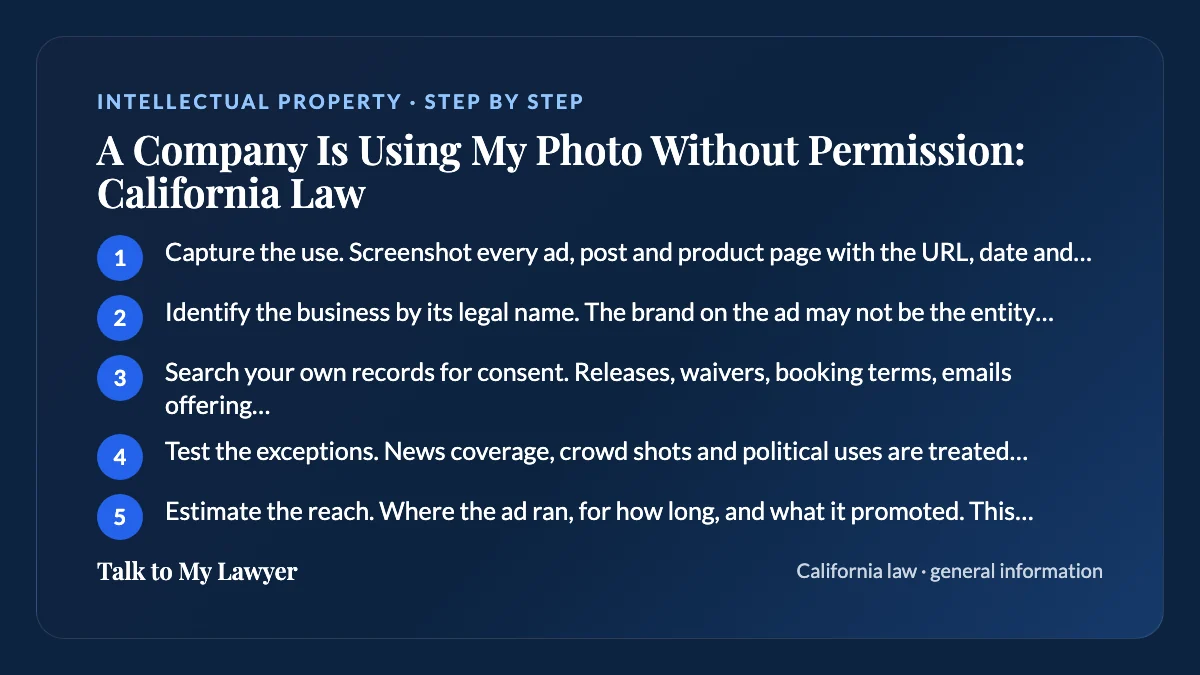
- Capture the use. Screenshot every ad, post and product page with the URL, date and time visible. Save video ads as files, and note each date you saw the ad running.
- Identify the business by its legal name. The brand on the ad may not be the entity that owns it. Our legal name lookup guide shows how to confirm the owner.
- Search your own records for consent. Releases, waivers, booking terms, emails offering a discount for photos.
- Test the exceptions. News coverage, crowd shots and political uses are treated differently.
- Estimate the reach. Where the ad ran, for how long, and what it promoted. This supports a request for an accounting of revenue.
- Write the demand. Ask for removal by a date, confirmation of every place the image was used, preservation of records, and compensation.
Since at least August 4, your company has used my photograph in paid social media advertisements for laser treatments, including the ad captured in the enclosed screenshots. I never consented to this use. California Civil Code section 3344 prohibits the knowing use of a person's photograph or likeness for advertising without prior consent. Please remove every use of my image by October 31, confirm in writing each place it appeared and the dates, preserve all records of the campaign, and contact me to discuss compensation.
Example: how the numbers could be framed
Example (hypothetical): a Sacramento fitness studio uses a former member's workout photo in an ad campaign for new memberships that runs for eight weeks. The studio's records later show $18,000 in sign-ups through the ad's tracking link, and the member has no evidence of other financial harm.
- The statutory floor is $750, since actual damages are hard to show.
- The profits remedy lets the member point to the $18,000 in gross revenue tied to the ad. The studio would then have to prove its deductible costs.
- A letter can ask for an accounting, so the member is not guessing at revenue.
- What a court would award, if anything, depends on the evidence. The letter states the statute's measures without promising a figure.
When your face is already in someone's ad campaign
A likeness demand may need to cover removal, an accounting of revenue, preservation of ad records and payment at once, and the fee-shifting rule means an overreaching claim carries its own risk. Those are reasons some people prefer that a lawyer write it, especially when the business is large, the ad ran across several platforms, or a minor's image is involved.
Through Talk to My Lawyer, a licensed California attorney writes your letter from your facts and documents, including your screenshots, any releases and the business's legal name, and sends it on your behalf. For advice on a lawsuit or a takedown order, talk to a lawyer about your facts.
Frequently asked questions
How much can I sue for if a company used my picture without permission?
Under Civil Code section 3344, the business is liable for the greater of $750 or your actual damages, plus profits from the ad that your damages figure does not already include. Punitive damages may also be awarded, and the prevailing party gets attorney's fees and costs. What a court actually awards depends on the evidence, such as how long the ad ran and what revenue it brought in.
Can a business post my photo on social media without permission?
It depends on the purpose. Section 3344 targets use of your photo on products or to advertise or sell without consent. A business that posts a photo of you in an ad or promotional post may be liable. News coverage and incidental crowd shots are treated differently. Separately, if you took the photo, posting it without a license may raise copyright issues.
Does the right of publicity apply to people who are not famous?
Yes. Section 3344 protects any person whose name, voice, signature, photograph or likeness is knowingly used to advertise or sell without consent. Celebrity is not a requirement. The $750 minimum applies even when your image had no established market price, so a claim does not depend on proving you were already paid for endorsements.
Is it illegal to use someone's photo in an ad if it was taken in public?
Taking a photo in public and using it to sell something are separate questions. California's statute focuses on the commercial use and the lack of consent, not on where the photo was taken. It does exempt people shown only as part of a crowd, such as spectators at a game, unless they are singled out as individuals. News and public affairs uses are also exempt.
What changed in California's likeness law in 2026?
As of October 2026, section 3344 includes a provision from SB 683, effective January 1, 2026, that lets a person seek an injunction or temporary restraining order. If a court orders the business to remove or stop distributing the content, the business must do so within two business days after the order is served, unless the order sets a different time.
Sources
Checked against these official sources on October 18, 2026.
- California Civil Code section 3344 (California Legislative Information)
- California Civil Code section 3344.1 (California Legislative Information)
- California Labor Code section 927 (California Legislative Information)
This guide explains California law in general terms as of October 2026. It is general information, not legal advice for your situation, and local rules can add to it.
Join the email list and get a lawyer letter started
With Talk to My Lawyer, a licensed California attorney writes your letter from your facts and documents and sends it on your behalf. Join the Talk to My Lawyer email list for letter checklists, document prompts, and reminders before you start your letter.