Quick answer
To collect money from a customer in California, send a written demand, then use small claims or a lawsuit if it stays unpaid. If the customer is an individual who bought for personal or household use, the Rosenthal Act (Civil Code 1788 and following) covers a business collecting its own debts, so avoid threats, false statements and unauthorized fees. A business entity can claim up to $6,250 in small claims.
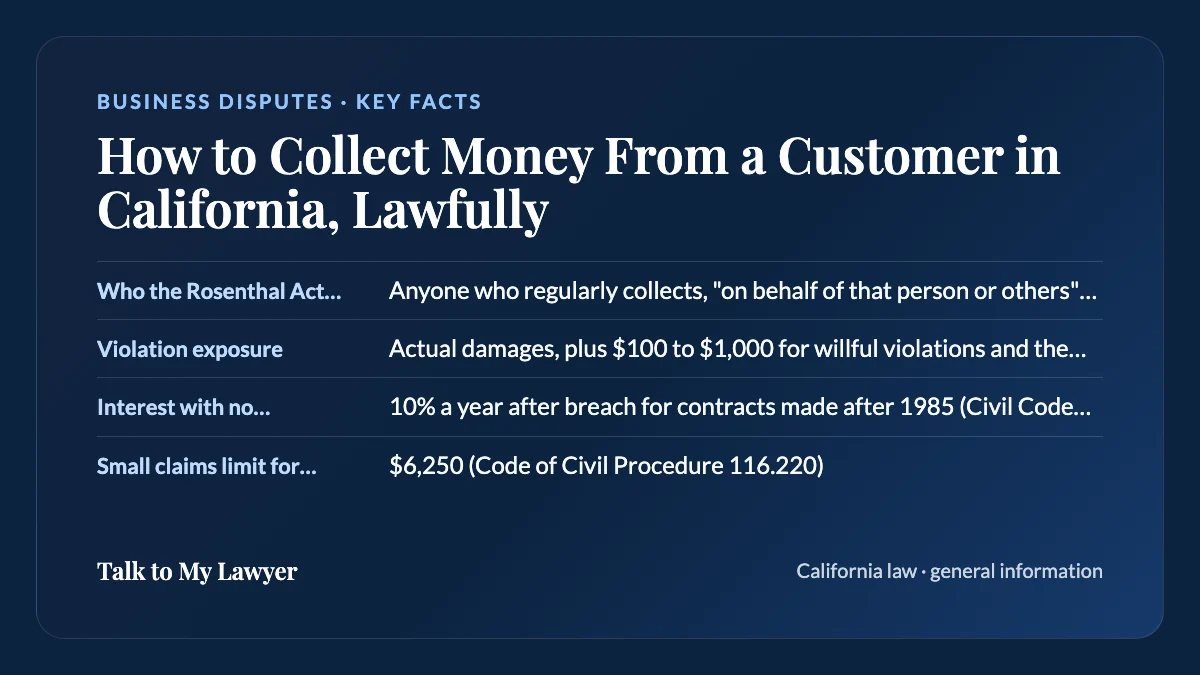
At a glance
- Who the Rosenthal Act covers
- Anyone who regularly collects, "on behalf of that person or others" (Civil Code 1788.2(c))
- Violation exposure
- Actual damages, plus $100 to $1,000 for willful violations and the debtor's attorney's fees (Civil Code 1788.30)
- Interest with no agreed rate
- 10% a year after breach for contracts made after 1985 (Civil Code 3289)
- Small claims limit for a business
- $6,250 (Code of Civil Procedure 116.220)
- Time to sue
- 4 years on a written contract or book account (CCP 337); 2 on an oral one (CCP 339); 4 for sales of goods (Com. Code 2725)
Does California collection law apply when you collect your own customer's bill?
Yes, when the customer is an individual who bought on credit for personal, family or household use. Under the Rosenthal Fair Debt Collection Practices Act, a debt collector includes any person who, in the ordinary course of business, regularly collects "on behalf of that person or others" (Civil Code section 1788.2(c)). Unlike the federal FDCPA, which mainly targets third-party collectors, the state law reaches the original creditor.
A consumer credit transaction is one where a natural person acquires property, services or money on credit, primarily for personal, family or household purposes. Billing a homeowner after you finish a repair, or letting a client pay in installments, can fit.
- Household customers: covered.
- Business customers on ordinary invoices: generally not covered. As of October 2026, the Act also reaches certain commercial debts owed by individuals to lenders, commercial financing providers and debt buyers (up to $500,000, for credit entered into, renewed, sold or assigned on or after July 1, 2025, under Civil Code section 1788.1(d)). It excludes trade credit, meaning credit a business whose main line is goods or services extends in connection with providing them.
- Collection agencies you hire: covered, and they generally need a state license.
What can't a business say or do when collecting from a consumer?
The core rule is honesty and restraint. Civil Code section 1788.17 also requires anyone collecting consumer debt to follow most of the federal FDCPA's conduct rules, though a creditor's own employees collecting in the creditor's name are exempt from the federal validation-notice requirement.
| Prohibited practice | Rule |
|---|---|
| Threatening garnishment, seizure or arrest unless that action is actually contemplated and legally permitted | Civil Code 1788.10(e) |
| Falsely saying a lawsuit has been or will be filed | Civil Code 1788.13(j) |
| Falsely saying attorney's fees, service fees or other charges can be added | Civil Code 1788.13(e) |
| Falsely saying the debt has been or will be reported to a credit bureau | Civil Code 1788.13(f) |
| Contacting the customer's employer except in narrow cases, or telling most family members about the debt | Civil Code 1788.12(a) and (b) |
| Calling repeatedly to annoy, or so often it becomes harassment | Civil Code 1788.11(d) and (e) |
| Writing on a lawyer's letterhead unless a lawyer actually sent or authorized it | Civil Code 1788.13(c) |
Exposure includes the customer's actual damages, an added penalty between $100 and $1,000 when a violation is willful and knowing, and the customer's attorney's fees if the customer prevails (Civil Code section 1788.30). A collector avoids liability for a curable violation if, within 15 days of discovering it or receiving written notice of it, it tells the customer and fixes it.
Can you add interest and late fees to an unpaid customer balance?
Interest, yes, within what the contract and the law allow; late fees, only with care. If your contract sets an interest rate, it keeps running after a missed payment. If the contract sets none, Civil Code section 3289(b) applies 10 percent a year from the breach for contracts made after January 1, 1986.
Flat late fees are treated as liquidated damages. In a consumer contract for goods or services bought for personal or household use, a preset damages clause is void except where fixing the real loss would be impracticable or extremely difficult, and the parties agreed on a presumed amount (Civil Code section 1671(c) and (d)). A late fee buried in fine print and set high to punish is vulnerable.
Collection costs are another line to watch. The Rosenthal Act bars collecting the collector's own fees or expenses from the debtor except as permitted by law (Civil Code section 1788.14(b)). For worked numbers, see unpaid invoice demand letters.
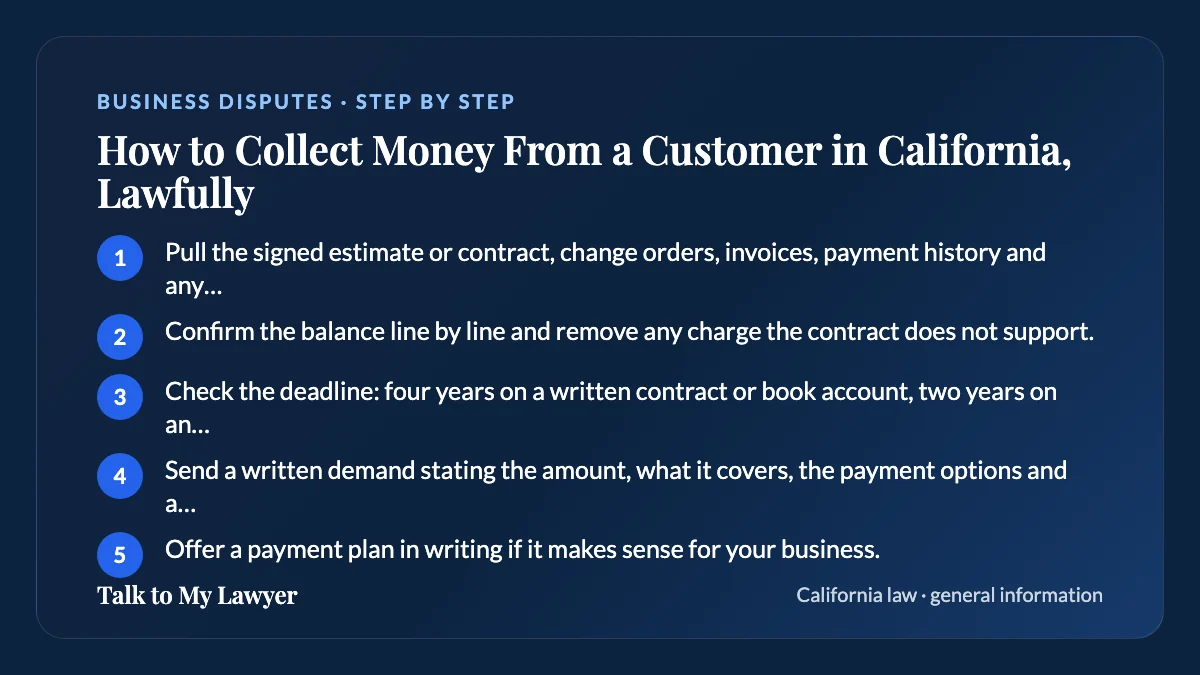
Steps to collect an unpaid customer balance
- Pull the signed estimate or contract, change orders, invoices, payment history and any messages about the work.
- Confirm the balance line by line and remove any charge the contract does not support.
- Check the deadline: four years on a written contract or book account (Code of Civil Procedure section 337), two years on an oral contract (section 339), though a sale of goods has four years under Commercial Code section 2725.
- Send a written demand stating the amount, what it covers, the payment options and a reasonable due date.
- Offer a payment plan in writing if it makes sense for your business.
- If there is no payment, decide between small claims court, a civil lawsuit or a licensed collection agency.
- Keep a log of every call, email and letter, with dates.
Our records show a balance of $2,840 for the water heater replacement completed at your home on July 18, under the signed estimate dated July 10. We have enclosed the invoice and the payment history. Please pay the balance by September 30 by check or through the payment link on the invoice. If you would like to arrange monthly payments, please call or reply by that date so we can confirm a plan in writing.
Notice what the sample leaves out: no threat of credit reporting, no talk of liens unless one is actually available and planned, and no added fees the contract does not allow.
Can a business use small claims court to collect from a customer?
Yes, up to $6,250 for a business entity (Code of Civil Procedure section 116.220). The higher $12,500 limit applies only to natural persons (section 116.221), so a sole proprietor suing in their own name may qualify for it. Claims are filed on form SC-100.
- Form SC-100 says you must ask the defendant to pay before you sue, and a dated demand letter documents that you did.
- Each filer gets only two small claims a year, statewide, for amounts over $2,500 (section 116.231).
- Lawyers cannot sit with either side in the courtroom, so someone from your business presents the case.
- Winning is a judgment, not a payment. Collecting it is a separate step.
The filing itself is covered in our small claims demand letter guide.
Example: one customer, two different rule sets
Example (hypothetical): a landscaping company is owed $3,900 by a homeowner for a backyard project and $5,200 by a property management firm for monthly maintenance.
| Question | Homeowner | Management firm |
|---|---|---|
| Rosenthal Act applies? | Yes, personal or household purpose | No, trade credit to a business |
| Late fee in contract | Tested under the stricter consumer standard of section 1671(d) | Valid unless shown unreasonable when signed (1671(b)) |
| Small claims, company as plaintiff | Within the $6,250 limit | Within the $6,250 limit |
Both fit within the limit, and together they would use up the company's two filings over $2,500 for that calendar year.
When a customer disputes the bill: an attorney-written demand
A customer who forgot needs a reminder, and your own invoice note may do. A customer who says the work was defective, owes more than small claims can award, or may be covered by the Rosenthal Act needs a letter in which every statement is accurate. That is where an attorney-written demand helps, as it does when you want to mention a mechanics lien or another remedy and need the wording right.
Through Talk to My Lawyer, a licensed California attorney writes your letter from your facts and documents (your contract, invoices and payment records) and sends it on your behalf. Licensing and litigation questions are best answered by a lawyer looking at your own business records.
Frequently asked questions
Does the Rosenthal Act apply to small businesses collecting their own invoices?
It can. The Act covers anyone who regularly collects consumer debts on its own behalf or for others. If your customer is an individual who bought services or goods on credit for personal, family or household use, your collection calls and letters must follow its rules, even though you are the original business and not a collection agency.
Can I report a customer's unpaid bill to the credit bureaus?
Only if you actually furnish data to a credit bureau and follow the reporting rules that come with it. Rosenthal bars falsely stating that a debt has been or is about to be reported. Saying you will report when you have no reporting relationship is the kind of statement that creates liability.
How long does a California business have to sue a customer for an unpaid bill?
A signed contract or a written book account generally gives you four years (Code of Civil Procedure section 337); a handshake deal for services gives you two (section 339), and a sale of goods four (Commercial Code section 2725). The period generally runs from the missed due date. A signed written acknowledgment of the debt can affect timing (Code of Civil Procedure section 360), so keep any such message and log every partial payment.
Can I charge a customer for my collection costs?
Only where the law or a valid contract term allows it. The Rosenthal Act bars collecting a collector's fees or expenses from the debtor except as permitted by law, and it bars falsely saying fees can be added. An attorney's fee clause in a signed contract may allow fees to the prevailing party in a lawsuit, but that is decided by the court.
Sources
Checked against these official sources on October 18, 2026.
- California Civil Code section 1788.2 (California Legislative Information)
- California Civil Code section 1788.30 (California Legislative Information)
- California Civil Code section 1788.13 (California Legislative Information)
- California Civil Code section 1671 (California Legislative Information)
- California Code of Civil Procedure section 116.220 (California Legislative Information)
- Debt collection licensees (California Department of Financial Protection and Innovation)
This guide explains California law in general terms as of October 2026. It is general information, not legal advice for your situation, and local rules can add to it.
Join the email list and get a lawyer letter started
With Talk to My Lawyer, a licensed California attorney writes your letter from your facts and documents and sends it on your behalf. Join the Talk to My Lawyer email list for letter checklists, document prompts, and reminders before you start your letter.