Quick answer
If a contractor is not paid in California, the main tools are a demand letter, a mechanics lien and, for subcontractors and suppliers, a stop payment notice. Liens depend on deadlines: preliminary notice within 20 days of first work where required, a lien recorded within 90 days after completion (sooner if a notice of completion is recorded), and a foreclosure lawsuit within 90 days after recording.
At a glance
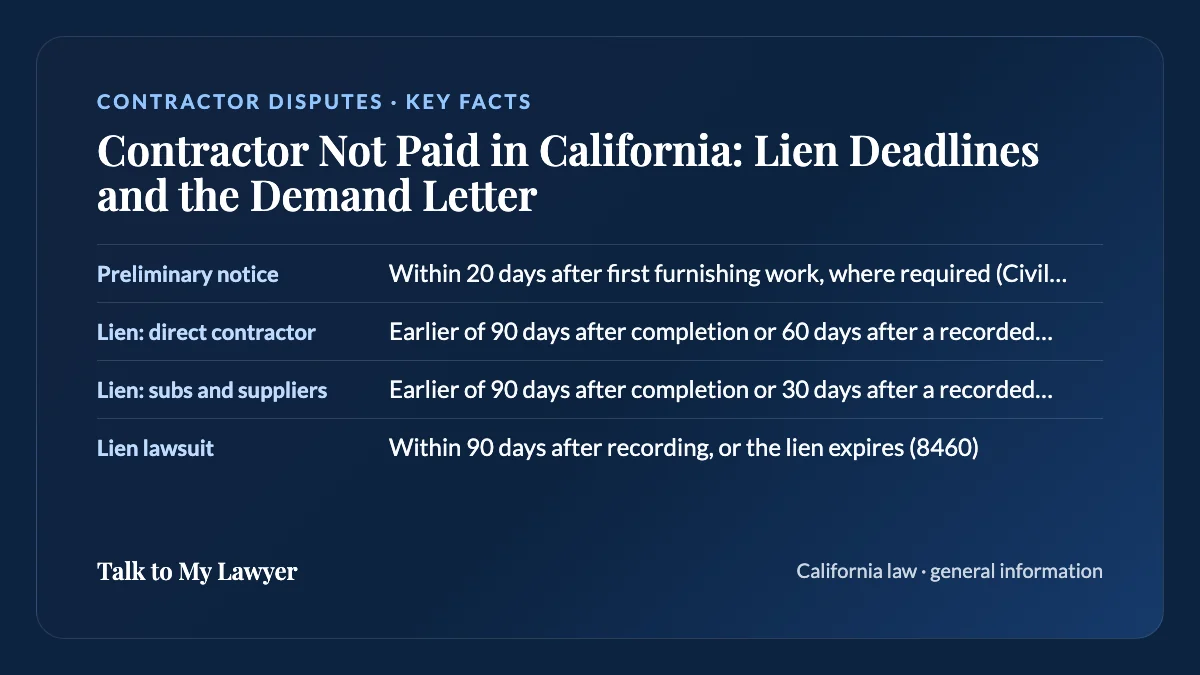
- Preliminary notice
- Within 20 days after first furnishing work, where required (Civil Code 8204)
- Lien: direct contractor
- Earlier of 90 days after completion or 60 days after a recorded notice (8412)
- Lien: subs and suppliers
- Earlier of 90 days after completion or 30 days after a recorded notice (8414)
- Lien lawsuit
- Within 90 days after recording, or the lien expires (8460)
- Late payment penalty
- 2 percent per month on amounts wrongfully withheld (8800, B&P 7108.5)
- License rule
- Must be licensed at all times during the work to sue for pay (B&P 7031)
What can a contractor do if they are not paid in California?
A contractor who is not paid in California can send a written payment demand, record a mechanics lien, give a stop payment notice in some situations, and sue for breach of contract. The lien and notice tools are strict: miss a step or a date and they can be lost.
Which tools apply depends on your position on the job:
- Direct contractor: you contracted with the owner. You can record a lien and claim prompt payment penalties against the owner.
- Subcontractor or supplier: you contracted with the general contractor or another sub. You can record a lien, give a stop payment notice and claim penalties against the contractor who paid you late.
- Laborer: you worked for wages on the project. Laborers are not required to give preliminary notice (Civil Code section 8200(e)).
This guide is for the builder's side. If you are the owner trying to get money back from a contractor, see the contractor refund demand letter guide.
Does a contractor need a license to sue for payment?
Yes. Business and Professions Code section 7031 bars anyone acting as a contractor from suing to collect pay for work that requires a license unless they were duly licensed at all times during the work, regardless of the merits of the claim.
The same section lets a person who used an unlicensed contractor sue to recover all compensation paid, and it makes a security interest taken for that work unenforceable. If licensure is disputed, the contractor must prove it with a verified certificate from the Contractors State License Board showing a license in the proper classification for the whole job.
Before any demand goes out, check your license status and classification for the full period of the job. A mid-project lapse is a problem to discuss with a lawyer first.
What are the California mechanics lien deadlines?
A mechanics lien is a claim recorded with the county recorder against the property you improved. It runs on three clocks, and a demand letter does not pause any of them.
| Step | Deadline | Civil Code |
|---|---|---|
| Preliminary notice | No later than 20 days after you first furnish work. A late notice covers only work done in the 20 days before it and afterward. | 8204 |
| Record lien (direct contractor) | After completing your contract and before the earlier of 90 days after completion of the work of improvement or 60 days after the owner records a notice of completion or cessation | 8412 |
| Record lien (everyone else) | After you stop providing work and before the earlier of 90 days after completion or 30 days after a recorded notice of completion or cessation | 8414 |
| Sue to enforce the lien | Within 90 days after the lien is recorded, or the lien expires and is unenforceable | 8460 |
"Completion" has a legal meaning. Under section 8180 it includes actual completion, owner occupation or use with labor stopped, 60 days of continuous cessation of labor, or a recorded notice of cessation after 30 days of stopped work. An owner who records a notice of completion must generally send you a copy within 10 days, or it does not shorten your deadline (section 8190). That copy rule does not apply to an owner who lives in a dwelling of four or fewer units.
What do California prompt payment laws require?
California sets payment deadlines and a 2 percent monthly penalty for money withheld without a good faith dispute.
- Owner to direct contractor (Civil Code 8800): unless otherwise agreed in writing, the owner must pay an undisputed progress payment within 30 days after a notice demanding payment under the contract. With a good faith dispute, the owner may withhold no more than 150 percent of the disputed amount. Violations carry a penalty of 2 percent per month, and the prevailing party in a collection action gets costs and a reasonable attorney's fee.
- Retention (Civil Code 8812, 8814, 8818): an owner that withholds retention must pay it to the direct contractor within 45 days after completion of the work of improvement, and a direct contractor must pass each sub's share on within 10 days after receiving it, with the same 2 percent monthly penalty.
- Contractor to subcontractor (B&P Code 7108.5): a prime contractor or sub must pay a subcontractor within seven days after receiving each progress payment, unless otherwise agreed in writing, with a 2 percent per month penalty, attorney's fees for the prevailing party and possible license discipline.
Because section 8800 runs from a notice demanding payment under the contract, a written demand that follows your contract's payment terms, and is delivered by a method the mechanics lien law's notice rules allow (Civil Code section 8100 and following), can be the step that starts that clock.
When does a stop payment notice help?
A stop payment notice tells the owner or construction lender to hold back funds to cover your claim. It reaches money that has not been paid out yet, so it is most useful while the project still has funds.
- Anyone with lien rights, other than a direct contractor, may give the owner a stop payment notice (section 8520). Anyone with lien rights may give one to a construction lender (section 8530).
- It must be signed and verified and may claim only amounts due for work provided through its date (section 8502).
- It is valid only if you gave any required preliminary notice and served it before the lien recording deadline ran out (section 8508).
- A lawsuit to enforce it can be filed 10 days after giving it and no later than 90 days after the period for giving it expires (section 8550).
Overstating the claim carries risk. Willfully demanding money for work not provided forfeits the stop payment claim and the lien (section 8504), and willfully including unfurnished work in a lien forfeits the lien (section 8422).
Home improvement jobs: rules the owner may raise
On residential remodels, the owner may answer your demand with your own contract. Business and Professions Code section 7159.5 sets rules for home improvement contracts with owners or tenants:
- The contract must be in writing and state the agreed contract amount in dollars and cents.
- A down payment cannot exceed $1,000 or 10 percent of the contract price, whichever is less.
- Except for the down payment, you cannot request or accept payment that exceeds the value of work performed or materials delivered.
- On request after any payment, you must provide an unconditional lien release for the paid portion, and the owner may withhold further payments until you do.
Tie each figure in your demand to the payment schedule and to the work actually performed or materials delivered.
How to write a contractor payment demand letter
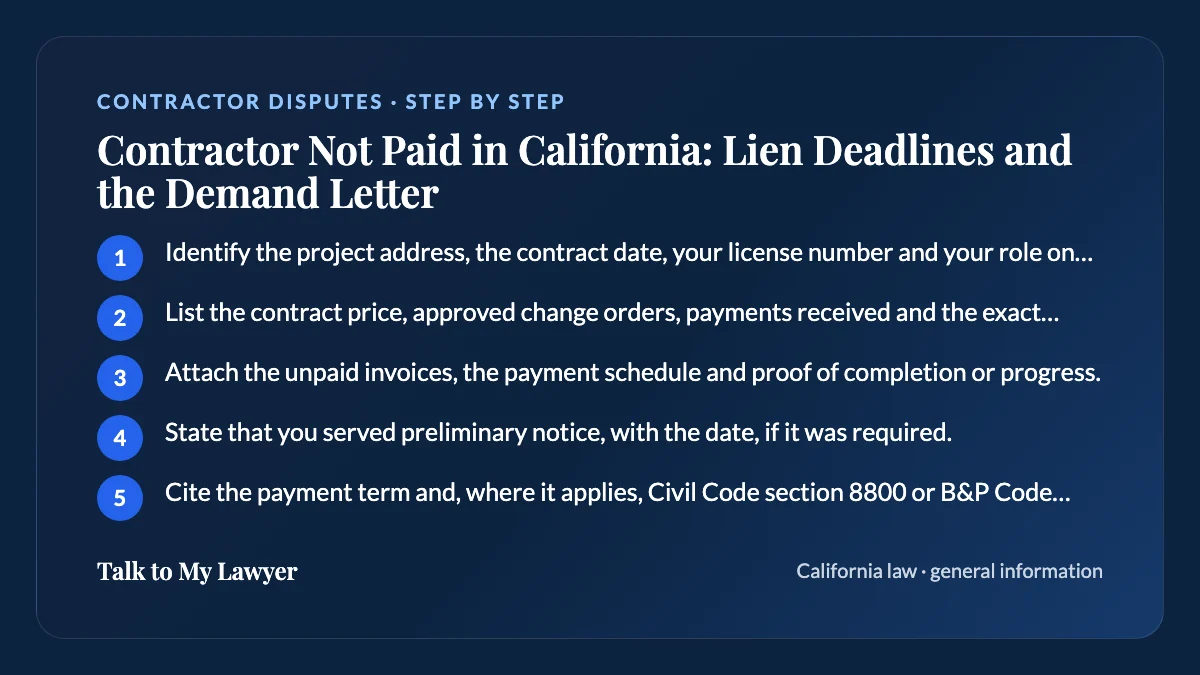
- Identify the project address, the contract date, your license number and your role on the job.
- List the contract price, approved change orders, payments received and the exact balance.
- Attach the unpaid invoices, the payment schedule and proof of completion or progress.
- State that you served preliminary notice, with the date, if it was required.
- Cite the payment term and, where it applies, Civil Code section 8800 or B&P Code section 7108.5.
- Set a payment date that falls well before your lien recording deadline.
- State that you reserve your lien and stop payment notice rights.
Under our May 4 contract for the kitchen remodel at 22 Ridge Road, progress payment 3 of $8,000 was due on completion of cabinet installation, which was finished on August 12. I gave written notice demanding payment on August 15, and no dispute has been raised. Please pay $8,000 by September 14, 30 days after that notice. Under Civil Code section 8800, amounts wrongfully withheld accrue a penalty of 2 percent per month. I reserve all rights under the mechanics lien law.
Example (hypothetical): a remodeler is the only contractor on a kitchen job, finishes the whole project on June 2, and is owed a final $12,000. No notice of completion is recorded, so the 90-day recording deadline under section 8412 falls on August 31. If the lien is recorded on August 10, section 8460 requires a foreclosure lawsuit by November 8.
Not sure which entity owes you? Our guide to finding the legal name of a business in California helps you address the letter correctly. For general invoice demands, see the unpaid invoice demand letter guide.
When an attorney-written payment demand makes sense
Lien and stop payment deadlines set construction collections apart from an ordinary unpaid bill. An attorney's letter is worth considering when those deadlines are close, when you are a sub chasing payment through a general contractor, when the owner claims defective work, or when the balance is beyond small claims limits: $12,500 for a natural person, including a sole proprietor, and $6,250 for a business entity (Code of Civil Procedure sections 116.221 and 116.220).
Through Talk to My Lawyer, a licensed California attorney writes your letter from your contract, invoices, change orders and notices, and sends it on your behalf. Recording a lien or filing suit involves separate steps, so talk to a lawyer about your facts and deadlines.
Frequently asked questions
How long does a contractor have to file a mechanics lien in California?
A direct contractor must record the lien after completing its contract and before the earlier of 90 days after the project is completed or 60 days after the owner records a notice of completion or cessation (Civil Code section 8412). Subcontractors and suppliers have the earlier of 90 days after completion or 30 days after a recorded notice (section 8414). A lawsuit to enforce the lien must follow within 90 days of recording.
Do I need a preliminary notice if I contracted directly with the homeowner?
A claimant with a direct contract with the owner must give preliminary notice only to the construction lender, if there is one (Civil Code section 8200(e)). Subcontractors and suppliers generally must give it to the owner, the direct contractor and any lender within 20 days after first furnishing work. Laborers are not required to give it.
Can an unlicensed contractor recover payment in California?
Generally not through the courts. Business and Professions Code section 7031 bars a person acting as a contractor from suing to collect pay for licensed work unless they were licensed at all times during the work, and the owner may sue to recover what was paid. A narrow substantial compliance exception covers contractors who were licensed before the work, acted reasonably and in good faith to keep the license, and acted promptly to fix the lapse (section 7031(e)).
How fast must a general contractor pay a subcontractor in California?
Within seven days after receiving each progress payment, unless the parties agreed otherwise in writing (Business and Professions Code section 7108.5). If there is a good faith dispute, the contractor may hold back no more than 150 percent of the disputed amount. Late payment carries a 2 percent monthly penalty payable to the subcontractor, and the prevailing party in a collection action recovers attorney's fees.
Does sending a demand letter extend my lien deadline?
No. The recording deadlines in Civil Code sections 8412 and 8414, and the 90-day enforcement deadline in section 8460, keep running while you negotiate. The only extension section 8460 allows requires an agreed extension of credit with a recorded notice. Set your letter's payment date with these dates in mind.
Sources
Checked against these official sources on October 17, 2026.
- California Civil Code section 8204 (California Legislative Information)
- California Civil Code section 8412 (California Legislative Information)
- California Civil Code section 8460 (California Legislative Information)
- California Civil Code section 8800 (California Legislative Information)
- California Business and Professions Code section 7108.5 (California Legislative Information)
- California Business and Professions Code section 7031 (California Legislative Information)
This guide explains California law in general terms as of October 2026. It is general information, not legal advice for your situation, and local rules can add to it.
Join the email list and get a lawyer letter started
With Talk to My Lawyer, a licensed California attorney writes your letter from your facts and documents and sends it on your behalf. Join the Talk to My Lawyer email list for letter checklists, document prompts, and reminders before you start your letter.