Quick answer
A commercial lease dispute in California is governed mainly by the lease itself, which sets repair duties, cost sharing, notice and cure periods and remedies. Since January 1, 2025, SB 1103 adds protections for qualified commercial tenants, including the right to supporting documentation within 30 days of a written request before paying building operating costs (Civil Code section 1950.9). A demand letter should follow the lease's notice clause.
At a glance
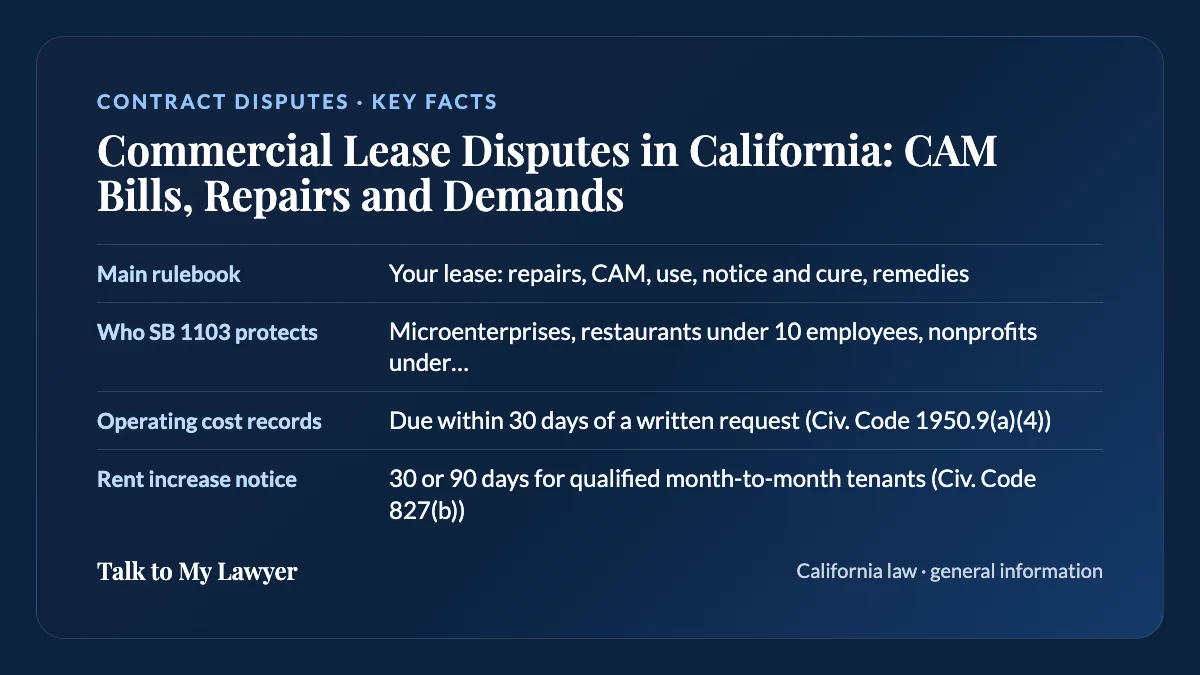
- Main rulebook
- Your lease: repairs, CAM, use, notice and cure, remedies
- Who SB 1103 protects
- Microenterprises, restaurants under 10 employees, nonprofits under 20, after written notice
- Operating cost records
- Due within 30 days of a written request (Civ. Code 1950.9(a)(4))
- Rent increase notice
- 30 or 90 days for qualified month-to-month tenants (Civ. Code 827(b))
- Time to sue on a written lease
- Four years (Code Civ. Proc. 337)
What law governs a commercial lease dispute in California?
The lease does most of the work. California's strongest tenant statutes, such as the residential deposit rules and the Tenant Protection Act, are written for dwellings. In a store, office or warehouse lease, the written agreement usually decides who repairs the roof, how common area costs are split, what the space can be used for, and what happens when someone breaks a promise.
That means the first step in any dispute is a close reading of a few clauses:
- Repairs and maintenance: which systems the landlord keeps up, such as the roof, structure or common areas, and which the tenant does.
- Operating expenses or CAM: what costs can be passed through, how your share is calculated, and whether you have audit rights.
- Use and exclusives: what you may sell or do there, and whether the landlord promised not to lease to a competitor.
- Notices: where notices must be sent, how, and to whom.
- Default and cure: how long each side has to fix a problem after written notice.
- Disputes: attorney fee clauses, mediation or arbitration requirements, and any jury waiver.
Are you a qualified commercial tenant under SB 1103?
SB 1103 (Chapter 1015, Statutes of 2024, effective January 1, 2025) gives extra protection to a qualified commercial tenant: a microenterprise, a restaurant with fewer than 10 employees, or a nonprofit with fewer than 20 employees. A microenterprise is a business with five or fewer employees, including the owner, that generally lacks sufficient access to loans, equity or other financial capital (Business and Professions Code section 18000).
Status is not automatic. The tenant must give the landlord a written notice that it qualifies, with a self-attestation of its employee count, within the previous 12 months. For a fixed-term lease, that notice must be given before or when the lease is signed, and annually after that. If you never sent it, the protections may not apply yet.
| Protection | What it does | Statute |
|---|---|---|
| Building operating costs | Fees only with proportional allocation, recent costs and supporting documentation | Civil Code 1950.9 |
| Rent increase notice | Month-to-month: 30 days for increases of 10 percent or less, 90 days above that | Civil Code 827(b) |
| Termination notice | Landlord ending a periodic tenancy: 60 days' notice, or 30 if occupied less than a year | Civil Code 1946.1 |
| Translation | Lease translation when negotiated primarily in Spanish, Chinese, Tagalog, Vietnamese or Korean | Civil Code 1632 |
How do you dispute CAM or operating cost charges?
Start by asking for the backup in writing. For a qualified commercial tenant, Civil Code section 1950.9 says a landlord cannot charge a fee to recover building operating costs unless the costs are allocated proportionately (by tenant, square footage or another documented method), were incurred within the previous 18 months or are reasonably expected within the next 12, and the landlord provides supporting documentation within 30 days of a written request.
Supporting documentation means dated, itemized quotes, contracts, receipts or invoices, a tabulation showing how costs were allocated among tenants, and a signed, dated attestation by the landlord that they are true and correct. Costs you paid directly to a third party, or costs someone else already reimbursed, cannot be included. The landlord also cannot change the allocation formula to raise your share without written notice and documentation.
Section 1950.9 applies to leases signed or renewed on or after January 1, 2025, to month-to-month and shorter tenancies, and to older leases that say nothing about operating costs. Violations can bring actual damages, attorney fees at the court's discretion, and, where the landlord acted willfully or with oppression, fraud or malice, three times actual damages plus punitive damages. A tenant sued for possession over unpaid operating cost fees can raise a violation as a defense, and a waiver of these rights is void.
If you do not qualify, your rights come from the lease. Some commercial leases include an audit clause with a short window to object after the annual statement, so check for that deadline first.
What counts as a landlord's breach of a commercial lease?
A breach is a failure to do something the lease requires. Common examples include ignoring a roof leak the landlord must repair, letting common areas or parking fall into disrepair, leasing to a competitor in violation of an exclusive-use clause, blocking access during construction, or billing charges the lease does not permit.
Keep a log with dates, photos, repair requests and the business effect, such as days closed or inventory lost. Damages in a contract claim generally need proof, so a log built as things happen is far more useful than a reconstruction months later. Our breach of contract demand letter guide explains how damages are usually framed.
Why the lease's notice and cure clause shapes your letter
Many commercial leases say a party is not in default until it receives written notice and fails to cure within a set number of days, sometimes with longer periods for problems that take time to fix. If your letter goes to the wrong address or skips required language, the cure clock may not start.
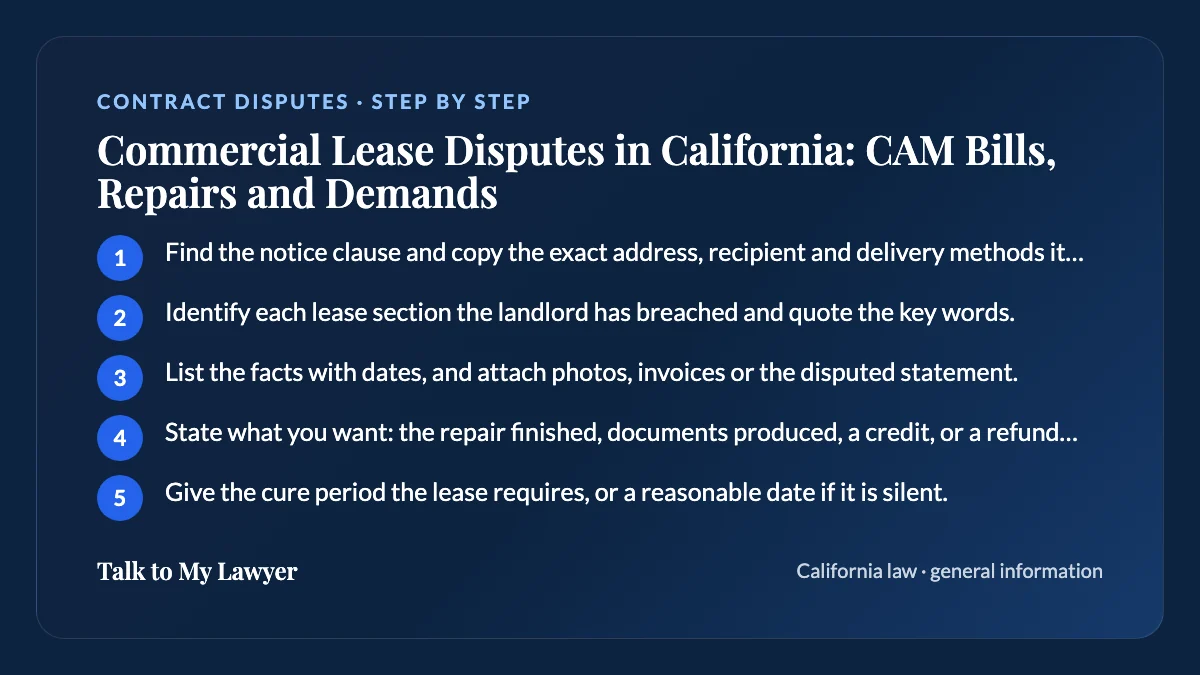
- Find the notice clause and copy the exact address, recipient and delivery methods it lists.
- Identify each lease section the landlord has breached and quote the key words.
- List the facts with dates, and attach photos, invoices or the disputed statement.
- State what you want: the repair finished, documents produced, a credit, or a refund, with a dollar figure where possible.
- Give the cure period the lease requires, or a reasonable date if it is silent.
- If you are a qualified commercial tenant, cite the SB 1103 section that applies and confirm your notice and self-attestation is on file.
- Send by every method the lease allows and keep delivery proof.
Under Section 22 of the Lease, this is written notice of default. Section 9.2 requires Landlord to maintain the roof, and the roof above Suite 104 has leaked on March 4, March 19 and April 2, damaging inventory valued at $3,150 (photos and invoices enclosed). Please complete permanent roof repairs within the 30-day cure period in Section 22 and reimburse $3,150. Separately, as a qualified commercial tenant, I request supporting documentation for the 2025 operating expense reconciliation under Civil Code section 1950.9.
What happens if the landlord does not respond?
The next step depends on your lease and the amount at stake. Check for a mediation or arbitration clause, which may need to come first. For a business, the small claims ceiling is generally $6,250 (Code of Civil Procedure section 116.220); a natural person suing in their own name can claim up to $12,500 (section 116.221). Larger claims go to civil court.
Code of Civil Procedure section 337 sets a four-year limit for an action on a written contract, and a signed lease is one. For a broader view of court options, see our guide to sending a final demand letter before a lawsuit.
Commercial lease disputes: when to bring in an attorney
Commercial leases are long, and the wording of a default notice can affect what happens next. Bringing in a lawyer to write the notice is a reasonable step when the dollar amount is significant, when the lease has an attorney fee or cure clause you want to trigger correctly, when the landlord's only answer has been silence, or when you need to preserve SB 1103 rights.
If you use Talk to My Lawyer, a licensed California attorney writes your letter from the lease, the disputed statements and your repair log, follows the lease's notice requirements, and sends it on your behalf. Questions about bigger remedies, such as ending the lease early, are best taken to a lawyer who can review the full agreement.
Frequently asked questions
Can a commercial landlord charge CAM fees without showing receipts in California?
For a qualified commercial tenant under SB 1103, no. Civil Code section 1950.9 bars a landlord from charging building operating costs until it provides supporting documentation, such as itemized invoices, an allocation tabulation and a signed attestation. Other tenants depend on the lease, which may include audit or inspection rights with deadlines to object to annual statements.
Does California have a habitability law for commercial tenants?
California's best-known tenant repair protections are written for residential dwellings. In a commercial lease, repair and maintenance duties are usually allocated by the lease itself, and some leases shift a large share to the tenant. Read the repair, maintenance and casualty clauses closely, and talk to a lawyer if the landlord's duties are unclear.
How do I become a qualified commercial tenant under SB 1103?
Your business must be a microenterprise, a restaurant with fewer than 10 employees, or a nonprofit with fewer than 20 employees. You then give the landlord a written notice that you qualify, with a self-attestation of your employee count. For a fixed-term lease, the notice goes in before or at signing and again each year. Month-to-month tenants must have given it within the previous 12 months.
How much notice does a commercial landlord need to raise rent in California?
For most commercial leases, the lease controls. For a qualified commercial tenant on a month-to-month or shorter tenancy, Civil Code section 827 now requires 30 days' written notice for increases of 10 percent or less within 12 months, and 90 days for larger increases. The increase does not take effect until the notice period runs, and the notice must explain these rules.
Can I sue my commercial landlord in small claims court?
Yes, if the claim fits the limit. The small claims cap is $6,250 for most businesses and $12,500 for claims brought by an individual. Attorneys generally cannot take part in conducting the case (Code of Civil Procedure section 116.530). If your lease requires mediation or arbitration, or your damages are larger, another forum may apply. A small claims advisor can explain filing rules in your county.
Sources
Checked against these official sources on October 18, 2026.
- California Civil Code section 1950.9 (California Legislative Information)
- SB 1103 Tenancy of commercial real properties (Chapter 1015, Statutes of 2024) (California Legislative Information)
- California Civil Code section 827 (California Legislative Information)
- California Business and Professions Code section 18000 (California Legislative Information)
- California Code of Civil Procedure section 116.220 (California Legislative Information)
- California Code of Civil Procedure section 337 (California Legislative Information)
This guide explains California law in general terms as of October 2026. It is general information, not legal advice for your situation, and local rules can add to it.
Join the email list and get a lawyer letter started
With Talk to My Lawyer, a licensed California attorney writes your letter from your facts and documents and sends it on your behalf. Join the Talk to My Lawyer email list for letter checklists, document prompts, and reminders before you start your letter.