Quick answer
California's commercial security deposit return rule is Civil Code section 1950.7. A landlord may keep only amounts reasonably necessary for unpaid rent, tenant-caused damage or cleaning, if the deposit was made for those purposes. The rest is generally due within 30 days after the landlord gets possession, with a two-week deadline for part of large rent-only deposits. Bad-faith retention can bring up to $200 plus actual damages.
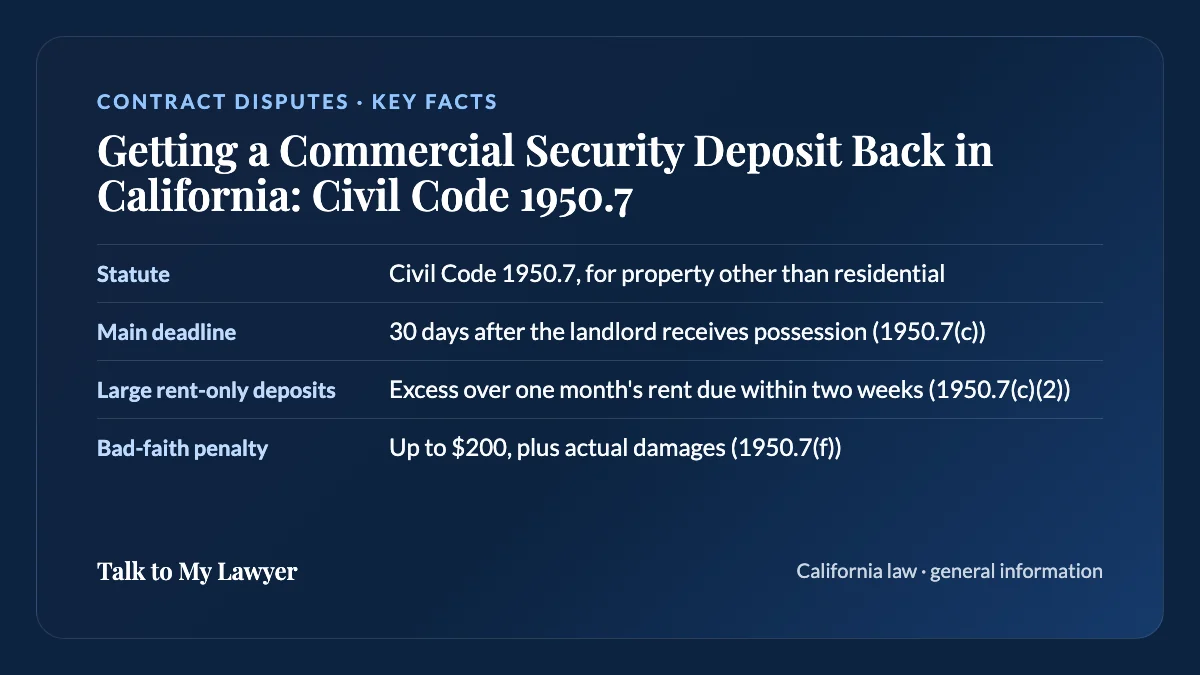
At a glance
- Statute
- Civil Code 1950.7, for property other than residential
- Main deadline
- 30 days after the landlord receives possession (1950.7(c))
- Large rent-only deposits
- Excess over one month's rent due within two weeks (1950.7(c)(2))
- Bad-faith penalty
- Up to $200, plus actual damages (1950.7(f))
- Small claims
- Up to $6,250 for most businesses (Code Civ. Proc. 116.220)
How long does a commercial landlord have to return a security deposit in California?
Generally 30 days from the date the landlord receives possession of the premises (Civil Code section 1950.7(c)). The clock runs from when the landlord gets the space back, so the date you returned keys or surrendered possession is the one to document.
The statute sets three timelines depending on what the landlord is claiming and how big the deposit is:
| Landlord's claim | Deposit size | When the balance is due |
|---|---|---|
| Unpaid rent only | No more than one month's rent, plus any amount clearly labeled as last month's rent | When the parties agree, but no later than 30 days after possession |
| Unpaid rent only | More than one month's rent plus any labeled last month's rent | Whatever remains above one month's rent within two weeks; the rest returned or accounted for within 30 days |
| Includes repairs or cleaning | Any size | When the parties agree, but no later than 30 days after possession |
Your lease may set an earlier date, so check its deposit clause.
What can a commercial landlord keep from the deposit?
Only amounts reasonably necessary to cover tenant defaults in paying rent, to repair damage to the premises caused by the tenant, or to clean the premises when the tenancy ends, and only if the deposit was made for any or all of those purposes (section 1950.7(c)).
- Check the lease's deposit clause. It defines what the deposit secures. Some leases also require restoration of alterations or removal of signage and fixtures at the end, which can affect what the landlord claims as damage.
- Check the surrender clause. It often describes the condition the space must be in at move-out, such as broom-clean.
- Damage means tenant-caused. Section 1950.7 refers to damage caused by the tenant. Conditions that existed before you moved in, or that the landlord was responsible for maintaining, are worth raising.
- Reasonable means reasonable. A $4,000 cleaning charge for a small office with photos showing clean floors invites a question.
The deposit is held for the tenant, and your claim to it comes before claims of the landlord's creditors, except a trustee in bankruptcy (section 1950.7(b)).
How commercial deposit rules differ from residential rules
If you have read about apartment deposits, adjust your expectations. The residential statute, Civil Code section 1950.5, is far more detailed and was amended several times between 2024 and 2026. Section 1950.7 was last amended in 2003 and remains short.
| Topic | Commercial (1950.7) | Residential (1950.5) |
|---|---|---|
| Deadline | 30 days after possession, two weeks for part of large rent-only deposits | 21 days after the tenant vacates |
| Paperwork | Balance returned (for large rent-only deposits, part may be accounted for); no receipt or photo list in the statute | Itemized statement with receipts and photos |
| Bad-faith penalty | Up to $200 plus actual damages | Up to twice the deposit plus actual damages |
| Deposit cap | None in the statute | Generally one month's rent since July 1, 2024 |
| Sale of the building | Transfer with notice by personal delivery or certified mail, or refund | Transfer with notice by personal delivery or first-class mail, or refund with accounting |
Because the statute does not list documents, your lease and your own evidence matter more. Ask for an accounting and invoices anyway, since the statute allows the landlord to keep only amounts reasonably necessary for the listed purposes.
Did SB 1103 change commercial deposit rules?
No. As of October 2026, section 1950.7 has not been amended since 2003. SB 1103, effective January 1, 2025, added protections for qualified commercial tenants (small businesses, small restaurants and small nonprofits) covering operating cost charges, rent increase notices, termination notices and lease translation, but it left the deposit statute alone.
If your dispute also involves CAM reconciliations or other lease charges, see our guide to a commercial lease dispute letter in California.
What if the landlord sold the building during your lease?
When the landlord's interest ends by sale, assignment or otherwise, the landlord must within a reasonable time either transfer the remaining deposit to the successor and notify you by personal delivery or certified mail of the transfer, any claims against it, and the new owner's name and address, or return the deposit to you (section 1950.7(d)). A successor that receives the deposit takes on the same obligations.
If you never got a transfer notice, your demand letter can go to both the old and new owners, asking each to confirm who holds the funds.
Example: applying the two-week and 30-day rules
Example (hypothetical): a boutique paid $5,000 a month in rent and a $10,000 deposit, with nothing labeled as last month's rent. The landlord receives possession on June 1. The tenant owes $1,500 in unpaid rent and nothing else.
- The claim is for rent only and the deposit is larger than one month's rent, so the two-week rule applies. After the $1,500 rent claim, $8,500 remains, and the part above one month's rent, $3,500, is due by June 15.
- The other $5,000 must be returned or accounted for by July 1, 30 days after possession.
- If the landlord instead claims $2,000 for repairs, the two-week rule no longer fits; the balance after lawful deductions is due within 30 days.
Steps for a commercial deposit demand letter
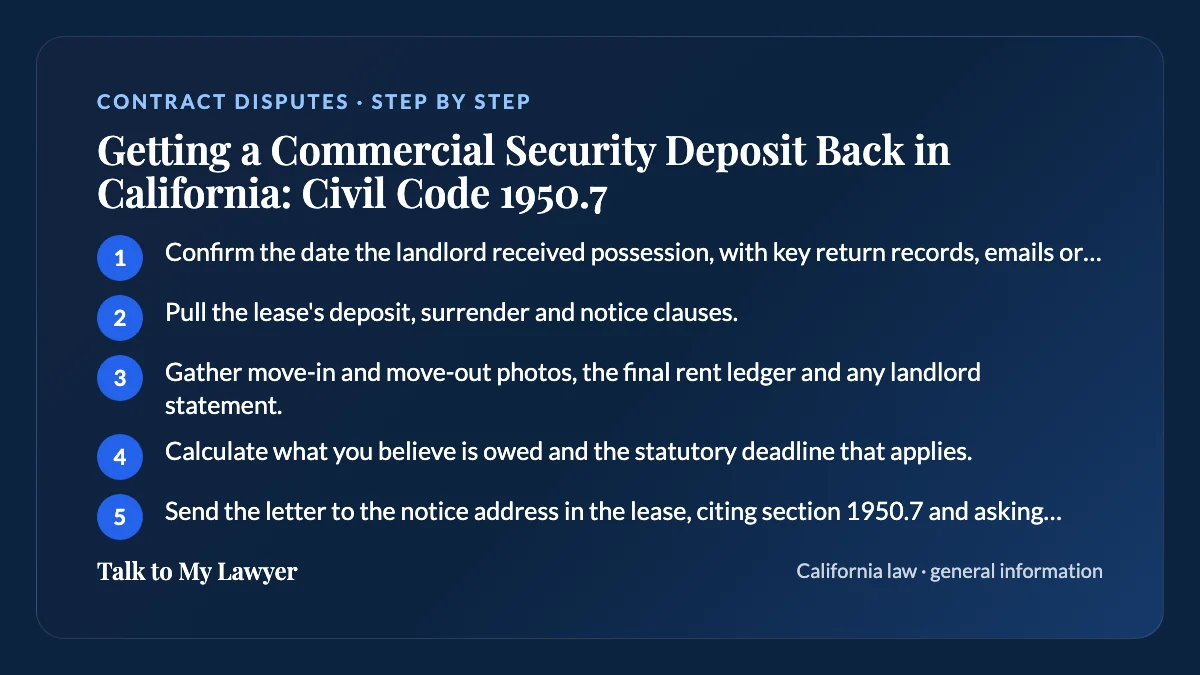
- Confirm the date the landlord received possession, with key return records, emails or a signed surrender.
- Pull the lease's deposit, surrender and notice clauses.
- Gather move-in and move-out photos, the final rent ledger and any landlord statement.
- Calculate what you believe is owed and the statutory deadline that applies.
- Send the letter to the notice address in the lease, citing section 1950.7 and asking for payment or an accounting with invoices by a set date.
- Mention that bad-faith retention can bring up to $200 in addition to actual damages.
We surrendered Suite 210 and returned all keys on June 1, which you acknowledged by email that day. Our lease required a $10,000 security deposit. More than 30 days have passed, and we have received neither the deposit nor an accounting. Under California Civil Code section 1950.7(c), please return the balance of the deposit, or provide an itemized accounting with supporting invoices for any deductions, by July 20.
If the landlord does not respond, small claims is one option: a business claimant is generally limited to $6,250 (Code of Civil Procedure section 116.220), and a natural person to $12,500 (section 116.221). Ask the court's small claims advisor which limit fits how your business is organized. Filing steps are covered in our small claims demand letter guide.
When an attorney-written commercial deposit letter makes sense
Commercial deposits can be large, and the $200 statutory penalty is modest, so the lease and the facts carry most of the weight. An attorney-written letter can help when the deposit is above the small claims limit, the lease has an attorney fee clause, the landlord is offsetting disputed charges, or the building changed hands.
At Talk to My Lawyer, a licensed California attorney writes your letter using the lease, your surrender records and photos, applies the section 1950.7 deadline that fits your deposit, and sends it on your behalf. If a lawsuit becomes likely, a lawyer can tell you which court and claims fit.
Frequently asked questions
Does a commercial landlord have to send an itemized statement in California?
Section 1950.7 does not list itemization requirements the way the residential statute does. It says that for large rent-only deposits the remainder must be returned or accounted for within 30 days. Your lease may require more. Even without a statutory list, asking for an accounting and invoices is reasonable, because a landlord may keep only amounts reasonably necessary for the allowed purposes.
What is the penalty if a commercial landlord keeps a deposit in bad faith?
Civil Code section 1950.7(f) allows damages of up to $200 for bad-faith retention, in addition to actual damages, against the landlord or a transferee who holds the deposit. That is much smaller than the residential penalty of up to twice the deposit. Whether retention was in bad faith is decided by a court based on the facts.
Can a commercial landlord keep my deposit for normal wear?
The commercial statute allows deductions for damage caused by the tenant and cleaning at the end of the tenancy, if the deposit was made for those purposes, and only in amounts reasonably necessary. It does not use the residential phrase about ordinary wear and tear, so your lease's surrender and repair clauses become important. Ask the landlord to show what damage you caused.
Is there a limit on how much a commercial landlord can charge as a deposit?
Section 1950.7 does not cap commercial deposits. The amount is set by negotiation and the lease. The residential cap of generally one month's rent, in effect since July 1, 2024, applies only to residential property. A large deposit does trigger the two-week return rule for rent-only claims under section 1950.7(c)(2).
How long do I have to sue for a commercial deposit in California?
Code of Civil Procedure section 337 allows four years to sue on a written contract, which includes a written lease. When the clock started on a deposit claim depends on the facts, so talk to a lawyer if timing is close. Small claims has its own dollar limits and a rule allowing no more than two claims over $2,500 per calendar year, so check which court fits.
Sources
Checked against these official sources on October 18, 2026.
- California Civil Code section 1950.7 (California Legislative Information)
- California Civil Code section 1950.5 (California Legislative Information)
- SB 1103 Tenancy of commercial real properties (Chapter 1015, Statutes of 2024) (California Legislative Information)
- California Code of Civil Procedure section 116.220 (California Legislative Information)
- California Code of Civil Procedure section 116.231 (California Legislative Information)
- California Code of Civil Procedure section 337 (California Legislative Information)
This guide explains California law in general terms as of October 2026. It is general information, not legal advice for your situation, and local rules can add to it.
Join the email list and get a lawyer letter started
With Talk to My Lawyer, a licensed California attorney writes your letter from your facts and documents and sends it on your behalf. Join the Talk to My Lawyer email list for letter checklists, document prompts, and reminders before you start your letter.