Quick answer
To dispute a credit report error, write to each credit bureau that shows it and to the company that reported it. Identify the item, explain why it is wrong and attach proof. Under the Fair Credit Reporting Act (15 U.S.C. section 1681i), the bureau must reinvestigate free of charge within 30 days, or up to 45 days if you send more information during that period.
At a glance
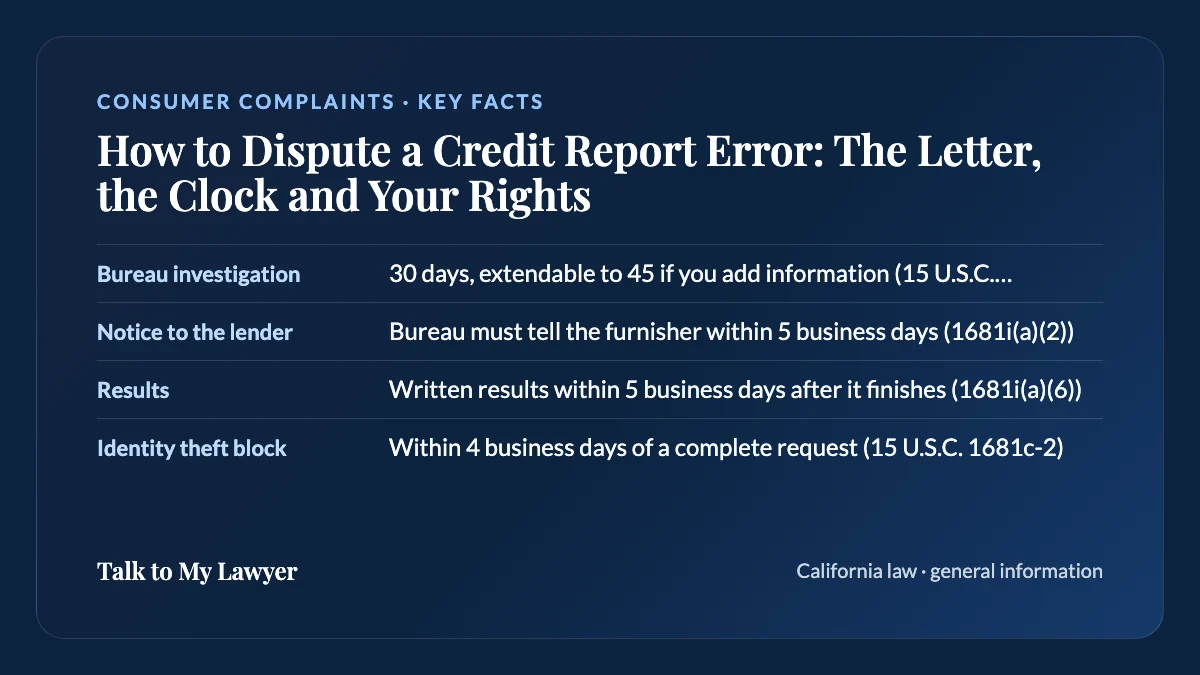
- Bureau investigation
- 30 days, extendable to 45 if you add information (15 U.S.C. 1681i(a)(1))
- Notice to the lender
- Bureau must tell the furnisher within 5 business days (1681i(a)(2))
- Results
- Written results within 5 business days after it finishes (1681i(a)(6))
- Identity theft block
- Within 4 business days of a complete request (15 U.S.C. 1681c-2)
- California law
- Reinvestigation and police-report blocks under Civil Code 1785.16
- Free reports
- Weekly from each nationwide bureau at AnnualCreditReport.com
How do you dispute a credit report error?
You dispute a credit report error in writing with every bureau that lists it, and separately with the business that supplied the information, which the law calls the furnisher. The FTC's guidance covers both routes, and each recipient has its own duty to investigate.
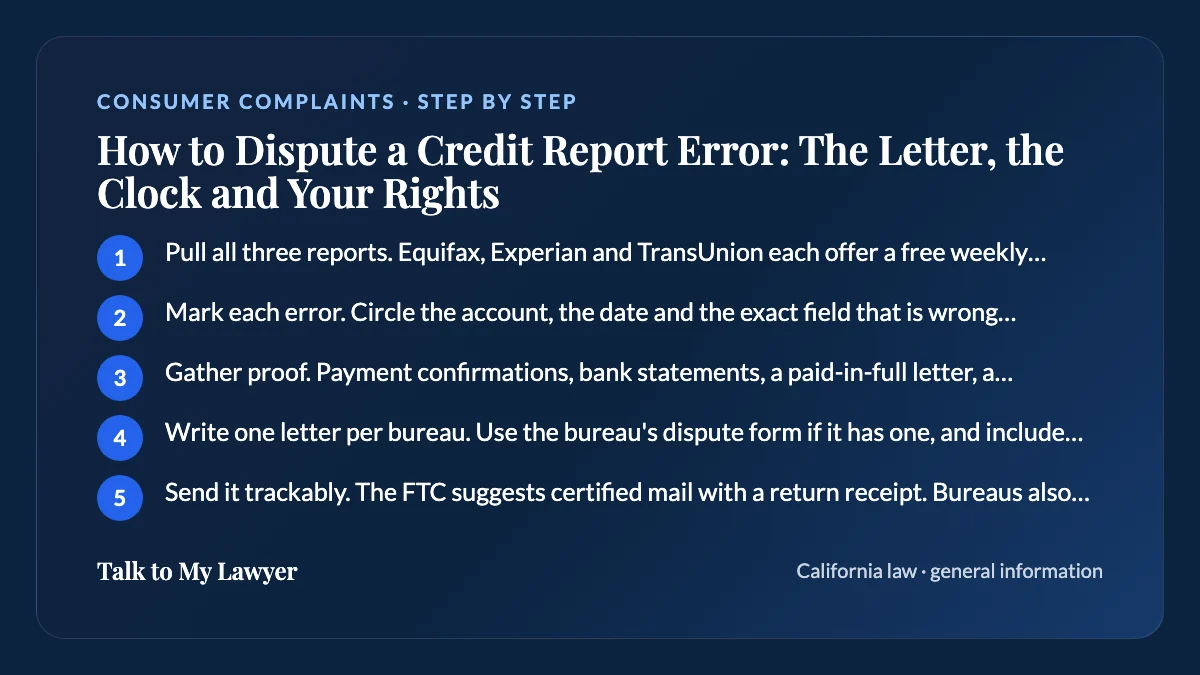
- Pull all three reports. Equifax, Experian and TransUnion each offer a free weekly report at AnnualCreditReport.com, the only site authorized for the free federal reports.
- Mark each error. Circle the account, the date and the exact field that is wrong: balance, payment status, account owner or a debt you never had.
- Gather proof. Payment confirmations, bank statements, a paid-in-full letter, a settlement agreement or an identity theft report. Send copies, never originals.
- Write one letter per bureau. Use the bureau's dispute form if it has one, and include your full name, address and the report with the errors circled.
- Send it trackably. The FTC suggests certified mail with a return receipt. Bureaus also take online and phone disputes, but a letter gives you a dated record of what you sent.
- Write to the furnisher too, at the dispute address it gives on your report or its website.
- Calendar day 30 from the date each bureau receives your letter.
How long does a credit bureau have to investigate?
A credit bureau has 30 days from receiving your dispute to finish a reasonable reinvestigation and either record the item's current status or delete it, free of charge (15 U.S.C. section 1681i(a)(1)). If you send relevant new information during those 30 days, the bureau can take up to 15 more days. California's Consumer Credit Reporting Agencies Act has its own reinvestigation section, worded as a 30-business-day period (Civil Code section 1785.16(a)).
| Step | Federal rule (FCRA) | California rule (Civil Code 1785.16) |
|---|---|---|
| Reinvestigation | 30 days; up to 45 if you add information | 30-business-day period |
| Notice to the furnisher | Within 5 business days | Within 5 business days |
| Dispute rejected as frivolous | Notice with reasons within 5 business days | Notice with specific reasons within 5 business days |
| Results sent to you | Within 5 business days after completion | Within 5 days after completion |
| Deleted item comes back | Furnisher must certify accuracy; you get written notice within 5 business days | Furnisher must certify accuracy; you get written notice |
| Your statement of dispute | Bureau may limit it to 100 words | Bureau may limit it to 100 words |
Where the two laws overlap, the shorter federal clock is the one to watch. California adds a useful line: the mere presence of contradicting information in your file is not, by itself, a reason to call your dispute frivolous (section 1785.16(e)).
What to put in a credit report dispute letter
A dispute letter should let the bureau find the item in seconds and see why it is wrong. Keep the tone factual.
- Your full name, current address, date of birth and the report or file number.
- Each disputed item: creditor name, account number (last four digits are enough), and the specific field that is wrong.
- What the correct information is and how your enclosures prove it.
- What you request: deletion, correction or an update.
- A list of enclosures, and a request for written results and an updated report.
I dispute the following item in my credit file: Northgate Auto Finance, account ending 4471, reported as 60 days late for March 2026. That payment was made on February 27, 2026, as shown on the enclosed bank statement and the lender's payment confirmation. Please reinvestigate under 15 U.S.C. section 1681i and Civil Code section 1785.16, correct the payment history for March 2026 to show it paid on time, and send me the results and an updated copy of my report.
Should you dispute with the lender or collector directly?
Yes, alongside the bureau dispute. Under 15 U.S.C. section 1681s-2(a)(8), you can dispute directly with the furnisher at the address it specifies. Your notice must identify the information, explain why it is wrong and include the supporting documents the furnisher requires. The furnisher must investigate and report back within the same period a bureau has, and if the data is wrong it must tell every bureau it reported to.
There is a reason not to rely on the direct route alone. The federal statute says its private damages provisions do not apply to violations of the furnisher duties in subsection (a), which covers direct disputes. They do apply to subsection (b), the duties a furnisher owes after a bureau forwards your dispute: investigate, review what the bureau sent, report results and correct or delete unverifiable data. A dispute through the bureau is what triggers those duties.
If the item is a collection account, our guides to validating a debt and responding to a collection letter cover the collector's separate obligations.
When the error is identity theft
Accounts opened by someone else call for a block rather than a correction. Under 15 U.S.C. section 1681c-2, a bureau must block the information no later than 4 business days after it receives proof of your identity, a copy of an identity theft report, your identification of the entries, and your statement that they do not relate to any transaction of yours. It must then notify the furnisher.
California law adds its own block. If you give a bureau a valid police report filed under Penal Code section 530.5, the bureau must promptly and permanently block the information you say resulted from the identity theft (Civil Code section 1785.16(k)). A block can be lifted only on limited grounds, such as a material misrepresentation or proof you knowingly received goods or money from the transaction.
If thieves also moved money out of your bank account, disputing an unauthorized bank transfer has its own deadlines under Regulation E.
What if the bureau verifies the error anyway?
A verified result is not the end of the record. These are the next moves the statutes give you:
- Ask how it was verified. The bureau must describe the procedure it used, including the furnisher's name, address and phone number if available, within 15 days of your request.
- Add a statement of dispute. Future reports must note that you dispute the item and include your statement or a summary.
- Ask the bureau to notify past recipients of a deletion or your statement of dispute. Federal law covers anyone who received your report for employment in the past 2 years or for other purposes in the past 6 months. California's version reaches back 12 months for non-employment reports.
- Dispute again with new evidence, not the same letter, since a furnisher may treat a substantially similar repeat dispute as frivolous.
- Complain to the CFPB, which accepts complaints about credit reporting.
Example (hypothetical): a borrower disputes a late mark with all three bureaus on April 1. Two delete it by April 20. The third reports it verified on April 28 without addressing the enclosed bank statement. The borrower's next letter goes to that bureau and the lender, asks for the method of verification, and encloses the statement again with the lender's own payment confirmation.
When an attorney-written credit dispute letter makes sense
A first round of bureau disputes needs nothing more than the steps above. A letter from a lawyer can make sense after a bureau or furnisher has verified information you can prove is wrong, when an error is costing you a loan or apartment, or when identity theft spans several accounts.
If you choose Talk to My Lawyer, a licensed California attorney writes your letter from your reports, statements and prior dispute results and sends it on your behalf. Copies go out to each bureau and the furnisher. If you are weighing a claim under the FCRA or California's credit reporting act, get legal advice on your own situation.
Frequently asked questions
Is it better to dispute a credit report online or by mail?
Either is allowed. Bureaus accept online, phone and mail disputes. The FTC suggests a written letter sent by certified mail with a return receipt, with copies of your documents and the report marked up, because it creates a dated record of exactly what you sent. Keep copies of everything, whatever method you use.
What happens after 30 days if the credit bureau does not respond?
Federal law requires the bureau to finish its reinvestigation within 30 days of receiving your dispute, or 45 days if you added information. California's statute also directs the bureau to promptly delete or correct information it can no longer verify. If the deadline passes without results, send a follow-up letter noting the date of receipt and consider a CFPB complaint.
Can a deleted item come back on my credit report?
Only if the furnisher certifies that the information is complete and accurate. The bureau must then notify you in writing within 5 business days of reinserting it, and tell you how to reach the furnisher. You can dispute the reinserted item again. California law also requires bureaus to keep procedures that prevent deleted information from reappearing.
Do I have to pay to dispute an error on my credit report?
No. The Fair Credit Reporting Act requires the bureau to reinvestigate without charge, and California's statute also says the reinvestigation is done without charge. You can also get free weekly reports from Equifax, Experian and TransUnion through AnnualCreditReport.com to check whether a correction was made.
Can a credit bureau refuse to investigate my dispute?
It can end a reinvestigation if it reasonably decides the dispute is frivolous or irrelevant, for example because you did not give enough information. It must then tell you within 5 business days, explain why and say what information it needs. You can then send the missing information with a new dispute.
Sources
Checked against these official sources on October 18, 2026.
- 15 U.S. Code section 1681i, Procedure in case of disputed accuracy (Legal Information Institute, Cornell Law School)
- 15 U.S. Code section 1681s-2, Responsibilities of furnishers (Legal Information Institute, Cornell Law School)
- 15 U.S. Code section 1681c-2, Block of information resulting from identity theft (Legal Information Institute, Cornell Law School)
- California Civil Code section 1785.16 (California Legislative Information)
- Disputing errors on your credit reports (Federal Trade Commission)
- Free credit reports (Federal Trade Commission)
This guide explains California law in general terms as of October 2026. It is general information, not legal advice for your situation, and local rules can add to it.
Join the email list and get a lawyer letter started
With Talk to My Lawyer, a licensed California attorney writes your letter from your facts and documents and sends it on your behalf. Join the Talk to My Lawyer email list for letter checklists, document prompts, and reminders before you start your letter.