Quick answer
To dispute an unauthorized bank transfer, tell your bank by phone, in person or in writing as soon as you see it, and within 60 days after it sends the statement showing it. Under Regulation E (12 CFR 1005.6), reporting a stolen card or login within two business days caps your loss at $50. The bank must investigate within 10 business days, or 45 with provisional credit.
At a glance
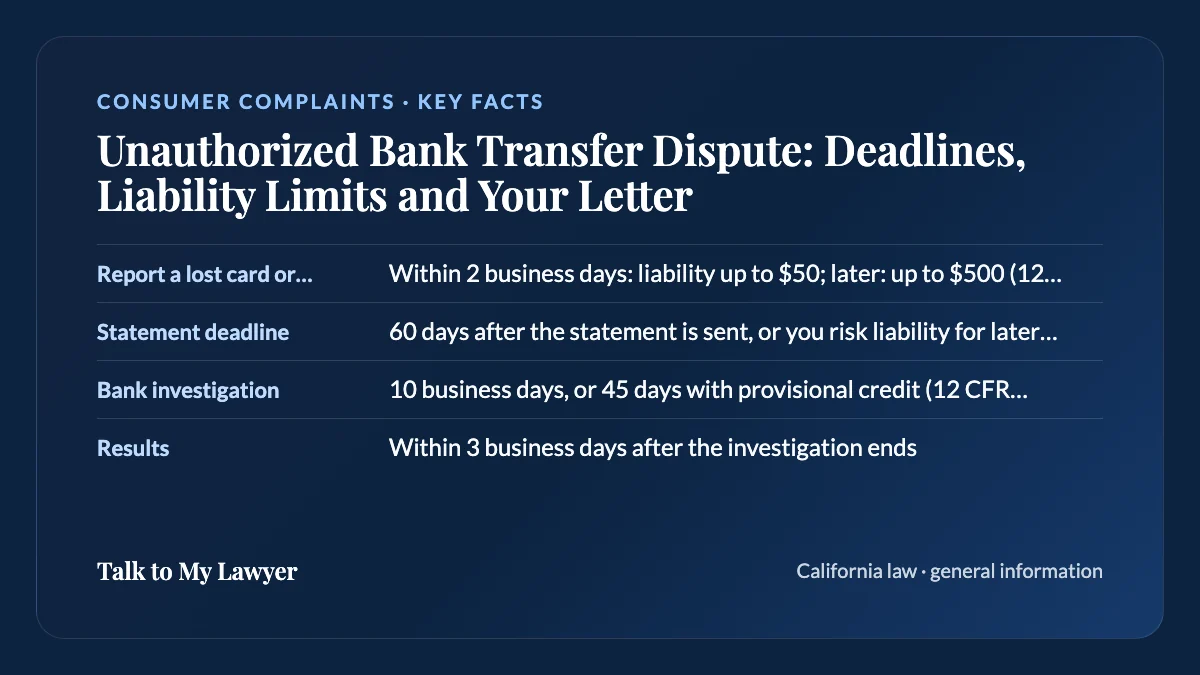
- Report a lost card or login
- Within 2 business days: liability up to $50; later: up to $500 (12 CFR 1005.6(b))
- Statement deadline
- 60 days after the statement is sent, or you risk liability for later transfers
- Bank investigation
- 10 business days, or 45 days with provisional credit (12 CFR 1005.11(c))
- Results
- Within 3 business days after the investigation ends
- Your negligence
- Cannot be used to raise your liability (CFPB Regulation E FAQs)
What should you do first after an unauthorized transfer?
Tell your bank right away, then confirm in writing. Under Regulation E, notice counts when you take reasonable steps to give the bank the information, whether in person, by phone or in writing (12 CFR 1005.6(b)(5)). A letter you mail counts as notice on the day you mail it.
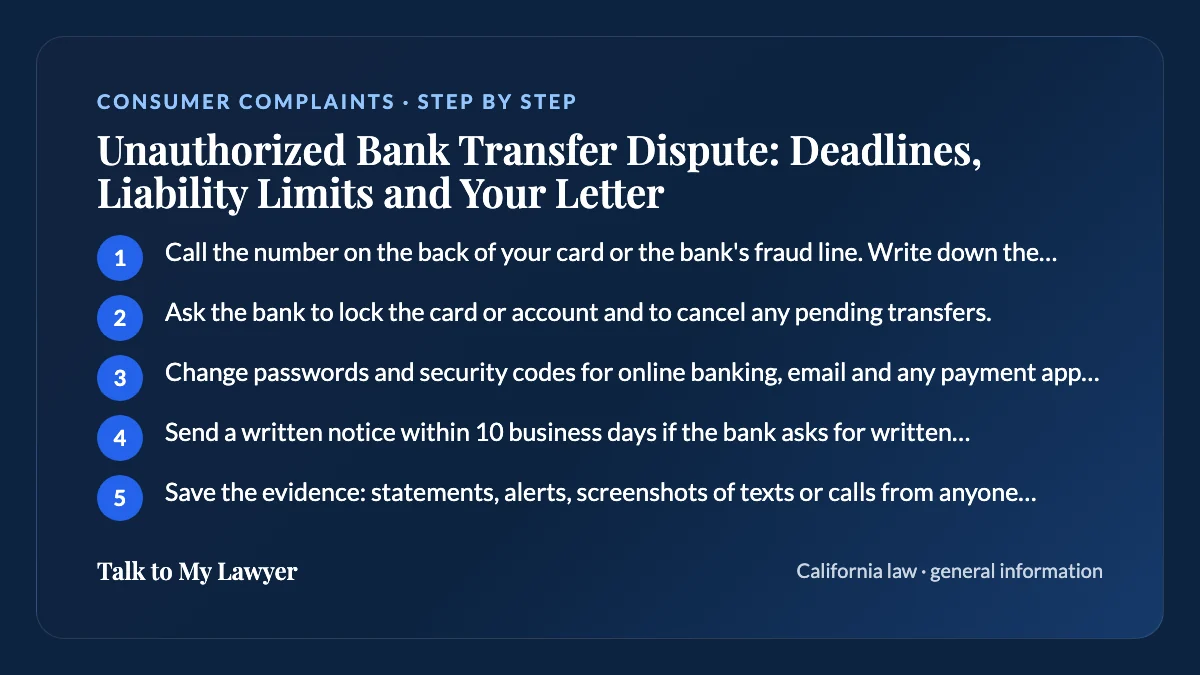
- Call the number on the back of your card or the bank's fraud line. Write down the date, time, the person's name and any claim number.
- Ask the bank to lock the card or account and to cancel any pending transfers.
- Change passwords and security codes for online banking, email and any payment app linked to the account.
- Send a written notice within 10 business days if the bank asks for written confirmation of your call (12 CFR 1005.11(b)(2)). Do it even if no one asks, so the dates are on paper.
- Save the evidence: statements, alerts, screenshots of texts or calls from anyone posing as the bank, and your device's login history.
- Watch for the provisional credit and for a letter with the bank's findings.
A police report can help your records, but the CFPB's Regulation E FAQs say a bank may not delay starting or finishing its investigation while it waits for one.
How much of an unauthorized transfer can you lose?
Your share depends on when you report. Regulation E sets three tiers in 12 CFR 1005.6(b):
| When you notify the bank | Most you can be held liable for | Rule |
|---|---|---|
| Within 2 business days after learning a card, PIN or login was lost or stolen | The lesser of $50 or the transfers before notice | 1005.6(b)(1) |
| After those 2 business days | The lesser of $500 or $50 plus later transfers the bank shows notice would have stopped | 1005.6(b)(2) |
| More than 60 days after the statement showing the transfer was sent | Transfers after day 60 and before notice that the bank shows timely notice would have prevented | 1005.6(b)(3) |
If extenuating circumstances delayed your notice, the bank must extend these time limits to a reasonable period (1005.6(b)(4)). If your account agreement or state law sets a lower limit, the lower one applies.
How long does a bank have to investigate an unauthorized transfer dispute?
A bank has 10 business days to investigate and decide. If it needs longer, it may take up to 45 days, but only if it provisionally credits the disputed amount within those 10 business days, tells you within 2 business days, and gives you full use of the money (12 CFR 1005.11(c)).
- Results are due within 3 business days after the investigation ends, and a confirmed error must be corrected within 1 business day.
- Longer periods apply to transfers made within 30 days after an account's first deposit (20 business days, and up to 90 days), and to point-of-sale debit card and foreign-initiated transfers (up to 90 days).
- If the bank finds no error, it must explain its findings in writing and tell you that you can ask for the documents it relied on. It must send copies promptly when you ask.
- If it reverses a provisional credit, it must tell you the date and amount and keep honoring checks and payments to third parties for 5 business days without overdraft fees, for items it would have paid anyway.
- The bank may not require you to contact the merchant first, according to the CFPB's FAQs.
Are Zelle and scam payments covered?
A person-to-person payment is covered by the Electronic Fund Transfer Act and Regulation E when it meets the definition of an electronic fund transfer, according to the CFPB's FAQs. The harder question is whether it was unauthorized.
Regulation E defines an unauthorized transfer as one started by someone other than you, without actual authority, that does not benefit you (12 CFR 1005.2(m)). The CFPB's FAQs address a common scam directly: if a caller posing as your bank tricks you into sharing your login or a one-time code and then sends the money, that transfer is unauthorized. Being tricked into revealing access information is not the same as furnishing an access device.
If you entered and sent the payment yourself, perhaps to a fake seller or a romance scammer, the bank may treat it as authorized, since you started it. That does not end every option. Your bank's or payment app's own policies may offer more, and the facts of how the payment was started matter, so describe them precisely in your letter.
What to put in an unauthorized transfer dispute letter
The notice must let the bank identify your name and account and say why you believe there is an error, including the type, date and amount where you can (12 CFR 1005.11(b)(1)). Add anything that shows you did not start the transfer.
I am writing to confirm my phone report of September 14, claim number 55-2081. Two electronic transfers from my checking account ending 3307 were not made or authorized by me: $600 on September 13 and $800 on September 14, both to a recipient I do not know. On September 12 a caller claiming to be from your fraud department asked for a one-time passcode, which I provided. I did not initiate either transfer. Under 12 CFR 1005.11, please investigate, provisionally credit $1,400 if your investigation will take longer than 10 business days, and send me your written findings.
Mark the letter as a notice of error under Regulation E, keep a copy and send it in a way you can track.
Example: how the $50 and $500 tiers play out
Example (hypothetical): a debit card is stolen on a Saturday and the owner notices that afternoon. Thieves make transfers of $300 on Sunday, $500 on Tuesday and $700 on Thursday.
| Owner reports | Business days after learning | Maximum liability |
|---|---|---|
| Monday | 1 | $50 |
| Tuesday | 2 | $50 |
| Friday | 5 | Up to $500: $50 plus the later transfers the bank shows prompt notice would have stopped |
The tiers turn on when the loss or theft became known, so note that date in your letter. Whether a cap applies in a particular case depends on the facts the bank can prove.
What if the bank denies your claim?
Ask in writing for the documents the bank relied on, which Regulation E entitles you to. Then consider a complaint with the Consumer Financial Protection Bureau, which accepts complaints about bank accounts and money transfers; its complaint page says companies generally respond within 15 days.
The federal statute adds a pointed remedy. A court can award treble damages if the bank failed to provisionally recredit within the 10-day period and either did not investigate in good faith or had no reasonable basis to find no error, or if it knowingly and willfully concluded there was no error when the evidence did not support that (15 U.S.C. section 1693f(e)).
For a disputed card purchase instead of a transfer, see chargebacks versus demand letters. If the fraud also hit your credit file, our guide to disputing a credit report error covers identity theft blocks. If the amount fits the small claims limit, see how a demand letter works before small claims.
When an attorney-written bank dispute letter makes sense
A first Regulation E notice to your bank can be a short letter you send yourself. Bringing in a lawyer to write the next letter is reasonable when the bank has denied the claim, when it reversed a provisional credit, when it is calling a fraudster's transfer authorized, or when the loss is large.
Through Talk to My Lawyer, a licensed California attorney writes your letter from your statements, alerts and the bank's findings and sends it on your behalf, marked as a Regulation E notice of error. Any lawsuit under the Electronic Fund Transfer Act is a step to plan with a lawyer.
Frequently asked questions
Does my bank have to give me a provisional credit?
Only if it takes longer than 10 business days to investigate. To use the longer 45-day period, the bank must provisionally credit the disputed amount, with any interest, within 10 business days of your notice and give you full use of the funds. If it asked for written confirmation of a phone report and did not receive it, it does not have to provide the credit.
Is a transfer unauthorized if I gave a scammer my one-time code?
According to the CFPB's Regulation E FAQs, yes, if a third party tricked you into sharing access information and then initiated the transfer. The FAQs explain that a consumer who is fraudulently induced to share credentials has not furnished an access device, so the exclusion for people you gave access to does not apply. A payment you entered and sent yourself is treated differently.
Can I report an unauthorized transfer by phone?
Yes. Regulation E allows notice in person, by telephone or in writing. The bank may require written confirmation within 10 business days of a phone report, and if it does, it must tell you so and give you the address. A written follow-up also gives you proof of what you reported and when.
What if I missed the 60-day statement deadline?
You may still dispute, but the protection narrows. Under 12 CFR 1005.6(b)(3), you can become liable for unauthorized transfers that occur after the 60 days and before you give notice, if the bank shows that timely notice would have prevented them. If extenuating circumstances caused the delay, the bank must extend the time limit to a reasonable period.
Sources
Checked against these official sources on October 18, 2026.
- 12 CFR 1005.6, Liability of consumer for unauthorized transfers (Legal Information Institute, Cornell Law School)
- 12 CFR 1005.11, Procedures for resolving errors (Legal Information Institute, Cornell Law School)
- 12 CFR 1005.2, Definitions (Legal Information Institute, Cornell Law School)
- Electronic Fund Transfers FAQs (Consumer Financial Protection Bureau)
- 15 U.S. Code section 1693f, Error resolution (Legal Information Institute, Cornell Law School)
- Submit a complaint (Consumer Financial Protection Bureau)
This guide explains California law in general terms as of October 2026. It is general information, not legal advice for your situation, and local rules can add to it.
Join the email list and get a lawyer letter started
With Talk to My Lawyer, a licensed California attorney writes your letter from your facts and documents and sends it on your behalf. Join the Talk to My Lawyer email list for letter checklists, document prompts, and reminders before you start your letter.