Quick answer
If a business gets a fake negative review, document it, report it to the platform under its content rules, and post a short factual reply. A letter to the reviewer can ask for removal of false statements of fact. Honest opinions are protected: California Civil Code 1670.8 and the federal Consumer Review Fairness Act bar penalizing reviews, and the FTC prohibits unfounded legal threats to suppress them.
At a glance
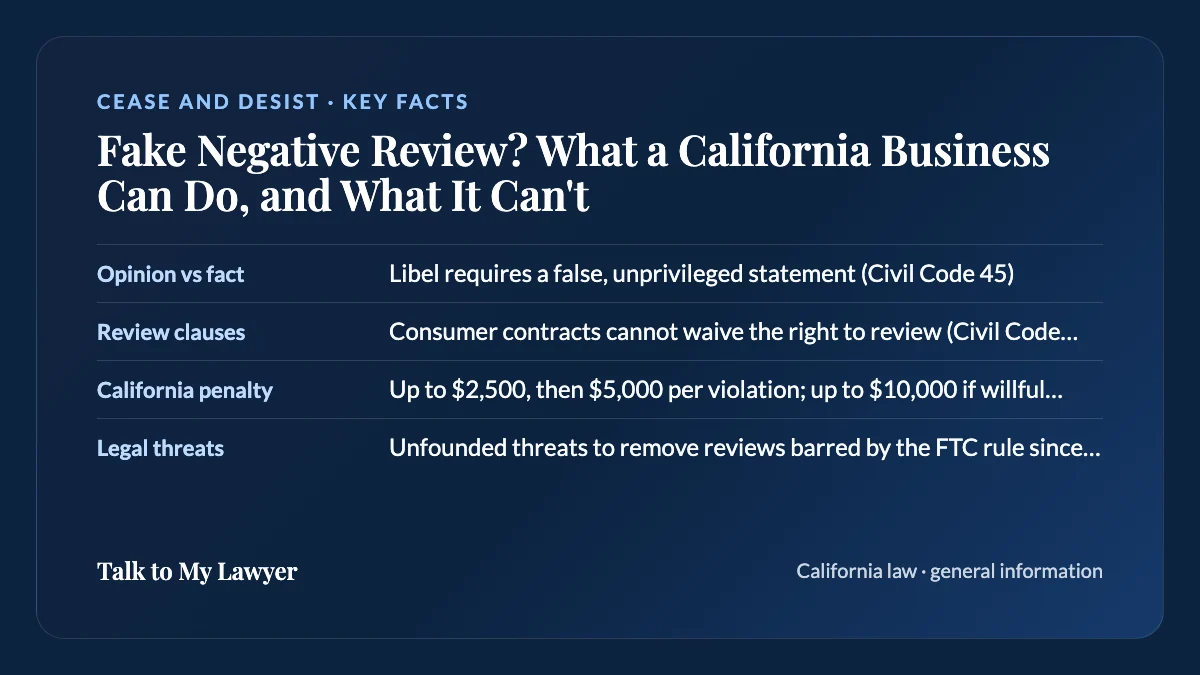
- Opinion vs fact
- Libel requires a false, unprivileged statement (Civil Code 45)
- Review clauses
- Consumer contracts cannot waive the right to review (Civil Code 1670.8; 15 U.S.C. 45b)
- California penalty
- Up to $2,500, then $5,000 per violation; up to $10,000 if willful (1670.8)
- Legal threats
- Unfounded threats to remove reviews barred by the FTC rule since October 21, 2024
- Lawsuit risk
- Anti-SLAPP motion with fee award to a winning defendant (CCP 425.16)
- Deadline
- One year to sue for libel (CCP 340(c))
What should a business do first about a fake negative review?
Preserve it, check it against your records, and report it to the platform before you do anything else. Review sites remove content under their own policies, and a report citing those rules is a route that does not require contacting the reviewer at all.
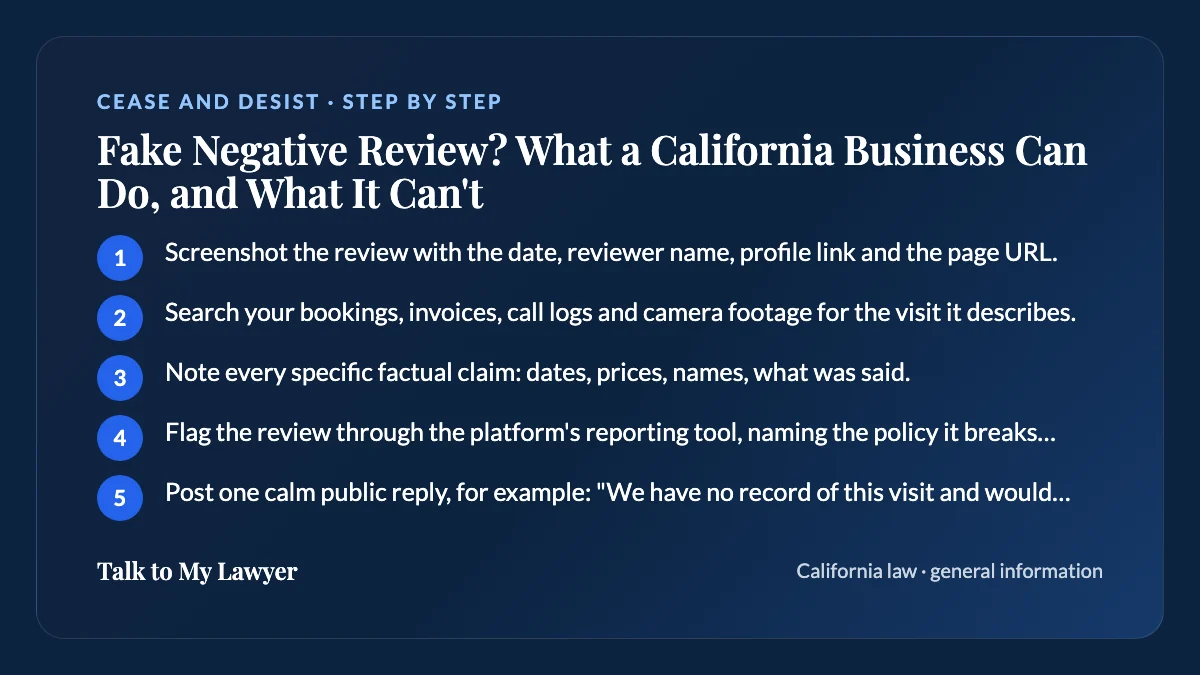
- Screenshot the review with the date, reviewer name, profile link and the page URL.
- Search your bookings, invoices, call logs and camera footage for the visit it describes.
- Note every specific factual claim: dates, prices, names, what was said.
- Flag the review through the platform's reporting tool, naming the policy it breaks, such as reviews from non-customers, conflicts of interest or off-topic content.
- Post one calm public reply, for example: "We have no record of this visit and would like to look into it. Please contact us at the number below."
- Decide whether a direct letter is warranted, using the sorting table below.
Skip the angry reply. Public responses stay up long after the review is gone, and some kinds of response, described below, can create legal exposure for the business.
Is the review fake, false, or just harsh?
The category decides what you can lawfully ask for. In California, libel is a false and unprivileged written publication that exposes a person to contempt or ridicule or tends to injure them in their occupation (Civil Code section 45). Opinion and exaggeration generally are not statements of fact.
| What the review says | How the law tends to treat it | Reasonable ask |
|---|---|---|
| "Worst haircut of my life. Overpriced." | Opinion about a real service | None beyond a reply; leave it alone |
| "They charged my card twice and refused a refund" (no such charge exists) | A checkable statement of fact that may be false | Correction or removal, with your records attached |
| Detailed story about a visit with no matching booking or payment | Possibly from a non-customer, which platform content policies may prohibit | Platform report first, then a letter if the author is known |
| Posted by a competitor, a former employee or someone paid to post it | May raise unfair competition or other claims beyond the review itself | Legal advice before any contact |
If a competitor is behind a pattern of reviews, our guide to competitor false advertising covers the unfair competition laws that may apply.
Laws that limit how a business can respond to reviews
Three sets of rules protect reviewers, and a letter that ignores them can hand the reviewer a complaint of their own.
- California Civil Code section 1670.8. A consumer contract cannot waive the customer's right to make statements about the business. It is unlawful to threaten to enforce such a clause or otherwise penalize a consumer for a protected statement. Penalties run up to $2,500 for a first violation and $5,000 for each later one, with up to $10,000 more for willful, intentional or reckless violations, and the consumer can sue to collect them.
- Consumer Review Fairness Act (15 U.S.C. section 45b). Form contract terms that restrict reviews, impose a fee for posting one, or claim ownership of review content are void, and offering a form contract that contains them is treated as a violation of an FTC rule. The act preserves defamation claims and lets a business remove content on its own site that is libelous, harassing, unrelated or clearly false.
- FTC Consumer Reviews and Testimonials Rule (16 C.F.R. part 465). In effect since October 21, 2024, it bars using unfounded or groundless legal threats, physical threats, intimidation, or public accusations the business knows are false (or makes with reckless disregard for the truth) to prevent a review or get one removed. The FTC's guidance says you may threaten legal action only if you have a legitimate basis.
Could suing the reviewer backfire under California's anti-SLAPP law?
It can. California's anti-SLAPP statute, Code of Civil Procedure section 425.16, lets a defendant ask the court to strike a claim that arises from statements made in a public forum about an issue of public interest. The plaintiff must then show a probability of winning, discovery is paused while the motion is pending, and a defendant who wins the motion is entitled to attorney's fees and costs.
Whether a particular review counts as speech on an issue of public interest depends on the facts, and that is a question for a lawyer before any suit is filed. A business with clear proof that a specific factual statement is false stands in a different position from one objecting to tone or opinion.
Timing matters too. An action for libel must be brought within one year (Code of Civil Procedure section 340(c)), so note the date the review was posted.
What a lawful letter to the reviewer should say
A lawful letter is narrow: it points to specific false statements of fact, shows why they are false, and asks for a correction. It should not demand money for an opinion, cite a contract clause about reviews, or threaten action you have no basis for.
- Quote the exact sentences you say are false, and only those.
- Explain the records that contradict each one.
- Ask for removal or correction of those sentences within a reasonable time, such as 14 days.
- Invite the reviewer to share any information you are missing, in case the visit was real.
- Keep the tone measured. The letter may be screenshotted and posted.
Your review posted on August 4 states that our clinic "charged my card $480 twice and refused a refund." Our payment processor records show no transaction under your name or card on any date, and no refund request. You are welcome to share your opinion of any service you received. We ask that you remove or correct the statement about the double charge by August 22. If we have missed a record of your visit, please let us know so we can review it.
Our guide to defamation cease and desist letters goes further into the elements of a defamation claim.
What if the reviewer is anonymous or ignores the letter?
If you cannot identify the author, the platform is usually the only practical channel short of litigation. Unmasking an anonymous poster generally requires filing a lawsuit and serving a subpoena on the platform, which brings the anti-SLAPP issues above into play. A pattern of reviews from new accounts in a short window is worth documenting and reporting as a group.
If the reviewer is known and does not respond, options include a second report to the platform with your letter attached, a reply that states your records calmly, or a consultation about a claim. Our guide to online content removal demand letters covers requests to platforms and site owners.
When a review letter should come from an attorney
A reply to a fake review carries risk in both directions: a letter that reads as an unfounded threat can break California or federal law, while one that is too vague gives the reviewer nothing to correct. Having an attorney write it is worth considering when the review states specific false facts that are hurting bookings, when you suspect a competitor or former employee, or when the reviewer has hired a lawyer or threatened an anti-SLAPP motion.
Through Talk to My Lawyer, a licensed California attorney writes your letter from the review, your booking and payment records and any platform correspondence, limits it to statements that can be shown false, and sends it on your behalf. Before filing any defamation claim, get advice on your evidence and the anti-SLAPP risk from a lawyer.
Frequently asked questions
Can I sue someone for a fake negative review in California?
You can sue for libel if a review makes a false statement of fact that harms your business, but you must file within one year, and the reviewer may bring an anti-SLAPP motion under Code of Civil Procedure section 425.16. If that motion succeeds, you may have to pay the reviewer's attorney's fees. Talk to a lawyer about your evidence before filing.
How do I get a fake review removed from Google or Yelp?
Use the platform's reporting tool and name the specific policy the review breaks, such as content from someone who was never a customer, conflicts of interest, or off-topic material. Attach or describe your evidence if the form allows. Platforms apply their own rules and decide on their own; a court order is a separate route that requires a lawsuit.
Can my customer contract stop people from leaving bad reviews?
No. California Civil Code section 1670.8 bars consumer contracts from waiving a customer's right to make statements about a business, and threatening to enforce such a term is itself unlawful. The federal Consumer Review Fairness Act also voids form contract clauses that restrict reviews, charge fees for them or claim rights to review content.
Is it legal to send a cease and desist letter to a reviewer?
Yes, if it has a legitimate basis. The FTC's Consumer Reviews and Testimonials Rule bars unfounded or groundless legal threats used to prevent or remove reviews, and its guidance says a business may threaten legal action when it has a legitimate basis. A letter focused on specific, provably false statements of fact, with evidence, is different from one objecting to a negative opinion.
Should I reply publicly to a fake review?
A short, factual reply can help readers who see the review. State that you have no record of the visit, invite the reviewer to contact you, and stop there. Avoid accusing the reviewer of lying unless you are sure, since the FTC rule also bars public accusations that are knowingly false, or made with reckless disregard for the truth, when used to suppress a review.
Sources
Checked against these official sources on October 18, 2026.
- California Civil Code section 1670.8 (California Legislative Information)
- 15 U.S. Code section 45b, Consumer Review Fairness Act (Legal Information Institute, Cornell Law School)
- Consumer Review Fairness Act: What Businesses Need to Know (Federal Trade Commission)
- The Consumer Reviews and Testimonials Rule: Questions and Answers (Federal Trade Commission)
- California Code of Civil Procedure section 425.16 (California Legislative Information)
- California Code of Civil Procedure section 340 (California Legislative Information)
This guide explains California law in general terms as of October 2026. It is general information, not legal advice for your situation, and local rules can add to it.
Join the email list and get a lawyer letter started
With Talk to My Lawyer, a licensed California attorney writes your letter from your facts and documents and sends it on your behalf. Join the Talk to My Lawyer email list for letter checklists, document prompts, and reminders before you start your letter.