Quick answer
Competitor false advertising in California can violate Business and Professions Code section 17500, which bars untrue or misleading statements the advertiser knew or should have known were false, and the Unfair Competition Law, section 17200. A competitor who lost money or property can sue under both. Federal Lanham Act section 43(a) also covers ads misrepresenting a product's qualities. A cease and desist letter can come first.
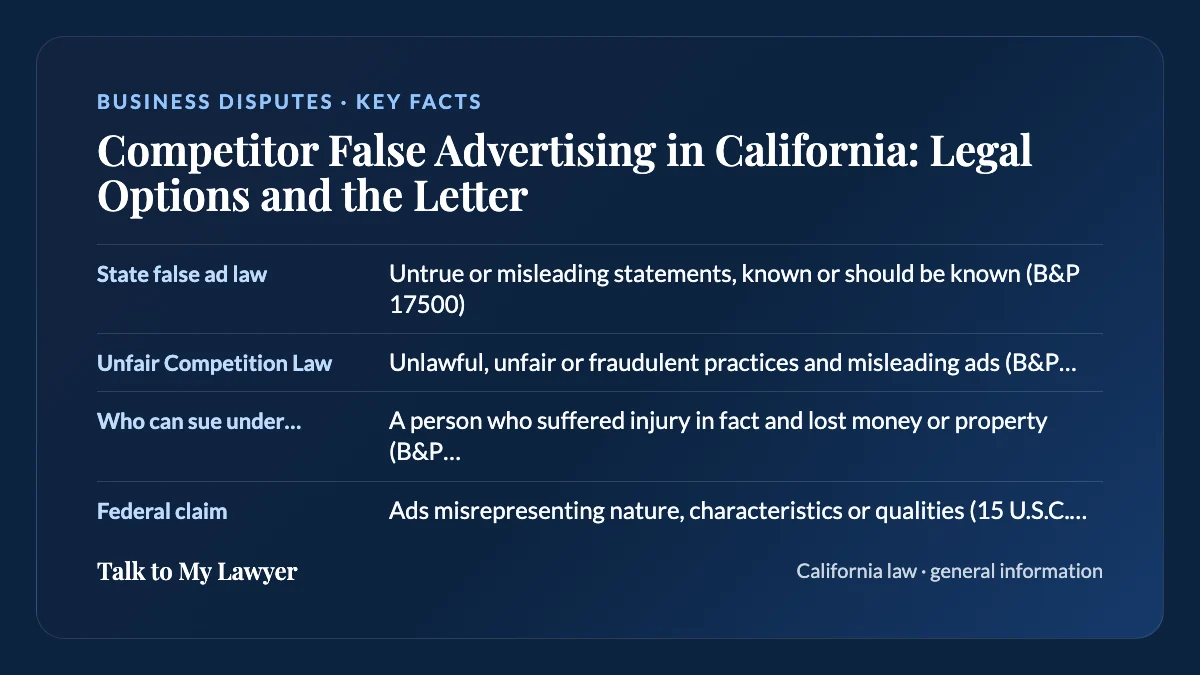
At a glance
- State false ad law
- Untrue or misleading statements, known or should be known (B&P 17500)
- Unfair Competition Law
- Unlawful, unfair or fraudulent practices and misleading ads (B&P 17200)
- Who can sue under state law
- A person who suffered injury in fact and lost money or property (B&P 17204, 17535)
- Federal claim
- Ads misrepresenting nature, characteristics or qualities (15 U.S.C. 1125(a)(1)(B))
- UCL deadline
- Four years from when the claim accrued (B&P 17208)
Can you stop a competitor's false advertising in California?
Yes, if the claim is false or misleading and it is costing you business. California's false advertising law makes it unlawful to make or spread any statement, including over the internet, that is untrue or misleading and that the advertiser knew, or by reasonable care should have known, was untrue or misleading (Business and Professions Code section 17500).
The Unfair Competition Law, or UCL, covers any unlawful, unfair or fraudulent business practice and any untrue or misleading advertising, including anything that violates section 17500 (section 17200). Federal law adds a third route: Lanham Act section 43(a) lets any person who believes they are or are likely to be damaged sue over commercial advertising that misrepresents the nature, characteristics, qualities or geographic origin of goods or services (15 U.S.C. section 1125(a)(1)(B)). Courts apply further limits on which plaintiffs qualify, so ask a lawyer whether you do.
A cease and desist letter is a low-cost opening move. It names the claim, shows why it is false and asks for it to come down. If you are unsure how that kind of letter differs from a demand for money, see our guide to what a cease and desist letter means.
California false advertising law, the UCL and the Lanham Act compared
| B&P 17500 (false advertising) | B&P 17200 (UCL) | Lanham Act 43(a) | |
|---|---|---|---|
| What it reaches | Untrue or misleading statements made to sell property or services | Unlawful, unfair or fraudulent practices and misleading ads | Commercial advertising or promotion that misrepresents goods or services |
| Private standing | Injury in fact and lost money or property (section 17535) | Injury in fact and lost money or property (section 17204) | Any person who believes they are or are likely to be damaged |
| Private remedies | Injunction and restitution (section 17535) | Injunction and restitution (section 17203) | Injunction; defendant's profits, damages and costs; fees in exceptional cases (15 U.S.C. 1117(a)) |
| Public enforcement | Also a misdemeanor: up to six months in county jail, a $2,500 fine, or both (section 17500) | Civil penalties up to $2,500 per violation, sought only by public prosecutors (section 17206) | Not applicable |
| Court | California superior court | California superior court | Federal court |
Restitution under the state laws means returning money or property acquired through the unlawful practice, which is not the same as recovering your lost profits. That difference is one reason to ask a lawyer whether the federal claim also fits.
What can a competitor lawfully say about your product?
Truthful comparison is generally allowed. A competitor can name your brand and compare price, features or test results, as long as the comparison is accurate and not misleading. What crosses the line is a specific, checkable claim that is false or that leaves a misleading impression.
For businesses advertising to California consumers, section 17508(a) singles out three claim types: claims that purport to rest on factual, objective or clinical evidence; claims comparing a product's effectiveness or safety to other brands; and claims purporting to be based on any fact. False or misleading claims of those kinds are unlawful. The Attorney General, district attorneys, city attorneys, county counsel and the Director of Consumer Affairs may also demand the evidence behind such a claim, within one year of the last day it ran (section 17508(b)).
- Likely opinion or puffery: "the friendliest service in town," "our favorite blend."
- Measurable and testable: "twice as fast as Brand X," "lab-tested to remove 99.9 percent of allergens," "the only state-certified installer."
- Misleading by omission: a price comparison that leaves out a mandatory fee, or test results from a product version no longer sold.
If the problem is a rival using your brand name or logo in a way that confuses buyers, that is a trademark issue; see our trademark cease and desist letter guide.
Example: one ad, three problems
Example (hypothetical): a water filter company sees a competitor's paid search ad and landing page with these lines.
| Claim in the ad | Why it may be false or misleading | Evidence to gather |
|---|---|---|
| "Filters twice as fast as Brand A" | Your published flow rate is higher than theirs | Spec sheets for both products and an independent test if you have one |
| "The only NSF-certified filter sold in California" | Your product holds the same certification | Your certificate and the certifier's public listing |
| "Brand A filters were recalled" | No recall ever happened | Regulator recall database search results, dated |
The third line is about you rather than their product, so it may also raise trade libel questions. A letter would address each line separately and ask for each one to be removed.
Building the letter: evidence first, then the demand
Your letter is only as strong as the proof that the statement is false and that it reached buyers. Collect it before you write, and keep originals in case the ads change.
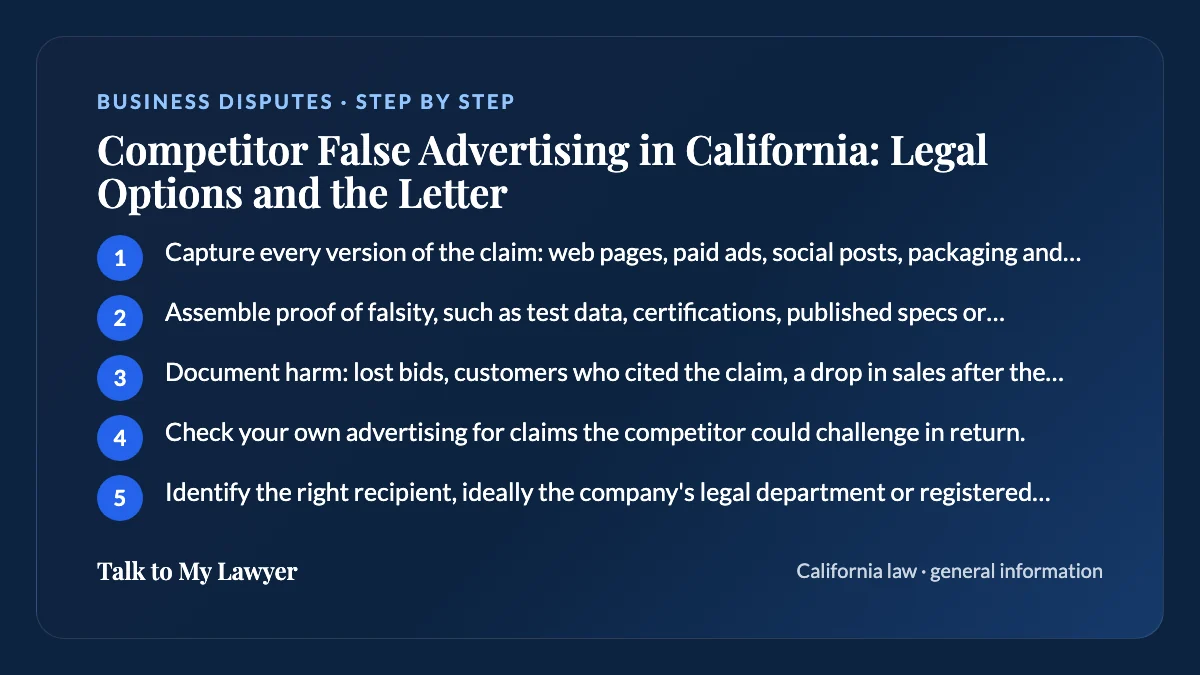
- Capture every version of the claim: web pages, paid ads, social posts, packaging and sales sheets, with dates and URLs.
- Assemble proof of falsity, such as test data, certifications, published specs or public records.
- Document harm: lost bids, customers who cited the claim, a drop in sales after the campaign began.
- Check your own advertising for claims the competitor could challenge in return.
- Identify the right recipient, ideally the company's legal department or registered agent; the steps for finding a business's legal name apply here.
- Write the demand: quote each claim, explain why it is false, and ask that it be removed or corrected by a set date.
- Ask the competitor to preserve its ad files and substantiation, and keep yours.
Your website and Google Ads state that your filter "filters twice as fast as Brand A." Brand A's published flow rate is 2.1 gallons per minute and yours is 1.6, as shown in the enclosed specification sheets. This statement is untrue and misleading under California Business and Professions Code sections 17200 and 17500 and section 43(a) of the Lanham Act. Please remove it from all advertising by June 20 and confirm in writing that it will not be used again.
What happens if the competitor ignores the letter?
You have several paths, and they can be combined:
- Lawsuit for an injunction under the UCL or section 17500 in state court, or under the Lanham Act in federal court. UCL claims must be brought within four years of accrual (section 17208).
- Report to public enforcers. The Attorney General or a local district attorney can investigate, request substantiation under section 17508 and seek civil penalties.
- Platform complaints. Ad networks and marketplaces have their own policies on misleading claims and may remove ads that break them.
The competitor may answer through counsel, and may question your own advertising in return. Our guide to receiving a cease and desist letter shows what the other side will be weighing.
Sending a false advertising demand through an attorney
A false advertising demand may end up on the competitor's lawyer's desk, and it can invite a close look at your own ads. Attorney drafting is worth weighing when the claim targets your brand by name, when a campaign is running across several channels, when you may need an injunction, or when you want the letter to set up claims under both California law and the Lanham Act.
Through Talk to My Lawyer, a licensed California attorney writes your letter from your screenshots, test data and sales records, ties each challenged claim to the law it violates, and sends it on your behalf. Whether to file suit, and in which court, is a question for a lawyer who has seen your evidence.
Frequently asked questions
Can I sue a competitor for false advertising in California?
Yes, if you meet the standing rules. Under Business and Professions Code sections 17204 and 17535, a private party must have suffered injury in fact and lost money or property because of the false advertising. Remedies under the state laws are injunctions and restitution. The federal Lanham Act separately allows suits by anyone likely to be damaged, with possible recovery of profits and damages.
Is it illegal to compare your product to a competitor's by name?
No. Comparative advertising is lawful when it is truthful and not misleading. California Business and Professions Code section 17508 specifically makes false or misleading comparisons of effectiveness or safety unlawful, and allows public officials to demand the evidence behind such claims. An accurate comparison of price or features, with support, is generally allowed.
What is the difference between puffery and false advertising?
Puffery is vague praise no reasonable buyer treats as a measurable fact, such as "the best coffee in town." False advertising involves specific claims that can be tested and shown wrong, such as speed, test results, certifications or prices. The more precise and checkable a claim is, the more likely a court will treat it as a statement of fact.
How long do I have to bring a false advertising claim in California?
Unfair Competition Law claims must be filed within four years after the cause of action accrued (Business and Professions Code section 17208). Other claims, including those under section 17500 and the Lanham Act, may follow different rules. Because ads change quickly, document each version with dates as soon as you see it, and ask a lawyer which deadline applies.
Can the government fine a competitor for false ads?
Yes. Public prosecutors, including the Attorney General and district attorneys, can seek civil penalties of up to $2,500 per violation under the Unfair Competition Law, and section 17500 violations are also misdemeanors. Private competitors cannot collect those penalties, but they can report the ads and share their evidence with enforcers.
Sources
Checked against these official sources on October 18, 2026.
- California Business and Professions Code section 17500 (California Legislative Information)
- California Business and Professions Code section 17508 (California Legislative Information)
- California Business and Professions Code section 17535 (California Legislative Information)
- Business and Professions Code sections 17200 to 17210 (Unfair Competition Law enforcement) (California Legislative Information)
- 15 U.S. Code section 1125 (Legal Information Institute, Cornell Law School)
- 15 U.S. Code section 1117 (Legal Information Institute, Cornell Law School)
This guide explains California law in general terms as of October 2026. It is general information, not legal advice for your situation, and local rules can add to it.
Join the email list and get a lawyer letter started
With Talk to My Lawyer, a licensed California attorney writes your letter from your facts and documents and sends it on your behalf. Join the Talk to My Lawyer email list for letter checklists, document prompts, and reminders before you start your letter.