Quick answer
If you received a cease and desist letter, you have not been sued. It is a private demand, not a court order. Note the deadline, keep every related file, identify the legal claim (copyright, trademark, defamation, contract or harassment), check whether insurance may cover it, and decide whether to comply, negotiate or dispute in writing. Some claims have short time limits, such as one year for defamation in California.
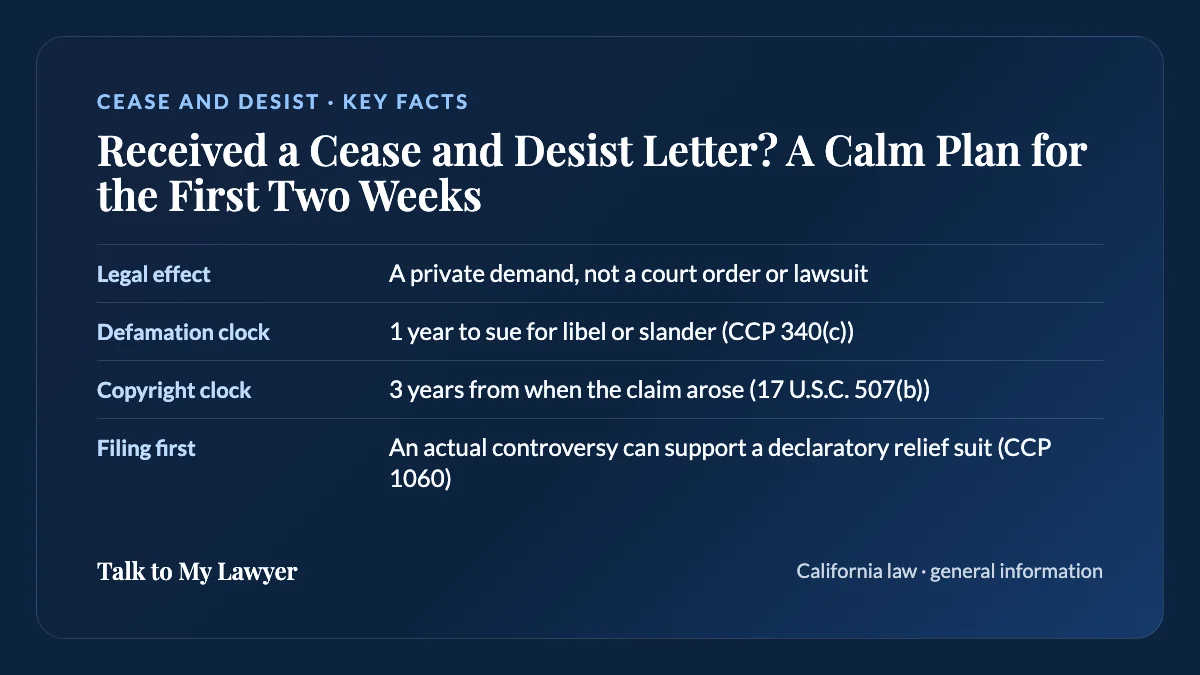
At a glance
- Legal effect
- A private demand, not a court order or lawsuit
- Defamation clock
- 1 year to sue for libel or slander (CCP 340(c))
- Copyright clock
- 3 years from when the claim arose (17 U.S.C. 507(b))
- Filing first
- An actual controversy can support a declaratory relief suit (CCP 1060)
- Speech claims
- Anti-SLAPP motion within 60 days of service of a complaint (CCP 425.16(f))
Does receiving a cease and desist letter mean you are being sued?
No. What you are holding is a private demand from a person, a company or its lawyer. It has no court seal, no case number and no power on its own to force you to do anything. A lawsuit starts with a filed complaint and formal service of court papers on you.
That does not make the letter meaningless. It tells you what the sender believes you did, it can be evidence later that you were on notice, and it can signal what the sender plans to file if you do not respond. A sender is also free to sue without ever sending one.
For the sender's side of this document, our guide on what a cease and desist letter is explains why people send them and what they usually ask for.
What to do in the first 48 hours
Slow down, keep everything and write things down. The first two days set up every option you have later.
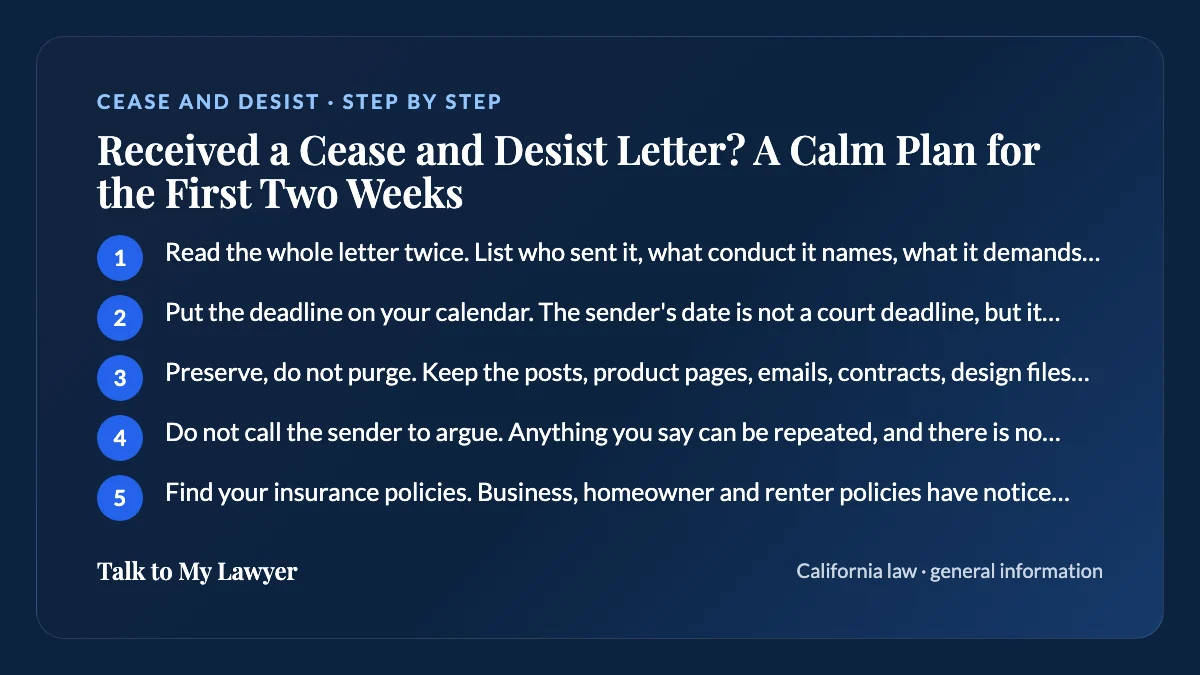
- Read the whole letter twice. List who sent it, what conduct it names, what it demands and the response date.
- Put the deadline on your calendar. The sender's date is not a court deadline, but it is the point at which the sender says it will decide on next steps.
- Preserve, do not purge. Keep the posts, product pages, emails, contracts, design files and texts the letter mentions. If you decide to take content down, save a dated copy first. Destroying evidence after you know a dispute exists can be used against you.
- Do not call the sender to argue. Anything you say can be repeated, and there is no record of what you meant.
- Find your insurance policies. Business, homeowner and renter policies have notice requirements, and late notice can complicate coverage.
- Write a short timeline. When you created the work, began using the name, posted the review or signed the contract, with documents for each date.
How do you tell whether the claim in the letter is real?
Name the legal theory first, then ask what the sender would have to prove. One letter can mix several theories, and a demand that sounds sweeping can rest on a narrow claim.
| Claim in the letter | What the sender generally has to show | Time limit or remedy to know |
|---|---|---|
| Copyright | It owns a protected work and you copied its protected expression, as opposed to an idea or a fact | Suit within 3 years (17 U.S.C. 507(b)); statutory damages of $750 to $30,000 per work, up to $150,000 if willful (17 U.S.C. 504(c)) |
| Trademark | It has rights in a mark and your use is likely to confuse buyers about the source | Federal Lanham Act claims; the letter may demand a name or logo change |
| Defamation | You published a false statement of fact about it that caused harm; truth and opinion are common defenses | Suit within 1 year (CCP 340(c)) |
| Breach of contract (NDA, non-solicitation) | A valid agreement, a promise you broke and resulting loss | 4 years on a written contract (CCP 337); 2 years on an oral one (CCP 339) |
| Use of name or photo in ads | Knowing use of identity to sell without consent | Greater of $750 or actual damages, plus profits (Civil Code 3344) |
Check the dates against these windows. A defamation letter about a review you posted three years ago reads very differently from one about last week's post. Patent letters are their own category; see our guide to a patent infringement letter you received.
Can answering a cease and desist letter lead to a lawsuit, or let you file first?
Yes, in both directions. A letter that threatens suit can create what courts call an actual controversy, and either side may then ask a court to decide who is right.
- Declaratory relief. California lets a person in an actual controversy over a contract or their legal rights ask the superior court for a binding declaration, even before any breach (Code of Civil Procedure section 1060). Federal courts have a similar power (28 U.S.C. 2201). Some recipients use this to have a court rule that their logo or product does not infringe.
- The sender may file quickly. A defiant reply can prompt the sender to file instead of waiting. Weigh tone carefully.
- Speech claims. If the sender later sues you over something you said on a public issue, California's anti-SLAPP law allows a special motion to strike, generally filed within 60 days of service of the complaint. A defendant who wins that motion is generally entitled to attorney's fees and costs (CCP 425.16(c) and (f)).
Whether to file first, or whether a claim qualifies for an anti-SLAPP motion, depends on your facts. Talk to a lawyer before taking either step.
Could insurance cover a cease and desist claim?
Possibly, so read your policies before you reply. Some commercial general liability policies include coverage called personal and advertising injury, which can reach certain defamation and advertising-related claims. Media, professional and homeowner policies vary widely.
Look for the notice clause, which tells you how and when to report a claim, and for exclusions such as intellectual property carve-outs. Send the insurer a copy of the letter in writing and keep proof you sent it. Coverage depends on the exact policy wording, so do not assume either way.
Your response options, from compliance to a firm no
You have more choices than giving in or ignoring it. A written answer keeps a clean record whatever you decide.
| Option | When it fits | What to watch |
|---|---|---|
| Comply | The claim has merit or the cost of a fight outweighs the change | Confirm in writing what you changed, and avoid admitting liability or damages |
| Partial change | Part of the claim is fair, such as one image or one phrase | Say what you changed and why the rest stays |
| Ask for support | The letter makes ownership or falsity claims without proof | Request registration numbers, the specific statements, or the contract clause |
| Dispute | You have a defense such as truth, prior use or no contract | State facts calmly; overstatement can be quoted back |
| Negotiate | Both sides want to avoid court | An offer to compromise, and what is said while negotiating it, cannot be used to prove liability (Evidence Code 1152) |
| No reply | A letter with no plausible basis, such as an obvious scam | Silence leaves the sender's version as the only written account |
We received your letter dated September 30 regarding the Juniper Lane product line. We take the concerns seriously and are reviewing them. Our records show we adopted the name in March 2023 and have used it continuously since. To evaluate your claim, please identify the registration or first-use date you rely on and the specific products you believe cause confusion. We will respond further by October 24. This letter is not an admission of any claim.
Example: one letter, three possible answers
Example (hypothetical): a ceramics seller in Oakland receives a letter from a larger brand saying the seller's mug line, sold under a similar two-word name, infringes its trademark. The letter demands that all listings come down in 10 days and that the seller pay $15,000.
- If the seller's records show it used the name first, the reply can set out those dates and decline the demand.
- If the products overlap and the seller started later, a rebrand on a reasonable timeline with no payment may be a fair counteroffer.
- If the seller's business policy covers advertising injury, the seller notifies the insurer before answering so it does not miss a notice condition.
In each version, the seller keeps the old listings saved, writes down its first-use date with proof, and replies in writing before the stated deadline.
When the letter names your business or your livelihood
Your reply to a cease and desist letter can be quoted back to you, word for word, if the dispute reaches court. Having a lawyer write it can make sense when the sender is represented by counsel, when the letter demands money or a rebrand, when your income depends on the work or name in question, or when a speech claim may later raise anti-SLAPP issues.
Through Talk to My Lawyer, a licensed California attorney writes your response letter from your facts and documents, such as your timeline, first-use records and the letter itself, and sends it on your behalf. For advice on whether to file first or how to defend a lawsuit, talk to a lawyer about your facts. If the envelope held a request for money rather than a demand to stop, see responding to a demand letter.
Frequently asked questions
Do I have to obey a cease and desist letter?
Not as a legal command. The letter is a request from the other side, and only a court order can compel you to act. It can still matter: it shows you were told about the claim, which can be relevant to issues like willfulness in a copyright case, and it may come before a lawsuit. A court order, such as an injunction, is different and must be obeyed.
Should I ignore a cease and desist letter?
Ignoring it is a choice, but it leaves the sender's version as the only written account of the dispute and leaves the next move entirely to the sender. A short written reply that acknowledges receipt, asks for support for the claim or sets out your position keeps a record. If the letter is from a lawyer or demands money, consider getting legal advice before deciding.
Can I be sued after I comply with a cease and desist?
Yes. Stopping the conduct does not erase a claim for past harm, such as damages for earlier copying or a past defamatory post. That is why a written settlement or release, which a lawyer can review, matters if the sender also wants money. Compliance can still narrow the dispute and may affect what remedies a court would consider.
Is there a legal deadline to answer a cease and desist?
There is no legal deadline to answer a private letter. The date in the letter is the sender's own choice. The deadlines that matter come from the law: limitation periods for the sender to sue, such as one year for defamation in California, and court deadlines once you are served. If you need more time, ask for it in writing.
What if the cease and desist letter is a scam?
Some letters, especially emailed copyright or domain notices, are not from the rights holder at all. Check that the sender's firm or company exists using official sources, look up any registration number it cites, and never pay through a link in the letter. You can confirm a California lawyer's license on the State Bar of California website before responding.
Sources
Checked against these official sources on October 18, 2026.
- California Code of Civil Procedure section 340 (California Legislative Information)
- California Code of Civil Procedure section 1060 (California Legislative Information)
- California Code of Civil Procedure section 425.16 (California Legislative Information)
- California Evidence Code section 1152 (California Legislative Information)
- 17 U.S. Code section 504: Remedies for infringement (Legal Information Institute, Cornell Law School)
- 17 U.S. Code section 507: Limitations on actions (Legal Information Institute, Cornell Law School)
This guide explains California law in general terms as of October 2026. It is general information, not legal advice for your situation, and local rules can add to it.
Join the email list and get a lawyer letter started
With Talk to My Lawyer, a licensed California attorney writes your letter from your facts and documents and sends it on your behalf. Join the Talk to My Lawyer email list for letter checklists, document prompts, and reminders before you start your letter.