Quick answer
If you received a patent infringement letter, read it closely but do not reply right away. Check that the patent exists, who owns it, whether its maintenance fees are paid and when it expires, then compare its claims to your product. Federal law governs patents: damages reach back at most six years before a lawsuit (35 U.S.C. section 286), and a letter is not a lawsuit.
At a glance
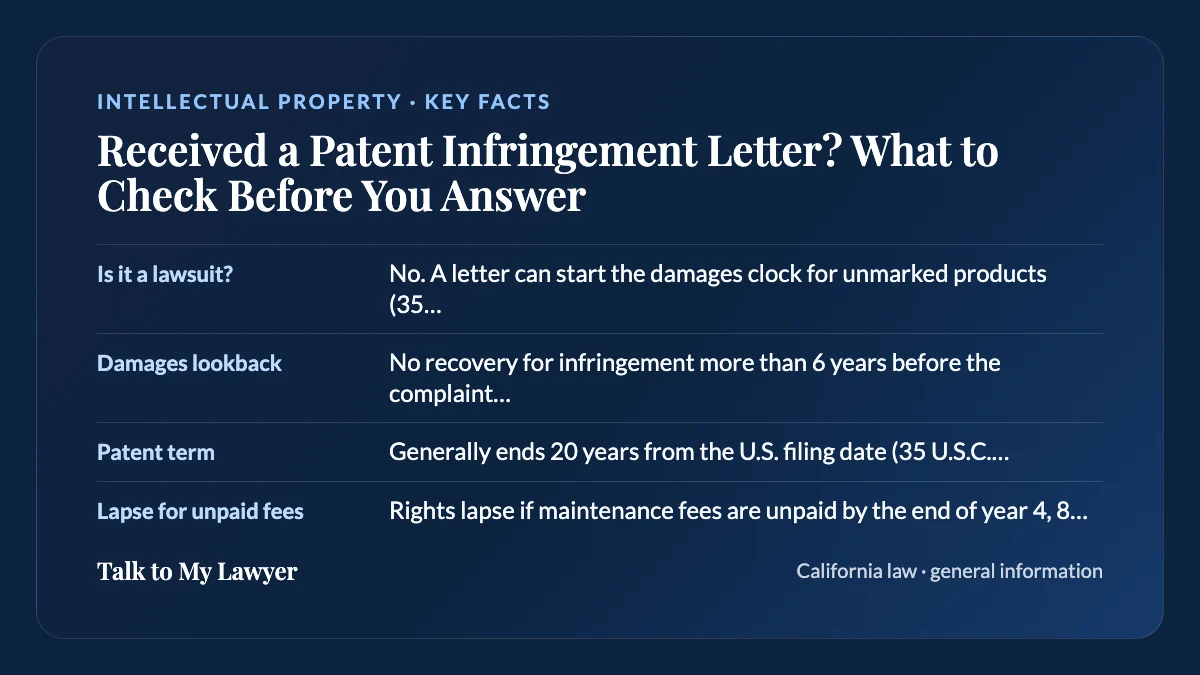
- Is it a lawsuit?
- No. A letter can start the damages clock for unmarked products (35 U.S.C. 287(a))
- Damages lookback
- No recovery for infringement more than 6 years before the complaint (35 U.S.C. 286)
- Patent term
- Generally ends 20 years from the U.S. filing date (35 U.S.C. 154(a)(2))
- Lapse for unpaid fees
- Rights lapse if maintenance fees are unpaid by the end of year 4, 8 or 12 after issue (USPTO)
- Validity challenge timing
- Inter partes review barred if filed more than 1 year after you are served with a complaint (35 U.S.C. 315(b))
What should you do after you receive a patent infringement letter?
Slow down and gather facts before anyone answers. A patent letter is an opening move, not a court order, and the most useful early work is quiet: reading, checking and saving records.
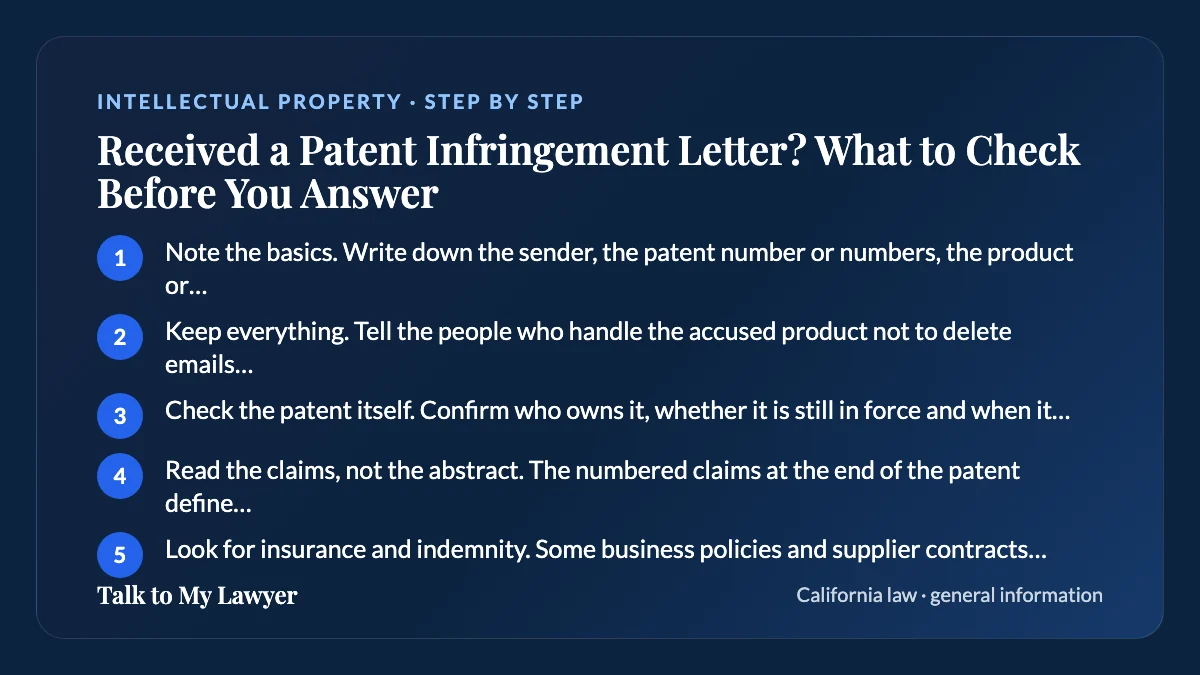
- Note the basics. Write down the sender, the patent number or numbers, the product or feature accused, any deadline, and what the letter asks for (a license fee, a stop, or a meeting).
- Keep everything. Tell the people who handle the accused product not to delete emails, design files, sales records or older versions of the code or product.
- Check the patent itself. Confirm who owns it, whether it is still in force and when it expires, using the public USPTO records described below.
- Read the claims, not the abstract. The numbered claims at the end of the patent define what it covers.
- Look for insurance and indemnity. Some business policies and supplier contracts address intellectual property claims. Read the notice terms.
- Hold your reply. Avoid phone calls or emails that describe how your product works or concede anything until you know what the patent covers.
If the letter came from a competitor about a trademark or copyright instead, the rules are different. Our guide to what to do after a cease and desist letter covers those.
Why do patent owners send letters before suing?
A letter can change how much money is at stake later. Under 35 U.S.C. section 287(a), a patent owner who sells a patented product without marking it with the patent number generally cannot recover damages until the accused infringer is notified. After that notice, damages can be recovered for infringement that continues. A detailed letter may be the sender's way of creating that notice.
Notice can also feed an argument about willfulness. Under section 284, a court may increase damages up to three times the amount found. Under section 285, a court may award attorney fees to the prevailing party, but only in exceptional cases.
How do you check whether the patent is valid, owned and still in force?
The first-round checks use free public records from the U.S. Patent and Trademark Office (USPTO). Each one can change the value of the claim against you.
| What to check | Where | Why it matters |
|---|---|---|
| Full text and claims | USPTO Patent Public Search | The claims define the patent's scope. From November 7, 2026, the USPTO says this tool requires signing in with a USPTO account. |
| Who owns it | USPTO Assignment Center records | The sender should be the owner or have a right to enforce. A mismatch is worth asking about. |
| Maintenance fees | USPTO maintenance fee records | If fees go unpaid by the end of year 4, 8 or 12 after issue, the USPTO says patent rights lapse and are no longer enforceable. |
| Expiration | Filing date on the patent | The term generally ends 20 years from the U.S. filing date, or the earliest related filing it claims (35 U.S.C. section 154(a)(2)). |
| Damages window | Dates of your sales | No recovery for infringement more than six years before the complaint or counterclaim is filed (35 U.S.C. section 286). |
An expired patent can still support a claim for past damages within the six-year window. It cannot stop future sales.
How can you tell if your product actually infringes the patent?
Infringement is measured claim by claim. A product generally infringes a claim only if it contains every element that claim describes. A letter that only names the patent and your product, without showing how each element is met, leaves the hardest question unanswered.
Example (hypothetical): a small online furniture store receives a letter saying its 'room preview' feature infringes a patent. Claim 1 requires five steps, including a 3D scan taken by the customer's phone. The store's tool uses flat product photos and no scanning. If that is accurate, the store can ask the sender to identify where the scan element appears, which the letter never addressed.
Asking for a claim chart (a table matching each claim element to a feature of your product) is a common, calm first request. Building one takes real work, so the reply shows how closely the sender studied your product.
What if the letter looks like a bad-faith patent shakedown?
Some patent letters are sent in bulk with little investigation. In 2014 the Federal Trade Commission settled charges against MPHJ Technology Investments, which the FTC said sent thousands of letters to small businesses claiming many companies had already paid for licenses, and law firm letters threatening suits within two weeks that were never filed. The settlement barred the company and its lawyers from false or unsupported claims about how widely the patents had been licensed, and from misrepresenting that a lawsuit was coming.
- The letter names no specific claim or product feature.
- It cites other companies that supposedly paid, with no names or numbers you can check.
- It sets a very short deadline and a fee that looks priced to be cheaper than a lawyer.
- The sender is a company you cannot connect to the patent's recorded owner.
Several states have passed laws aimed at bad-faith patent demand letters. Which state laws, if any, reach a particular sender is a question for a lawyer, because patent rights themselves are federal. Even a letter that looks like a shakedown can call for a measured written answer rather than silence.
How can you respond to a patent demand letter?
The right response depends on what your checks turn up. These are the common paths, and more than one can run at the same time.
- Ask for specifics. Request the asserted claims, a claim chart and proof of ownership. This commits you to nothing.
- Deny with reasons. If the patent is expired, lapsed, or plainly does not read on your product, say so briefly.
- Negotiate. If the claim holds up after your checks, a license or a design change is one way to resolve it.
- Challenge validity. A petition for inter partes review asks the USPTO's Patent Trial and Appeal Board to reconsider the patent. It cannot be instituted if filed more than one year after you are served with an infringement complaint (35 U.S.C. section 315(b)).
- Notify partners. A supplier or platform that provided the accused technology may have duties under your contract.
We received your letter dated March 3 concerning U.S. Patent No. [number]. To evaluate your assertion, please identify each claim you contend is infringed, provide a chart showing where each element of those claims appears in our product, and provide documents showing your right to enforce the patent. Nothing in this letter is an admission of any kind, and we reserve all rights.
General points about tone, and the rules that keep settlement offers out of evidence, are in our step-by-step plan for answering any demand.
Answering a patent letter through a California attorney
A short request for a claim chart is something a business owner can send without help. Patent letters raise harder questions when the sender has already filed suits, when a license fee is significant, when the accused feature came from a vendor, or when you want your position on expiration or non-infringement stated precisely and on the record.
Through Talk to My Lawyer, a licensed California attorney writes your response letter from the demand you received, your product details and your USPTO findings, and sends it on your behalf. For an infringement or validity opinion, talk to a registered patent attorney about your facts.
Frequently asked questions
Should I ignore a patent infringement letter?
Ignoring it has risks. If the patented product was not marked, the letter may serve as notice that starts the damages clock under 35 U.S.C. section 287(a), and continued sales after notice can matter to a willfulness argument. A brief written reply that asks for specifics and admits nothing is different from silence. Whether and how to answer should be weighed with a lawyer who has read the letter.
How do I find out if a patent is expired?
Look up the patent's filing date and maintenance fee status in USPTO records. A utility patent generally expires 20 years from its U.S. filing date, or from the earliest related application it claims. It can also lapse early: the USPTO says rights lapse if maintenance fees and surcharges are not paid by the end of the 4th, 8th or 12th year after issue. An expired patent can still support claims for past damages.
Can a patent owner collect damages for sales from many years ago?
Not for infringement more than six years before the complaint or counterclaim is filed. Section 286 of the Patent Act sets that limit. Within those six years, damages may still be limited if the owner sold unmarked products and did not give notice. Keep sales records organized by date so the numbers can be separated if the dispute moves forward.
What is a claim chart and can I ask for one?
A claim chart is a table that lists each element of a patent claim beside the part of the accused product said to meet it. You can ask the sender for one in writing. Nothing requires a sender to provide it before suing, but the request is reasonable and the reply, or lack of one, helps show how carefully the claim was investigated.
Is there a deadline to challenge a patent at the USPTO?
For inter partes review, yes. A petition cannot be instituted if it is filed more than one year after the petitioner, a real party in interest or a privy is served with a complaint alleging infringement of the patent (35 U.S.C. section 315(b)). A demand letter alone does not start that one-year clock. Service of a lawsuit does.
Sources
Checked against these official sources on October 18, 2026.
- 35 U.S. Code section 287: Limitation on damages and other remedies; marking and notice (Legal Information Institute, Cornell Law School)
- 35 U.S. Code section 286: Time limitation on damages (Legal Information Institute, Cornell Law School)
- 35 U.S. Code section 315: Relation to other proceedings or actions (Legal Information Institute, Cornell Law School)
- 35 U.S. Code section 298: Advice of counsel (Legal Information Institute, Cornell Law School)
- Maintain your patent (U.S. Patent and Trademark Office)
- FTC Settlement Bars Patent Assertion Entity From Using Deceptive Tactics (Federal Trade Commission)
This guide explains California law in general terms as of October 2026. It is general information, not legal advice for your situation, and local rules can add to it.
Join the email list and get a lawyer letter started
With Talk to My Lawyer, a licensed California attorney writes your letter from your facts and documents and sends it on your behalf. Join the Talk to My Lawyer email list for letter checklists, document prompts, and reminders before you start your letter.