Quick answer
Two California statutes shape franchise disputes beyond the contract. The Franchise Relations Act (Business and Professions Code 20000 and following) generally requires good cause, 60 days' notice and a chance to cure before termination, and 180 days' notice of nonrenewal. The Franchise Investment Law (Corporations Code 31000 and following) governs the sale, including delivery of the disclosure document at least 14 days before signing or payment.
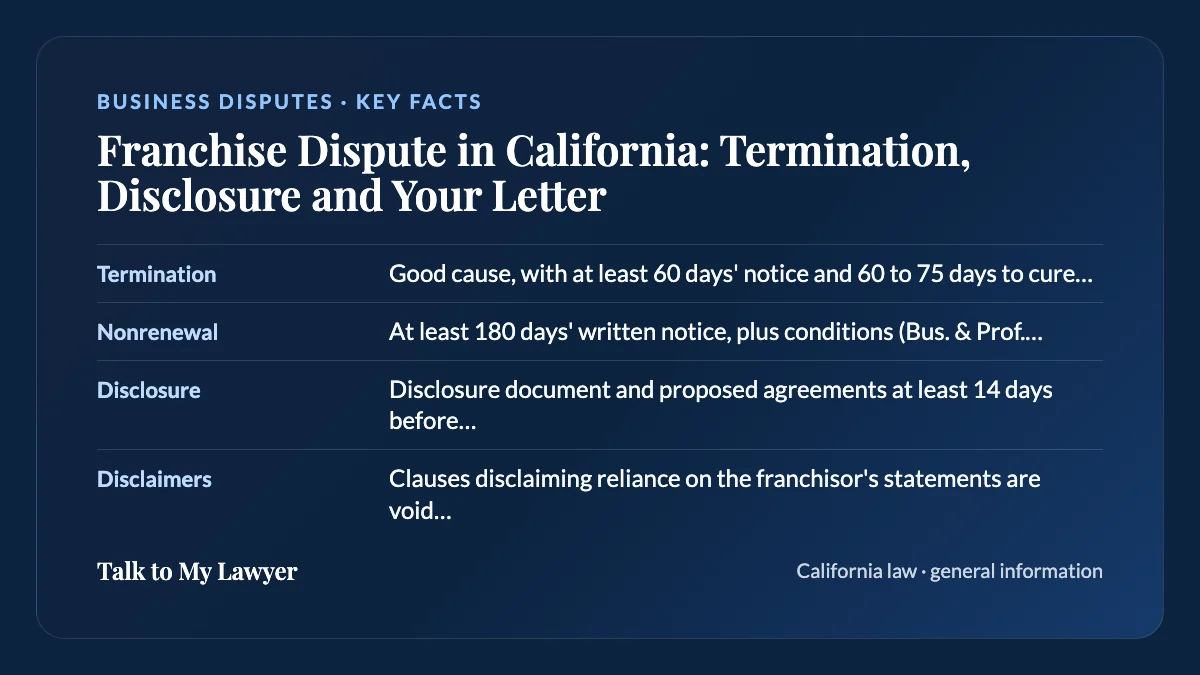
At a glance
- Termination
- Good cause, with at least 60 days' notice and 60 to 75 days to cure (Bus. & Prof. Code 20020)
- Nonrenewal
- At least 180 days' written notice, plus conditions (Bus. & Prof. Code 20025)
- Disclosure
- Disclosure document and proposed agreements at least 14 days before signing or payment (Corp. Code 31119)
- Disclaimers
- Clauses disclaiming reliance on the franchisor's statements are void (Corp. Code 31512.1)
- Deadline for sale claims
- Earliest of 4 years, 1 year after discovery, or 90 days after a qualifying notice (Corp. Code 31303)
- Venue
- Out-of-state venue clauses void for franchises operating in California (Bus. & Prof. Code 20040.5)
Which California franchise law covers your dispute?
It depends on when the problem arose. Disputes about how the franchise was sold fall under the Franchise Investment Law. Disputes about ending the relationship fall under the Franchise Relations Act. Day-to-day disagreements often come down to the franchise agreement itself.
| Issue | Main law | Examples |
|---|---|---|
| The sale | Franchise Investment Law, Corporations Code 31000 and following | Late or missing disclosure document, unregistered offer, misleading earnings claims |
| Termination or nonrenewal | Franchise Relations Act, Business and Professions Code 20000 and following | Termination without a chance to cure, nonrenewal without 180 days' notice |
| Ongoing obligations | The franchise agreement and general contract law | Royalty calculations, territory, required suppliers, marketing fund use |
Both statutes apply only to a franchise as California defines it: a right to sell goods or services under a marketing plan prescribed in substantial part by the franchisor, substantially associated with its trademark, in exchange for a franchise fee paid directly or indirectly (Corporations Code section 31005; the Franchise Relations Act uses the same three-part test in Business and Professions Code section 20001). A license or distributorship can qualify even if nobody called it a franchise.
Can a franchisor terminate a California franchise early?
Only for good cause, as a general rule. Under Business and Professions Code section 20020, good cause is limited to a failure to substantially comply with the lawful requirements of the franchise agreement after the franchisee receives at least 60 days' notice and a reasonable opportunity to cure of at least 60 days. The cure period cannot exceed 75 days unless the parties separately agree.
Section 20021 lists events that allow immediate termination without a chance to cure, including:
- Bankruptcy, insolvency or an assignment for the benefit of creditors.
- Abandonment, such as failing to operate for five consecutive required days, unless caused by fire, flood, earthquake or similar events beyond the franchisee's control.
- A written agreement to terminate.
- Material misrepresentations in acquiring the franchise, or conduct that reflects materially and unfavorably on the system.
- Failing for 10 days after notice to comply with a law or regulation that applies to the business.
- Repeated noncompliance, or the same noncompliance after a cure.
- Failing to pay fees within five days after written notice that they are overdue.
- A reasonable determination that continued operation poses an imminent danger to public health or safety.
For franchise agreements entered into, amended or renewed on or after January 1, 2023, a lawful termination or nonrenewal triggers section 20022, which generally requires the franchisor to buy back inventory, supplies, equipment, fixtures and furnishings bought from it or its approved suppliers, at the price paid minus depreciation, subject to exceptions. The franchisor may offset amounts the franchisee owes only if the franchisee agrees to the amount or a final adjudication has fixed it.
How much notice does a franchisor need to give before not renewing?
At least 180 days' prior written notice of its intention not to renew (Business and Professions Code section 20025). Notice alone is not enough: the statute also requires that one of several conditions be met, such as:
- Letting the franchisee sell the business during those 180 days to a buyer who meets the franchisor's current requirements.
- Not refusing renewal in order to take over the location with company staff, and agreeing not to enforce a noncompete against the franchisee after expiration.
- Grounds that would permit termination under sections 20020 or 20021.
- A mutual agreement not to renew.
- Withdrawal from the franchisee's geographic market, with protections for the franchisee.
- The franchisee's failure to accept renewal terms substantially the same as those the franchisor then customarily offers.
What if the franchise was sold with missing or misleading disclosures?
California makes it unlawful to sell a franchise that must be registered without first giving the buyer the franchise disclosure document and all proposed agreements at least 14 days before signing a binding agreement or paying anything, whichever comes first (Corporations Code section 31119). An offer must be registered with the state's Department of Financial Protection and Innovation unless an exemption applies (section 31110). The federal FTC Franchise Rule sets a similar 14-calendar-day disclosure period.
Untrue statements or misleading omissions of material fact in sales communications are also unlawful (section 31201). For violations of the registration and 14-day disclosure rules, among others, section 31300 makes the seller liable for damages, and for rescission if the violation was willful. Misstatement claims can rest on different provisions, so the claim needs to be matched to the right statute.
The deadline is short. A claim under section 31300 must be brought within four years of the violation, one year after you discover it, or 90 days after a qualifying written notice disclosing a violation, whichever expires first (section 31303).
What remedies does a California franchisee have?
For a termination or nonrenewal that violates the Franchise Relations Act, the franchisee is entitled to the fair market value of the franchised business and franchise assets plus other damages caused by the violation, and a court may grant preliminary and permanent injunctions (Business and Professions Code section 20035). The franchisor may offset certain amounts the franchisee owes (section 20036).
Two clauses to check in your agreement: a provision restricting venue to a forum outside California is void for claims involving a franchise operating in California (section 20040.5), and any provision requiring a franchisee to waive the Franchise Investment Law is void (Corporations Code section 31512). Arbitration clauses raise separate questions that a lawyer should look at.
Steps to write a franchise dispute letter
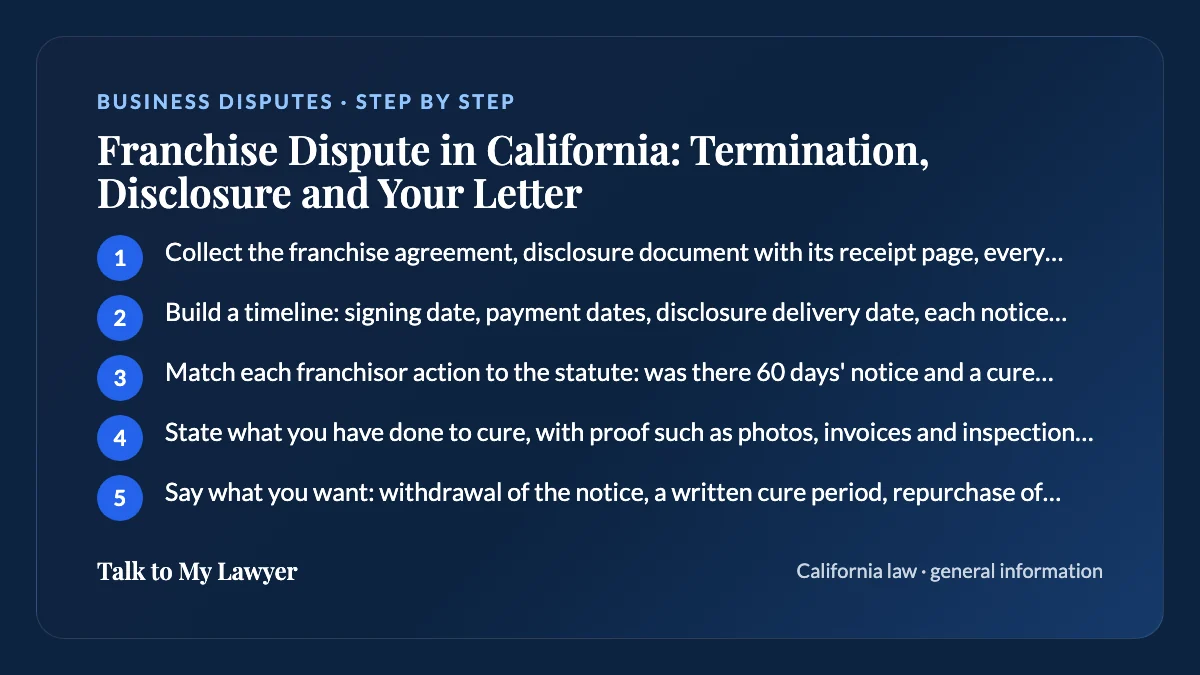
- Collect the franchise agreement, disclosure document with its receipt page, every notice from the franchisor, and your payment and inspection records.
- Build a timeline: signing date, payment dates, disclosure delivery date, each notice and each cure step.
- Match each franchisor action to the statute: was there 60 days' notice and a cure period, or 180 days' notice of nonrenewal with a required condition?
- State what you have done to cure, with proof such as photos, invoices and inspection reports.
- Say what you want: withdrawal of the notice, a written cure period, repurchase of inventory, or another specific step.
- Follow the agreement's notice clause for address and method, and send by a trackable method.
Your September 2 notice terminates our franchise effective October 2 for alleged brand-standard failures. California Business and Professions Code section 20020 requires at least 60 days' notice and a cure period of at least 60 days for this type of noncompliance, and none of the grounds in section 20021 applies. We have already corrected the items in your August inspection report, as shown in the enclosed photos and invoices. Please withdraw the notice in writing by September 20.
For general contract-dispute letter structure, see our guide to breach of contract demand letters. If the dispute also involves your premises lease, see commercial lease disputes in California.
When the franchise itself is on the line: an attorney-written letter
A termination or nonrenewal notice brings several statutes into play at once: the notice and cure rules, the buy-back duty, and the agreement's venue and arbitration terms. An attorney-written letter can address them together while the cure clock runs. The same applies to a sale that may have involved misleading earnings claims, where the one-year discovery deadline can apply. A dispute over a single inspection item or a royalty calculation may need only a clear letter of your own.
Through Talk to My Lawyer, a licensed California attorney writes your letter from your facts and documents (the franchise agreement, disclosure document and the franchisor's notices) and sends it on your behalf. Rescission, arbitration and litigation each call for advice on your own agreement and history.
Frequently asked questions
Can a franchisor terminate my franchise without giving me a chance to fix the problem?
Only for specific reasons listed in Business and Professions Code section 20021, such as bankruptcy, abandonment, repeated violations, unpaid fees after a five-day written notice, or an imminent danger to public health or safety. Otherwise, California generally requires good cause, at least 60 days' notice and a cure period of at least 60 days before termination.
What happens if I did not get the franchise disclosure document 14 days before signing?
For a franchise that must be registered, selling it without delivering the disclosure document and proposed agreements at least 14 days before signing or payment is unlawful under Corporations Code section 31119. A franchisee can sue for damages, and for rescission if the violation was willful. The claim has a short deadline, as little as one year after discovery.
Does the California Franchise Relations Act apply if my agreement says another state's law governs?
California's franchise statutes protect franchises operating in the state, and a clause restricting venue to a forum outside California is void for claims involving a California franchise. How a choice-of-law clause interacts with the Act is a fact-specific question. Raise it with a lawyer before relying on either reading.
Can I complain to the state about a franchisor?
Yes. The Department of Financial Protection and Innovation administers the Franchise Investment Law, including franchise registration, and accepts complaints through its online complaint portal. A complaint does not replace your own claim or pause the deadlines that apply to it.
Sources
Checked against these official sources on October 18, 2026.
- California Business and Professions Code section 20020 (California Legislative Information)
- California Business and Professions Code section 20025 (California Legislative Information)
- California Corporations Code section 31119 (California Legislative Information)
- California Corporations Code section 31303 (California Legislative Information)
- California Corporations Code section 31512.1 (California Legislative Information)
- Franchise Investment Law (California Department of Financial Protection and Innovation)
This guide explains California law in general terms as of October 2026. It is general information, not legal advice for your situation, and local rules can add to it.
Join the email list and get a lawyer letter started
With Talk to My Lawyer, a licensed California attorney writes your letter from your facts and documents and sends it on your behalf. Join the Talk to My Lawyer email list for letter checklists, document prompts, and reminders before you start your letter.