Quick answer
California's Freelance Worker Protection Act (Business and Professions Code sections 18100 to 18107, effective January 1, 2025) protects one-person businesses hired for listed professional services worth $250 or more. The hiring party must provide a signed written contract and pay by the contract date, or within 30 days after the work is done. Late payment can bring damages of up to twice the unpaid amount, plus attorney's fees.
At a glance
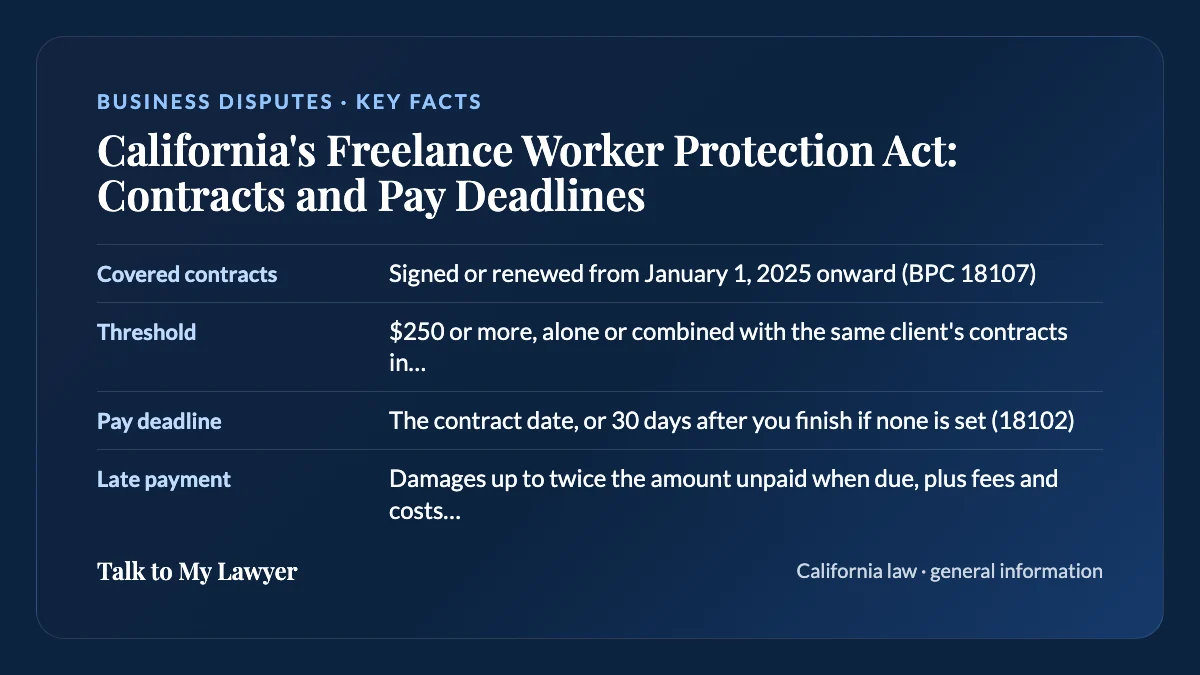
- Covered contracts
- Signed or renewed from January 1, 2025 onward (BPC 18107)
- Threshold
- $250 or more, alone or combined with the same client's contracts in the prior 120 days (18101)
- Pay deadline
- The contract date, or 30 days after you finish if none is set (18102)
- Late payment
- Damages up to twice the amount unpaid when due, plus fees and costs (18106)
- Refused contract
- Extra $1,000 if you asked for a written contract before starting and were refused (18106(b)(1))
What is California's Freelance Worker Protection Act?
It is a short set of payment and contract rules for freelancers, added to the Business and Professions Code by SB 988 and in force since January 1, 2025. It applies only to contracts entered into or renewed on or after that date (section 18107).
The Act does four things. It requires a written contract with specific terms, sets a payment deadline, bars clients from demanding extra work or a discount as the price of paying on time, and prohibits retaliation. Any waiver of these rights in a contract is void (section 18104).
Who counts as a freelance worker under the Act?
A "freelance worker" is a person, or an organization of no more than one person, incorporated or not and with or without a trade name, hired as a bona fide independent contractor to provide professional services worth at least $250 (section 18101(a)). Smaller jobs count if, together with all of that client's contracts with you in the previous 120 days, they reach $250.
"Professional services" borrows a defined list from Labor Code section 2778(b)(2). Several categories carry their own conditions there, such as working under a written contract or not primarily working at the client's location. The list includes:
- Marketing work that is original and creative, and human resources administration.
- Graphic design, grant writing and fine art.
- Still photography, photojournalism, videography and photo editing (with limits for motion picture work).
- Freelance writing, translation, editing, copy editing, illustration and newspaper cartooning.
- Content contributors, advisers, producers, narrators and cartographers for publications or educational works.
- Travel agent services, enrolled agents before the IRS, payment processing agents, appraisers and registered professional foresters.
- Licensed estheticians, electrologists, manicurists, barbers and cosmetologists who meet set independence conditions, and specialized performers teaching a short master class.
If your work is not on that list, this Act does not apply, though ordinary contract law still does. Some cities add their own rules: Los Angeles, for example, has freelance worker protections administered by its Office of Wage Standards. The hiring party has to be a California person or organization. Federal, state, local and foreign governments are excluded, and so is an individual hiring for the personal benefit of themselves, their family or their home.
What must a freelance contract include in California?
The agreement has to be written down, and the hiring party must give you a signed copy, on paper or electronically, and keep the contract for at least four years (section 18103(a)). At a minimum it must state:
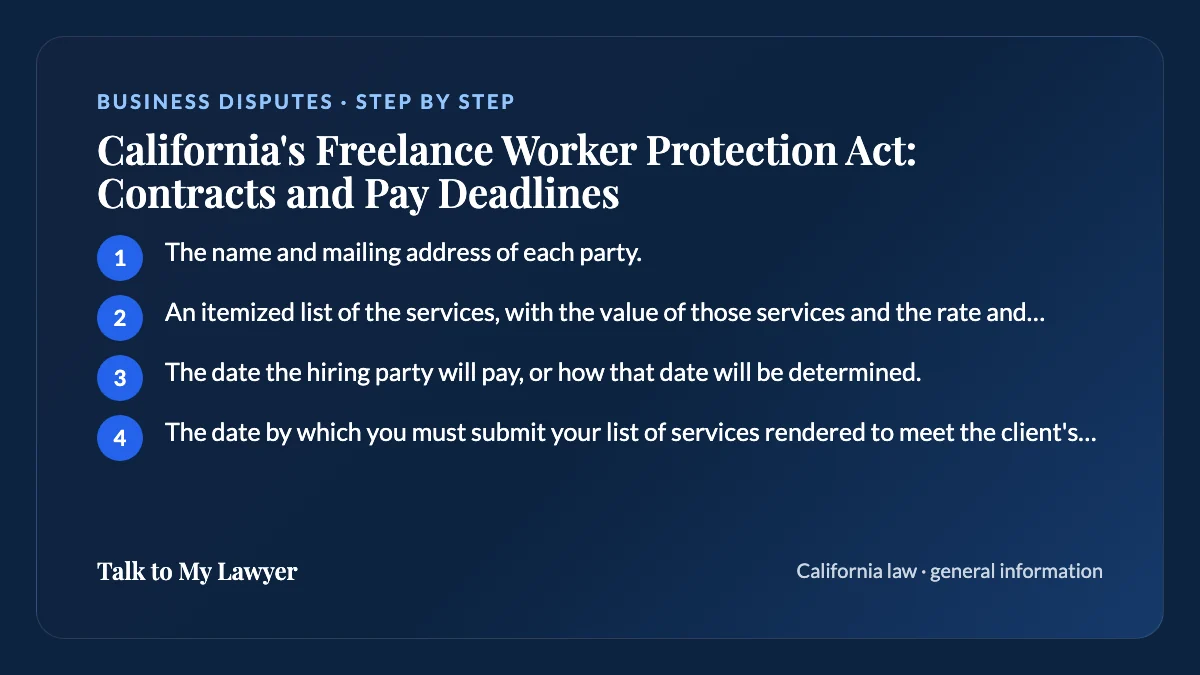
- The name and mailing address of each party.
- An itemized list of the services, with the value of those services and the rate and method of pay.
- The date the hiring party will pay, or how that date will be determined.
- The date by which you must submit your list of services rendered (often an invoice) to meet the client's internal processing deadlines.
No written contract does not mean no deal. Section 18103(c) keeps oral contracts and promissory estoppel available, and lists evidence that a contract existed: the client's statements about your rate, a written summary of the rate and work that you sent before starting (an email or text counts), and your performance of the work as you understood it.
How long does a client have to pay a freelancer?
The client must pay on or before the date in the contract. If the contract sets no date, payment is due no later than 30 days after you complete the services (section 18102(a)).
Once you have started work, the client may not make timely payment conditional on your accepting less money, providing more goods or services, or granting more intellectual property rights than the contract gives (section 18102(b)). A demand for an unpaid extra revision round, or for a full copyright assignment the contract never mentioned, is the kind of condition that rule describes.
The client also may not penalize you, or take action reasonably likely to deter you, for opposing a violation, asserting your rights or taking part in an enforcement proceeding (section 18105). Dropping a freelancer from future projects because they cited the Act is the kind of conduct that section addresses.
What can a freelancer recover for late payment?
You, or a public prosecutor, can sue to enforce the Act. A prevailing freelancer is entitled to reasonable attorney's fees and costs, injunctive relief and other appropriate remedies, plus damages under section 18106(b):
| Violation | Damages |
|---|---|
| You asked for a written contract before starting and the client refused | An additional $1,000 |
| Pay not made by the section 18102 deadline | Up to twice the amount that remained unpaid when payment was due |
| Late pay where a requested contract was refused | Double damages, with the unpaid amount measured by the rate you reasonably understood applied |
| Any other violation of the Act | Damages that may be awarded equal to the value of the contract or of the work performed, whichever is greater |
Small claims court can hear the case if the total does not exceed $12,500 when an individual files (CCP section 116.221). That section covers claims brought by a natural person; an LLC or corporation suing in its own name is subject to a different limit, so check which applies before filing. Our walkthrough of demand letters ahead of a small claims filing explains what the court expects.
Freelancer or misclassified employee?
The Act protects people who really are independent contractors. If a client controls your schedule and methods the way an employer would, you may be an employee instead, with wage and hour rights that go further.
| Issue | Freelance Worker Protection Act | Employee rights |
|---|---|---|
| Who decides status | Applies to bona fide independent contractors | Labor Code tests, including the ABC test |
| Payment timing | Contract date or 30 days after completion | Regular paydays and final pay deadlines |
| Late-pay remedy | Up to double the unpaid amount, plus fees | Wage claims, penalties and interest under the Labor Code |
If you suspect you were treated as a contractor when you were really an employee, read our guide to independent contractor misclassification before choosing which rules to invoke.
Example and steps: a late-pay letter under the Act
Example (hypothetical): a solo graphic designer agrees by email to a $4,800 logo and brand package for a Fresno restaurant group, with no payment date stated. She delivers the final files on March 10. Payment is due by April 9. On April 20, still unpaid, the client says it will pay only after one more design round. The unpaid amount at the due date was $4,800, so damages of up to $9,600 are available under section 18106(b)(2), plus fees and costs if she sues and prevails.
- Confirm coverage: your service is on the professional services list, you work alone, and the job (or the last 120 days of jobs with this client) totals at least $250.
- Collect the contract or the emails and texts that set the rate and scope, and proof of the completion date.
- Work out the due date: the contract date, or 30 days after completion.
- Write to the client, cite Business and Professions Code sections 18102 and 18106, state the amount owed and refuse any added conditions politely.
- Set a payment date and method, and keep proof of delivery.
- If payment does not come, decide with advice whether small claims or a civil action fits the amount. Our unpaid invoice guide covers interest and collection steps.
I completed the logo and brand package described in our February 12 emails and delivered the final files on March 10. Because no payment date was set, the $4,800 fee was due by April 9 under California Business and Professions Code section 18102(a). Section 18102(b) does not allow payment to be conditioned on additional design rounds. Please pay $4,800 by May 5 by bank transfer to the account on my invoice.
When a freelance pay letter from an attorney makes sense
Forty days past delivery, with a client asking for one more round before it pays, a friendly invoice reminder may no longer be enough. An attorney's letter fits better when the client disputes that the Act applies, when the fee is large or spread over several contracts, when the client is demanding extra rights to your work, or when you were dropped from a project after raising the law.
Through Talk to My Lawyer, a licensed California attorney writes your letter from your contract, emails and invoices, explains how the Freelance Worker Protection Act applies to your project, and sends it on your behalf. Whether a double-damages suit is worth bringing deserves a conversation with counsel who has seen the contract.
Frequently asked questions
Does the Freelance Worker Protection Act cover LLCs?
It can. The definition covers a person or an organization made up of no more than one person, whether or not it is incorporated or uses a trade name. A single-member LLC or one-person corporation providing listed professional services may qualify. A company with employees or several owners doing the work does not fit the definition.
Does the Act apply if my client is outside California?
The Act defines a hiring party as a person or organization in the State of California, so a client located elsewhere may fall outside it. Where a client operates in several states, coverage may depend on the facts. Ordinary contract law, and possibly the law of the client's state, may still give you a way to collect, so talk to a lawyer about a cross-border job.
What if my contract was signed before 2025?
The Act applies only to contracts entered into or renewed on or after January 1, 2025 (Business and Professions Code section 18107). An older contract that was renewed after that date, for example for a new term or project, may be covered from the renewal. Work under a pre-2025 contract that was never renewed is governed by ordinary contract law.
Can a client make me sign away these rights?
No. Section 18104 says a waiver of any provision of the Act is contrary to public policy and void. The contract can still set its own payment date, which then controls under section 18102(a), but a clause saying you give up the Act's protections has no effect.
Is a homeowner who hires me covered by the Act?
No. The Act excludes an individual hiring services for the personal benefit of themselves, their family members or their homestead. A family hiring a photographer for a reunion, for example, is not a hiring party under the Act. A business, nonprofit or professional practice hiring the same photographer would be, if the other conditions are met.
Sources
Checked against these official sources on October 18, 2026.
- California Business and Professions Code sections 18100 to 18107 (Freelance Worker Protection Act) (California Legislative Information)
- California Business and Professions Code section 18100 (California Legislative Information)
- California Labor Code section 2778 (California Legislative Information)
- California Code of Civil Procedure section 116.221 (California Legislative Information)
- Office of Wage Standards (City of Los Angeles)
This guide explains California law in general terms as of October 2026. It is general information, not legal advice for your situation, and local rules can add to it.
Join the email list and get a lawyer letter started
With Talk to My Lawyer, a licensed California attorney writes your letter from your facts and documents and sends it on your behalf. Join the Talk to My Lawyer email list for letter checklists, document prompts, and reminders before you start your letter.