Quick answer
A demand letter for money owed states what the debt is, how it arose, the exact amount with a short breakdown, and a payment deadline. In California, a contract that sets no interest rate carries 10% a year after breach (Civil Code section 3289), written contract claims generally must be filed within four years (CCP 337), and small claims court hears claims up to $12,500 for individuals.
At a glance
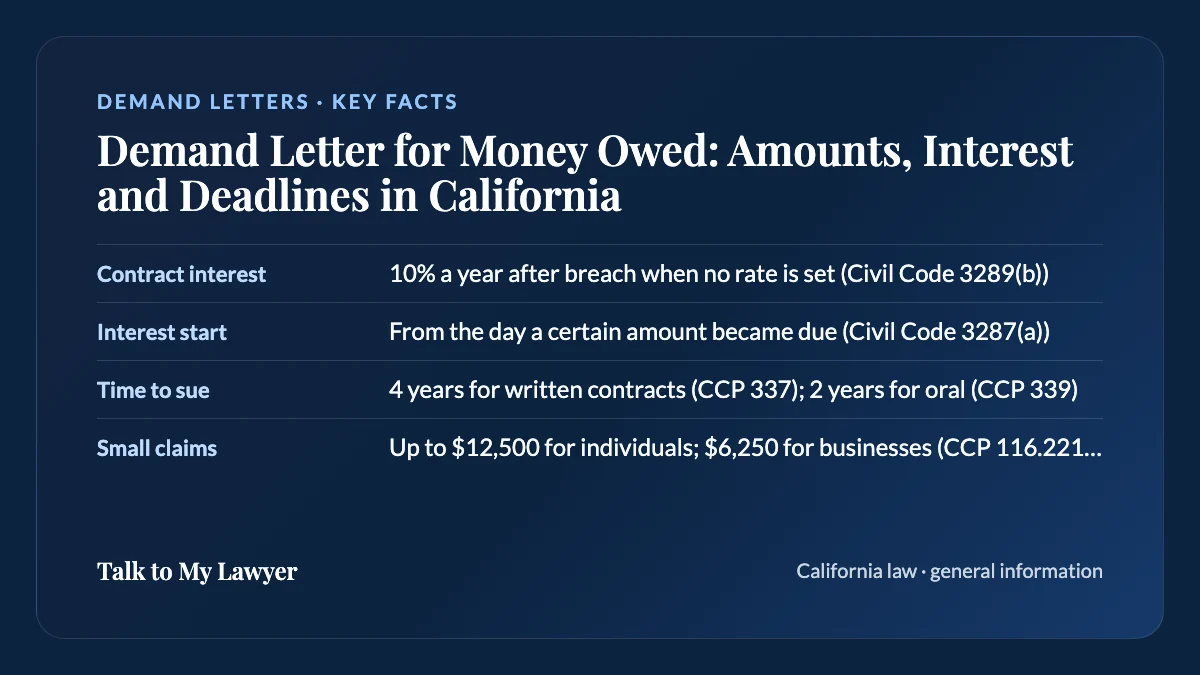
- Contract interest
- 10% a year after breach when no rate is set (Civil Code 3289(b))
- Interest start
- From the day a certain amount became due (Civil Code 3287(a))
- Time to sue
- 4 years for written contracts (CCP 337); 2 years for oral (CCP 339)
- Small claims
- Up to $12,500 for individuals; $6,250 for businesses (CCP 116.221, 116.220)
- Frequency limit
- No more than two small claims over $2,500 per calendar year statewide (CCP 116.231)
What kind of money is owed to you?
Start by naming the debt, because the type sets the rules. A refund owed by a store, a loan to a friend and unpaid wages each have different deadlines, notice rules and penalties.
| Money owed | Rule that shapes the letter | Detailed guide |
|---|---|---|
| Unpaid invoice from a client | Contract terms; 10% interest after breach if no rate set (Civil Code 3289) | Unpaid invoice demand letter |
| Personal loan to a friend or family member | Written or oral terms; 4-year or 2-year filing limits (CCP 337, 339) | Personal loan repayment letter |
| Bounced check | Certified-mail demand; 30 days to pay before treble damages of $100 to $1,500 (Civil Code 1719) | Bounced check demand letter |
| Final paycheck or wages | A day's wages accrue for each day final pay is willfully late, capped at 30 days (Labor Code 203) | Unpaid wages demand letter |
| Security deposit | Deadline and itemization rules for returning deposits (Civil Code 1950.5) | Security deposit demand letter |
| Refund for poor service or goods | Contract and consumer protection rules; CLRA notice for some claims (Civil Code 1782) | Refund demand letter |
Several of these have their own guides with the full rules: unpaid invoices, personal loans, security deposits and unpaid wages. The steps below apply to all of them.
How do you calculate the amount to demand?
Begin with the principal, subtract what has been paid, and add only amounts you can document or that the law or your contract allows. A number that holds up to a line-by-line check is worth more than a larger one that does not.
- Principal. The agreed price, the loan amount, the deposit or the refund. Use the figure in the contract, invoice or receipt.
- Credits. Partial payments, returned goods, setoffs you agreed to. Leaving these out makes the total wrong, and the reader will notice.
- Interest. The contract's rate if it has one. If a contract made after January 1, 1986 sets no rate, Civil Code section 3289(b) provides 10 percent per year after the breach.
- Contract fees. Late fees or collection costs, where your contract allows them.
- Statutory amounts. Penalties such as bounced-check treble damages only when you have met the statute's notice steps.
Leave out amounts you cannot back up, such as charges for your time chasing payment or a general sum for stress. They are hard to support and pull attention from the amounts you can prove.
Example: adding 10% interest to a debt
Example (hypothetical): a garden designer in Riverside finished a backyard project under a written contract for $4,000 due March 1, 2026. The contract sets no interest rate. The designer writes a demand letter on October 1, 2026, 214 days later.
| Item | Calculation | Amount |
|---|---|---|
| Principal | Contract price, no payments received | $4,000.00 |
| Interest at 10% per year | $4,000 x 10% x 214 / 365 | $234.52 |
| Total requested | Principal plus interest to October 1 | $4,234.52 |
The example uses simple daily interest for illustration. Courts decide how interest is computed in a given case. You can also offer to waive interest if paid by the deadline, which keeps the focus on the principal.
Which deadlines should you check before you write?
Check the filing deadline first, because a demand letter does not stop it. California sets four years to sue on a written contract (Code of Civil Procedure section 337) and two years on an oral agreement (section 339). Some debts have different clocks, and the start date can be disputed.
Then check where the claim would go. Small claims court hears claims up to $12,500 for individuals and $6,250 for businesses (CCP 116.221 and 116.220). Each calendar year, a person can bring only two small claims anywhere in the state that ask for more than $2,500 apiece (CCP 116.231).
If your deadline is close, the letter should give a shorter response window, or you may need legal advice about filing first.
Steps to write and send a demand letter for money owed
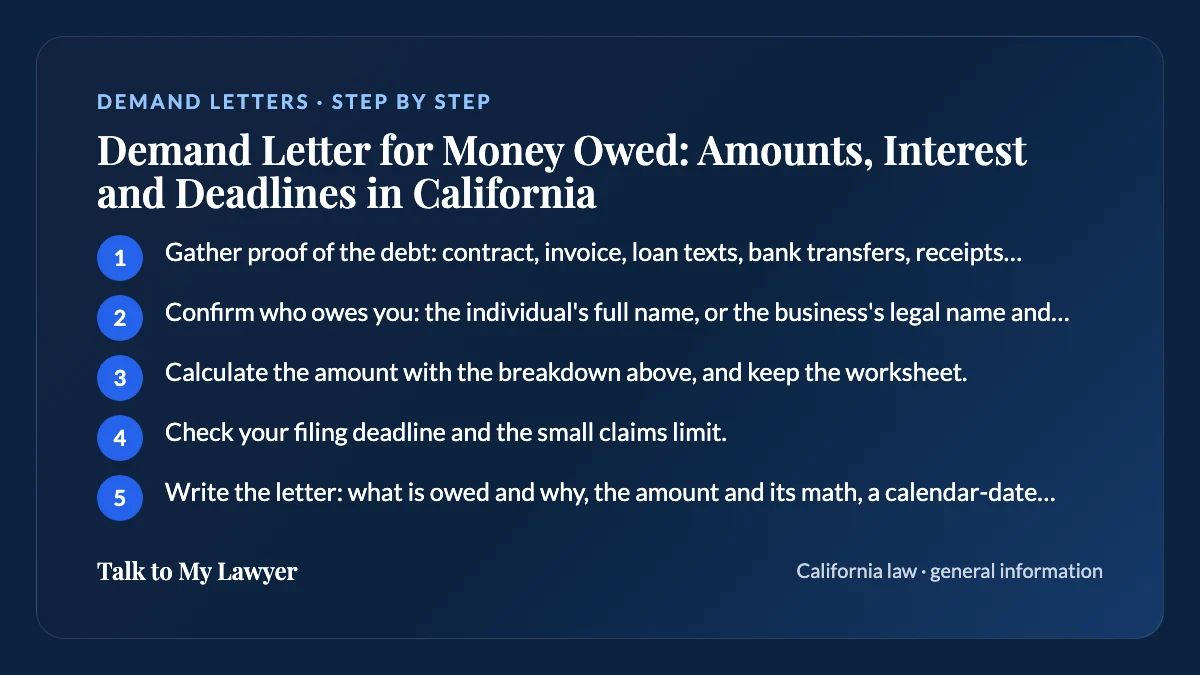
- Gather proof of the debt: contract, invoice, loan texts, bank transfers, receipts, earlier reminders.
- Confirm who owes you: the individual's full name, or the business's legal name and address.
- Calculate the amount with the breakdown above, and keep the worksheet.
- Check your filing deadline and the small claims limit.
- Write the letter: what is owed and why, the amount and its math, a calendar-date deadline, and how to pay.
- State the next step calmly, such as filing in small claims court.
- Mail it by a method that leaves proof, such as certified mail, add an email copy, and keep both.
On February 9, 2026, I sent you $2,000 by Zelle as a loan, and your text that afternoon promised repayment by June 30. You repaid $500 on May 2. The remaining $1,500 is past due. Please pay $1,500 by October 25 by Zelle to the same number or by check to the address above. If the balance is still unpaid on that date, I will look into a small claims filing.
What happens after you send the letter?
One of four things: they pay, they offer less, they dispute the debt, or they say nothing. Plan for each before the deadline arrives.
- Payment. Confirm receipt in writing. If it is a settlement for less than the full amount, put the terms in a short signed agreement.
- Counteroffer or payment plan. Get the schedule in writing, including what happens if a payment is missed.
- Dispute. Read the reasons carefully. A dispute about the amount may be resolved with documents; a dispute about whether anything is owed may need a court.
- Silence. Small claims plaintiffs have to ask for payment before filing, and your letter satisfies that step. Bring a copy to court.
Agreeing to discuss a smaller figure does not by itself weaken your claim: under Evidence Code section 1152, an offer to compromise and the talks around it cannot be used to prove liability.
When the amount, or the relationship, raises the stakes
Money owed between friends, former business partners or long-time clients can be awkward to ask for, and a large balance raises the cost of a mistake. A lawyer-written letter is one option when the debt is above the small claims limit, when the filing deadline is near, when the other side disputes the contract, or when a business keeps pointing you to a different company.
Through Talk to My Lawyer, a licensed California attorney writes your letter from your facts and documents, such as the contract, payment records and messages, and sends it on your behalf. For advice about collecting a judgment or suing, talk to a lawyer about your facts.
Frequently asked questions
Can I charge interest in a demand letter for money owed?
Where your contract or the law allows it, yes. A rate written into the contract keeps running after a breach (Civil Code 3289(a)). If a contract made after January 1, 1986 has no rate, California Civil Code section 3289(b) provides 10 percent per year after the breach. Civil Code section 3287 allows interest from the day a certain amount became due. Show the start date and the calculation in the letter.
How long do I have to collect money owed in California?
It depends on the debt. For a written contract, the filing window is generally four years (CCP 337); for an oral one, two years (CCP 339). Other claims, such as wage or property damage claims, have their own periods. Sending a demand letter does not extend these deadlines.
What if someone owes me money but there is no written contract?
An oral agreement can still be enforced, but you will need other proof: texts or emails mentioning the debt, bank transfers, witnesses, or partial repayments. Quote those in your letter. The filing deadline for an oral contract is generally two years in California, shorter than the four years for a written one.
Is a demand letter required before small claims court?
California's court self-help site requires a request for payment before a small claims filing, with narrow exceptions, such as when asking would be unsafe. Asking in person, by letter or by email all count. A demand letter is a clear way to do it because it leaves a dated record.
Can I demand more than the small claims limit?
You can demand the full amount owed in a letter. If you later file in small claims, individuals are limited to $12,500 and businesses to $6,250, so you would have to give up the excess or file in a different court. Ask a small claims advisor which court fits before you file.
Sources
Checked against these official sources on October 18, 2026.
- California Civil Code section 3289 (California Legislative Information)
- California Civil Code section 3287 (California Legislative Information)
- California Code of Civil Procedure section 337 (California Legislative Information)
- California Code of Civil Procedure section 339 (California Legislative Information)
- California Code of Civil Procedure section 116.231 (California Legislative Information)
- Small claims in California (California Courts Self-Help Guide)
This guide explains California law in general terms as of October 2026. It is general information, not legal advice for your situation, and local rules can add to it.
Join the email list and get a lawyer letter started
With Talk to My Lawyer, a licensed California attorney writes your letter from your facts and documents and sends it on your behalf. Join the Talk to My Lawyer email list for letter checklists, document prompts, and reminders before you start your letter.