Quick answer
A demand letter for money owed by a friend states the amount you lent, when you paid it, what was repaid, and the date you want the balance. In California, you generally have two years to sue on an oral loan (Code of Civil Procedure 339) and four years on a written one (section 337). Texts and payment memos can help show it was a loan, not a gift.
At a glance
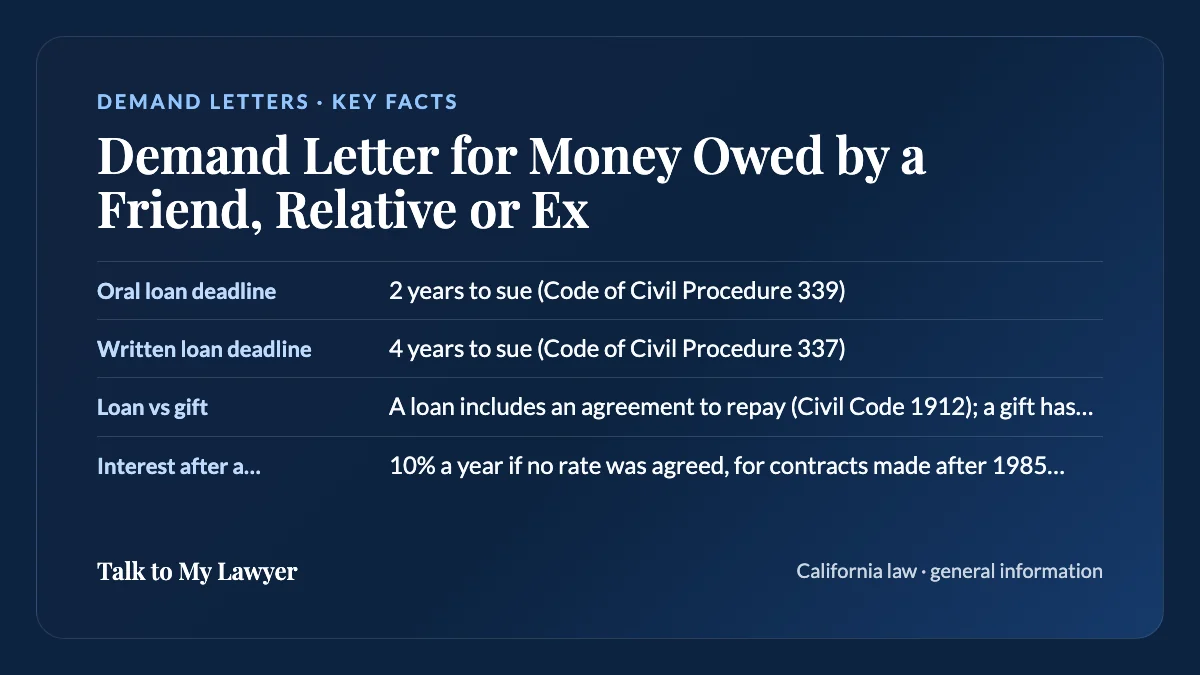
- Oral loan deadline
- 2 years to sue (Code of Civil Procedure 339)
- Written loan deadline
- 4 years to sue (Code of Civil Procedure 337)
- Loan vs gift
- A loan includes an agreement to repay (Civil Code 1912); a gift has none (Civil Code 1146)
- Interest after a missed payment
- 10% a year if no rate was agreed, for contracts made after 1985 (Civil Code 3289)
- Small claims limit
- $12,500 for individuals (CCP 116.221)
Was it a loan or a gift?
It was a loan if the other person agreed to pay the money back. California defines a loan of money as a contract in which one person delivers money and the other "agrees to return at a future time" an equivalent sum (Civil Code section 1912). A gift is a voluntary transfer "without consideration," meaning nothing is promised in return (section 1146).
With friends and family, nobody signs a note, so the question becomes what the evidence shows. Courts look at the whole picture.
| Evidence | What it can show |
|---|---|
| Payment memo such as "loan" or "pay back by June" | The purpose at the time the money moved |
| Texts like "I'll get you back Friday" or "sorry I'm late on this" | An acknowledgment that money is owed |
| Partial repayments | Conduct consistent with a debt |
| A spreadsheet or note you both saw | The amount and agreed schedule |
| Messages describing it as help, a present or "don't worry about it" | Possibly a gift, which works against a repayment claim |
Save everything now: screenshots with dates, bank and app statements, and any voicemails. Keep the original messages on your phone as well as the screenshots.
How long do you have to collect a personal loan in California?
Two years for an oral agreement and four years for a written one. Code of Civil Procedure section 339 sets two years for a contract "not founded upon an instrument of writing," and section 337 sets four years for a contract founded on a writing.
- The clock generally starts when the borrower fails to pay as agreed, not on the day you handed over the money. For a loan with no set repayment date, when the clock starts can be harder to pin down.
- Whether a chain of texts counts as a written contract is a fact question. Do not assume the four-year period applies because you have messages.
- A later acknowledgment or promise to pay can extend the deadline only if it is in a writing signed by the borrower (Code of Civil Procedure section 360). Whether a text counts as a signed writing is a question for a lawyer, so save every message where the borrower admits the debt.
- A signed promissory note may fall under different rules. Our guide to promissory note default letters covers those.
A demand letter does not pause any deadline. If the two-year mark is approaching, talk to a lawyer about filing before it passes.
Can you charge interest on money you lent a friend?
Sometimes, within limits. Civil Code section 1914 presumes a loan of money is made upon interest unless the parties expressly stated otherwise in writing at the time. Any rate you agreed on stays chargeable after the borrower stops paying (section 3289(a)).
With no agreed rate, the statute adds 10 percent a year from the breach for contracts made after January 1, 1986 (section 3289(b)). That is interest from the missed payment forward, not from the day you lent the money.
The California Constitution also caps what a private lender can charge (Article XV, section 1). For money lent primarily for personal, family or household use, the parties may agree in writing to a rate of up to 10 percent a year; otherwise the constitutional rate is 7 percent. A friend-to-friend rate above the cap is usury, which can undercut the lender's claim to interest, so talk to a lawyer before demanding it. For the math, see adding interest to a demand letter.
Example: working out the balance
Example (hypothetical): on February 1, you send your cousin $4,000 by bank transfer with the memo "loan, repay $500 a month from March." He pays $500 in March and $500 in April, then stops. Nothing was said about interest.
| Item | Amount |
|---|---|
| Amount lent | $4,000 |
| Repaid | $1,000 |
| Principal still owed | $3,000 |
| Simple interest at 10% a year, if a court treats the full balance as due from the first missed payment | About $25 a month |
Your letter can ask for the $3,000 and state that you reserve interest. Whether the whole balance is due at once, or each $500 installment separately, depends on what you agreed, so keep the demand to what the evidence supports.
Steps to write a demand letter for money owed by a friend
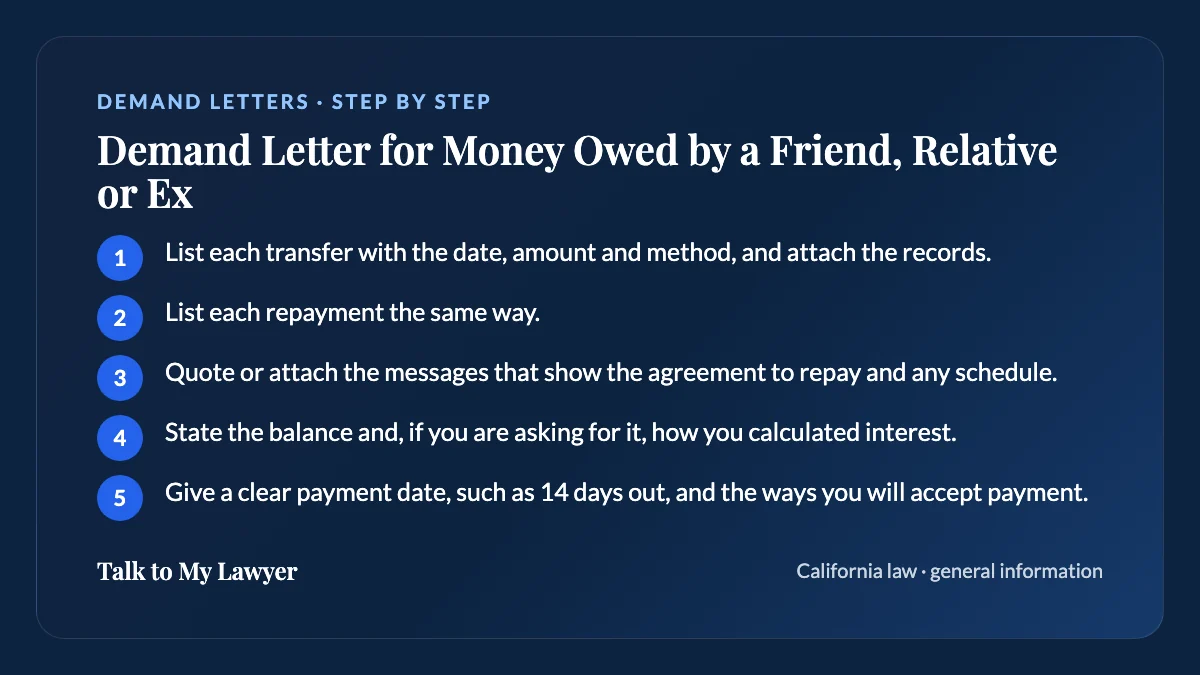
- List each transfer with the date, amount and method, and attach the records.
- List each repayment the same way.
- Quote or attach the messages that show the agreement to repay and any schedule.
- State the balance and, if you are asking for it, how you calculated interest.
- Give a clear payment date, such as 14 days out, and the ways you will accept payment.
- Offer a payment plan if you are open to one, and say it must be confirmed in writing.
- Say you may file in small claims court if the balance is not paid or a plan is not agreed.
On February 1, I lent you $4,000 by bank transfer, and you agreed by text that day to repay $500 a month starting in March. You paid $500 on March 3 and $500 on April 2. The remaining $3,000 is unpaid. Please pay the balance by November 15, or contact me by then to agree on a written payment schedule. If I have not heard from you by then, I plan to ask the small claims court to decide it.
Keep it about money and dates. Old arguments, mutual friends and personal history weaken a letter that a judge may later read.
Can you take a friend to small claims court for a loan?
Yes, if the balance is $12,500 or less, the cap for claims brought by a natural person (Code of Civil Procedure section 116.221). The claim form, SC-100, says you must ask the defendant to pay before you sue, and a dated letter shows you did.
- Filing fees run from $30 to $100, and you can ask the court for a fee waiver.
- Neither you nor your friend can bring a lawyer to argue at the hearing, though either of you may consult one before it.
- Bring the transfer records, the messages and a copy of your demand letter.
- Claims above $2,500 are limited to two per filer per calendar year statewide (section 116.231).
For the filing steps, see what to do before filing in small claims.
When the borrower is family or the amount is large
Money between relatives carries history that no letter can settle, so the letter's job is narrower: dates, amounts and the agreement to repay. You can write that yourself. Attorney drafting fits better when the borrower insists the money was a gift, when the balance exceeds the $12,500 small claims cap, when a former partner owes money from the relationship, or when the two-year deadline is close and the facts need to be pinned down in writing.
If you use Talk to My Lawyer, a licensed California attorney writes your letter from your facts and documents (your transfer records and messages) and sends it on your behalf. If you are deciding whether to sue a relative, get advice on your own situation first.
Frequently asked questions
Is a text message enough to prove a loan in California?
It can help. An oral loan is a valid contract, and texts are evidence of what was agreed. A message such as "I'll pay you back next month" sent near the time of the transfer tends to support a loan. A judge weighs all the evidence, including how the money was described when it moved and whether any repayments were made.
What if my friend says the money was a gift?
Then the question is what the evidence shows. A gift is a transfer made voluntarily without anything promised in return. Messages asking for repayment that went unchallenged, partial repayments, or memos calling it a loan point the other way. Gather those before you write, and describe them plainly in your letter.
Can I sue someone for money I lent them without a contract?
Yes. A spoken agreement to repay is an enforceable contract in California, though harder to prove than a written one. The deadline to sue on an oral contract is generally two years from the breach under Code of Civil Procedure section 339, so note when the borrower first missed a payment.
Should I send the demand letter by text or mail?
Use a method you can prove. Certified mail with a return receipt, email, or both are common choices. A text can work as a reminder, but a dated letter is easier to bring to small claims court. Delivery choices are covered in our guide on how to send a demand letter.
Can I report a friend who won't pay me back to the police?
An unpaid personal loan is generally a civil matter, not a crime. Threatening criminal charges to get paid can create legal problems for you. Keep your letter to the debt, the evidence and what you will do through the civil courts, such as filing in small claims.
Sources
Checked against these official sources on October 18, 2026.
- California Code of Civil Procedure section 339 (California Legislative Information)
- California Civil Code section 1912 (California Legislative Information)
- California Civil Code section 3289 (California Legislative Information)
- California Constitution, Article XV, section 1 (California Legislative Information)
- California Code of Civil Procedure section 116.221 (California Legislative Information)
- Small claims in California (California Courts Self-Help Guide)
This guide explains California law in general terms as of October 2026. It is general information, not legal advice for your situation, and local rules can add to it.
Join the email list and get a lawyer letter started
With Talk to My Lawyer, a licensed California attorney writes your letter from your facts and documents and sends it on your behalf. Join the Talk to My Lawyer email list for letter checklists, document prompts, and reminders before you start your letter.