Quick answer
To send a demand letter by certified mail, take it to a Post Office, buy Certified Mail ($5.55 as of October 4, 2026) plus postage, and add a Return Receipt ($4.65 hard copy or $2.91 electronic) if you want the recipient's signature. Keep the postmarked receipt. Some California laws require a method: CLRA notices go by certified or registered mail with return receipt requested.
At a glance
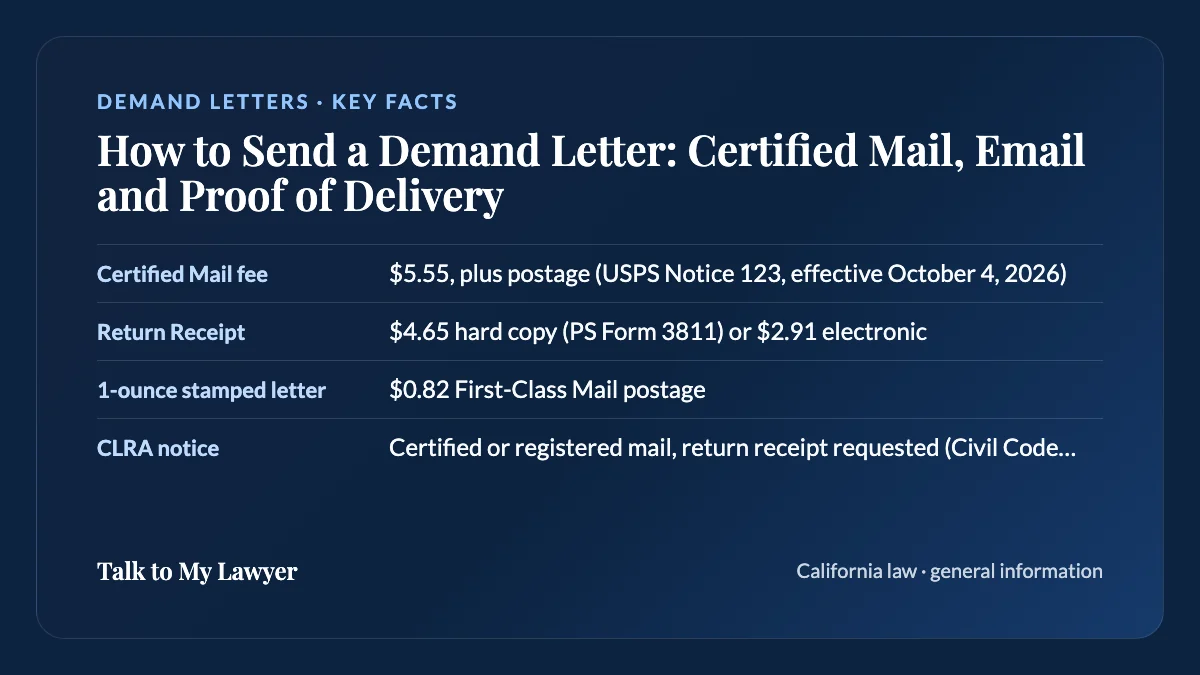
- Certified Mail fee
- $5.55, plus postage (USPS Notice 123, effective October 4, 2026)
- Return Receipt
- $4.65 hard copy (PS Form 3811) or $2.91 electronic
- 1-ounce stamped letter
- $0.82 First-Class Mail postage
- CLRA notice
- Certified or registered mail, return receipt requested (Civil Code 1782)
- Bad check demand
- Certified mail; 30 days to pay from the mailing date (Civil Code 1719)
What is the best way to send a demand letter?
The best way is any method that lets you prove what you sent, when you sent it and that it reached the right person. For most California demands, that means Certified Mail with a Return Receipt, plus a same-day email copy if you have a working address. When a statute or your contract names a method, follow it exactly.
No single method is required for every demand letter. The California Courts Self-Help Guide says that before small claims you can ask for the money in person, by letter or by email. The method matters most when a law ties a deadline or a remedy to it.
How much does certified mail cost as of October 2026?
USPS prices changed on October 4, 2026. These are the retail figures in the Postal Service's Notice 123 price list and its extra services page.
| Service | Price | What you get |
|---|---|---|
| First-Class Mail, 1 oz stamped letter | $0.82 | Postage only, no tracking |
| Certified Mail | $5.55 plus postage | Postmarked sender's receipt if mailed at the counter, and a delivery record |
| Return Receipt, hard copy (PS Form 3811) | $4.65 | Card with the recipient's signature mailed back to you |
| Return Receipt, electronic | $2.91 | Emailed record with the recipient's signature |
| Certified Mail Restricted Delivery | $14.35 | Delivery only to the named addressee or authorized agent |
| Certificate of Mailing (PS Form 3817) | $2.45 | Official record of the date USPS accepted the mail; USPS keeps no copy |
| Registered Mail | From $20.90 | Highest-security service, with a mailing receipt |
Example: a one-ounce letter by Certified Mail with an electronic Return Receipt costs $0.82 + $5.55 + $2.91 = $9.28. With the green hard-copy card instead, the total is $11.02. Heavier envelopes with exhibits cost more in postage, so weigh them at the counter.
When does California law dictate how a demand is delivered?
A few statutes attach rules to the delivery itself. Miss them and you can lose a remedy even if the letter is otherwise perfect.
- Consumers Legal Remedies Act. Civil Code section 1782 calls for a written notice, sent by certified or registered mail with a return receipt requested, at least 30 days before a damages suit. It goes to where the transaction happened or to the company's main California office.
- Bounced or stopped checks. Civil Code section 1719 requires the written demand to be mailed by certified mail. The writer has 30 days from the mailing date to pay. In a stop-payment case, a court cannot award damages unless it receives a copy of the demand and a signed certified mail receipt showing delivery, or attempted delivery if refused.
- Your contract. Many contracts have a "Notices" clause naming an address, a method (mail, courier or email) and when notice counts as received. Follow it word for word, and send a courtesy copy by email if the clause allows it.
Which person or entity you address matters as much as the method. A letter to the wrong business name can create arguments later; see our guide to finding a business's legal name in California.
How to send a demand letter by certified mail, step by step
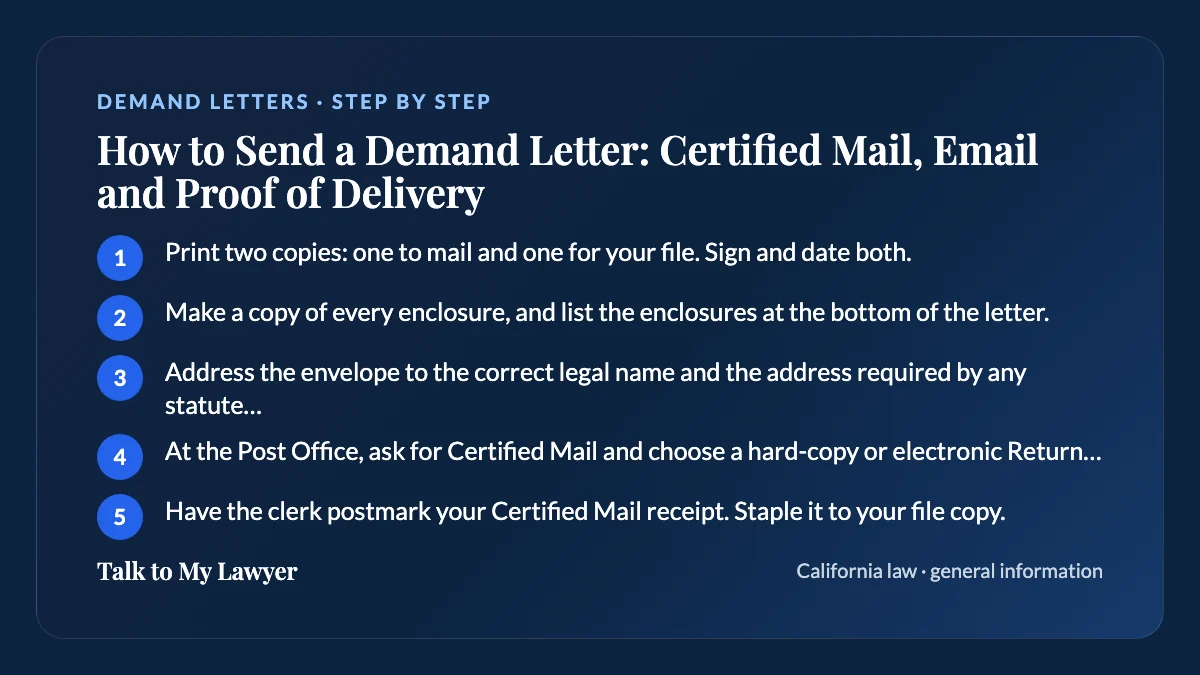
- Print two copies: one to mail and one for your file. Sign and date both.
- Make a copy of every enclosure, and list the enclosures at the bottom of the letter.
- Address the envelope to the correct legal name and the address required by any statute or contract notice clause.
- At the Post Office, ask for Certified Mail and choose a hard-copy or electronic Return Receipt.
- Have the clerk postmark your Certified Mail receipt. Staple it to your file copy.
- Email a PDF of the signed letter the same day, if you have a working address, and note in the email that the original is coming by certified mail.
- Track the article number online and save a screenshot or printout when it shows delivered.
- File the return receipt with your copy when it arrives, and calendar your response deadline.
Can you send a demand letter by email, text or hand delivery?
Yes, where no statute or contract requires a mailed notice. Email is fast and leaves a timestamp, but it is easy for the recipient to say it went to spam. Text messages are easy to miss and hard to print cleanly. Hand delivery works if you bring a witness or get a signed acknowledgment.
| Method | Strength | Weak spot |
|---|---|---|
| Certified Mail + Return Receipt | Mailing record, delivery record and signature | Recipient can refuse or leave it unclaimed |
| Email with PDF | Instant, timestamped, easy to forward to a decision-maker | Delivery and opening are hard to prove |
| First-Class Mail + Certificate of Mailing | Cheap proof of the mailing date | No proof of delivery |
| Courier or process server | Witness to delivery | Higher cost |
| Hand delivery | Immediate | Needs a witness or signed receipt |
Pairing two methods covers the weak spot of each. Certified mail plus email is a common combination.
Checklist: the proof of delivery to keep
- An exact copy of the letter as sent, with every enclosure.
- The postmarked Certified Mail receipt with the article number.
- The tracking history, printed or saved as a PDF.
- The Return Receipt card or the electronic signature record.
- The sent email, with the attachment and the timestamp.
- Any returned envelope, kept unopened.
- A short log of follow-up calls and replies, with dates.
Bring this file to small claims or to your lawyer. Form SC-100 asks whether you asked the defendant to pay before suing, and your file answers that question with documents.
What if the letter is refused or comes back unclaimed?
Keep the returned envelope sealed and resend by First-Class Mail with a Certificate of Mailing, plus email. A refusal does not erase your demand. For a stopped check, Civil Code section 1719 expressly accepts a signed certified mail receipt showing attempted delivery that was refused as part of the required proof.
Do not let a delivery problem eat your filing window. The statute of limitations keeps running while letters go back and forth; our guide to California statutes of limitations lists the common deadlines.
Getting the address, the method and the letter right the first time
Delivery mistakes are quiet ones: a CLRA notice sent to the wrong address, a contract notice clause nobody read, or a bad check demand mailed without the terms section 1719 requires. An attorney can account for each of these before the envelope is sealed.
Through Talk to My Lawyer, a licensed California attorney writes your letter from your facts and documents, addresses it to the right party, and sends it on your behalf by the method your claim calls for. Deadlines depend on your facts, so check yours with a lawyer.
Frequently asked questions
Does a demand letter have to be sent by certified mail in California?
Not always. Many demand letters can go by any reliable method, and the Self-Help Guide says you can ask for money before small claims in person, by letter or by email. Certified mail is required for some statutory notices, such as CLRA notices under Civil Code 1782 and bad check demands under Civil Code 1719. A contract's notice clause may also set the method.
How much does certified mail with a return receipt cost in 2026?
As of USPS prices effective October 4, 2026, Certified Mail is $5.55 plus postage. A hard-copy Return Receipt adds $4.65, or $2.91 for the electronic version. For a one-ounce stamped letter at $0.82, the total is $11.02 with the hard-copy card or $9.28 with the electronic receipt. Heavier envelopes cost more.
Can I send a demand letter by email?
Yes, unless a statute or your contract requires mail or another method. Email is quick and timestamped, which helps, but proving the recipient saw it can be harder. Sending the same letter by certified mail and email gives you both a fast copy and a delivery record. Save the sent email with its attachment.
What if the recipient refuses the certified letter?
Keep the returned envelope unopened as evidence, then resend by First-Class Mail with a Certificate of Mailing and by email. A refusal does not undo your demand, and for stop-payment demands Civil Code 1719 accepts a signed receipt showing attempted delivery that was refused. Keep counting toward your filing deadline while you resend.
Where should I send a demand letter to a business?
Use the business's correct legal name and an address that will reach someone with authority: the address in your contract's notice clause, the principal place of business, or the agent for service of process listed with the California Secretary of State. For a CLRA notice, section 1782 points to where the deal took place or the company's main place of business in California.
Sources
Checked against these official sources on October 18, 2026.
- Notice 123, Price List (effective October 4, 2026) (United States Postal Service)
- Insurance and Extra Services (United States Postal Service)
- California Civil Code section 1782 (California Legislative Information)
- California Civil Code section 1719 (California Legislative Information)
- Ask for the money (California Courts Self-Help Guide)
This guide explains California law in general terms as of October 2026. It is general information, not legal advice for your situation, and local rules can add to it.
Join the email list and get a lawyer letter started
With Talk to My Lawyer, a licensed California attorney writes your letter from your facts and documents and sends it on your behalf. Join the Talk to My Lawyer email list for letter checklists, document prompts, and reminders before you start your letter.