Quick answer
The California statute of limitations depends on the claim: 4 years for a written contract (CCP 337), 2 years for an oral contract (CCP 339) or personal injury (CCP 335.1), 3 years for property damage or fraud (CCP 338), and 1 year for libel or slander (CCP 340). Claims against public entities need a written claim within six months or one year (Government Code 911.2).
At a glance
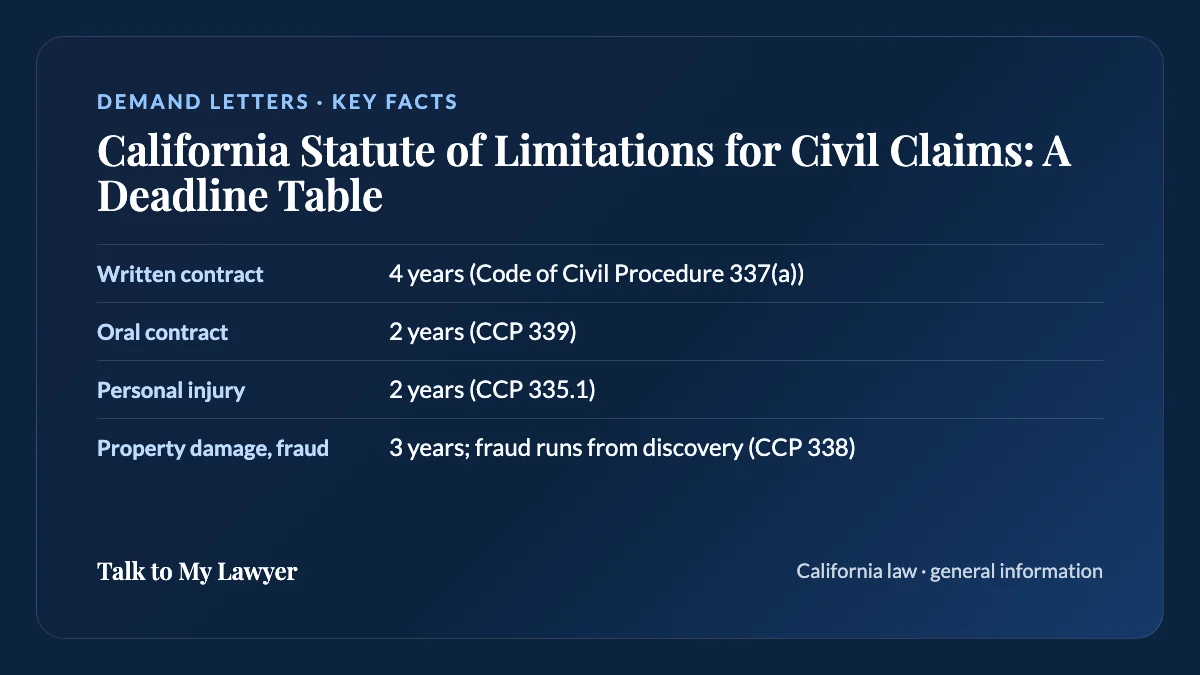
- Written contract
- 4 years (Code of Civil Procedure 337(a))
- Oral contract
- 2 years (CCP 339)
- Personal injury
- 2 years (CCP 335.1)
- Property damage, fraud
- 3 years; fraud runs from discovery (CCP 338)
- Libel or slander
- 1 year (CCP 340(c))
- Public entity claim
- 6 months for injury or personal property; 1 year for others (Gov. Code 911.2)
What is the statute of limitations in California?
A statute of limitations is the deadline for filing a lawsuit. In California, most civil deadlines are in Title 2 of the Code of Civil Procedure, starting at section 312, and they range from one to four years for everyday claims. Some claims have much shorter administrative steps first, such as a written claim to a city or county.
If you file late, the other side can raise the deadline as a defense and the case can be thrown out, however strong your facts are. That is why the date on your calendar matters more than the date on your demand letter.
California statute of limitations table for common claims
| Type of claim | Deadline | Statute |
|---|---|---|
| Breach of a written contract | 4 years | CCP 337(a) |
| Book account, account stated, open account in writing | 4 years | CCP 337(b) |
| Breach of an oral contract | 2 years | CCP 339 |
| Contract for the sale of goods | 4 years; the original agreement can shorten it to no less than 1 year | Commercial Code 2725 |
| Personal injury, assault, battery, wrongful death | 2 years | CCP 335.1 |
| Damage to real property (trespass or injury) | 3 years | CCP 338(b) |
| Taking, keeping or damaging personal property | 3 years | CCP 338(c)(1) |
| Fraud or mistake | 3 years from discovery of the facts | CCP 338(d) |
| Liability created by statute (other than a penalty) | 3 years | CCP 338(a) |
| Statutory penalty or forfeiture owed to an individual | 1 year, unless the statute sets another | CCP 340(a) |
| Libel or slander | 1 year | CCP 340(c) |
| Claim against a public entity for injury, death or personal property | Written claim within 6 months | Gov. Code 911.2 |
| Other claims against a public entity | Written claim within 1 year | Gov. Code 911.2 |
When does the clock start running?
Usually on the day the claim "accrues": the day of the breach, the injury or the damage. A contract claim generally starts when a payment or performance was due and did not happen, not on the day the contract was signed.
Some statutes start the clock later. For fraud or mistake, section 338(d) says the claim is not treated as accrued until the injured party discovers the facts. For a sale of goods, section 2725 of the Commercial Code takes the opposite approach: the claim accrues at the breach even if you did not know about it, and a breach of warranty generally occurs on delivery unless the warranty explicitly covers future performance.
What can pause or extend a California deadline?
Pausing a deadline is called tolling. A few rules come up often:
- Minors and people lacking legal capacity. Under CCP 352, the time someone is under 18 or lacks capacity when the claim accrues does not count. This rule does not apply to claims against public entities that require a government claim.
- A written tolling agreement. CCP 360.5 lets the other side waive the deadline in a signed writing. Each waiver is limited to four years and can be renewed.
- A signed acknowledgment of the debt. CCP 360 says an acknowledgment or promise must be in a writing signed by the person owing it to restart a contract clock. Payments on a promissory note also count.
- Community mediation. For county-funded dispute resolution programs, Business and Professions Code 467.4(b) lets the parties agree in writing to pause the deadline while the program's process is pending.
Tolling rules have exceptions and court-made doctrines layered on top. If your deadline depends on one, talk to a lawyer about your facts.
Does a demand letter stop the statute of limitations?
No. Sending a demand letter, making phone calls or negotiating does not pause the deadline. Only a filed lawsuit (or, where required, a filed government claim) stops it, unless the other side signs a tolling agreement.
Section 337(d) makes the point for debts on written contracts: once the four years have run, a person may not sue or start an arbitration to collect, and the period can be extended only under section 360. Send your final demand letter before a lawsuit early enough that you still have time to file if it goes unanswered.
Example: counting a deadline on an oral loan
Example (hypothetical): Dana lent a coworker $4,000 on a handshake, to be repaid by March 1, 2025. Nothing was written down. The coworker missed the date.
- Claim type: oral contract, two years under CCP 339.
- Accrual: March 1, 2025, when repayment was due and missed.
- Last day to file: on or about March 1, 2027.
- In June 2026 the coworker texts, "I know I owe you, I'll pay." Whether that message satisfies the signed-writing rule in CCP 360 is a legal question, so Dana should not treat it as buying more time.
- Practical plan: send a demand letter by late 2026 with a 14-day deadline, and be ready to file in small claims well before March 2027.
Why claims against cities and counties need special care
Before suing a city, county, school district or state agency, you generally must present a written government claim. For death, personal injury or damage to personal property, Government Code 911.2 sets a six-month deadline from accrual; other claims get one year.
If the entity sends a written rejection notice, Government Code 945.6 generally gives you six months from that notice to sue. If no notice is given, the period is two years from accrual. Small claims form SC-100 asks the same question: if you are suing a public entity, you must file a written claim first. Our guide to a government claim against a city covers the forms.
How to find and protect your deadline, step by step
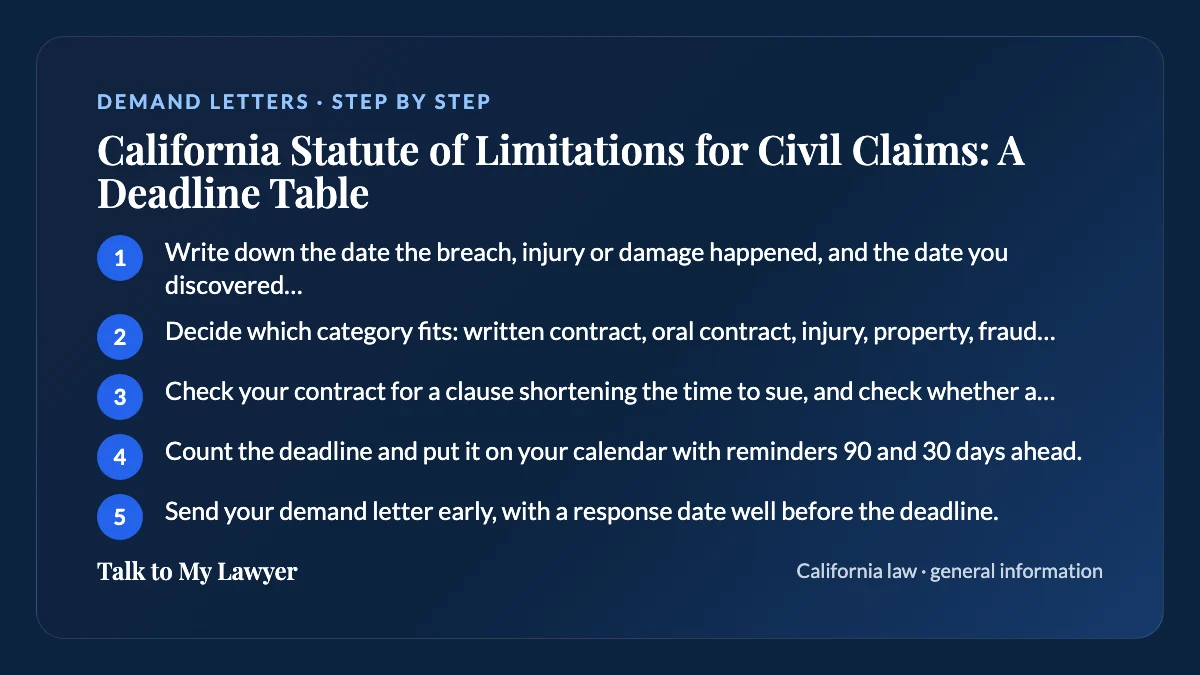
- Write down the date the breach, injury or damage happened, and the date you discovered it.
- Decide which category fits: written contract, oral contract, injury, property, fraud, statute or government claim.
- Check your contract for a clause shortening the time to sue, and check whether a public entity is involved.
- Count the deadline and put it on your calendar with reminders 90 and 30 days ahead.
- Send your demand letter early, with a response date well before the deadline.
- If talks continue near the deadline, ask for a signed tolling agreement or file to protect the claim.
A demand letter written with the deadline in view
The date on a demand letter only helps if it leaves time to file afterward. An attorney can set the response date with your filing deadline in mind, flag a government claim requirement before it lapses, and propose a tolling agreement when talks need more time.
Through Talk to My Lawyer, a licensed California attorney writes your letter from your facts and documents, sets a response date that fits your timeline, and sends it on your behalf. Deadlines turn on details; before relying on any date in this guide, have a lawyer look at your facts.
Frequently asked questions
Does a demand letter extend the statute of limitations in California?
No. A demand letter, phone calls and settlement talks do not pause the clock. The deadline stops when you file a lawsuit, or when the other side signs a written waiver or tolling agreement. Under CCP 360.5, a written waiver can last up to four years at a time and must be signed by the person who owes the obligation.
How long do you have to sue for breach of contract in California?
Four years for a contract in writing under Code of Civil Procedure 337(a), and two years for an oral contract under section 339. Contracts for the sale of goods fall under Commercial Code 2725, which sets four years but lets the original agreement shorten it to as little as one year. The clock generally starts at the breach.
What is the deadline to file a claim against a city in California?
Under Government Code 911.2, a written claim for death, personal injury or damage to personal property must be presented within six months after the claim accrues. Other claims get one year. After a written rejection, you generally have six months to sue under Government Code 945.6. Minors' tolling under CCP 352 does not apply to these claims.
How long do I have to sue for defamation in California?
One year. Code of Civil Procedure 340(c) sets a one-year deadline for libel and slander. Because the period is short, people dealing with online posts or false statements should note the date the statement was published, save copies with dates, and get legal advice quickly if a lawsuit is a possibility.
What is the statute of limitations for personal injury in California?
Two years under Code of Civil Procedure 335.1, which covers injury or death caused by another person's wrongful act or neglect, plus assault and battery. If the injury involves a public entity, such as a city bus or a sidewalk, a written government claim is generally due within six months under Government Code 911.2.
Sources
Checked against these official sources on October 18, 2026.
- California Code of Civil Procedure section 337 (California Legislative Information)
- California Code of Civil Procedure section 338 (California Legislative Information)
- California Code of Civil Procedure section 340 (California Legislative Information)
- California Government Code section 911.2 (California Legislative Information)
- California Code of Civil Procedure section 360.5 (California Legislative Information)
- How to File a Wage Claim (California Labor Commissioner's Office)
This guide explains California law in general terms as of October 2026. It is general information, not legal advice for your situation, and local rules can add to it.
Join the email list and get a lawyer letter started
With Talk to My Lawyer, a licensed California attorney writes your letter from your facts and documents and sends it on your behalf. Join the Talk to My Lawyer email list for letter checklists, document prompts, and reminders before you start your letter.