Quick answer
To file a claim against a city in California, submit a written government claim to the city before you sue. Claims for injury or damage to personal property, such as a car hit by a pothole, are due within six months; other claims within one year (Government Code section 911.2). The city then has 45 days to act, and a written rejection gives you six months to sue.
At a glance
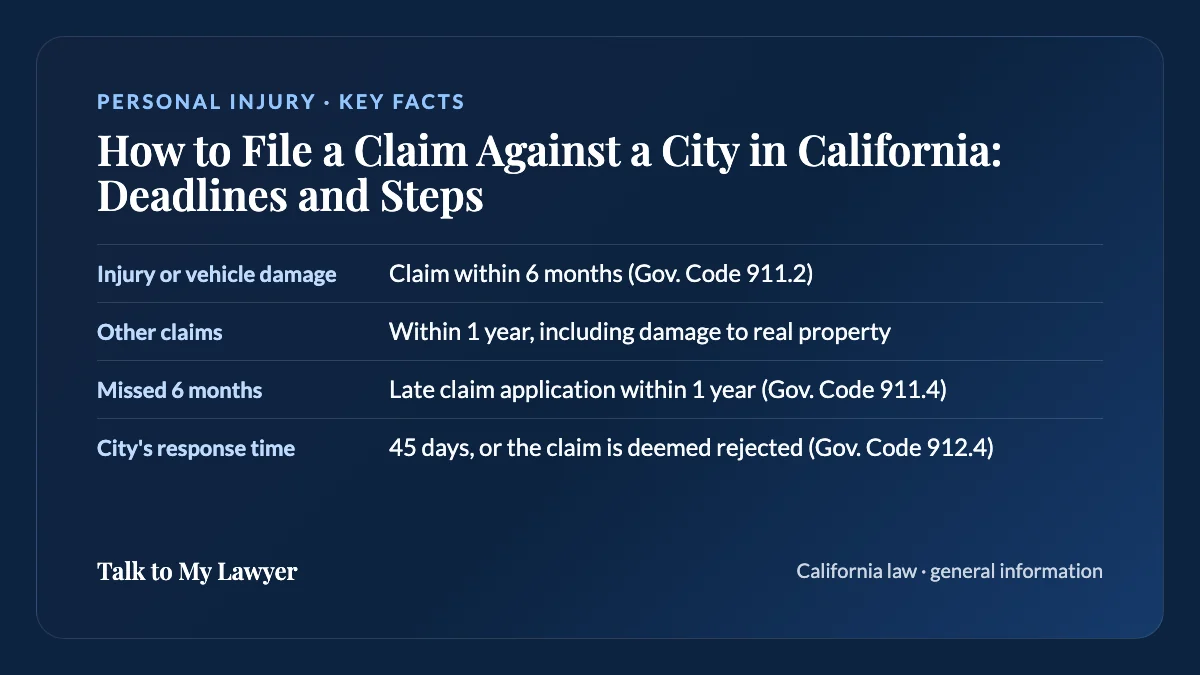
- Injury or vehicle damage
- Claim within 6 months (Gov. Code 911.2)
- Other claims
- Within 1 year, including damage to real property
- Missed 6 months
- Late claim application within 1 year (Gov. Code 911.4)
- City's response time
- 45 days, or the claim is deemed rejected (Gov. Code 912.4)
- Time to sue
- 6 months after written rejection; 2 years if no notice (Gov. Code 945.6)
Do you have to file a claim before suing a city in California?
Yes. For money damages against a city, county or other public entity, the Government Claims Act requires a written claim to the entity first. You can only file in court after the claim is rejected or the entity fails to act on it in time.
That applies to small claims court too. The California Courts self-help guide puts it plainly: before you can sue a government agency, you must first file a claim with the agency.
Common city claims include:
- Potholes, broken sidewalks and missing signs. A public entity can be liable for a dangerous condition of its property if an employee created it, or if the entity had actual or constructive notice in time to fix it (Government Code section 835).
- Fallen trees and limbs from city-maintained trees, under the same dangerous-condition rules.
- City vehicles. A public entity is liable for injury or property damage caused by an employee's negligent driving within the scope of employment (Vehicle Code section 17001).
- Sewer backups, water main breaks and damaged property from city work.
How long do you have to file a claim against a city?
Six months or one year, depending on what was harmed (Government Code section 911.2).
| Type of claim | Deadline to present the claim | Example |
|---|---|---|
| Death, injury to a person, or damage to personal property | 6 months after the claim arises | Tire and rim destroyed by a pothole; a fall on a cracked sidewalk |
| Any other claim | 1 year after the claim arises | A city tree crushes your garage roof; a city breaches a contract with your business |
| Missed the 6-month deadline | Written application for leave to present a late claim, within a reasonable time up to 1 year, stating the reason for the delay | Government Code section 911.4 |
Notice the split in the tree example: a branch that lands on your car is damage to personal property (six months), while one that lands on your house is damage to real property (one year). When one event damages both, the safer course is to file everything within six months.
What must a government claim include?
Government Code section 910 lists what every claim must show. The courts' self-help guide notes that many agencies post their claim forms online; whatever the form looks like, it needs these items:
- Your name and mailing address.
- The address where you want notices sent.
- The date, place and other circumstances of the incident.
- A general description of the injury, damage or loss, as far as known.
- The names of the public employees who caused it, if known.
- The amount claimed if it totals less than $10,000, with how you calculated it. Above $10,000, state no dollar amount; instead say whether the claim would be a limited civil case, which currently means $35,000 or less (Code of Civil Procedure section 85).
If the claim is missing something, the city may send a notice of insufficiency within 20 days that lists the defects, and it cannot act on the claim for 15 days after that notice (Government Code section 910.8). Answer it promptly with an amended claim.
Step by step: filing a claim for a pothole, tree or city vehicle
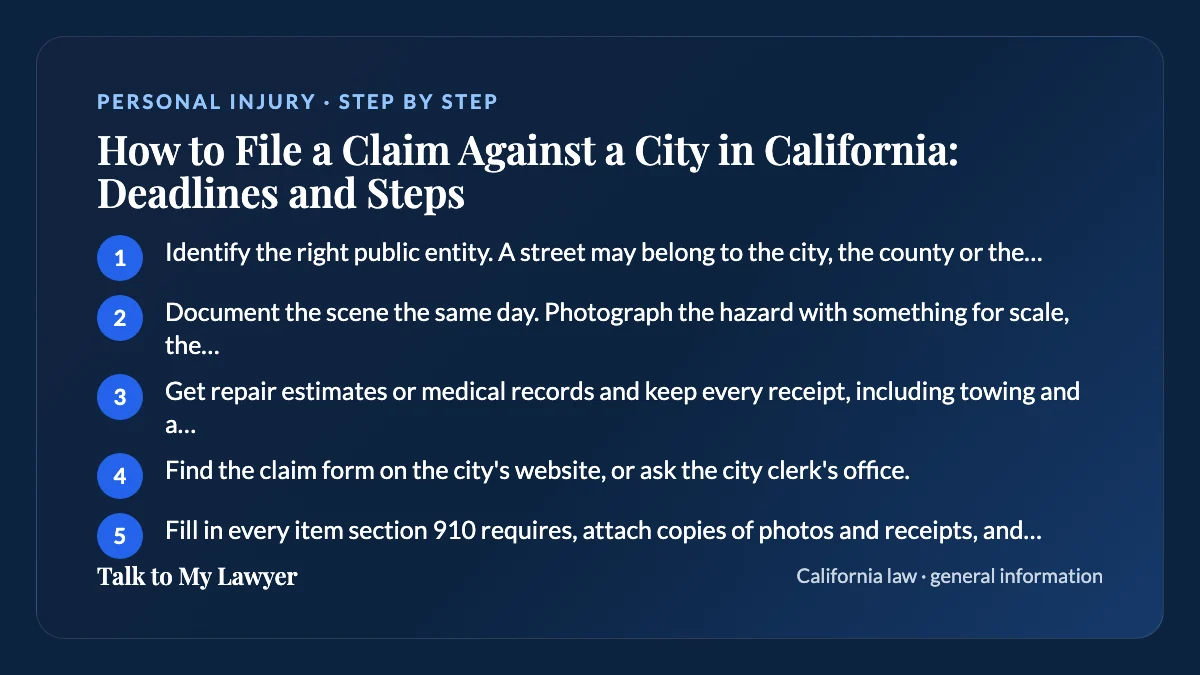
- Identify the right public entity. A street may belong to the city, the county or the state, and state highways are handled through the state's Government Claims Program, which charges a $25 filing fee unless waived (Government Code section 911.2(b)).
- Document the scene the same day. Photograph the hazard with something for scale, the street signs, and your damage. Note the exact location and time.
- Get repair estimates or medical records and keep every receipt, including towing and a rental.
- Find the claim form on the city's website, or ask the city clerk's office.
- Fill in every item section 910 requires, attach copies of photos and receipts, and keep originals.
- Deliver it and keep proof, such as a date-stamped copy or certified mail receipt.
- Calendar day 45 and, if a rejection arrives, six months from the date it was mailed or delivered.
Example (hypothetical): on January 10, 2026, a driver hits a deep pothole on a city street at night. The tire and rim cost $640, an alignment $160, and towing $340, for $1,140 in total. The claim is due by July 10, 2026. She files it in February with photos of the pothole, a tape measure showing its depth, and three emails neighbors sent the city about it in December, which go to notice.
What happens after you file a claim with the city?
The city's board or claims officer must act within 45 days (Government Code section 912.4). It can allow the claim, allow part of it, or reject it. If it does nothing, the claim is deemed rejected on day 45. You and the city can extend the 45 days by written agreement.
| What happens | Your deadline to sue |
|---|---|
| City mails or hands you a written rejection | 6 months from the date the notice was delivered or mailed |
| City never sends a written notice | 2 years from when the claim arose |
A rejection notice must carry a warning that, subject to certain exceptions, you have only six months to file a court action (Government Code section 913). Those dates come from section 945.6.
If the city rejects your claim: small claims or civil court
After rejection, you can sue in small claims court if the amount is within the limit, which is $12,500 for an individual. Anything above that limit belongs in superior court as a regular civil case. Either way, bring the claim, the rejection and your evidence of the dangerous condition and the city's notice of it.
Before the city acts, you can strengthen the claim. If you find new evidence, such as repair requests showing the pothole was reported months earlier, you can amend the claim, and the city then has 45 days to act on the amended version (section 912.4(a)).
Our guide to sending a demand letter before small claims in California covers the filing steps. For injury claims, see the personal injury demand letter guide, and for a fall on public property, our slip and fall claim guide.
Putting a lawyer's letter behind a city claim
A government claim is short, but the facts on it frame everything after: where the hazard was, how long the city knew, and how the amount was figured. A lawyer's letter accompanying the claim, or following a rejection, sets those facts against Government Code section 835 and the notice the city had.
Through Talk to My Lawyer, a licensed California attorney writes your letter from your photos, repair bills and claim paperwork, and sends it on your behalf to the city or its claims office. For advice on deadlines or a late claim, talk to a lawyer about your facts.
Frequently asked questions
Can I sue a city in small claims court in California?
Yes, but only after you present a written claim to the city and it is rejected or deemed rejected. The California Courts self-help guide says that before you can sue a government agency, you must first file a claim with it. Individuals can then claim up to $12,500 in small claims.
What if I missed the six-month deadline for a claim against a city?
You can apply in writing for leave to present a late claim, within a reasonable time and no later than one year after the claim arose (Government Code section 911.4). The application must explain the delay and attach the proposed claim. The city decides whether to grant it, and court relief may be possible if it refuses, so talk to a lawyer promptly.
Will the city pay for pothole damage to my car?
It may, if you show the pothole was a dangerous condition and the city created it or had actual or constructive notice of it in time to repair it or warn drivers (Government Code section 835). Prior complaints, repair requests and photos showing how long the pothole existed help on notice. File the claim within six months of the damage.
How long does a city have to respond to a government claim?
Forty-five days after the claim is presented (Government Code section 912.4). The city can allow, partly allow or reject it, and if it does nothing the claim is deemed rejected on day 45. A written rejection starts a six-month window to sue; without a written notice, you generally have two years from when the claim arose.
Is there a fee to file a government claim in California?
Claims presented to the State of California through the Department of General Services carry a $25 filing fee, which can be waived (Government Code section 911.2(b)). That fee rule is for state claims. Check the instructions on your city's or county's claim form for its own process.
Sources
Checked against these official sources on October 18, 2026.
- California Government Code section 911.2 (California Legislative Information)
- California Government Code section 910 (California Legislative Information)
- California Government Code section 912.4 (California Legislative Information)
- California Government Code section 945.6 (California Legislative Information)
- California Government Code section 835 (California Legislative Information)
- Ask a government agency to pay you by a deadline (California Courts Self-Help Guide)
This guide explains California law in general terms as of October 2026. It is general information, not legal advice for your situation, and local rules can add to it.
Join the email list and get a lawyer letter started
With Talk to My Lawyer, a licensed California attorney writes your letter from your facts and documents and sends it on your behalf. Join the Talk to My Lawyer email list for letter checklists, document prompts, and reminders before you start your letter.