Quick answer
A car accident property damage claim against the other driver asks the at-fault driver, or their liability insurer, to pay for your repairs or the car's lost value, plus a rental while it is fixed. In California you have three years to sue for vehicle damage (Code of Civil Procedure section 338), and each driver must report the crash to the DMV within 10 days if damage tops $1,000.
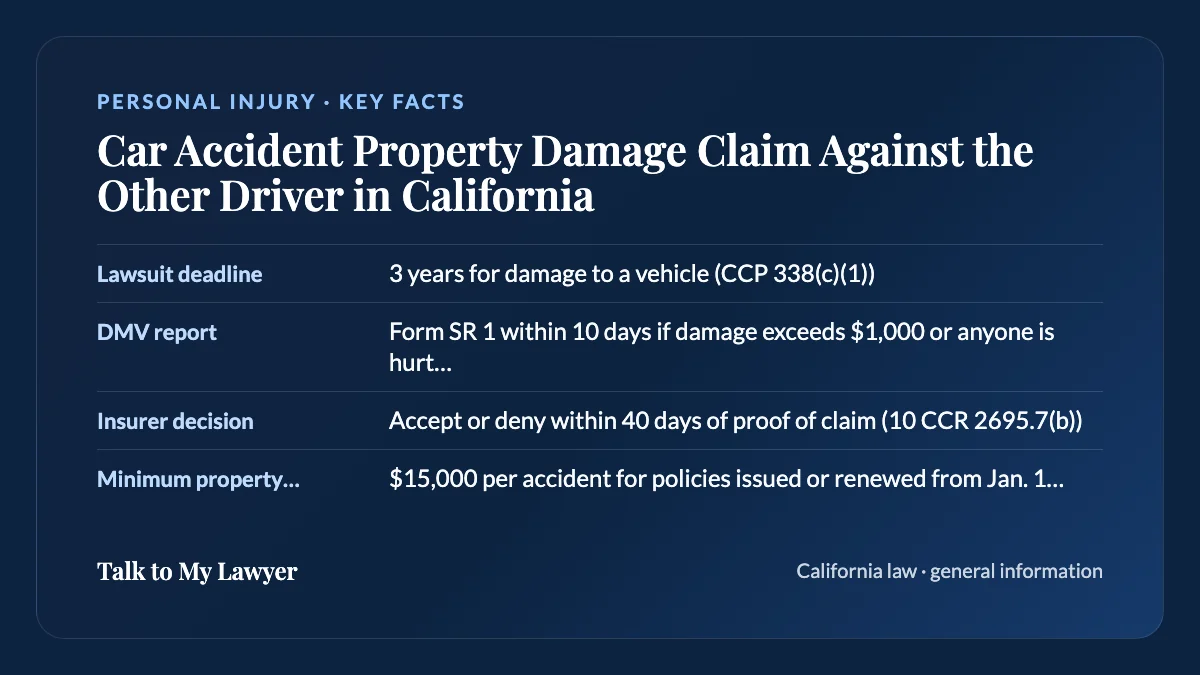
At a glance
- Lawsuit deadline
- 3 years for damage to a vehicle (CCP 338(c)(1))
- DMV report
- Form SR 1 within 10 days if damage exceeds $1,000 or anyone is hurt (Veh. Code 16000)
- Insurer decision
- Accept or deny within 40 days of proof of claim (10 CCR 2695.7(b))
- Minimum property coverage
- $15,000 per accident for policies issued or renewed from Jan. 1, 2025 (Veh. Code 16056)
- Small claims
- Up to $12,500 for individuals (CCP 116.221)
Who pays for your car damage when the other driver is at fault?
The at-fault driver owes you for the damage, and if that driver carries liability insurance, the claim goes to their insurer. This is called a third-party claim, because you are not the insurer's own customer.
You have three routes, and you can move between them:
- Third-party claim. You file with the other driver's insurer for repairs, rental and related costs. No deductible applies, but the insurer will investigate fault before it pays.
- Your own collision coverage. Your insurer can fix the car now, minus your deductible, and then seek repayment from the at-fault side. Ask whether it will try to recover your deductible too.
- A direct demand to the driver. If there is no insurance, or the insurer disputes fault or the amount, your demand goes to the driver personally.
California's minimum liability limits rose for policies issued or renewed on or after January 1, 2025. The property damage minimum is now $15,000 per accident, up from $5,000 (Vehicle Code section 16056). If your loss is larger than the other driver's limit, the policy limit does not cap what the driver owes, though collecting the rest is a separate problem.
Repair, total loss, rental, diminished value: what can you claim?
You can claim the reasonable cost to repair the car or its loss in value, whichever is less, plus the cost of renting a similar car while yours is repaired or replaced. That is how California's civil jury instructions measure vehicle damage (CACI Nos. 3903J and 3903M).
| Item | How it is measured | Proof to gather |
|---|---|---|
| Repairs | Reasonable repair cost, if less than the drop in value | Written estimate or final invoice from a shop you choose |
| Total loss | Fair market value just before the crash, minus the value after it | Listings for comparable cars, service records, upgrades |
| Diminished value | If the repaired car is worth less, the lost value plus the repair cost, capped at the pre-crash value | Appraisal comparing value before the crash and after repair |
| Loss of use | Reasonable cost to rent a similar car for the time reasonably needed to repair or replace yours | Rental agreement and receipts, shop in and out dates |
| Towing and storage | Reasonable amounts spent to keep the car from further harm (CACI No. 3931) | Tow and yard invoices |
When an insurer settles a total loss in cash, the amount must be based on the actual cost of a comparable automobile and include applicable taxes and one-time transfer fees (California Code of Regulations, title 10, section 2695.8(b)). The regulation also addresses third-party claimants who keep the damaged car.
An insurer cannot require you to use a particular repair shop (section 2695.8(e)). If it settles a partial loss on its own written estimate, it must give you a copy of that estimate (section 2695.8(f)).
Which deadlines apply after a California car accident?
Three clocks run after a damage-only crash: 10 days to report to the DMV, the insurer's claim-handling deadlines, and three years to file suit.
| Deadline | What must happen | Rule |
|---|---|---|
| 10 days | Each driver reports to the DMV on form SR 1 if any one person's property damage exceeds $1,000, or anyone was hurt or killed | Vehicle Code 16000 |
| 15 days | Insurer acknowledges the claim, sends forms and begins investigating | 10 CCR 2695.5(e) |
| 40 days | Insurer accepts or denies after proof of claim, or explains in writing why it needs more time and updates you every 30 days | 10 CCR 2695.7(b), (c)(1) |
| 30 days | Insurer pays once it accepts the claim in whole or in part | 10 CCR 2695.7(h) |
| 3 years | Lawsuit for injury to personal property, including a vehicle | CCP 338(c)(1) |
The SR 1 duty applies to every driver involved, whoever caused the crash, and it is separate from a police report or an insurance claim. If anyone was hurt, the injury claim has a shorter two-year limit (Code of Civil Procedure section 335.1); our personal injury demand letter guide covers that side.
What if the at-fault driver has no insurance?
When the other driver is uninsured, the money comes from your own policy or from the driver personally.
- Collision coverage pays for repairs, minus your deductible.
- Uninsured motorist property damage coverage, which insurers must offer, can pay your collision deductible when the other vehicle was uninsured. If you have no collision coverage, it pays for damage to your car up to its actual cash value or $3,500, whichever is less, and that version excludes loss of use (Insurance Code section 11580.26). Either way, it applies only if the vehicles actually touched, the other driver or the license plate is identified, and the crash was reported to your insurer within 10 business days.
- A demand to the driver. An uninsured driver is still responsible for the damage. A written demand sets out the amount and a date, and it becomes your record if you file in small claims.
If the driver was insured but the insurer is offering less than your documents support, see our guide to an auto insurance underpayment demand letter.
How to build a property damage demand, step by step
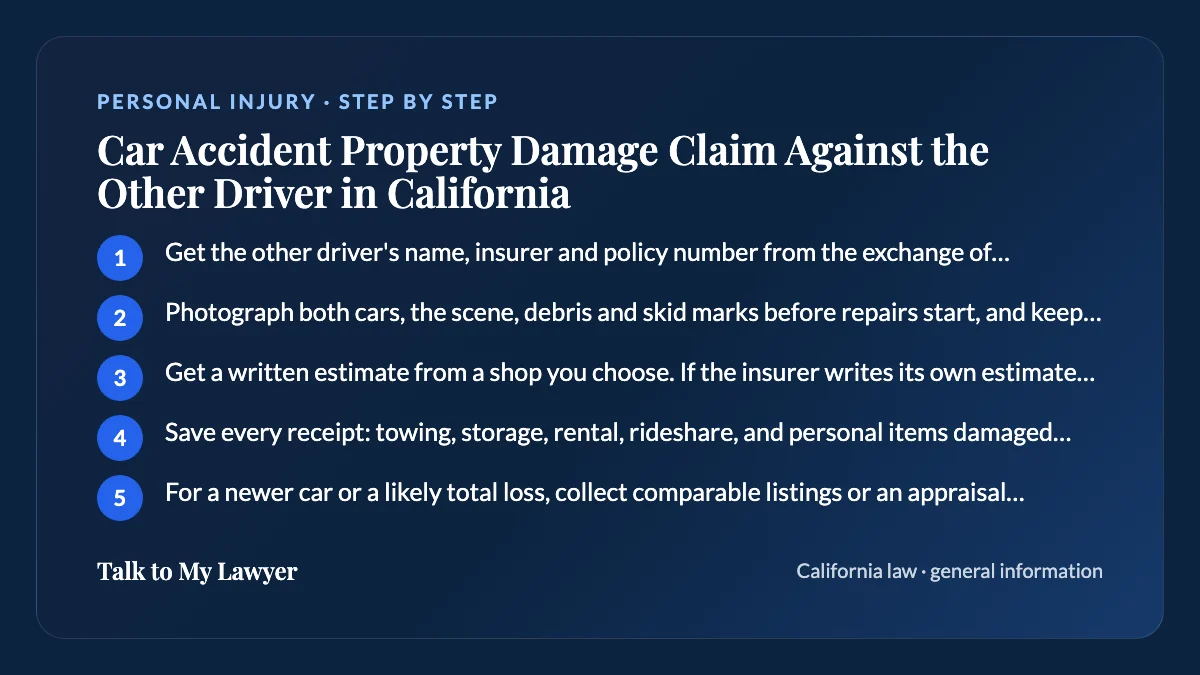
- Get the other driver's name, insurer and policy number from the exchange of information or the police report, and open the claim in writing.
- Photograph both cars, the scene, debris and skid marks before repairs start, and keep the original files with their dates.
- Get a written estimate from a shop you choose. If the insurer writes its own estimate, ask for a copy.
- Save every receipt: towing, storage, rental, rideshare, and personal items damaged inside the car.
- For a newer car or a likely total loss, collect comparable listings or an appraisal for pre-crash value and, after repair, diminished value.
- Write the demand: date and place, why the other driver is responsible, each amount with its document, the total, and a response date.
- Send it to the adjuster and keep proof of delivery. If you also send it to the driver, use the address from the police report or the exchange of information.
Example: a rear-end collision demand with numbers
Example (hypothetical): a driver is stopped at a red light in Fresno when another car hits her from behind. The other driver's insurer accepts fault but offers only the repair bill.
| Item | Amount | Document |
|---|---|---|
| Repairs at her chosen shop | $6,800 | Final invoice |
| Towing and two days of storage | $310 | Tow yard receipts |
| Rental car, 12 days at $55 | $660 | Rental agreement and receipt |
| Diminished value after repair | $1,900 | Independent appraisal |
| Total demanded | $9,670 | Itemized list with copies |
On March 4, 2026, your insured struck the rear of my vehicle while I was stopped at the signal at Elm Avenue and 5th Street. Your company has accepted liability. I request $9,670: $6,800 for repairs, $310 for towing and storage, $660 for a rental during the 12 days of repair, and $1,900 for the loss in value shown in the enclosed appraisal. Please respond in writing by April 20, 2026.
The letter needs no threats: facts, figures, documents and a date carry it. Once an insurer accepts a claim in whole or in part, the regulations give it 30 days to pay the accepted amount (section 2695.7(h)), so an offer on the repairs alone should not hold up that payment while the other items are discussed.
What happens if the insurer or driver will not pay?
Your next steps are a complaint to the California Department of Insurance about how the claim was handled, small claims court, or a civil lawsuit for larger amounts.
- Department of Insurance. You can file a claim-handling complaint online or through the Consumer Hotline at 1-800-927-4357.
- Small claims. Individuals can sue for up to $12,500 (Code of Civil Procedure section 116.221), starting with form SC-100. Most filers pay $30 to $75 depending on the amount claimed (section 116.230), and lawyers generally cannot represent either side at the hearing (section 116.530).
- Ask first. The courts' self-help guide says you must ask the other side for the money before filing. Your demand letter is that request, so bring a copy.
Name the at-fault driver as the defendant; a lawyer can tell you whether the vehicle's owner should be named too. For the filing steps, see our guide to sending a demand letter before small claims.
When a lawyer-written damage demand helps
A total-loss figure thousands below the comparable listings, a driver with no insurance, or an adjuster who has gone quiet past the 40-day mark: those are the points where a damage claim stalls. A letter from a lawyer sets your receipts against the jury-instruction damage measures and the claim regulations, item by item.
Through Talk to My Lawyer, a licensed California attorney writes your letter from your estimates, receipts, photos and claim notes, and sends it on your behalf to the driver, the insurer or both. For advice on whether to sue or settle, talk to a lawyer about your facts.
Frequently asked questions
Can I claim diminished value from the other driver's insurance in California?
You can ask for it as part of a third-party claim. California's jury instructions allow damages for the difference between a car's value before the crash and its value after repairs, plus the repair cost, capped at the pre-crash value (CACI No. 3903J). No statute sets a formula, so support the number with an appraisal. Your own policy may limit diminished value on a claim against your own insurer.
Do I have to report a minor car accident to the DMV in California?
Only if it crosses the threshold. Vehicle Code section 16000 requires each driver to file form SR 1 with the DMV within 10 days when the crash caused more than $1,000 of damage to any one person's property, or injured or killed anyone. Look at the repair estimate before deciding no report is needed.
How long do I have to sue for car damage after an accident in California?
Three years from the crash for damage to your vehicle or other personal property, under Code of Civil Procedure section 338(c)(1). Injury claims have a two-year limit under section 335.1, and claims against a city or other public entity require a government claim within six months. Insurance policies also require prompt notice, so open the claim early even though the lawsuit deadline is longer.
Does the at-fault driver's insurance have to pay for my rental car?
Loss of use is a recognized item of damage. California's jury instructions measure it as the reasonable cost to rent a similar vehicle for the time reasonably needed to repair or replace yours (CACI No. 3903M). Ask the adjuster in writing to confirm rental coverage once fault is accepted, and keep the rental agreement and receipts. Rental time beyond a reasonable repair period may be disputed.
Can I take an uninsured driver to small claims court for car damage?
Yes. An uninsured driver is still responsible for the damage they caused, and an individual can claim up to $12,500 in small claims court. You must ask for payment before filing, which a demand letter does. A judgment and actual collection are separate steps, so also check whether your own collision or uninsured motorist property damage coverage applies.
Sources
Checked against these official sources on October 18, 2026.
- California Vehicle Code section 16000 (California Legislative Information)
- California Vehicle Code section 16056 (California Legislative Information)
- California Code of Civil Procedure section 338 (California Legislative Information)
- 10 CCR 2695.7 Standards for Prompt, Fair and Equitable Settlements (Legal Information Institute, Cornell Law School (California Code of Regulations text))
- 10 CCR 2695.8 Additional Standards Applicable to Automobile Insurance (Legal Information Institute, Cornell Law School (California Code of Regulations text))
- Judicial Council of California Civil Jury Instructions (CACI), 2026 edition (Judicial Council of California)
This guide explains California law in general terms as of October 2026. It is general information, not legal advice for your situation, and local rules can add to it.
Join the email list and get a lawyer letter started
With Talk to My Lawyer, a licensed California attorney writes your letter from your facts and documents and sends it on your behalf. Join the Talk to My Lawyer email list for letter checklists, document prompts, and reminders before you start your letter.