Quick answer
An uninsured motorist claim in California is a claim against your own auto insurer for injuries caused by a driver with no liability insurance, an unidentified hit-and-run driver, or an underinsured driver. Under Insurance Code section 11580.2, within two years of the accident you must sue the uninsured driver, reach an agreement with your insurer, or formally start arbitration by certified mail.
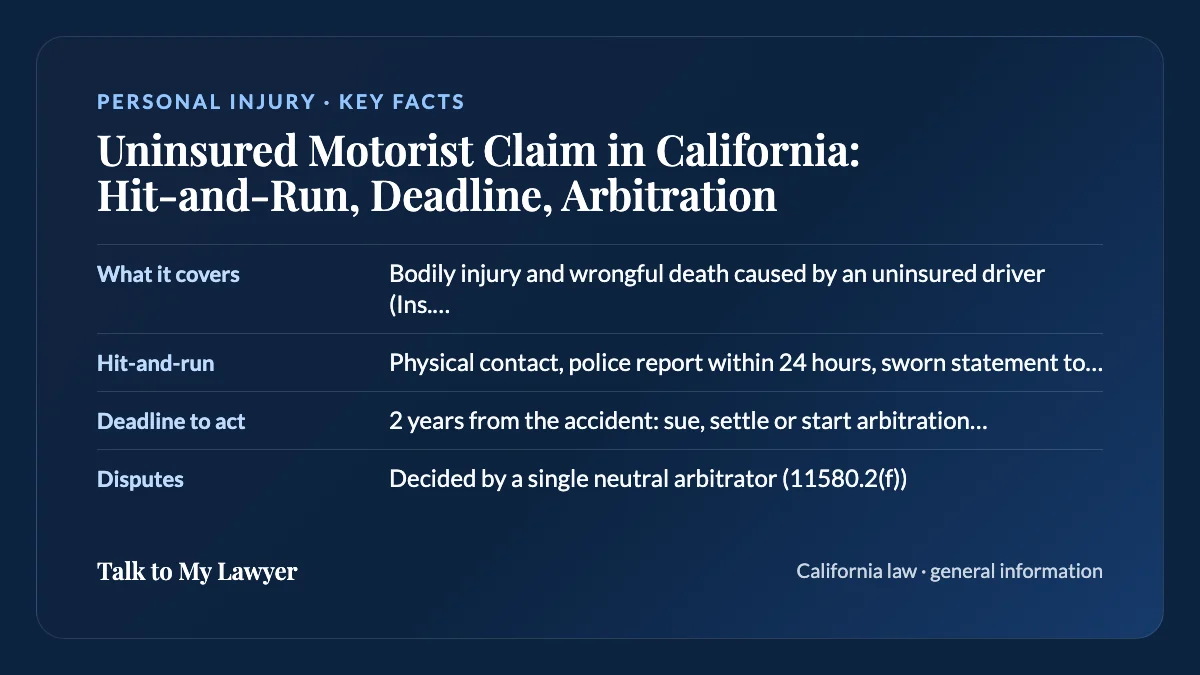
At a glance
- What it covers
- Bodily injury and wrongful death caused by an uninsured driver (Ins. Code 11580.2(a))
- Hit-and-run
- Physical contact, police report within 24 hours, sworn statement to insurer within 30 days
- Deadline to act
- 2 years from the accident: sue, settle or start arbitration (11580.2(i))
- Disputes
- Decided by a single neutral arbitrator (11580.2(f))
- Underinsured claims
- Only after the other driver's liability limits are paid (11580.2(p))
What is an uninsured motorist claim in California?
It is a claim under your own auto policy for the injury damages you could have recovered from an at-fault driver who has no usable insurance. Insurance Code section 11580.2 requires every California auto bodily injury liability policy to include uninsured motorist coverage unless you deleted it by a signed written agreement.
The coverage pays for bodily injury and wrongful death, measured by what you would be legally entitled to recover from the uninsured driver: medical bills, lost earnings, pain and suffering, up to your coverage limit. Damage to your car falls under a separate, optional coverage covered in our guide to car accident property damage claims.
Because the claim is against your own insurer, it is a first-party claim. The insurer owes you the claim-handling duties in the Fair Claims Settlement Practices Regulations, but on the value of your injuries it is your opponent.
Which drivers count as uninsured, and which do not?
| Situation | Uninsured under 11580.2? | Notes |
|---|---|---|
| At-fault driver had no bodily injury liability insurance | Yes | The core case |
| Driver's insurer denies coverage or will only admit it conditionally | Yes | Keep the denial letter |
| Hit-and-run, driver never identified | Yes, if the conditions below are met | Physical contact is required |
| Driver insured for less than your uninsured motorist limits | Treated as underinsured | Separate rules in subdivision (p) |
| Driver's insurer becomes insolvent within one year of the accident | Yes | Applies to accidents during the policy period |
| Vehicle owned by you or someone in your household | No | Excluded by the statute |
| Vehicle owned by the United States, the state or a local government | No | A claim against a public entity follows the Government Claims Act |
If a city truck or a county bus caused the crash, the route is a government claim, generally within six months. See our guide to filing a claim against a city in California.
Hit-and-run: the physical contact, 24-hour and 30-day rules
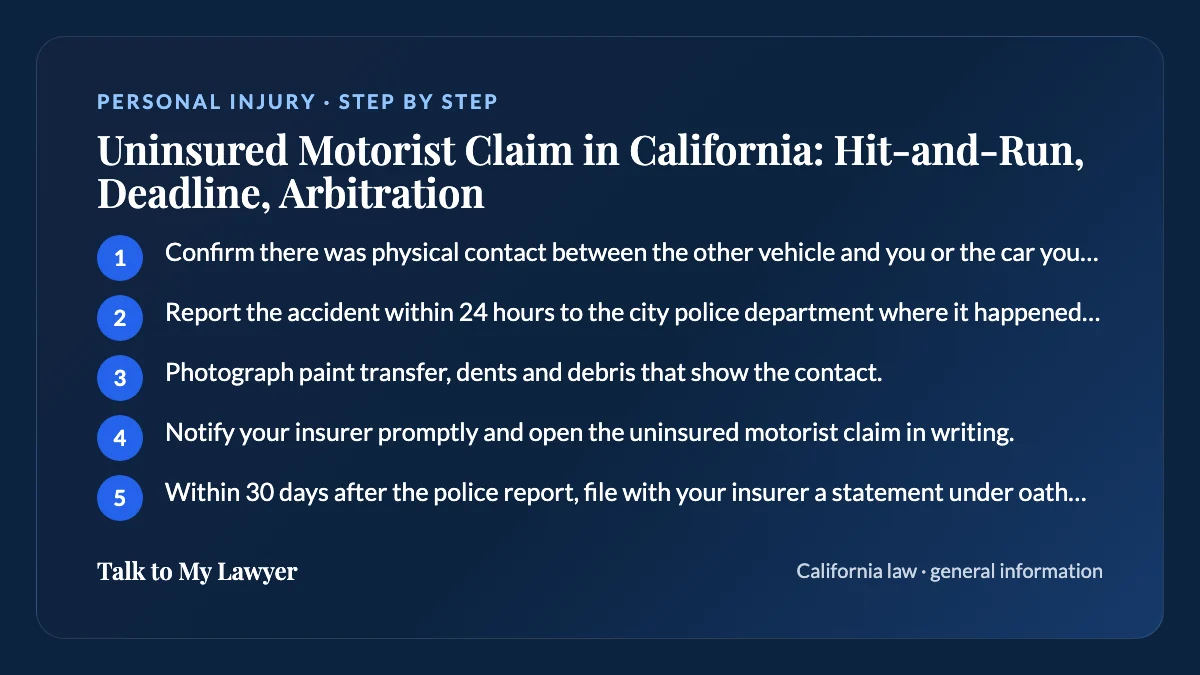
A hit-and-run driver counts as uninsured only if three conditions in section 11580.2(b) are met. These steps line up with them:
- Confirm there was physical contact between the other vehicle and you or the car you were in. A driver who ran you off the road without touching your car does not qualify under this rule.
- Report the accident within 24 hours to the city police department where it happened, or in unincorporated areas to the county sheriff or the local California Highway Patrol office. Keep the report number.
- Photograph paint transfer, dents and debris that show the contact.
- Notify your insurer promptly and open the uninsured motorist claim in writing.
- Within 30 days after the police report, file with your insurer a statement under oath that you have a claim against a person whose identity cannot be found, with the supporting facts.
The statute lets someone else make the police report on your behalf, and your legal representative can sign the sworn statement.
How long do you have to bring an uninsured motorist claim?
Within two years from the date of the accident, one of three things must happen (Insurance Code section 11580.2(i)(1)):
- You file a suit for bodily injury against the uninsured driver.
- You and your insurer conclude an agreement on the amount due.
- You formally start arbitration by written notice to the insurer, sent by certified mail, return receipt requested, to the insurer or its designated agent for process.
Some older guides cite a one-year period; the current text of section 11580.2(i) says two years. Once started, arbitration must be concluded within five years, with a longer window in some workers' compensation cases. Estoppel, waiver, impossibility, impracticality and futility can excuse a missed timeframe, as a court decides, and the parties can agree in writing to extend the time to finish arbitration.
Underinsured motorist claims: the other policy comes first
An underinsured vehicle has liability insurance, but less than the uninsured motorist limits on your policy. Underinsured coverage does not apply until every liability policy covering the at-fault vehicles has been paid out to its limits, through judgments or settlements, and you send proof of that payment to your insurer (section 11580.2(p)(3)).
Your insurer then pays up to your limit, minus what you received from the at-fault side (section 11580.2(p)(4)).
Example (hypothetical): your policy has $100,000 in uninsured and underinsured motorist coverage. The at-fault driver carries the $30,000 per-person minimum, and that insurer pays its full $30,000. The most your insurer can pay under underinsured coverage is $70,000, and only if your damages support it.
If you sue the underinsured driver, the statute requires you to give your own insurer a copy of the complaint by personal service or certified mail.
Demand, then arbitration: how disagreements with your insurer are decided
Whether you are entitled to recover, and how much, is settled by agreement with your insurer or, if you disagree, by arbitration before a single neutral arbitrator (section 11580.2(f)). A demand letter is how you start the agreement route: it lays out fault, injuries, records and a number.
Every arbitration demand must include a declaration under penalty of perjury stating whether you have a workers' compensation claim. If you do, the arbitrator generally waits until your condition is stationary and ratable.
I am making a claim under the uninsured motorist coverage of policy 123-456 for injuries from the collision on February 2, 2026, on Highway 99 near Merced. The other driver had no liability insurance, as shown in the enclosed police report. My medical expenses total $18,450 and my lost wages total $6,200; records and bills are enclosed. I request $55,000 within 30 days. If we cannot agree, this letter also serves as my written demand for arbitration under Insurance Code section 11580.2; my declaration under penalty of perjury regarding workers' compensation is enclosed.
Send any arbitration demand by certified mail, return receipt requested, to meet the statute's notice method. For more on building the injury figures, see our personal injury demand letter guide.
What deadlines does your own insurer have to meet?
California's claim regulations give your insurer 15 days to acknowledge the claim and begin investigating (10 CCR 2695.5(e)), and 40 days after proof of claim to accept or deny it, in whole or in part (10 CCR 2695.7(b)). If it needs more time, it must tell you in writing what it needs and why, and update you every 30 days.
A denial of a first-party claim must be in writing, list every basis for it, and tell you that you can have the matter reviewed by the California Department of Insurance. The Department's Consumer Hotline is 1-800-927-4357. For answering a written denial, see responding to an insurance claim denial.
A lawyer's letter when your own insurer is the other side
Uninsured motorist claims mix two things: a statute full of conditions, and an injury valuation on which your own insurer is your opponent. A letter from a lawyer ties your hit-and-run report, sworn statement and medical records to section 11580.2, and can serve as the formal arbitration notice the statute calls for.
Through Talk to My Lawyer, a licensed California attorney writes your letter from your policy, police report, medical records and bills, and sends it on your behalf to your insurer. For advice about arbitration strategy or the value of your injuries, talk to a lawyer about your facts.
Frequently asked questions
How long do I have to file an uninsured motorist claim in California?
Within two years from the accident, you must either sue the uninsured driver, reach an agreement with your insurer on the amount, or formally start arbitration by certified mail, return receipt requested (Insurance Code section 11580.2(i)). Hit-and-run claims also require a police report within 24 hours and a sworn statement to your insurer within 30 days. Report the claim to your insurer as early as possible.
Do I need physical contact for a hit-and-run uninsured motorist claim?
Yes. When the driver is never identified, section 11580.2(b) requires that the injury arose from physical contact between the other vehicle and you or the vehicle you were in. A phantom vehicle that forced you off the road without touching your car does not meet that condition. Photographs of paint transfer and damage help show the contact.
Is uninsured motorist coverage required in California?
Insurers must include it in every auto bodily injury liability policy, but you can delete it, fully or for named drivers, by signing a written agreement in the form the statute sets out. Insurers must offer limits equal to your bodily injury liability limits, though they are not required to offer more than $30,000 per person and $60,000 per accident (section 11580.2(m)). Check your declarations page to see whether you have it and what the limits are.
What is the difference between uninsured and underinsured motorist coverage?
Uninsured coverage applies when the at-fault driver has no liability insurance, cannot be identified after a hit-and-run, or has an insurer that denies coverage. Underinsured coverage applies when the driver has insurance, but less than your uninsured motorist limits. Underinsured benefits start only after the other driver's policy pays its full limits, and your insurer subtracts that payment from what it owes.
Does uninsured motorist coverage pay for damage to my car?
Not the bodily injury coverage in section 11580.2. Car damage from an uninsured driver falls under collision coverage or under uninsured motorist property damage coverage (Insurance Code section 11580.26), which can pay your collision deductible or, without collision coverage, up to the car's actual cash value or $3,500, whichever is less. Uninsured motorist property damage coverage requires actual physical contact between the vehicles.
Sources
Checked against these official sources on October 18, 2026.
- California Insurance Code section 11580.2 (California Legislative Information)
- California Insurance Code section 11580.26 (California Legislative Information)
- California Vehicle Code section 16056 (California Legislative Information)
- 10 CCR 2695.7 Standards for Prompt, Fair and Equitable Settlements (Legal Information Institute, Cornell Law School (California Code of Regulations text))
- 10 CCR 2695.5 Duties Upon Receipt of Communications (Legal Information Institute, Cornell Law School (California Code of Regulations text))
- Getting help: Consumer Hotline (California Department of Insurance)
This guide explains California law in general terms as of October 2026. It is general information, not legal advice for your situation, and local rules can add to it.
Join the email list and get a lawyer letter started
With Talk to My Lawyer, a licensed California attorney writes your letter from your facts and documents and sends it on your behalf. Join the Talk to My Lawyer email list for letter checklists, document prompts, and reminders before you start your letter.