Quick answer
A slip and fall claim in California is a premises liability claim under Civil Code section 1714. You must show the owner knew or should have known about the hazard in time to fix it or warn you, and that it caused your injury. You generally have two years to sue a private owner, but only six months to file a claim against a public entity.
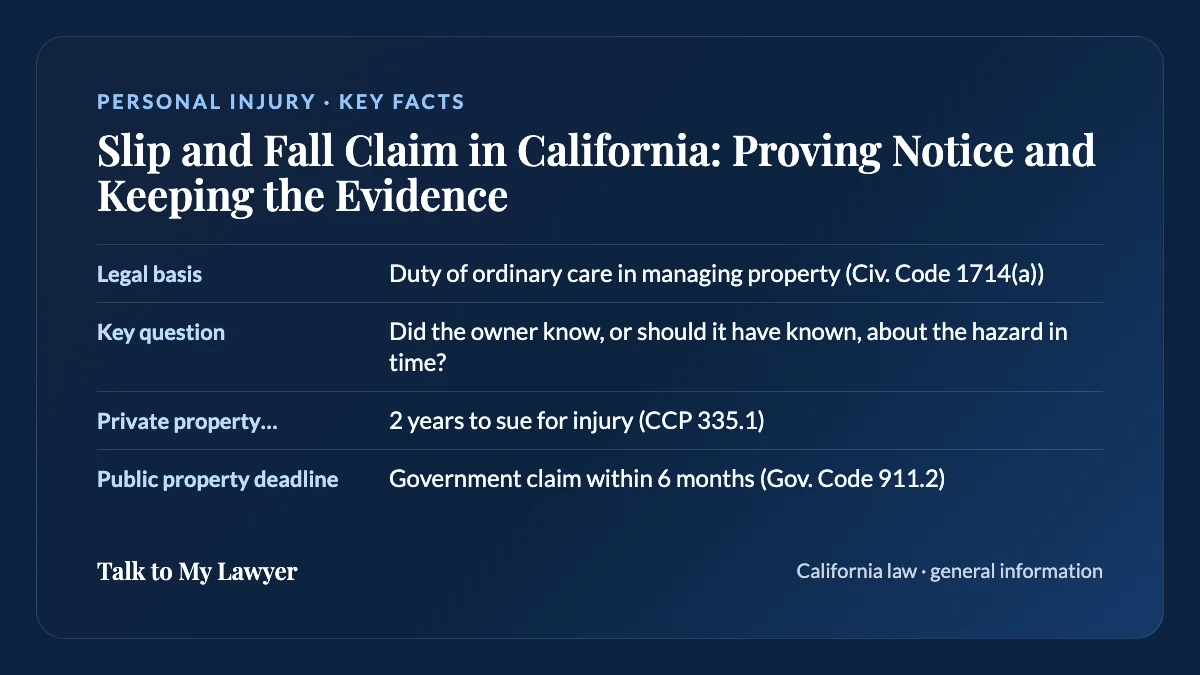
At a glance
- Legal basis
- Duty of ordinary care in managing property (Civ. Code 1714(a))
- Key question
- Did the owner know, or should it have known, about the hazard in time?
- Private property deadline
- 2 years to sue for injury (CCP 335.1)
- Public property deadline
- Government claim within 6 months (Gov. Code 911.2)
- Your own care
- Damages reduced by your share of fault (CACI No. 405)
What do you have to prove in a California slip and fall claim?
You have to show the property owner or occupier was negligent in maintaining the property and that the negligence caused your injury. The duty comes from Civil Code section 1714(a), which makes everyone responsible for injuries caused by a want of ordinary care in managing their property.
California's civil jury instructions break a premises claim into four elements (CACI No. 1000):
- The defendant owned, leased, occupied or controlled the property.
- The defendant was negligent in using or maintaining it.
- You were harmed.
- The negligence was a substantial factor in causing your harm.
For a hazard such as a spill, a loose mat or a broken step, negligence means three things (CACI No. 1003): the condition created an unreasonable risk of harm, the owner knew or with reasonable care should have known about it, and the owner failed to repair it, guard against it or give an adequate warning.
Did the owner know about the hazard? How notice works
Notice is the element that separates a hazard from a claim. A store is not liable simply because someone fell; the question is whether it had a fair chance to find and fix the hazard.
| Kind of notice | What it means | Evidence that shows it |
|---|---|---|
| Created by the owner | If the owner or an employee created the condition, the owner is treated as knowing about it (CACI No. 1012) | Mop bucket nearby, freshly waxed floor, staff stacking produce that dripped |
| Actual notice | The owner was told or saw the hazard | Earlier complaints, a staff member who walked past it, an incident log |
| Constructive notice | The hazard existed long enough that reasonable inspections would have found it (CACI No. 1011) | Dirty track marks through the spill, dried edges, inspection logs with gaps |
For stores, the jury instruction based on Ortega v. Kmart adds that the owner must make reasonable inspections, and that if no inspection was made within a reasonable time before the fall, a jury may infer the condition existed long enough to be discovered. That is why sweep logs and video timestamps matter so much.
Evidence that disappears first, and how to keep it
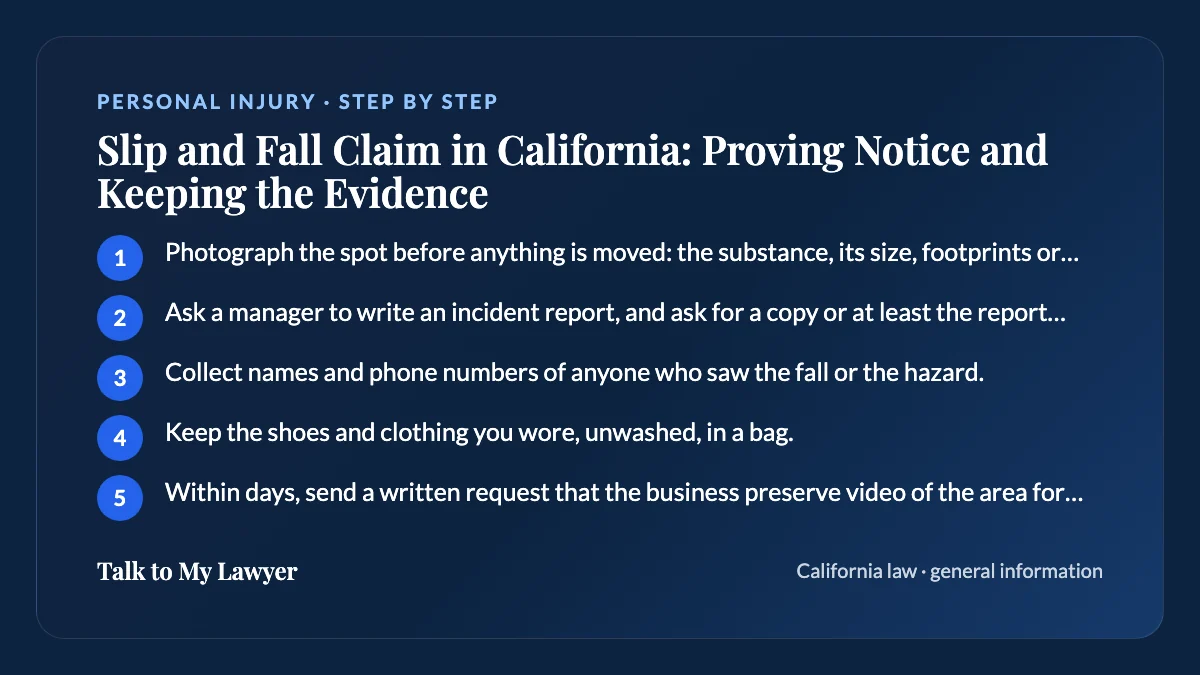
A spill can be mopped up within minutes, and video systems can record over old footage on a set schedule. These steps capture what you can:
- Photograph the spot before anything is moved: the substance, its size, footprints or cart tracks through it, and the absence of a warning sign.
- Ask a manager to write an incident report, and ask for a copy or at least the report number and the manager's name.
- Collect names and phone numbers of anyone who saw the fall or the hazard.
- Keep the shoes and clothing you wore, unwashed, in a bag.
- Within days, send a written request that the business preserve video of the area for the hours before and after the fall, plus cleaning and inspection logs for that day.
- Get medical care promptly and tell the provider exactly how you fell, so the record ties the injury to the incident.
On September 12, 2026, at about 4:15 p.m., I slipped on liquid on the floor of aisle 7 at your store at 300 Main Street, Riverside, and was injured. Please preserve all video recordings of aisle 7 and its approaches from 12:00 p.m. to 6:00 p.m. that day, the incident report, and all floor inspection and cleaning records for that date. Please also send me the name and contact details of your liability insurer.
For a broader list of documents to gather, see our demand letter evidence checklist.
Store, apartment or city sidewalk: who gets the claim and by when
The deadline depends on who controls the property. Public property runs on a much shorter clock.
| Where you fell | First step | Deadline | Notice standard |
|---|---|---|---|
| Store, restaurant, office or other business | Claim with the business or its liability insurer | 2 years to sue (CCP 335.1) | Ordinary care; actual or constructive notice |
| Apartment common area or rental | Claim with the owner or property manager and its insurer | 2 years to sue (CCP 335.1) | Ordinary care by whoever controls the area |
| City sidewalk, park, library or other public property | Written government claim to the public entity | 6 months to file the claim (Gov. Code 911.2) | Dangerous condition, plus notice in time to act, or created by an employee (Gov. Code 835) |
For public property, a public entity has constructive notice only if the condition existed long enough and was obvious enough that it should have been discovered, which can include asking whether its inspection system was reasonable (Government Code section 835.2). If you miss the six-month window, you can apply to present a late claim within one year, stating the reason for the delay (section 911.4). Our guide to filing a claim against a city in California walks through the form.
What a slip and fall demand letter should include
Once treatment has settled enough to know your costs, the demand goes to the owner or its liability insurer. It should cover:
- Date, time and exact location, with photos of the hazard.
- The notice facts: who created the hazard, who knew, and how long it was there.
- Your injuries and treatment, with medical records and bills.
- Lost income, with pay records.
- Future care your doctor expects, in writing.
- A specific amount and a response date.
Example (hypothetical): a shopper fractures a wrist on spilled detergent. Store video shows the leak started 40 minutes earlier and two employees walked past it. Her letter leads with those two facts, then lists $8,900 in medical bills, $2,400 in missed wages and her surgeon's note about therapy, and asks the insurer to respond within 30 days.
For valuing pain and future care, our personal injury demand letter guide goes further.
Having a lawyer write the slip and fall letter
In a fall case, the best evidence about notice (the video and the inspection logs) sits with the store or landlord, not with you. A lawyer's letter names those records, asks that they be kept, and frames your claim around the notice rules the insurer will apply.
Through Talk to My Lawyer, a licensed California attorney writes your letter from your photos, incident report, medical records and bills, and sends it on your behalf to the property owner or its insurer. For advice on a public entity claim or a lawsuit, talk to a lawyer about your facts.
Frequently asked questions
How long do I have to file a slip and fall claim in California?
For a fall on private property, such as a store or apartment complex, you generally have two years from the injury to file a lawsuit (Code of Civil Procedure section 335.1). For a fall on public property, you must first present a written claim to the public entity within six months (Government Code section 911.2). Talk to a lawyer promptly if you are near either deadline.
Do I have to prove the store knew about the spill?
You have to show the store knew or should have known. Knowledge is assumed if an employee created the hazard. Otherwise you can show someone told the store or saw it, or that the hazard was there long enough that reasonable inspections would have found it. Missing inspections before the fall can support that inference under the jury instruction drawn from Ortega v. Kmart.
What if I tripped on a broken city sidewalk?
Claims against a city follow the Government Claims Act. You file a written claim with the city within six months, describing the date, place, injury and amount. To recover, you generally must show a dangerous condition of public property and either that an employee created it or that the city had actual or constructive notice in time to fix it (Government Code section 835).
Can I recover if I was looking at my phone when I fell?
Possibly, with a reduction. California applies comparative fault, so if your inattention contributed to the fall, a jury reduces your damages by your percentage of responsibility rather than denying the claim. The owner has to prove your negligence was a substantial factor. Whether the hazard was obvious also matters, so photographs of what you could see from where you walked help.
What is a premises liability claim?
It is a negligence claim against someone who owns, leases, occupies or controls property, based on how they kept it. Slip and fall, trip and fall, falling objects and broken stairs are common examples. The claim rests on the duty of ordinary care in Civil Code section 1714 and on whether the person in control knew or should have known about the danger.
Sources
Checked against these official sources on October 18, 2026.
- California Civil Code section 1714 (California Legislative Information)
- Judicial Council of California Civil Jury Instructions (CACI), 2026 edition (Judicial Council of California)
- California Government Code section 835 (California Legislative Information)
- California Government Code section 911.2 (California Legislative Information)
- California Government Code section 911.4 (California Legislative Information)
- California Code of Civil Procedure section 335.1 (California Legislative Information)
This guide explains California law in general terms as of October 2026. It is general information, not legal advice for your situation, and local rules can add to it.
Join the email list and get a lawyer letter started
With Talk to My Lawyer, a licensed California attorney writes your letter from your facts and documents and sends it on your behalf. Join the Talk to My Lawyer email list for letter checklists, document prompts, and reminders before you start your letter.