Quick answer
A dog bite claim in California rests on Civil Code section 3342: the owner is liable for a bite that happens in a public place or while you are lawfully on private property, even if the dog never bit anyone before. You generally have two years to sue for the injury (Code of Civil Procedure section 335.1). The owner's homeowner's or renter's insurance may pay the claim.
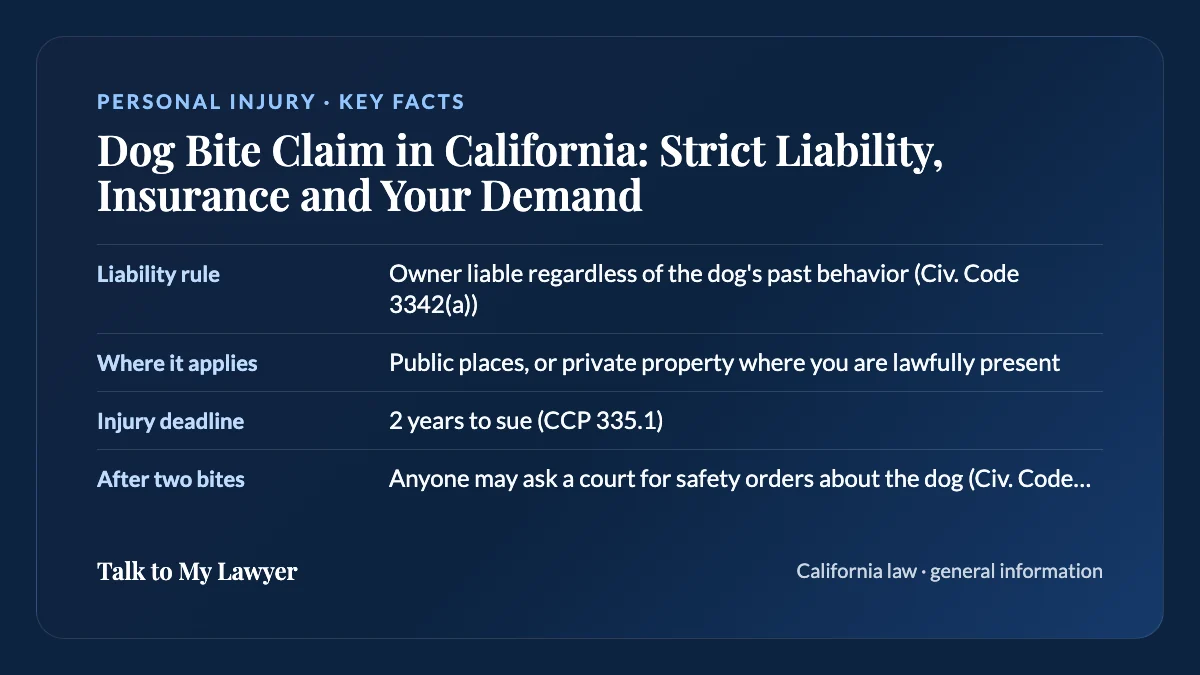
At a glance
- Liability rule
- Owner liable regardless of the dog's past behavior (Civ. Code 3342(a))
- Where it applies
- Public places, or private property where you are lawfully present
- Injury deadline
- 2 years to sue (CCP 335.1)
- After two bites
- Anyone may ask a court for safety orders about the dog (Civ. Code 3342.5(b))
- Small claims
- Up to $12,500 for individuals (CCP 116.221)
Is a dog owner automatically liable for a bite in California?
Yes, for bites. Under Civil Code section 3342(a), the owner of a dog is liable for the damages suffered by anyone the dog bites in a public place or while lawfully in a private place, including the owner's own property. It applies regardless of the dog's former viciousness or the owner's knowledge of it.
So California has no one-free-bite rule. A friendly family dog with a clean record is treated the same as a dog with a history.
The statute defines lawful presence on the owner's property in two ways:
- You were there performing a duty imposed by state law or by federal law or postal regulations, such as a mail carrier on a route.
- You were there on the owner's invitation, express or implied, such as a guest, a delivery driver at the front door, or a neighbor returning a borrowed tool.
Under the Judicial Council's jury instructions, the bite does not have to break the skin for the statute to apply (CACI No. 463, citing Johnson v. McMahan).
When the dog bite statute does not apply
Strict liability has limits, and the owner may raise them in reply to your demand.
| Situation | Does section 3342 apply? | What else may apply |
|---|---|---|
| Trespasser on the owner's property | No. The statute covers public places and lawful presence only | Other negligence rules; ask a lawyer |
| Police or military dog working | Limited exception when the dog was defending itself or helping an officer (for example, holding a suspect), the agency has a written policy on dog use, and the bitten person was involved in the incident (3342(b) to (d)) | Bystanders not involved keep the statute's protection |
| Knocked down or scratched, no bite | No. The statute is about bites | Negligence, or liability for an animal with known dangerous tendencies (CACI No. 462) |
| Veterinarian or kennel worker treating or boarding the dog | Courts have held these workers assume the risk of bites | Depends on the job and facts |
| Victim teased or provoked the dog | The statute applies, but assumption of risk and comparative fault can still be argued | Damages may be reduced |
If the dog jumped on you without biting, the claim looks more like an ordinary injury claim, and our personal injury demand letter guide is the better starting point.
Who pays a dog bite claim: the owner or their insurance?
The legal responsibility belongs to the owner, and the money may come from the owner's homeowner's or renter's liability insurance, if they have it and it covers the dog. Policy wording differs, and some policies contain exclusions or lower limits for animal liability, so the owner's own policy terms decide what it covers.
Ask the owner, in writing, for the name of their insurer and the policy number. If the owner reports the bite to that insurer, an adjuster takes over the claim and becomes the person you deal with.
Section 3342 names the owner. A claim against someone else, such as a landlord, dog walker or the person keeping the dog that day, depends on other negligence rules and on what that person knew, so talk to a lawyer about those facts.
What California's dangerous dog laws add after a bite
Once a dog has bitten someone, the owner has a duty to take reasonable steps to remove the danger the dog presents to others (Civil Code section 3342.5(a)). After bites on at least two separate occasions, any person, the district attorney or the city attorney may ask a court for orders about the dog, which can include removing the animal from the area.
The Food and Agricultural Code separately defines a potentially dangerous dog, including one that, unprovoked, bites a person causing a less severe injury (section 31602), and a vicious dog, including one that, unprovoked and aggressively, inflicts severe injury on or kills a person (section 31603). Cities and counties can add their own dog-control rules, so the local animal control agency is the place that tracks these designations.
These proceedings concern the dog and public safety. Your money claim is separate and stands on section 3342.
What to do in the first two weeks after a dog bite
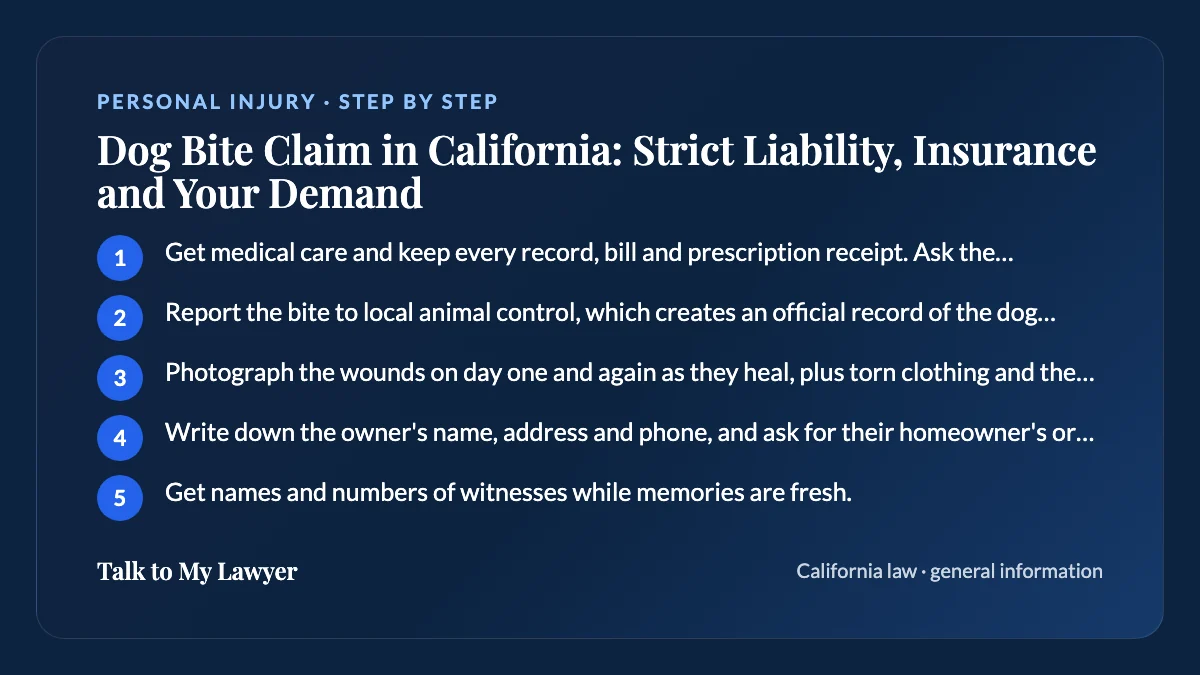
- Get medical care and keep every record, bill and prescription receipt. Ask the provider whether rabies follow-up is needed.
- Report the bite to local animal control, which creates an official record of the dog, the owner and the date.
- Photograph the wounds on day one and again as they heal, plus torn clothing and the place it happened.
- Write down the owner's name, address and phone, and ask for their homeowner's or renter's insurer.
- Get names and numbers of witnesses while memories are fresh.
- Keep a short daily note of pain, missed work, sleep and activities you could not do.
- Keep pay stubs or a letter from your employer showing hours lost.
For a fuller list of records worth keeping, see our demand letter evidence checklist.
What to put in a dog bite demand letter
A dog bite demand states where you were and why you were there, cites section 3342, lists your losses with documents, and asks for a specific amount by a specific date.
- Medical bills paid and owed, including urgent care, stitches, follow-up and any plastic surgery consultation.
- Expected future treatment, such as scar revision, with the provider's written estimate.
- Lost wages, documented by pay records.
- Damaged property: clothing, glasses, a phone dropped in the attack.
- Pain, scarring and emotional distress, described concretely and supported by your notes and photos.
On June 8, 2026, your dog, a tan mixed-breed named Bruno, bit my left forearm while I was on the public sidewalk in front of 1820 Oak Street, San Jose. Under California Civil Code section 3342, a dog's owner is liable for a bite suffered in a public place regardless of the dog's prior behavior. My medical bills to date total $4,260, I missed four days of work ($1,120), and my surgeon estimates $3,500 for scar revision. Copies are enclosed. Please provide your homeowner's insurance information and respond by July 15, 2026.
How long do you have to bring a dog bite claim?
Two years from the bite to file a lawsuit for the injury (Code of Civil Procedure section 335.1). Damaged belongings fall under a separate three-year limit (section 338), but the injury deadline is the one to plan around.
If the total is $12,500 or less, an individual can file in small claims court (Code of Civil Procedure section 116.221). The courts' self-help guide says you must ask the other side for payment before filing, and your demand letter does that. A larger injury claim, such as one involving surgery or permanent scarring, belongs in civil court, where a lawyer can advise on value and strategy.
If the dog belongs to a city or county agency, a written government claim is required first, generally within six months. Our guide to claims against a California city or county walks through that process.
Getting the dog bite demand written by a lawyer
A dog bite demand has to settle two questions: whether you were lawfully where you were standing, and what the scar or the new fear of dogs will cost over time. A lawyer's letter answers the first with the words of section 3342 and the second with your records and your doctor's estimates.
Through Talk to My Lawyer, a licensed California attorney writes your letter from your medical records, photos, witness details and bills, and sends it on your behalf to the owner or their insurer. For advice on the value of an injury claim, talk to a lawyer about your facts.
Frequently asked questions
Does California have a one-bite rule for dogs?
No. Civil Code section 3342 makes the owner liable for a bite in a public place or while the victim is lawfully on private property, regardless of whether the dog was ever vicious before or the owner knew of it. In California, the dog's clean history is not a defense to a bite claim.
Can I make a dog bite claim if the skin was not broken?
Yes. The Judicial Council's jury instruction on the dog bite statute notes that the skin does not have to be broken for section 3342 to apply. The size of the claim still depends on the harm: bruising, a torn jacket, a doctor visit and anxiety around dogs are all real losses, but they need records and photos like any other injury.
How long do I have to file a dog bite lawsuit in California?
Generally two years from the date of the bite, under Code of Civil Procedure section 335.1. If the dog belonged to a public agency, a government claim must be filed first, generally within six months. Other rules can change the timing in some cases, including claims for children, so check the deadline with a lawyer if you are close to it.
Will the owner's homeowner's insurance pay for a dog bite?
It may. Homeowner's and renter's policies can include personal liability coverage that can apply to a dog bite, but policies differ: some exclude particular breeds or dogs with a bite history, or cap animal claims. Ask the owner in writing for the insurer's name and policy number, and send your demand to the adjuster once a claim is open.
What if a dog bit my child at a friend's house?
A child visiting on the owner's invitation is lawfully on the property, so section 3342 can apply even though the bite happened in a private home. A parent or guardian brings the claim on the child's behalf. Keep the pediatric and any counseling records, photograph the wound as it heals, and talk to a lawyer about how a settlement for a minor is approved.
Sources
Checked against these official sources on October 18, 2026.
- California Civil Code section 3342 (California Legislative Information)
- California Civil Code section 3342.5 (California Legislative Information)
- California Food and Agricultural Code section 31602 (California Legislative Information)
- California Code of Civil Procedure section 335.1 (California Legislative Information)
- Judicial Council of California Civil Jury Instructions (CACI), 2026 edition (Judicial Council of California)
- Ask for the money (California Courts Self-Help Guide)
This guide explains California law in general terms as of October 2026. It is general information, not legal advice for your situation, and local rules can add to it.
Join the email list and get a lawyer letter started
With Talk to My Lawyer, a licensed California attorney writes your letter from your facts and documents and sends it on your behalf. Join the Talk to My Lawyer email list for letter checklists, document prompts, and reminders before you start your letter.