Quick answer
To file small claims in California, ask the other side to pay first, complete form SC-100, and file it with the court in the right county with a $30 to $100 fee. Then have someone 18 or older who is not in the case serve the defendant at least 15 days before the hearing (20 if they live outside the county). Individuals can claim up to $12,500; businesses, $6,250.
At a glance
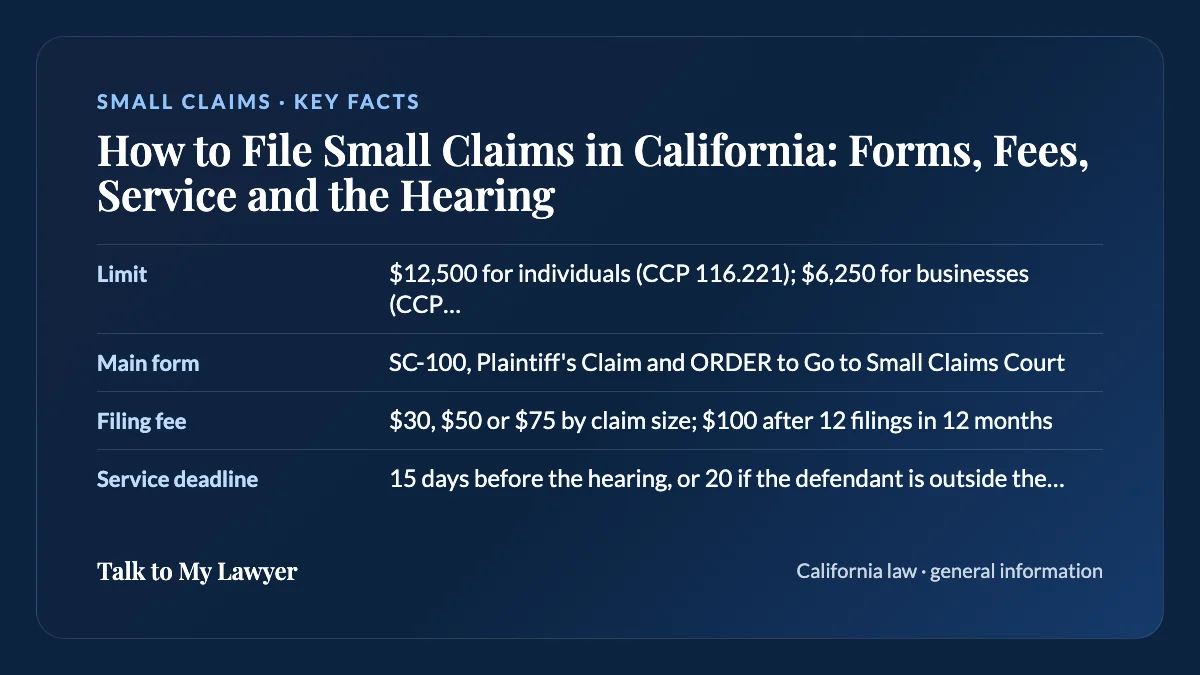
- Limit
- $12,500 for individuals (CCP 116.221); $6,250 for businesses (CCP 116.220)
- Main form
- SC-100, Plaintiff's Claim and ORDER to Go to Small Claims Court
- Filing fee
- $30, $50 or $75 by claim size; $100 after 12 filings in 12 months
- Service deadline
- 15 days before the hearing, or 20 if the defendant is outside the county (CCP 116.340)
- Lawyers
- Cannot represent you at the hearing (CCP 116.530)
- Appeal
- Plaintiff cannot appeal own claim; defendant has 30 days (CCP 116.750)
Can your case go to small claims court?
It can if you are asking for money (or certain limited orders) within the dollar limit. A natural person, including a sole proprietor, has a $12,500 ceiling under CCP 116.221. Corporations, partnerships and other businesses are limited to $6,250 under section 116.220.
- Each calendar year, you can bring at most two California small claims cases demanding more than $2,500 (CCP 116.231). SC-100 asks you to confirm this.
- If you have filed more than 12 small claims in the past 12 months, the fee is higher.
- Suing a government body, such as a city or school district, requires a written government claim first, and SC-100 asks for its date.
If your claim is larger than the limit, the civil division of the superior court is the usual route. A small claims advisor can explain your options.
Do you have to ask for the money before filing?
Yes, in most cases. Item 4 of form SC-100 states that you must ask the defendant, in person, in writing or by phone, to pay before you sue, and asks you to explain if you did not. The Self-Help Guide excuses the step when a restraining order is in place between the parties or contact would be unsafe.
A written demand doubles as evidence. Our guide to the demand letter before small claims explains what to include, and the small claims demand letter template gives a starting layout.
Where do you file a small claims case in California?
You file in the county, and courthouse, that the venue rules allow. Section 116.370 says small claims venue follows the same rules as other civil cases. Item 5 of SC-100 lists the usual reasons a courthouse is proper:
- Where the defendant lives or does business.
- Where your property was damaged, or where you were injured.
- Where a contract was made, signed, performed or broken, or where the defendant lived or did business when making it.
- For consumer contracts, retail installment contracts and vehicle finance sales, certain places tied to the buyer, such as where the buyer lives now.
The defendant can challenge venue in writing. If the court finds the venue wrong, it must dismiss the case without prejudice unless every defendant is present and agrees to proceed.
How to file small claims in California, step by step
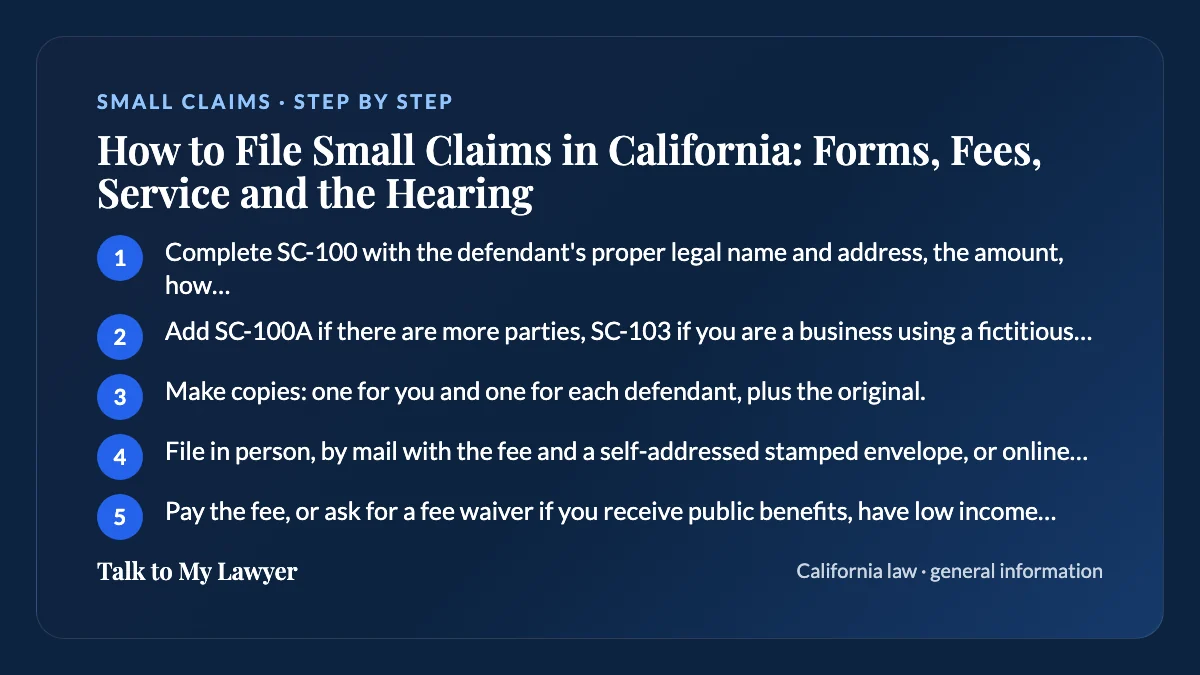
- Complete SC-100 with the defendant's proper legal name and address, the amount, how you calculated it and why you chose that courthouse.
- Add SC-100A if there are more parties, SC-103 if you are a business using a fictitious name, and any local forms your court requires.
- Make copies: one for you and one for each defendant, plus the original.
- File in person, by mail with the fee and a self-addressed stamped envelope, or online if your court accepts e-filing.
- Pay the fee, or ask for a fee waiver if you receive public benefits, have low income or cannot cover basic needs and the fee.
- Get your case number and hearing date from the clerk, then arrange service on each defendant.
| Amount claimed | Filing fee |
|---|---|
| Up to $1,500 | $30 |
| Over $1,500 up to $5,000 | $50 |
| Over $5,000 up to $12,500 | $75 |
| Any amount, if you filed more than 12 claims in the past 12 months | $100 |
How do you serve the defendant?
Someone 18 or older who is not part of the case must deliver the papers. You cannot serve them yourself. A friend, the sheriff in some counties or a paid process server can do it.
| Method | How it works | Watch for |
|---|---|---|
| Personal service | Server hands the papers to the defendant | The usual method |
| Substituted service | Papers left with an adult at home or work, plus a mailed copy | The Self-Help Guide says to finish 10 days earlier than the normal deadline |
| Certified mail by the clerk | Offered by some courts for a $15 fee | Complete only when the defendant signs the return receipt |
Service must be completed at least 15 days before the hearing if the defendant lives in the county, or 20 days if outside it (CCP 116.340). The server fills out SC-104, Proof of Service, which you file at least five days before the hearing. Form SC-104C helps identify the right person to serve at a business or public entity. If you cannot serve in time, file SC-150 to postpone.
What happens at the small claims hearing?
A judge hears both sides, looks at the evidence and decides, either at the hearing or later by mail. Bring the originals plus copies for the judge and the other side.
- Your demand letter and proof you sent it.
- Contracts, invoices, receipts, estimates and photos with dates.
- Texts and emails, printed in order.
- Witnesses, or form SC-107 to subpoena one.
- A one-page timeline and your calculation of the amount.
If you need an interpreter, ask the court clerk as soon as possible for a court-provided one, for example with form INT-300. SC-100 says you cannot bring your own unless the court has approved that interpreter. A defendant with a claim against you can file SC-120, Defendant's Claim, and bring it in the same case.
Can lawyers help, and who can appeal?
Lawyers cannot represent either side at the hearing, with narrow exceptions for lawyers suing or being sued themselves (CCP 116.530). A lawyer can advise you before or after the case, represent you on appeal and help enforce a judgment. Your county's small claims advisor can also help with filings, hearing procedure and collection; section 116.940 describes what these advisory services provide.
The plaintiff cannot appeal a loss on its own claim (CCP 116.710). The defendant can, by filing SC-140 within 30 days of the clerk handing over or mailing the notice of entry of judgment (CCP 116.750). The appeal is a new trial in superior court, where lawyers may take part. If you win, our guide to collecting a small claims judgment covers the next stage.
The letter that comes before the claim form
Small claims keeps lawyers out of the courtroom, not out of the run-up. Item 4 of SC-100 asks whether you requested payment first, and a written demand that sets out your amount, your math and your deadline on one page answers that question with a document.
Through Talk to My Lawyer, a licensed California attorney writes your letter from your facts and documents (the invoices, messages and receipts behind your claim) and sends it on your behalf before you file. If you are unsure small claims is the right court, a lawyer can weigh that with you before you file.
Frequently asked questions
How much does it cost to file small claims in California?
The filing fee is $30 for claims up to $1,500, $50 for claims over $1,500 up to $5,000, and $75 for claims over $5,000 up to $12,500. If you have filed more than 12 small claims in California in the past 12 months, the fee is $100. You can ask for a fee waiver if you cannot afford it, and service costs are separate.
Can I file small claims online in California?
Some courts accept small claims filings electronically, and section 116.320 allows filing by electronic means where authorized. Check your county superior court's website. You can also file in person with the clerk or by mail, sending the original SC-100, two copies, the fee and a self-addressed stamped envelope so the clerk can return your copies.
Can a business sue in small claims in California?
Yes, but the limit is lower. Corporations, partnerships and other businesses can claim up to $6,250, while individuals and sole proprietors can claim up to $12,500. A business using a fictitious business name files form SC-103 with the claim. The yearly cap of two cases seeking more than $2,500 covers businesses as well.
What if the defendant lives in another county?
You may still be able to file where you live if venue is proper there, for example where the contract was performed or your property was damaged. Check item 5 of SC-100. Service on a defendant outside your county must be completed at least 20 days before the hearing, instead of 15, under CCP 116.340.
Can I appeal if I lose my small claims case?
Not if you were the plaintiff and lost on your own claim. Section 116.710 bars that appeal. A defendant who loses can appeal to the superior court within 30 days after the clerk delivers or mails the notice of entry of judgment, using form SC-140. A plaintiff who did not appear can instead ask to vacate the judgment.
Sources
Checked against these official sources on October 18, 2026.
- California Code of Civil Procedure section 116.221 (California Legislative Information)
- California Code of Civil Procedure section 116.340 (California Legislative Information)
- California Code of Civil Procedure section 116.710 (California Legislative Information)
- File your small claims forms (California Courts Self-Help Guide)
- Serve your small claims forms (California Courts Self-Help Guide)
- Plaintiff's Claim and ORDER to Go to Small Claims Court (SC-100) (Judicial Council of California)
This guide explains California law in general terms as of October 2026. It is general information, not legal advice for your situation, and local rules can add to it.
Join the email list and get a lawyer letter started
With Talk to My Lawyer, a licensed California attorney writes your letter from your facts and documents and sends it on your behalf. Join the Talk to My Lawyer email list for letter checklists, document prompts, and reminders before you start your letter.