Quick answer
To collect a small claims judgment in California, wait 30 days after the notice of entry of judgment is handed or mailed to you. If the debtor has not paid, they must send you form SC-133 listing assets. You can then get a writ of execution (EJ-130) for wage garnishment or a bank levy, record an abstract of judgment as a lien, and add interest, generally 10 percent a year.
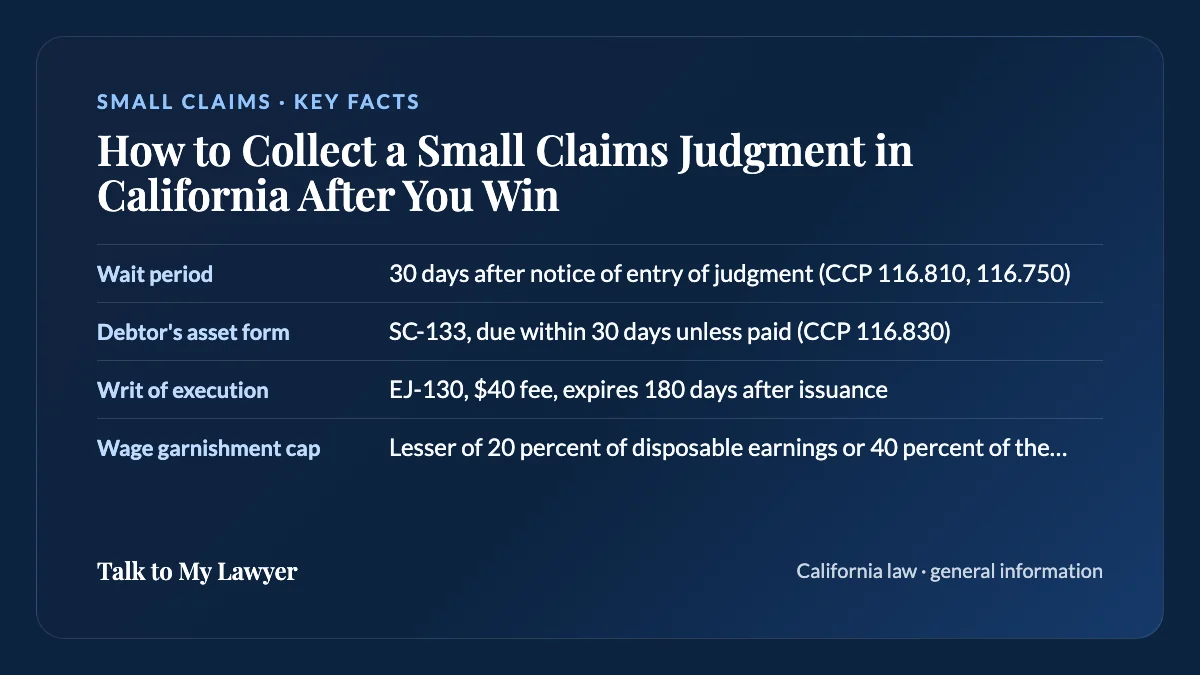
At a glance
- Wait period
- 30 days after notice of entry of judgment (CCP 116.810, 116.750)
- Debtor's asset form
- SC-133, due within 30 days unless paid (CCP 116.830)
- Writ of execution
- EJ-130, $40 fee, expires 180 days after issuance
- Wage garnishment cap
- Lesser of 20 percent of disposable earnings or 40 percent of the amount above 48 times the minimum wage (CCP 706.050)
- Interest
- 10% a year, or 5% for some personal and medical debt judgments (CCP 685.010)
- Judgment lifespan
- 10 years; renewable with EJ-190 (CCP 683.020)
When can you start collecting a small claims judgment?
You must wait at least 30 days after you were handed or mailed the Notice of Entry of Judgment (form SC-130 or SC-200). Section 116.810 automatically suspends enforcement until the time to appeal runs out, and a defendant's appeal deadline under section 116.750 is 30 days after the clerk delivers or mails that notice.
If the defendant files an appeal, enforcement stays suspended until the appeal is resolved or dismissed. If they file a motion to vacate, wait for the ruling. The court will not collect for you at any stage; every step below is yours to start. If you are still at the filing stage, our guide on how to file small claims in California covers the earlier steps.
How do you find out what the debtor owns?
Start with form SC-133, the Judgment Debtor's Statement of Assets. Section 116.830 requires the debtor to complete it and deliver it to you within 30 days after the clerk mails the notice of entry of judgment, unless the judgment is paid. It lists where they work, where they bank and what they own.
If the form never arrives or leaves gaps, ask for a debtor's examination, a court hearing where the debtor answers questions under oath.
- Use SC-134 if you never received SC-133; it orders the debtor to bring the form and appear.
- Use EJ-125 if you already have SC-133 and only need the hearing.
- The filing fee is $60. The papers must be served at least 30 days before the hearing; the sheriff usually charges about $40.
- The debtor must live or do business within 150 miles of the court. If not, the exam is filed in their county using an abstract of judgment.
- Use SC-107 to subpoena documents such as bank statements or pay stubs.
For a willful failure to provide SC-133, section 116.830 lets you ask the court to apply contempt sanctions, which can include arrest and attorney's fees.
What tools can you use to collect?
| Tool | What you file | Key details |
|---|---|---|
| Writ of execution | EJ-130 with the court clerk | $40 fee, added to the debt; expires 180 days after issuance |
| Wage garnishment | Writ plus WG-001 to the levying officer, usually the sheriff | Sheriff fee about $45; employer must return WG-005 within 15 days |
| Bank levy | Writ plus instructions to the sheriff | The sheriff works with the bank to collect |
| Real property lien | Abstract of Judgment EJ-001, recorded with the county recorder | Clerk certifies it for about $40, plus a recording fee |
| Business levies | Till tap, keeper or third-party levy through the sheriff | The Self-Help Guide warns these can be expensive |
For a judgment based on personal debt, the levying officer also needs form WG-015/EJ-135, Declaration of Address Verification, and the original must be filed with the court within 10 business days.
How much of a paycheck can be garnished?
Under section 706.050, the most that can be withheld in a workweek is the lesser of 20 percent of the debtor's disposable earnings, or 40 percent of the amount by which disposable earnings exceed 48 times the state minimum hourly wage. If the local minimum wage is higher, the local rate is used. Different multipliers apply to biweekly, semimonthly and monthly pay.
Less may be available if other garnishments are already in place, and orders such as child support or taxes can take priority. The debtor can also file a claim of exemption, which you can oppose with forms WG-009 and WG-010 within 10 days of the notice.
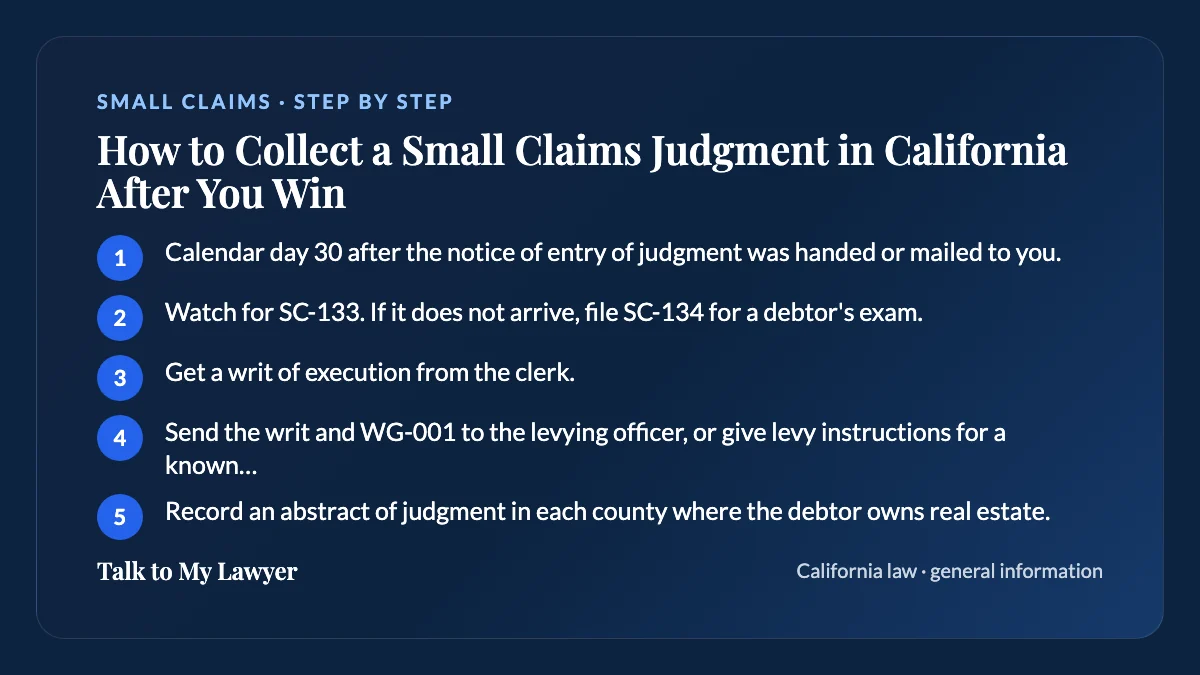
Collecting a judgment, step by step
- Calendar day 30 after the notice of entry of judgment was handed or mailed to you.
- Watch for SC-133. If it does not arrive, file SC-134 for a debtor's exam.
- Get a writ of execution (EJ-130) from the clerk.
- Send the writ and WG-001 to the levying officer (usually the sheriff), or give levy instructions for a known bank account.
- Record an abstract of judgment (EJ-001) in each county where the debtor owns real estate.
- Track every cost you pay, and add costs and interest with form MC-012.
- File an acknowledgment of satisfaction (SC-290) as soon as you are paid in full (CCP 116.850).
Can you add interest and collection costs?
Yes. Interest generally accrues at 10 percent a year on the unpaid principal (CCP 685.010). For judgments entered or renewed on or after January 1, 2023, the rate is 5 percent when the debtor is an individual and the claim relates to personal debt under $50,000 or medical expenses under $200,000. The lower rate does not cover tort, fraud or unpaid wage judgments. Interest before judgment follows different rules, covered in what interest and fees a demand letter can include.
Example (hypothetical): a $4,000 judgment for an unpaid contractor deposit against a business accrues interest at 10 percent, about $400 a year or roughly $1.10 a day. If the same $4,000 were owed by an individual on a personal loan used for household purposes, the 5 percent rate could apply instead, about $200 a year.
Costs you pay to collect, such as the writ fee and sheriff fees, can be added with MC-012, Memorandum of Costs After Judgment, within two years of paying each cost. The debtor can object with a motion to tax costs.
How long does a small claims judgment last?
Ten years from entry. After that, section 683.020 bars enforcement and ends any liens. The renewal application must be filed before the 10 years run out (CCP 683.130), using EJ-190 and EJ-195, with a $45 filing fee. The Self-Help Guide tells small claims winners that the earliest they can renew is after five years. The debtor must be served before you collect on the renewed judgment, and has 60 days to ask the court to vacate it.
Most renewals last another 10 years. Judgments in the 5 percent personal and medical debt categories can be renewed only once, for five years, under rules effective January 1, 2023. Renewing a lien or a wage garnishment needs a certified copy of EJ-190 given to the recorder or the levying officer.
A post-judgment payment letter, written by an attorney
Winning in small claims shifts the work from proving the debt to collecting it. A letter at day 30 that states the judgment, the accruing interest and the enforcement steps the law allows gives the debtor one clear, written chance to pay before you start paying levy fees. Attorneys may represent you in enforcing a small claims judgment (CCP 116.530).
Through Talk to My Lawyer, a licensed California attorney writes your letter from your facts and documents (the judgment, any payments received and your collection file) and sends it on your behalf. A contested levy or an exemption claim is a good moment to get a lawyer's view of your facts.
Frequently asked questions
How long does a small claims judgment last in California?
Ten years from the date it was entered. You must file for renewal before the 10 years end, using forms EJ-190 and EJ-195 with a $45 fee; the Self-Help Guide says the earliest you can renew is after five years. Most renewals add 10 years, but judgments for certain personal or medical debts can be renewed only once, for five years, under rules effective January 1, 2023.
Can I garnish wages with a small claims judgment?
Yes. You need a writ of execution (EJ-130) and an Application for Earnings Withholding Order (WG-001), which go to the levying officer, usually the sheriff. The Self-Help Guide puts the sheriff's fee at about $45. Withholding is capped at the lesser of 20 percent of disposable earnings or 40 percent of the amount above 48 times the minimum hourly wage.
What if the debtor never sends form SC-133?
You can ask the court for a debtor's examination with form SC-134, which orders the debtor to appear and bring a completed SC-133. The fee is $60 and service must be made at least 30 days before the hearing. For a willful refusal, Code of Civil Procedure 116.830 lets you ask the court to impose contempt sanctions.
What interest rate applies to a California small claims judgment?
Generally 10 percent a year on the unpaid principal under CCP 685.010. A 5 percent rate applies to judgments entered or renewed from 2023 onward when the debtor is an individual and the claim relates to personal debt under $50,000 or medical expenses under $200,000. Tort, fraud and unpaid wage judgments stay at 10 percent.
Can I put a lien on the debtor's house?
Yes. Get an Abstract of Judgment (form EJ-001) from the clerk, who certifies it for about $40, and record it with the county recorder wherever the debtor owns real estate. The recorder notifies the debtor. The lien does not force a sale on its own, and a forced sale has limits, including for consumer debt and homestead situations.
Sources
Checked against these official sources on October 18, 2026.
- Collect your money if you won your small claims case (California Courts Self-Help Guide)
- How to get a debtor's examination (California Courts Self-Help Guide)
- Collect money from someone's pay (California Courts Self-Help Guide)
- California Code of Civil Procedure section 685.010 (California Legislative Information)
- California Code of Civil Procedure section 706.050 (California Legislative Information)
- Renew a small claims judgment (California Courts Self-Help Guide)
This guide explains California law in general terms as of October 2026. It is general information, not legal advice for your situation, and local rules can add to it.
Join the email list and get a lawyer letter started
With Talk to My Lawyer, a licensed California attorney writes your letter from your facts and documents and sends it on your behalf. Join the Talk to My Lawyer email list for letter checklists, document prompts, and reminders before you start your letter.