Quick answer
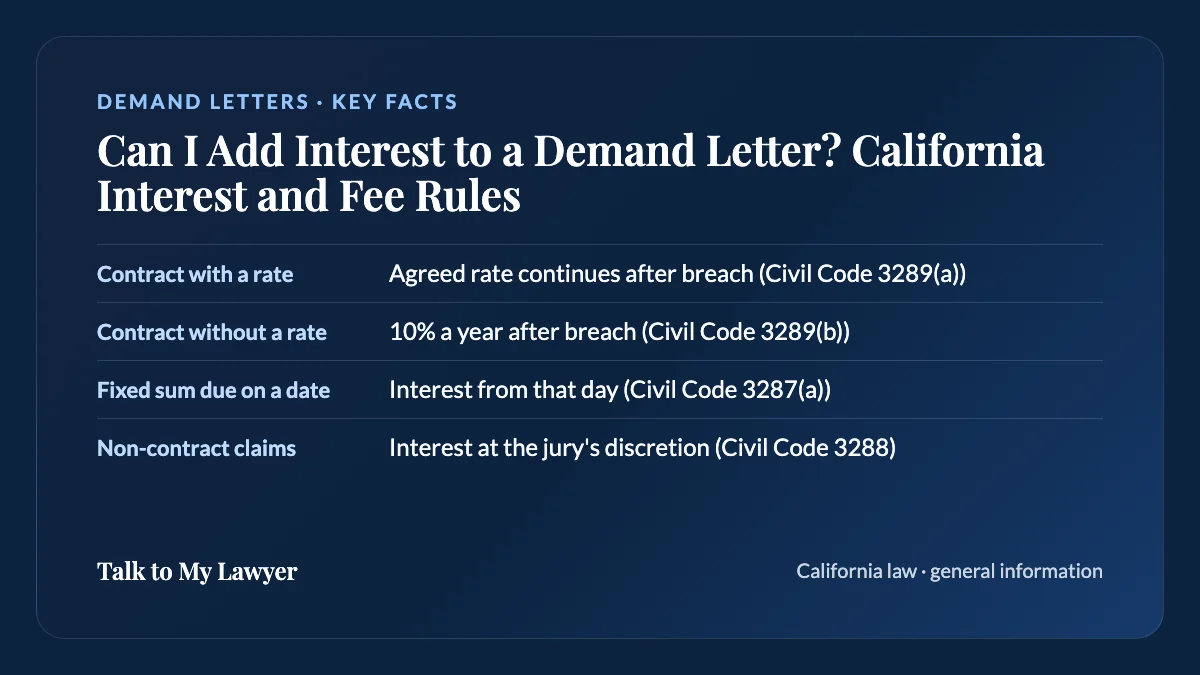
Yes, you can add interest to a demand letter in California when the law supports it. A rate set in the contract continues after breach (Civil Code 3289(a)). With no contract rate, the obligation bears 10 percent a year after breach (3289(b)). For a fixed sum due on a known date, Civil Code 3287 allows interest from that day. Attorney fees need a contract clause or statute.
At a glance
- Contract with a rate
- Agreed rate continues after breach (Civil Code 3289(a))
- Contract without a rate
- 10% a year after breach (Civil Code 3289(b))
- Fixed sum due on a date
- Interest from that day (Civil Code 3287(a))
- Non-contract claims
- Interest at the jury's discretion (Civil Code 3288)
- Attorney fees
- Only by contract clause or statute (CCP 1021, Civil Code 1717)
- Unpaid wages
- Interest at the 3289(b) rate from the due date (Labor Code 218.6)
Can you add interest to a demand letter in California?
Yes, when a statute or your contract gives you a right to it, and only at the rate the law allows. The key questions are whether the amount was fixed or easy to calculate, when it became due, and whether your contract names a rate.
| Your situation | Interest you can ask for | Source |
|---|---|---|
| Contract states an interest rate | The contract rate, continuing after the breach until a judgment replaces it | Civil Code 3289(a) |
| Contract made after January 1, 1986, that names no rate | 10 percent a year after the breach | Civil Code 3289(b) |
| Amount certain, or calculable, due on a particular day | Interest from that day | Civil Code 3287(a) |
| Contract claim where the amount is disputed or unliquidated | A court may award interest from a date it chooses, no earlier than filing | Civil Code 3287(b) |
| Tort or other non-contract claim | Interest may be given in the jury's discretion | Civil Code 3288 |
| Loan, forbearance or account after demand, with no rate agreed in writing | 7 percent a year | California Constitution, art. XV, sec. 1 |
| Unpaid wages | The 3289(b) rate from the date wages were due | Labor Code 218.6 |
Real estate loans secured by a deed of trust fall outside section 3289(b). Which rule applies can itself be disputed, especially between the 10 percent contract rate and the 7 percent constitutional rate. Loans also raise usury questions under article XV of the Constitution, which limits contracted interest rates and exempts certain lenders; if your claim involves interest you charged on a loan, get advice before demanding it.
Example: adding 10 percent interest to an unpaid invoice
Example (hypothetical): a graphic designer's contract with a client, signed in 2025, sets a fee of $8,000 due March 1, 2026, and says nothing about interest. The client never pays. The designer writes a demand on October 1, 2026.
| Item | Figure |
|---|---|
| Principal | $8,000.00 |
| Rate (no contract rate, Civil Code 3289(b)) | 10% a year, or about $2.19 a day |
| Days from March 1 to October 1, 2026 | 214 |
| Simple interest: $8,000 x 10% x 214 / 365 | $469.04 |
| Total demanded as of October 1 | $8,469.04, plus about $2.19 for each later day |
Showing the formula matters more than the total. A recipient can check every number, and a judge can see you claimed only what the statute allows. This illustration uses simple interest; if the contract or facts are unusual, have the method checked.
Can you charge a late fee on an unpaid invoice?
Only if the contract provides one, and only if it is enforceable. A late fee agreed in advance is a form of liquidated damages, governed by Civil Code section 1671.
- Business contracts: a liquidated damages clause is valid unless the party challenging it shows it was unreasonable when the contract was made (1671(b)).
- Consumer contracts and residential leases: an agreed damages figure is void unless, from the nature of the case, fixing the actual damage would be impracticable or extremely difficult (1671(c) and (d)).
- Any contract: damages must be reasonable, and grossly oppressive amounts are not recoverable (Civil Code 3359).
If your contract has no late fee, you cannot add one after the fact. Ask for the statutory interest instead.
Can you add attorney fees to a demand letter?
Only when a contract clause or a statute allows it. California follows the general rule in CCP section 1021: each side pays its own lawyer unless a statute or agreement says otherwise.
- Contract fee clauses. Civil Code 1717 makes a one-sided fee clause work both ways: the party who prevails on the contract can recover reasonable fees, whichever party the clause names. The right cannot be waived in contracts covered by the section.
- Wage claims. Labor Code 218.5 awards fees and costs to the prevailing party in nonpayment-of-wages actions if requested at the start, but an employer recovers them only if the employee sued in bad faith.
- Consumer claims. The Consumers Legal Remedies Act requires fees and costs for a prevailing plaintiff (Civil Code 1780(e)).
A demand letter can state that fees may be sought if a clause or statute applies, and cite it. Do not demand a lump sum for attorney fees you have not incurred. Also note that under 1717(b)(2), there is no prevailing party for fee purposes when a case is voluntarily dismissed or dismissed under a settlement, which affects how a settlement should address fees.
What about court costs and collection fees?
Court costs come later, in a lawsuit. Under CCP 1032(b), a prevailing party is entitled to costs as a matter of right unless a statute says otherwise, and section 1033.5 lists allowable items such as filing fees and service of process.
Collection charges are tightly limited for consumer debts. California's Rosenthal Act bars debt collectors from collecting their own fees or collection expenses from the debtor unless the law allows it (Civil Code 1788.14(b)), and the federal Fair Debt Collection Practices Act bars collecting any amount not expressly authorized by the agreement or permitted by law (15 U.S.C. 1692f(1)).
How to build the amount in your demand, step by step
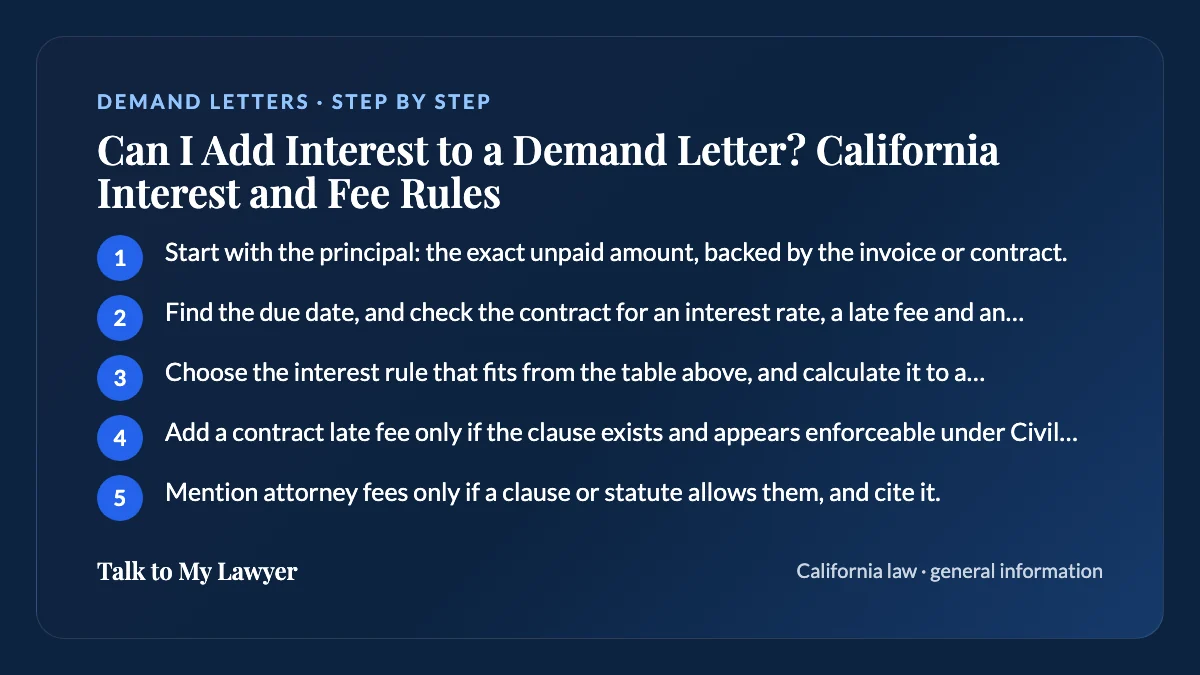
- Start with the principal: the exact unpaid amount, backed by the invoice or contract.
- Find the due date, and check the contract for an interest rate, a late fee and an attorney fee clause.
- Choose the interest rule that fits from the table above, and calculate it to a specific date.
- Add a contract late fee only if the clause exists and appears enforceable under Civil Code 1671.
- Mention attorney fees only if a clause or statute allows them, and cite it.
- Show the math in a short table in the letter, with a per-day figure for interest after your date.
- Leave out anything you cannot tie to a contract term or statute.
For the rest of the letter, see our guides to a demand letter for money owed and an unpaid invoice demand letter in California. The broader question of what losses to claim is covered in how to calculate damages for a demand letter.
When the add-ons are worth an attorney's pen
Interest, late fees and fee clauses are easy places for a demand letter to overreach, and an inflated number can hand the other side an argument. An attorney can match each add-on to its source, show the calculation, and leave out what the law does not support.
Through Talk to My Lawyer, a licensed California attorney writes your letter from your facts and documents (the contract, invoices and payment records), calculates the interest the law allows, and sends it on your behalf. Questions about loans, usury or fee recovery deserve a lawyer's look at your specific facts.
Frequently asked questions
What is the legal interest rate in California?
It depends on the claim. For a contract with no stated rate, Civil Code 3289(b) sets 10 percent a year after breach. The California Constitution sets 7 percent for loans, forbearances and accounts after demand when no lawful rate is agreed in writing. Judgments generally accrue 10 percent under CCP 685.010, with a 5 percent rate for some consumer debt judgments.
Can I charge interest if the contract does not mention it?
Often, yes. Under Civil Code 3289(b), a contract made after January 1, 1986, that sets no rate carries 10 percent annual interest once it is breached; real estate notes backed by a deed of trust are excluded. Civil Code 3287(a) also allows interest on an amount that was certain and due on a particular day.
Can I add attorney fees to my demand letter?
Only if a contract clause or statute allows fee recovery. Under CCP 1021, each side otherwise pays its own lawyer. If your contract has a fee clause, Civil Code 1717 lets the prevailing party on the contract recover reasonable fees. Statutes such as Labor Code 218.5 and Civil Code 1780(e) allow fees in certain wage and consumer claims.
Can I charge a late fee on an unpaid invoice in California?
Only if your contract includes one and it is enforceable. Late fees are liquidated damages under Civil Code 1671. In business contracts they are valid unless shown to be unreasonable when the contract was made. In consumer contracts and residential leases they fail unless the true loss would have been very hard to calculate. You cannot add one afterward.
Is there a risk in overstating the amount in a demand letter?
Yes. An inflated demand can weaken your credibility, and for consumer debts, collectors who seek amounts not authorized by the agreement or by law can violate the federal FDCPA and California's Rosenthal Act. Showing the principal, the interest rule and the calculation separately lets the reader check each piece and keeps the claim tied to what the law allows.
Sources
Checked against these official sources on October 18, 2026.
- California Civil Code section 3289 (California Legislative Information)
- California Civil Code section 3287 (California Legislative Information)
- California Constitution, Article XV (California Legislative Information)
- California Civil Code section 1717 (California Legislative Information)
- California Civil Code section 1671 (California Legislative Information)
- 15 U.S. Code section 1692f (Legal Information Institute, Cornell Law School)
This guide explains California law in general terms as of October 2026. It is general information, not legal advice for your situation, and local rules can add to it.
Join the email list and get a lawyer letter started
With Talk to My Lawyer, a licensed California attorney writes your letter from your facts and documents and sends it on your behalf. Join the Talk to My Lawyer email list for letter checklists, document prompts, and reminders before you start your letter.