Quick answer
To calculate damages for a demand letter, identify the type of claim, then add up the losses that rule allows. For breach of contract, California measures damages as the amount compensating for harm the breach caused or was likely to cause (Civil Code 3300). For other wrongs, such as property damage, it is the amount compensating for all harm proximately caused (Civil Code 3333). Damages must be reasonable.
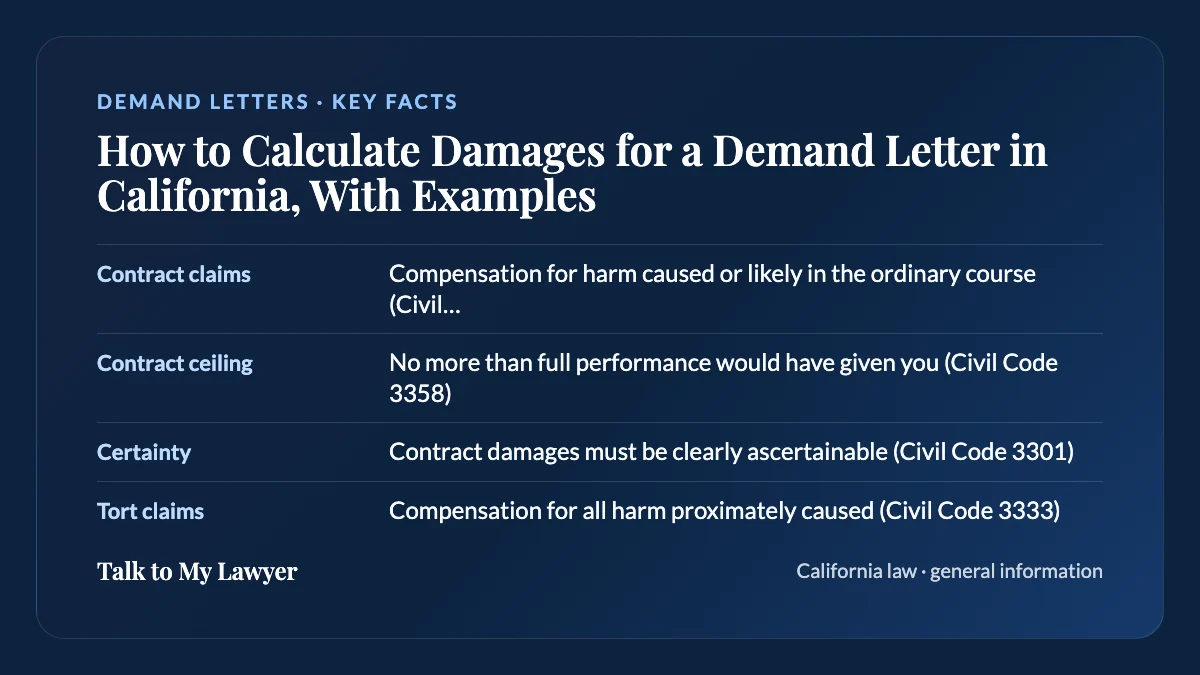
At a glance
- Contract claims
- Compensation for harm caused or likely in the ordinary course (Civil Code 3300)
- Contract ceiling
- No more than full performance would have given you (Civil Code 3358)
- Certainty
- Contract damages must be clearly ascertainable (Civil Code 3301)
- Tort claims
- Compensation for all harm proximately caused (Civil Code 3333)
- Punitive damages
- Not for contract claims; need clear and convincing proof of malice, oppression or fraud (Civil Code 3294)
How do you calculate damages for a demand letter?
Start by naming the claim, because the measure depends on it. California's Civil Code gives one formula for broken promises and another for other wrongs, and both share a ceiling: under section 3359, damages must be reasonable in all cases.
| Claim type | California measure | What it usually covers |
|---|---|---|
| Breach of contract | Amount that compensates for the detriment proximately caused, or likely in the ordinary course (Civil Code 3300) | Unpaid price, cost to finish or fix, extra cost of a replacement, lost profits you can prove |
| Tort (property damage, injury, conversion) | Amount that compensates for all detriment proximately caused, whether foreseeable or not (Civil Code 3333) | Repair cost or loss in value, medical bills, lost wages, pain and suffering |
| Conversion of personal property | Value at the time it was taken, with interest, plus fair compensation for time and money spent pursuing it (Civil Code 3336) | The item's value, interest and recovery costs |
"Detriment" is the Civil Code's word for a loss or harm suffered in person or property (section 3282).
How are contract damages calculated?
The goal is to put you where the deal would have left you, not further ahead. Section 3358 says you cannot recover more than you would have gained by full performance on both sides, and section 3301 bars contract damages that are not clearly ascertainable in nature and origin.
Example (hypothetical): a homeowner pays a contractor $9,000 of a $15,000 kitchen job. The contractor leaves with the cabinets half installed. A second contractor charges $8,500 to finish.
| Line item | Amount |
|---|---|
| Cost to finish with the new contractor | $8,500 |
| Plus amount already paid | $9,000 |
| Total cost of the finished kitchen | $17,500 |
| Minus the original contract price | $15,000 |
| Contract damages claimed | $2,500 |
| Plus documented extra costs, such as a second week of storage fees | $340 |
| Total demand | $2,840 |
The homeowner does not claim the full $9,000 back, because the kitchen got built. The claim is the extra it cost to get what the contract promised.
How are property damage and injury losses calculated?
For harm that does not arise from a contract, section 3333 allows compensation for all detriment proximately caused. For property, a demand commonly uses the reasonable cost of repair, or the loss in value where repair is not practical; which measure fits can be disputed. For personal injury, it includes medical bills, lost earnings and non-economic harm such as pain.
Example (hypothetical): a neighbor's contractor backs a truck into a fence and a parked car.
- Fence repair, lowest of two written bids: $2,150.
- Car body repair, insurer-approved shop estimate: $1,780.
- Rental car for four days while the car was in the shop, at $48 a day: $192.
- Total property damage demand: $4,122.
If an item has special value to you, section 3355 allows that peculiar value to be used against someone who had notice of it beforehand or who acted willfully. Explain the reason in the letter rather than simply raising the number. For a vehicle claim, our car accident property damage demand letter guide goes further.
Do you have to subtract losses you could have avoided?
Expect the other side to argue that you should have limited your losses, and price your claim with that argument in mind. If the cabinets were sitting in the rain, a court can ask why you did not cover them. If you kept a broken car in storage for months, the extra storage may be questioned.
California's conversion statute builds the idea in: one of the measures in section 3336 covers only the loss that a proper degree of prudence would not have averted. In practice, show the reasonable steps you took (a tarp, a quick replacement, a second bid) and claim their cost as part of your damages.
Should you include emotional distress or punitive damages?
Use caution with both. Neither has a formula, and an unsupported figure can make the rest of the letter look inflated.
- Emotional distress. It is hard to measure and contested. If you mention it, describe the effect briefly and keep it separate from your documented economic losses, so the reader can pay the provable part without arguing about the rest.
- Punitive damages. Civil Code 3294 allows them only for claims not arising from contract, and only on clear and convincing proof of oppression, fraud or malice. A demand letter may note that the facts could support them; putting a dollar figure on them invites dispute.
- Statutory damages and penalties. Some laws set their own amounts, such as the security deposit statute, which allows statutory damages of up to twice the deposit when a landlord keeps it in bad faith (Civil Code 1950.5). Cite the statute and apply its formula exactly.
Section 3359 adds a limit for every claim: where an obligation seems to create a right to unconscionable or grossly oppressive damages, only reasonable damages can be recovered.
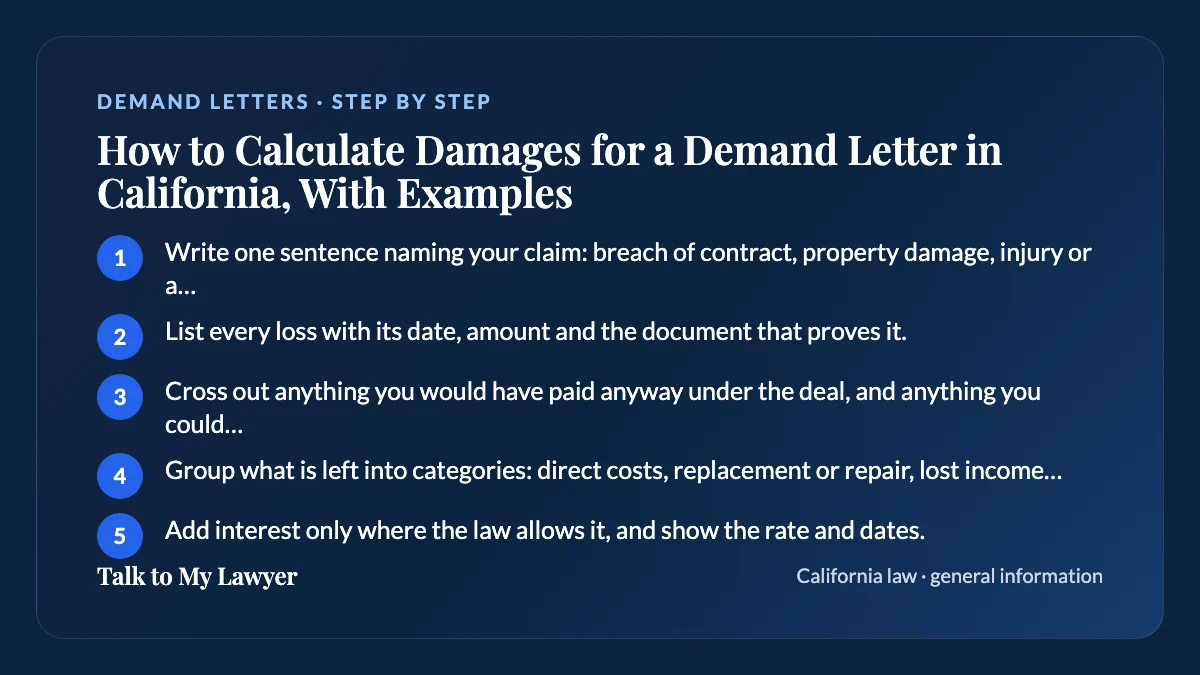
How to build a damages schedule for your letter, step by step
- Write one sentence naming your claim: breach of contract, property damage, injury or a statutory claim.
- List every loss with its date, amount and the document that proves it.
- Cross out anything you would have paid anyway under the deal, and anything you could reasonably have avoided.
- Group what is left into categories: direct costs, replacement or repair, lost income, and out-of-pocket expenses.
- Add interest only where the law allows it, and show the rate and dates.
- Total the schedule and check it against any contract ceiling or statutory cap.
- Put a short version in the letter and attach the backup.
Interest has its own rules, explained in our guide to adding interest and fees to a demand letter.
Checklist: documents that support each number
- The contract, quote, invoice or order confirmation.
- Receipts and bank or card statements showing what you paid.
- Written repair estimates, ideally two, and final repair invoices.
- Photos and video with dates, before and after.
- Pay stubs or an employer's written note confirming missed shifts.
- Medical bills and records for any injury.
- Messages where the other side admits the problem or promises to fix it.
For labeling and ordering exhibits, see the demand letter evidence checklist.
Turning a damages schedule into a letter
A damages schedule is where a demand shows its work, and where one padded line can cast doubt on every other figure. An attorney can choose the right measure for your claim, trim items the law will not support, and present the remainder so each figure ties to a document.
Through Talk to My Lawyer, a licensed California attorney writes your letter from your facts and documents (receipts, estimates and the rest), builds the damages figure on the measure that fits your claim, and sends it on your behalf. Injury, distress and punitive damages questions turn on specifics, so raise them with a lawyer who knows your facts.
Frequently asked questions
Can I ask for more than I lost in a demand letter?
You can ask, but a demand tied to the legal measure of your loss is easier to defend. For contract claims, Civil Code 3358 caps recovery at what full performance would have given you, and section 3359 requires damages to be reasonable. Some statutes add penalties or multiples, such as treble damages for bad checks; cite those specifically when they apply.
Can I claim emotional distress in a demand letter?
You can mention it, but treat it carefully. Emotional distress has no formula and is often disputed, especially in contract disputes. Describe the effect briefly and list it separately from your documented losses, such as repair bills and lost wages. That lets the other side pay the clear part. A lawyer can tell you whether your claim supports distress damages.
How do I calculate lost wages for a demand letter?
Multiply the hours or days you missed by your regular pay rate, and back it up with pay stubs, a timesheet or a written statement from your employer. Include only time lost because of the other side's conduct, such as recovery from an injury or attending repairs. Self-employed people can use invoices, booking records or tax returns to show typical earnings.
Should I include punitive damages in my demand?
It is generally wiser not to state a dollar figure. Civil Code 3294 allows punitive damages only for claims not arising from contract, and only on clear and convincing evidence of oppression, fraud or malice. A demand letter can note that the facts may support punitive damages if the case goes to court, while asking for a specific amount based on your documented losses.
Do I have to subtract money I saved because of the breach?
Generally, yes. Contract damages aim to put you where performance would have left you, so savings from not having to perform your own side, such as the unpaid balance of the contract price, reduce the claim. In the kitchen example, the homeowner's damages are the extra cost of finishing the job, not everything paid to the first contractor.
Sources
Checked against these official sources on October 18, 2026.
- California Civil Code section 3300 (California Legislative Information)
- California Civil Code section 3333 (California Legislative Information)
- California Civil Code section 3358 (California Legislative Information)
- California Civil Code section 3359 (California Legislative Information)
- California Civil Code section 3294 (California Legislative Information)
- California Civil Code section 3336 (California Legislative Information)
This guide explains California law in general terms as of October 2026. It is general information, not legal advice for your situation, and local rules can add to it.
Join the email list and get a lawyer letter started
With Talk to My Lawyer, a licensed California attorney writes your letter from your facts and documents and sends it on your behalf. Join the Talk to My Lawyer email list for letter checklists, document prompts, and reminders before you start your letter.