Quick answer
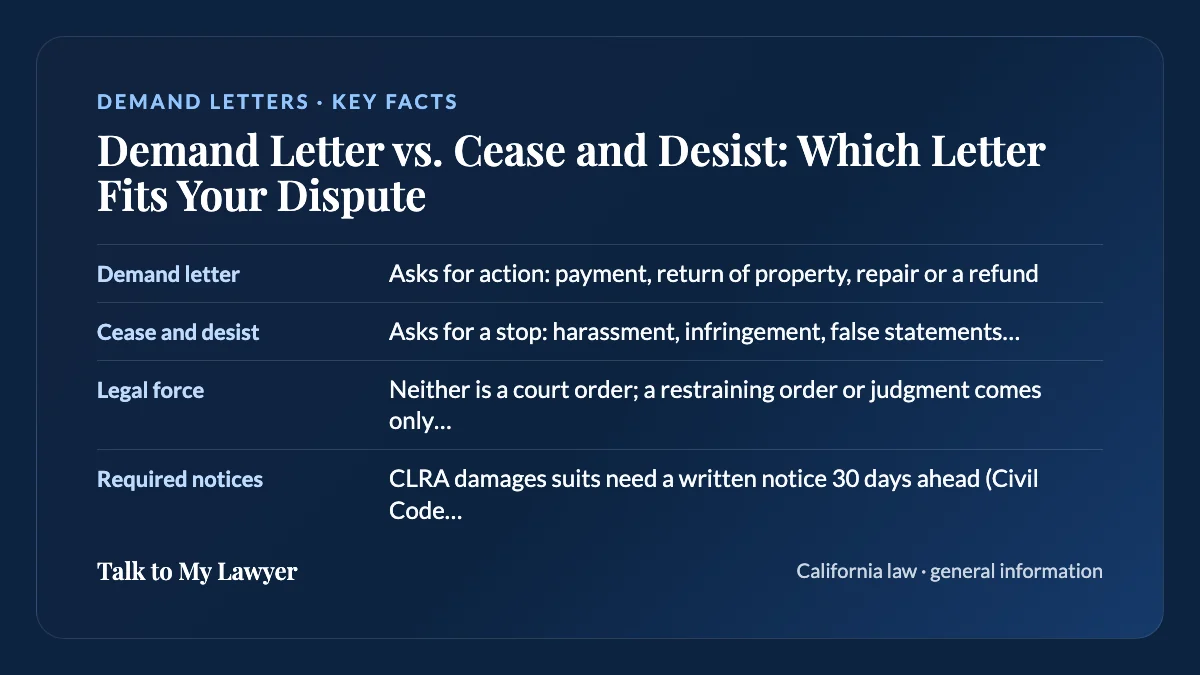
A demand letter asks someone to do something, usually pay money, return property or fix a problem, by a deadline. A cease and desist letter asks someone to stop doing something, such as harassment, copying your work or using your name. Neither is a court order. A letter can do both jobs, and some California laws require a written demand before you sue, such as the CLRA's 30-day notice.
At a glance
- Demand letter
- Asks for action: payment, return of property, repair or a refund
- Cease and desist
- Asks for a stop: harassment, infringement, false statements, unwanted contact
- Legal force
- Neither is a court order; a restraining order or judgment comes only from a court
- Required notices
- CLRA damages suits need a written notice 30 days ahead (Civil Code 1782)
- Small claims
- Form SC-100 requires asking the defendant for payment before filing
What is the difference between a demand letter and a cease and desist letter?
The difference is the ask. A demand letter asks the other side to do something they have not done, most often to pay. A cease and desist letter asks them to stop something they are doing. One looks back at a debt or a loss; the other looks forward at conduct you want ended.
| Demand letter | Cease and desist letter | |
|---|---|---|
| Main request | Pay, return, repair, refund or perform | Stop a specific activity and not repeat it |
| Typical deadline | A date to pay or respond | Immediately, or a short date to confirm in writing |
| What it documents | The amount owed and how you calculated it | The conduct, when it happened and why it is unlawful |
| Usual next step if ignored | Small claims or a civil lawsuit for money | A lawsuit asking for an injunction, or a restraining order petition |
| Laws that sometimes require one first | CLRA notice (Civil Code 1782), bad check demand (Civil Code 1719), small claims | Rarely required, but useful proof that the person was told |
For a fuller look at each letter on its own, see our guides on what a demand letter is and what a cease and desist letter means.
Which letter fits which kind of dispute?
Start with one question: if the other side did exactly what you asked tomorrow, would your problem be solved because they paid, or because they stopped? The table below matches common California disputes to the letter that usually fits.
| Situation | Letter that fits | Why |
|---|---|---|
| Client has not paid a $3,800 invoice | Demand letter | The harm is money owed on a contract |
| Former partner keeps contacting your customers with false claims | Cease and desist | The harm continues each time it happens |
| A business is using your photo on its site without a license | Both | You want the use to end and a fee for past use |
| Check you received bounced | Demand letter | Civil Code 1719 sets a certified-mail demand process |
| Seller misrepresented a used appliance | Demand letter (CLRA notice) | A CLRA damages claim needs written notice 30 days before suit |
| Neighbor keeps entering your yard | Cease and desist | You want the entries to stop |
| Collector calls your work number | Cease-contact letter | Federal and state collection laws give this letter its own rules |
The last row is a special case. A letter telling a debt collector to stop calling follows its own rules, covered in our guide to the debt collector cease contact letter.
When should one letter both demand payment and demand a stop?
Combine the two when the conduct is ongoing and it has already cost you money. Infringement, a contractor who keeps your materials and keeps billing, and a former employee using your client list are typical examples.
Example (hypothetical): a wedding photographer finds 14 of her images on a venue's website and brochure. She wants the images removed within 10 days and a license fee for the eight months they were used. One letter can list the images, demand removal, and state the fee with the math behind it.
Please remove the 14 photographs listed in Attachment A from your website and printed materials by November 3 and send me written confirmation once they are gone. Separately, the images were used without a license from February through September. My standard license fee for that use is $175 per image, for a total of $2,450, which I ask you to pay by November 17.
Keep the two requests in separate paragraphs with separate deadlines. That way the recipient can comply with the stop request right away while the money is discussed.
Is either letter legally binding?
No. A letter from you or your lawyer does not order anyone to do anything. Only a court can do that, through a judgment, an injunction or a restraining order. A civil harassment restraining order, for example, is granted by a judge and can last up to five years, according to the California Courts Self-Help Guide.
What a letter can do is create legal consequences that matter later:
- It can satisfy a required notice. Civil Code section 1782 makes a consumer who wants CLRA damages first send written notice describing the violation and asking for a correction, at least 30 days before filing, sent certified or registered, return receipt requested.
- It can raise what you may recover. For a bounced check, Civil Code section 1719 permits treble damages (with a $100 floor and a $1,500 ceiling) only after a written demand is mailed by certified mail and 30 days pass without payment.
- It meets the small claims ask. Item 4 of the small claims claim form, SC-100, requires plaintiffs to request payment from the defendant (face to face, by phone or in writing) before filing.
- It proves notice. A dated cease and desist letter shows the person was told, which can matter if the conduct continues.
A settlement offer made in either letter is also protected in one way: Evidence Code section 1152 makes an offer to compromise inadmissible to prove liability for the loss.
What should neither letter say?
Never tie a money demand to a threat to report someone to police or prosecutors. Under Penal Code sections 518 and 519, obtaining money through fear induced by a threat to accuse someone of a crime, or to expose a secret about them, can amount to extortion. The same rule covers a cease and desist letter that asks for payment.
- State facts you can prove, with dates.
- Name the law you rely on without exaggerating what it does.
- Leave out insults, personal attacks and guesses about motives.
- Do not claim a lawsuit has been filed if it has not.
- Do not copy the letter to the person's employer, family or customers unless a lawyer has told you that is appropriate.
How to choose and draft the right letter, step by step
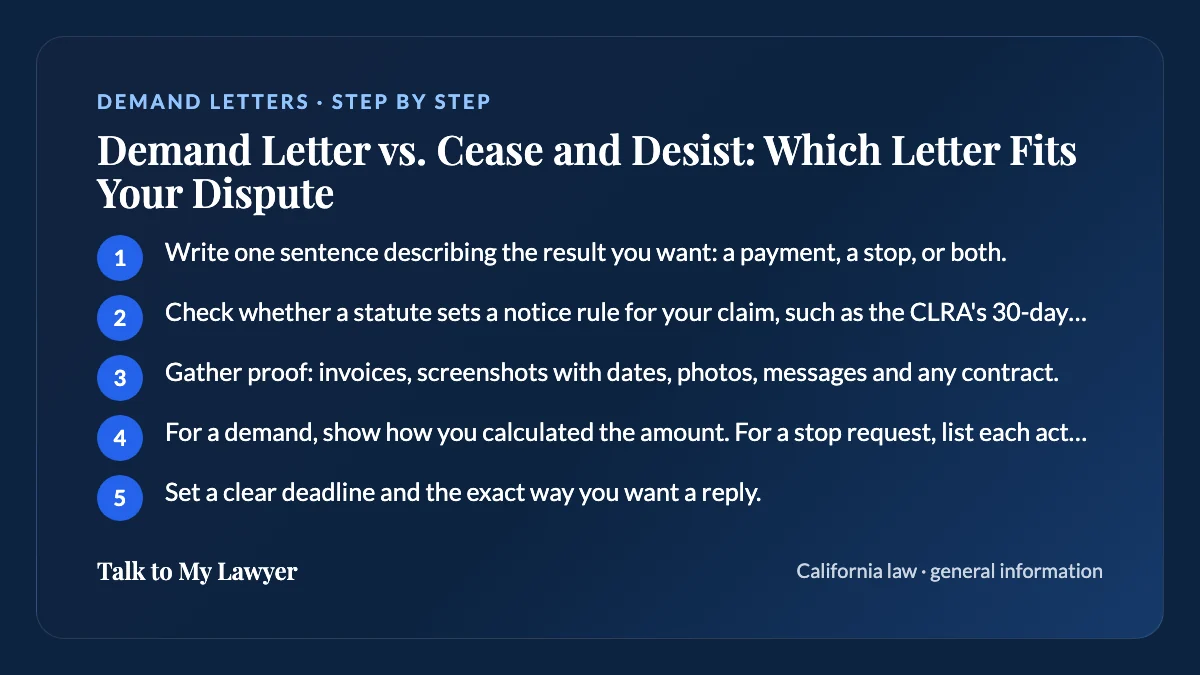
- Write one sentence describing the result you want: a payment, a stop, or both.
- Check whether a statute sets a notice rule for your claim, such as the CLRA's 30-day certified-mail notice or the bad check demand.
- Gather proof: invoices, screenshots with dates, photos, messages and any contract.
- For a demand, show how you calculated the amount. For a stop request, list each act and its date.
- Set a clear deadline and the exact way you want a reply.
- Send it in a way you can prove, and keep a copy of exactly what went out. Certified mail, email and proof of delivery are covered in how to send a demand letter.
- Calendar the deadline and your statute of limitations. A letter does not pause the clock.
Pay, stop, or both: having an attorney write it
A letter that says both "stop" and "pay" is the trickiest of the two to write, because the stop request and the money demand have to sit side by side without reading as a threat. Statutory notices are similar: the CLRA and bad check rules spell out what the letter must contain and how it must travel, and a defect can cost you remedies later.
Through Talk to My Lawyer, a licensed California attorney writes your letter from your facts and documents, framing the payment demand, the stop request or both, and sends it on your behalf. Whether to go further, with a lawsuit or a court order, is something to decide with a lawyer who knows your facts.
Frequently asked questions
Is a cease and desist letter legally binding in California?
No. A cease and desist letter is a request, not an order. Ignoring it is not contempt of court. What it does is put the person on written notice of your objection and the law you rely on. If the conduct continues, you may ask a court for an injunction or, in harassment cases, a civil harassment restraining order, which a judge can grant for up to five years.
Can a cease and desist letter also ask for money?
Yes. Many letters ask for both: stop the conduct and pay for the harm it has already caused, such as a license fee for past use of a photo. Keep the two requests separate, with their own deadlines and math. Avoid linking payment to any threat of criminal reporting, which can raise extortion concerns under Penal Code sections 518 and 519.
Is a written demand required before a California lawsuit?
It depends on the claim. In small claims, form SC-100 requires a request for payment before filing. Consumer damages suits under the CLRA need written notice 30 days ahead (Civil Code 1782). Bounced check treble damages require a certified-mail demand first (Civil Code 1719). Other claims may have no letter requirement at all.
What happens if someone ignores a cease and desist letter?
Nothing happens automatically. You decide whether to escalate, for example by filing a lawsuit seeking an injunction and damages, petitioning for a restraining order, or reporting the conduct to a platform or agency. The letter becomes evidence that the person knew about your objection, and its date can matter when a court looks at what happened afterward.
Are demand letters and cease and desist letters interchangeable?
No, though people use the terms loosely. A demand letter asks for something to be done, usually a payment by a deadline. A cease and desist letter asks for conduct to stop. A single letter can contain both requests, and the title on the letter matters less than whether each request is clear, supported by facts and paired with a deadline.
Sources
Checked against these official sources on October 18, 2026.
- California Civil Code section 1782 (California Legislative Information)
- California Civil Code section 1719 (California Legislative Information)
- California Penal Code section 519 (California Legislative Information)
- California Evidence Code section 1152 (California Legislative Information)
- Civil harassment restraining orders (California Courts Self-Help Guide)
- Plaintiff's Claim and ORDER to Go to Small Claims Court (SC-100) (Judicial Council of California)
This guide explains California law in general terms as of October 2026. It is general information, not legal advice for your situation, and local rules can add to it.
Join the email list and get a lawyer letter started
With Talk to My Lawyer, a licensed California attorney writes your letter from your facts and documents and sends it on your behalf. Join the Talk to My Lawyer email list for letter checklists, document prompts, and reminders before you start your letter.