Quick answer
A promissory note default demand letter tells the borrower which payment or term was missed, what the note allows next, and the amount due by a set date. With an acceleration clause, it may declare the full balance due. In California, suit on a note payable at a definite time is generally due within six years of the due date or accelerated due date (Commercial Code 3118).
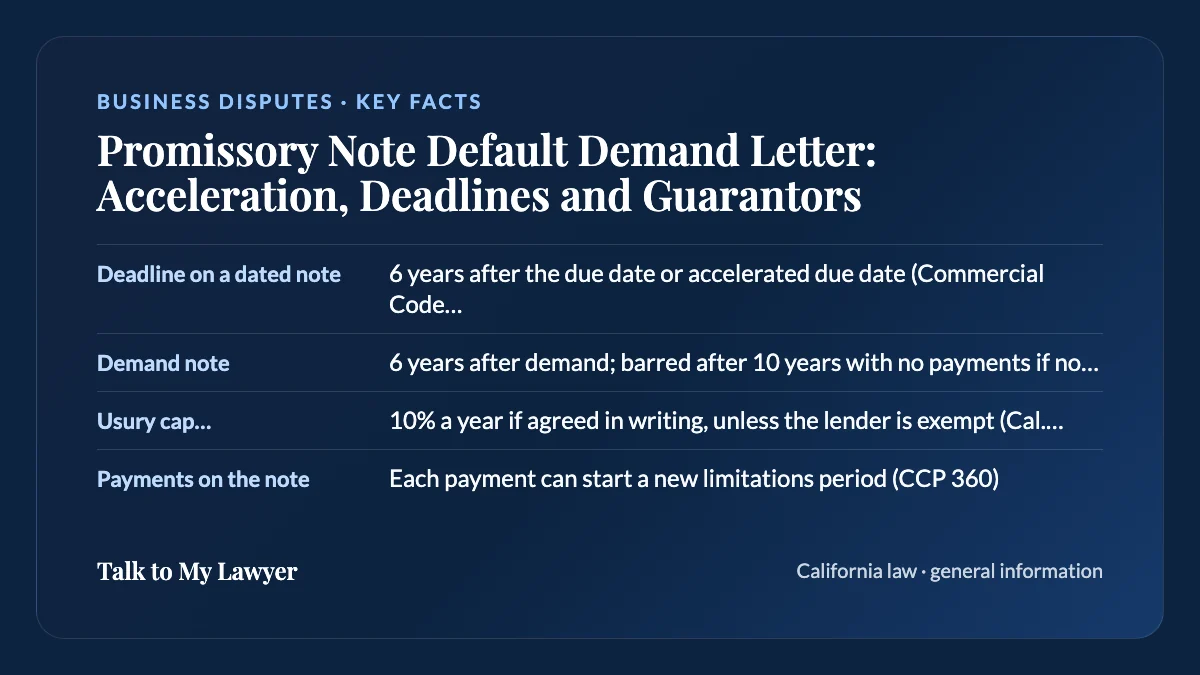
At a glance
- Deadline on a dated note
- 6 years after the due date or accelerated due date (Commercial Code 3118(a))
- Demand note
- 6 years after demand; barred after 10 years with no payments if no demand (3118(b))
- Usury cap, personal-purpose loan
- 10% a year if agreed in writing, unless the lender is exempt (Cal. Const. art. XV, sec. 1)
- Payments on the note
- Each payment can start a new limitations period (CCP 360)
- Guarantors
- A guarantor answers for another's debt (Civil Code 2787)
What counts as a default on a promissory note?
Default is whatever the note says it is. A missed payment is the usual trigger, but notes often list other events: a bounced check, the borrower's bankruptcy, the sale of collateral, or a broken promise in a related loan agreement.
- Grace period. Some notes treat a payment as late only after 5, 10 or 15 days.
- Notice and cure. Some require written notice of default and a set number of days to catch up before the holder can do anything more.
- Notice address. Many specify where and how notices must go. A letter sent elsewhere may not count.
- Default interest. Some raise the rate after default. That higher rate still has to fit within the law.
Before writing, pull the original note, every amendment, the payment history and any security agreement or deed of trust that goes with it.
How does an acceleration clause work?
An acceleration clause lets the holder declare the entire unpaid balance due at once after a default. Without one, you generally can claim only the installments that have come due.
| Clause type | Typical wording | What the letter does |
|---|---|---|
| Optional acceleration | "The holder may, at its option, declare..." | States clearly that the holder is exercising the option and gives the accelerated amount |
| Automatic acceleration | "The entire balance shall become immediately due..." | Confirms that the balance became due on the triggering event |
| Notice-first acceleration | "After written notice and 30 days to cure..." | Serves as the notice of default and starts the cure period; acceleration comes later |
Acceleration affects the deadline too. For a note payable at a definite time, the six-year limit runs from the due date, or from the accelerated due date if the balance was accelerated (Commercial Code section 3118(a)). Pick the date deliberately and state it.
How long do you have to sue on a promissory note in California?
Generally six years for a negotiable promissory note, and four years for a written loan agreement that is not a negotiable instrument. Which applies depends on the document.
| Type of obligation | Time limit | Source |
|---|---|---|
| Negotiable note payable at a definite time | 6 years after the due date or accelerated due date | Commercial Code 3118(a) |
| Negotiable note payable on demand | 6 years after demand; if no demand, barred after 10 continuous years with no principal or interest paid | Commercial Code 3118(b) |
| Other written loan contract | 4 years | Code of Civil Procedure 337 |
| Oral loan | 2 years | Code of Civil Procedure 339 |
A note is negotiable when it is an unconditional promise to pay a fixed amount, payable to order or bearer, on demand or at a definite time, without other undertakings (Commercial Code section 3104). Notes with extra obligations may not qualify. Under Code of Civil Procedure section 360, a payment on a promissory note can start a new limitations period, though a payment cannot revive a claim that has already expired. How that rule interacts with the Commercial Code's six-year period is a question for a lawyer.
What interest, late fees and attorney's fees can you claim?
The note's agreed rate keeps running after a breach until a judgment replaces it (Civil Code section 3289(a)). The rate itself must respect California's usury limits, set in the state Constitution.
- Personal, family or household loans: up to 10 percent a year if agreed in writing (Article XV, section 1). Loans used mainly to buy, build or improve real property are not treated as personal-purpose loans for this cap.
- Other loans: the higher of 10 percent or 5 percent plus the Federal Reserve Bank of San Francisco's rate on the date the Constitution specifies, again if agreed in writing. Without a written rate agreement, the constitutional rate is 7 percent.
- Exempt lenders: the caps do not apply to banks, credit unions, licensed finance lenders and certain loans made or arranged by licensed real estate brokers, among others.
- Late charges on a single-family, owner-occupied home loan: no more than 6 percent of the principal-and-interest installment or $5, whichever is greater, and only after 10 days (Civil Code section 2954.4), with some lenders excluded.
- Attorney's fees: recoverable when the note provides for them, and California makes a one-sided fee clause reciprocal (Civil Code section 1717).
Fees charged as a fee, bonus or commission count toward the usury limit under the same constitutional section. If a private loan's effective rate may exceed the cap, get legal advice before any interest goes into the demand.
Should the demand letter go to the guarantor too?
If the guaranty covers the default, it can. A guarantor is someone who "promises to answer for the debt, default, or miscarriage of another" (Civil Code section 2787). Read the guaranty to see whether it requires notice of default, a demand, or efforts to collect from the borrower first.
California gives guarantors several default protections. For example, a guarantor may require the creditor to proceed against the borrower first, and is released to the extent prejudiced if the creditor neglects to (Civil Code section 2845). A guaranty can waive these rights (section 2856), and the statute says a clause expressing an intent to waive works without any particular wording. Read the guaranty's waiver clause before deciding whom to pursue first.
One more check: if you are in the business of lending, California's debt collection law can reach your letters to individual borrowers and guarantors, including some business loans entered into, renewed, sold or assigned on or after July 1, 2025 (Civil Code sections 1788.1(d) and 1788.2).
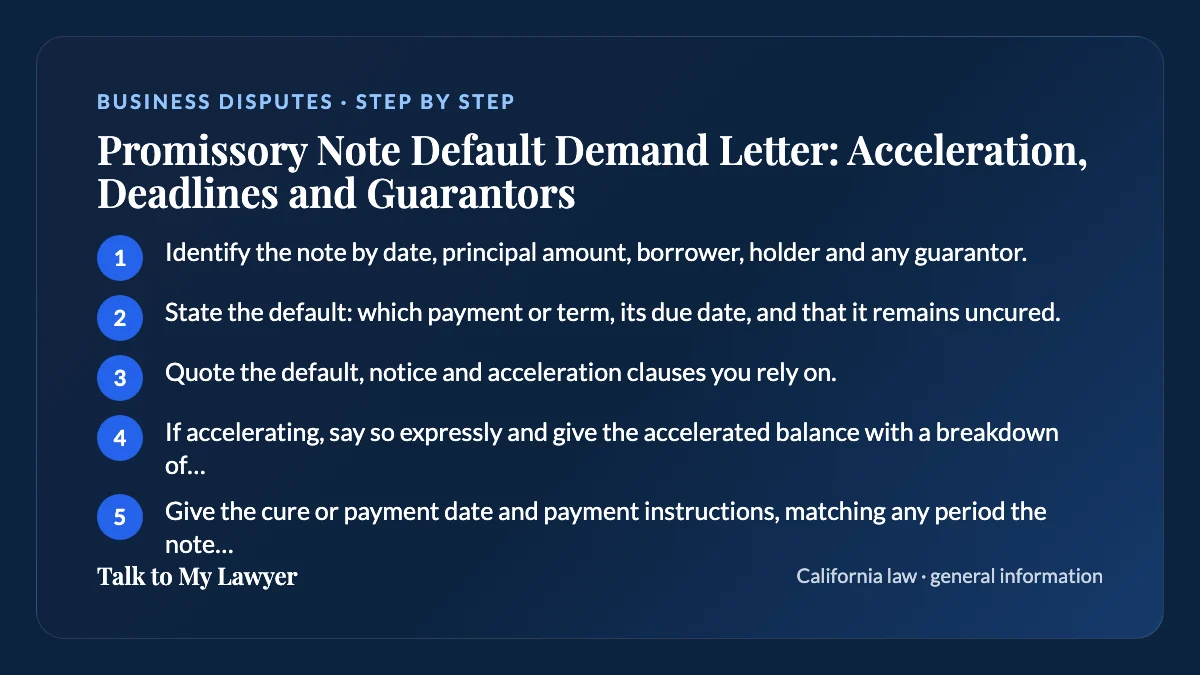
Steps to write a promissory note default demand letter
- Identify the note by date, principal amount, borrower, holder and any guarantor.
- State the default: which payment or term, its due date, and that it remains uncured.
- Quote the default, notice and acceleration clauses you rely on.
- If accelerating, say so expressly and give the accelerated balance with a breakdown of principal, interest and any allowed charges.
- Give the cure or payment date and payment instructions, matching any period the note requires.
- Send it to the notice address and by the method the note requires, with a copy to each guarantor if the guaranty calls for it.
Under the Promissory Note dated March 1, 2024, in the original principal amount of $30,000, monthly payments of $1,250 were due on July 1, August 1 and September 1, 2026. None has been received. Under section 7 of the Note, the holder elects to declare the entire unpaid balance of $21,480.00, plus accrued interest at the Note rate of 8 percent from June 1, 2026, immediately due. Please pay that amount by October 31, 2026.
For the basics of the format, see what a demand letter is. If the borrower is a friend or relative and nothing was signed, our guide to personal loan demand letters fits better.
What changes when the note is secured by real property?
A note secured by a deed of trust brings in foreclosure procedures and limits on deficiency judgments that a demand letter alone does not resolve. The California guaranty statute itself refers to these rules, including Code of Civil Procedure sections 580a, 580b, 580d and 726.
The 10 percent post-breach default rate in Civil Code section 3289(b) also does not apply to a note secured by a deed of trust on real property. If your note is secured by a home or other real estate, talk to a lawyer about the order of steps before you accelerate.
Before you accelerate the balance: an attorney-written default notice
Declaring the full balance due sets a new date for the six-year limit and may be subject to the note's cure terms, so the wording of an acceleration notice carries weight. A borrower who missed one payment may need only a one-page reminder. Attorney drafting fits when you plan to accelerate, when the note requires a precise notice-and-cure sequence, when a guarantor is involved, when the interest terms raise usury questions, or when collateral is part of the deal.
Through Talk to My Lawyer, a licensed California attorney writes your letter from your facts and documents (the note, guaranty and payment history) and sends it on your behalf. Foreclosure and a suit on the note each carry their own rules, so get advice specific to your loan before choosing either.
Frequently asked questions
Do I have to send a notice of default before suing on a promissory note?
It depends on the note. If it requires written notice and a cure period, you generally must follow that process first, and skipping it can give the borrower a defense. If it has no notice clause, a demand letter is still useful because it fixes the amount owed and the date, and shows a court you asked for payment.
What is the statute of limitations on a promissory note in California?
For a negotiable note payable at a definite time, generally six years after the due date or the accelerated due date under Commercial Code section 3118. A demand note has six years after demand. A written loan agreement that is not a negotiable instrument generally falls under the four-year limit for written contracts. Payments on the note can also affect the timing (Code of Civil Procedure section 360).
Can I charge default interest on a promissory note?
If the note provides for it and the total rate stays within California's usury limits or the lender is exempt. For personal-purpose loans by non-exempt lenders, the constitutional cap is 10 percent a year if agreed in writing. A default rate that pushes the total over the cap is a problem, so check the math before demanding it.
Can I go after the guarantor without suing the borrower?
Sometimes. California lets a guarantor require the creditor to pursue the borrower first, but a guaranty may waive that right, and the law allows the waiver. Read the guaranty's waiver and notice clauses. A demand letter can go to both the borrower and the guarantor at the same time.
What if the borrower makes a partial payment after I accelerate?
Accepting a partial payment can raise questions about whether you waived the acceleration, depending on the note's terms and what you say when you accept it. Some notes include a clause saying acceptance does not waive default. Confirm in writing how you are applying any partial payment, and talk to a lawyer if the borrower disputes it.
Sources
Checked against these official sources on October 18, 2026.
- California Commercial Code section 3118 (California Legislative Information)
- California Commercial Code section 3104 (California Legislative Information)
- California Constitution, Article XV, section 1 (California Legislative Information)
- California Code of Civil Procedure section 360 (California Legislative Information)
- California Civil Code section 2845 (California Legislative Information)
- California Civil Code section 2954.4 (California Legislative Information)
This guide explains California law in general terms as of October 2026. It is general information, not legal advice for your situation, and local rules can add to it.
Join the email list and get a lawyer letter started
With Talk to My Lawyer, a licensed California attorney writes your letter from your facts and documents and sends it on your behalf. Join the Talk to My Lawyer email list for letter checklists, document prompts, and reminders before you start your letter.