Quick answer
California's hidden fees law, Civil Code section 1770(a)(29), makes it illegal to advertise or display a price that leaves out mandatory fees. Only government taxes and fees, and actual shipping costs for physical goods, may be added later. The rule took effect July 1, 2024. Restaurants and bars may list a mandatory service charge separately if it is clearly shown with its purpose.
At a glance
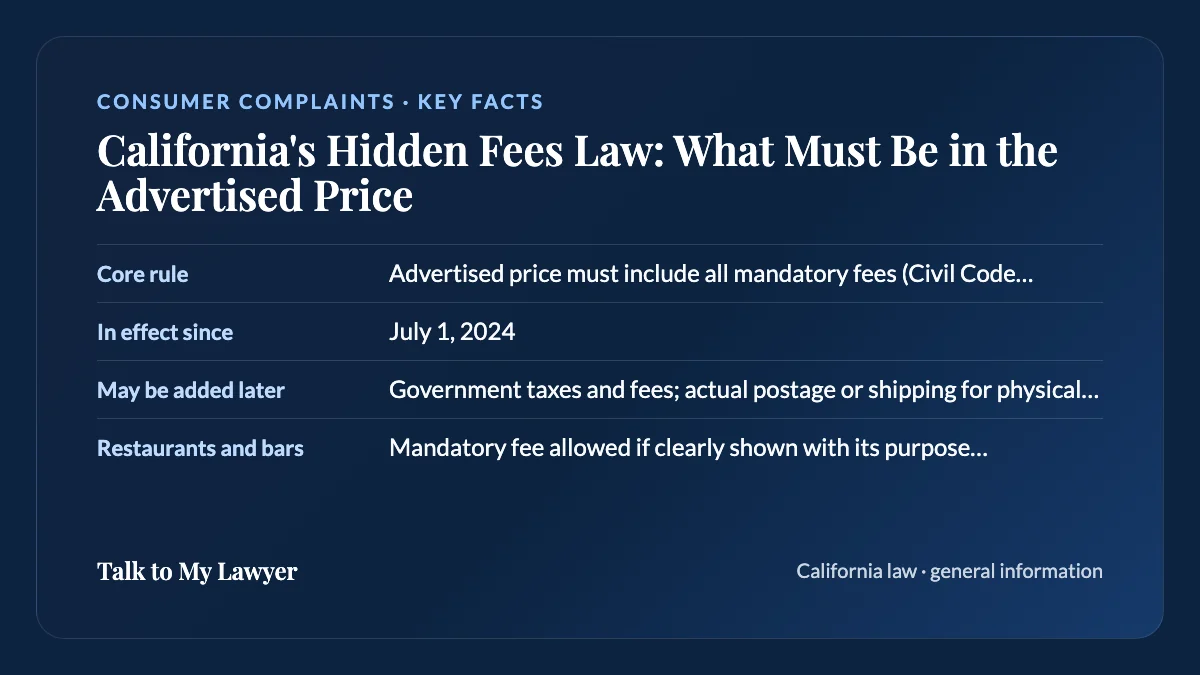
- Core rule
- Advertised price must include all mandatory fees (Civil Code 1770(a)(29))
- In effect since
- July 1, 2024
- May be added later
- Government taxes and fees; actual postage or shipping for physical goods
- Restaurants and bars
- Mandatory fee allowed if clearly shown with its purpose (1770(a)(29)(D))
- Federal overlap
- FTC rule on live-event tickets and short-term lodging, effective May 12, 2025 (16 CFR Part 464)
- Before suing for damages
- Written CLRA notice by certified or registered mail, 30 days ahead (Civil Code 1782)
What does California's hidden fees law require?
California's hidden fees law requires the first price you see to be the price you pay, apart from government taxes and shipping. Civil Code section 1770(a)(29) lists it as an unlawful practice to advertise, display or offer a price for a good or service that does not include all mandatory fees or charges.
The rule came from SB 478 and became operative on July 1, 2024. The California Attorney General calls it the Honest Pricing Law and describes its target as drip pricing: showing a low number up front and adding required fees as you click through. The AG's guidance also describes SB 478 as a transparency law, not a price control. A business can still set its prices and charge its fees; the price it advertises has to be the full amount you must pay.
Because section 1770 is part of the Consumers Legal Remedies Act (CLRA), a violation gives individual consumers a way to seek a remedy, which is where a written notice comes in.
Which charges can still be added at checkout?
The statute allows only two exclusions from the advertised price: taxes or fees imposed by a government on the transaction, and postage or carriage charges reasonably and actually incurred to ship a physical good. The Attorney General's guidance explains how other common charges fit.
| Charge | Must it be in the advertised price? | Basis |
|---|---|---|
| Sales tax or a city ticket tax | No | Government charges are excluded by the statute |
| Actual shipping cost for a physical item | No, but handling charges must be included | Statute and AG guidance |
| Mandatory service, booking or convenience fee | Yes | Statute |
| Mandatory resort, cleaning or facility fee | Yes | Statute; AG says hotels are covered |
| Optional add-ons, such as seat upgrades or insurance | No, if truly optional | AG guidance |
| Fees triggered by later conduct, such as late returns or smoking in a non-smoking room | No | AG guidance |
| Credit card fee | No, unless the business accepts only cards | AG guidance |
A variable fee that appears only at a late step is prohibited, according to the AG. So is a price followed by a line such as plus a 15 percent service fee. Telling you fees will be added does not cure the problem; the advertised number itself has to include them.
Restaurants, banks and broadband: who is exempt?
Three carve-outs are written into the statute itself, and the AG adds that purchases for commercial use are not covered.
- Restaurants, bars, food concessions, grocery stores and grocery delivery services. After SB 1524, a mandatory fee on individual food or beverage items is allowed if it is clearly and conspicuously displayed, with an explanation of its purpose, on any menu, ad or display that shows the price. Banquet and catering menus that fully disclose terms are also covered. The exemption does not extend to third-party food delivery platforms.
- Certain financial entities that already give disclosures under federal or state laws such as the Truth in Lending Act or the Truth in Savings Act are exempt for those transactions.
- Broadband providers that comply with the FCC's broadband consumer label rules are treated as complying with the California rule.
Tips you choose to leave are not mandatory fees, so the law does not touch them. A restaurant service charge that is printed only at the bottom of the bill, with no explanation on the menu, may be outside the exemption.
How does the FTC junk fee rule fit in?
A federal rule covers two industries nationwide. The FTC's Rule on Unfair or Deceptive Fees (16 CFR Part 464) took effect May 12, 2025 and applies to live-event tickets and short-term lodging, including hotels, motels and vacation rentals. As of October 2026 it remains in the Code of Federal Regulations.
Under the federal rule, any advertised price for a covered ticket or room must clearly disclose the total price, and the total price must be more prominent than other pricing information. Government charges, shipping charges and optional extras may be left out of the total, but their nature, purpose and amount must be disclosed before you pay. The rule also bans misrepresenting a fee's purpose or refundability.
The FTC rule does not displace California law where California protects consumers more (16 CFR 464.4). For a concert ticket or hotel room in California, both rules can apply at once. You can report a suspected federal violation through ReportFraud.ftc.gov.
Example: a hotel resort fee, line by line
Example (hypothetical): a booking site advertises a coastal hotel at $189 a night. After you choose three nights, the checkout adds a $35 nightly resort fee, a $12 booking fee and local occupancy tax. The card is charged $684 plus tax.
| Line | Amount | Can it be left out of the advertised price? |
|---|---|---|
| Room, 3 nights at $189 | $567 | Base price |
| Resort fee, 3 nights at $35 | $105 | No. It is mandatory, so the nightly price should have read $224 |
| Booking fee | $12 | No, if every guest must pay it |
| Occupancy tax | Varies | Yes. It is a government charge |
| Hidden amount | $117 | The figure a demand would focus on |
The same facts could raise questions under the FTC rule, since short-term lodging is covered. A court, not the guest, decides whether a violation occurred and what remedy fits.
How to send a CLRA notice about hidden fees
A CLRA damages suit has a precondition: a written notice sent 30 days or more before filing (Civil Code section 1782). The notice must identify the particular violations of section 1770 and demand that the business correct, repair, replace or otherwise rectify them.
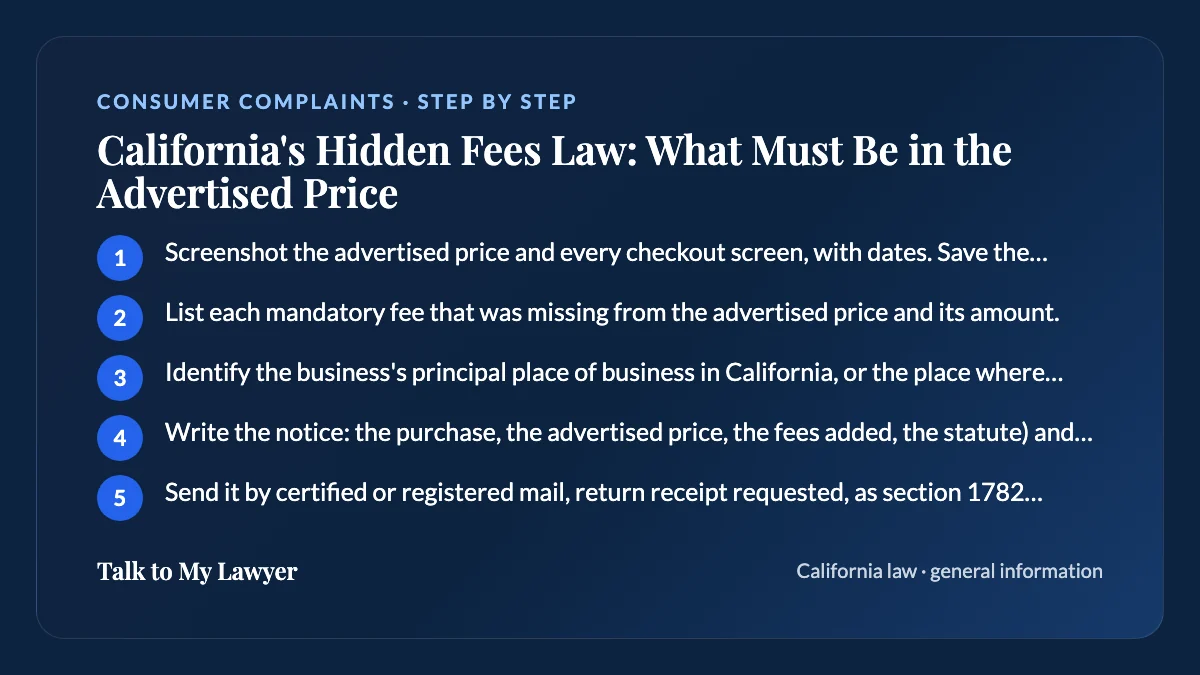
- Screenshot the advertised price and every checkout screen, with dates. Save the receipt and the card statement.
- List each mandatory fee that was missing from the advertised price and its amount.
- Identify the business's principal place of business in California, or the place where the transaction happened.
- Write the notice: the purchase, the advertised price, the fees added, the statute (section 1770(a)(29)) and the remedy you request, such as a refund of the hidden fees.
- Send it by certified or registered mail, return receipt requested, as section 1782 requires. Email can be a courtesy copy, not a substitute.
- Calendar 30 days from the date the business receives it.
On May 2, I booked three nights at your property through your website, which advertised a rate of $189 per night. At checkout, a mandatory $35 nightly resort fee and a $12 booking fee were added, for $117 not included in the advertised price. California Civil Code section 1770(a)(29) prohibits advertising a price that does not include all mandatory fees other than government charges and shipping. Under Civil Code section 1782, I request a refund of $117 to the card used for the booking.
If the business gives an appropriate correction or refund, or agrees to within a reasonable time, within 30 days of receiving the notice, an individual damages claim under the CLRA generally cannot go forward (section 1782(b)). The law also treats the business's attempt to comply as an offer to compromise, not an admission.
What can you recover, and where else can you go?
Section 1780 lists the remedies a court can award under the CLRA: actual damages, an order stopping the practice, restitution, punitive damages and other proper relief. The court must award costs and attorney's fees to a prevailing plaintiff. Seniors and people with disabilities may seek up to $5,000 more when a court makes specific findings of substantial harm.
For a refund of a few fees, you might start with the business and your card issuer. Our guide to a chargeback versus a demand letter explains the trade-offs. If a fee was tied to a subscription you could not cancel, see subscription cancellation letters. For surprise charges on a phone or internet bill, our guide to disputing a phone bill in California covers regulators and cramming rules.
When an attorney-written hidden fee letter makes sense
A one-time $12 fee may not justify more than an email. A formal notice earns its keep when the hidden charges are large, when they repeat every month, when the business has ignored you, or when you want the 30-day CLRA notice done correctly in case you later file.
Talk to My Lawyer can prepare that notice: a licensed California attorney writes your letter from your screenshots, receipts and statements, cites sections 1770(a)(29) and 1782, and sends it on your behalf by certified mail. A lawsuit or class claim raises separate questions, so speak with a lawyer before filing one.
Frequently asked questions
Are resort fees legal in California?
A hotel may still charge a mandatory resort fee, but under Civil Code section 1770(a)(29) the fee has to be included in the advertised room price. The Attorney General's guidance states the law applies to hotels and short-term rentals. Since May 12, 2025, the FTC's fee rule also requires hotels and lodging sites to show the total price, including mandatory fees, when they display a rate.
Can a California restaurant add a service charge to my bill?
Yes, if it follows the rule for food and beverage sellers. A restaurant, bar or food concession may charge a mandatory fee if it is clearly and conspicuously displayed, with an explanation of its purpose, on the menu, ad or other display that shows the food or drink price. Third-party delivery apps do not get this exemption and must show the full price.
Does the hidden fees law apply to online shopping and shipping?
Yes. It covers prices advertised online, in apps and in stores. Postage or carriage charges reasonably and actually incurred to ship a physical item may be added later, but the Attorney General's guidance says handling charges may not be split out that way. Any mandatory service or processing fee must be in the price shown.
Do I have to send a notice before suing over a hidden fee?
For a damages claim under the Consumers Legal Remedies Act, yes. Civil Code section 1782 requires written notice by certified or registered mail at least 30 days before filing. A request for an order stopping the practice can be filed without that notice, and the complaint can be amended to add damages at least 30 days later, after the notice is sent.
Is a credit card surcharge a hidden fee?
Not under California's rule as the Attorney General's guidance reads it. A fee for paying by card can be left out of the advertised price because you can choose another payment method. The exception is a business that accepts only credit cards, where the fee is effectively mandatory and belongs in the advertised price.
Sources
Checked against these official sources on October 18, 2026.
- California Civil Code section 1770 (California Legislative Information)
- SB 478 Honest Pricing Law frequently asked questions (California Attorney General)
- 16 CFR Part 464, Rule on Unfair or Deceptive Fees (eCFR, National Archives)
- Rule on Unfair or Deceptive Fees: frequently asked questions (Federal Trade Commission)
- California Civil Code section 1782 (California Legislative Information)
- California Civil Code section 1780 (California Legislative Information)
This guide explains California law in general terms as of October 2026. It is general information, not legal advice for your situation, and local rules can add to it.
Join the email list and get a lawyer letter started
With Talk to My Lawyer, a licensed California attorney writes your letter from your facts and documents and sends it on your behalf. Join the Talk to My Lawyer email list for letter checklists, document prompts, and reminders before you start your letter.