Quick answer
To dispute a phone bill in California, write to the carrier, list each charge you did not authorize and pay the undisputed balance. Public Utilities Code section 2890 allows only authorized charges, presumes an unverified charge was not authorized, and gives the company 30 days to verify your authorization or work to resolve the dispute. Unresolved phone disputes can go to the CPUC; internet disputes go to the FCC.
At a glance
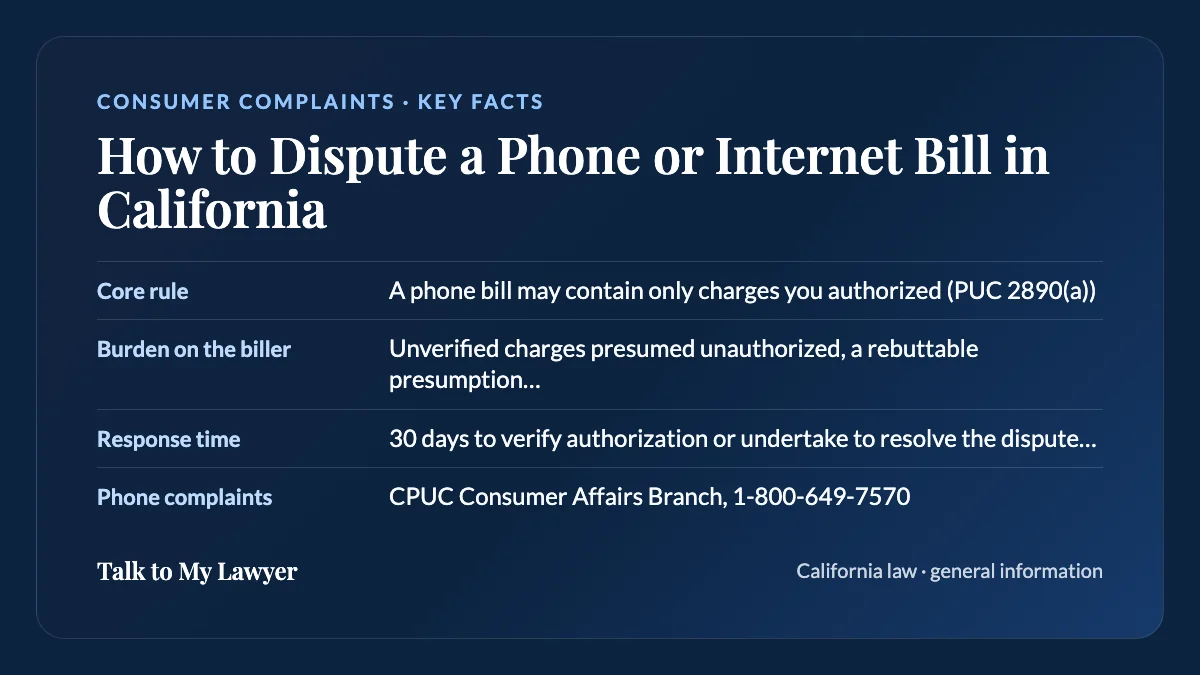
- Core rule
- A phone bill may contain only charges you authorized (PUC 2890(a))
- Burden on the biller
- Unverified charges presumed unauthorized, a rebuttable presumption (PUC 2890(d)(2)(D))
- Response time
- 30 days to verify authorization or undertake to resolve the dispute (PUC 2890(e))
- Phone complaints
- CPUC Consumer Affairs Branch, 1-800-649-7570
- Internet and cable
- CPUC refers these to the FCC; cable TV may go to your city
- Keep paying
- Pay undisputed charges while the dispute is reviewed (CPUC)
Which agency handles your phone or internet complaint?
The California Public Utilities Commission (CPUC) takes billing complaints about telephone service, but it does not regulate every technology. Its Consumer Affairs Branch FAQ points cable and internet disputes to the FCC, and cable TV problems to your local city government.
| Service | Start with | Then |
|---|---|---|
| Landline phone | The carrier's billing department | CPUC Consumer Affairs Branch |
| Wireless phone | The carrier | CPUC; the FAQ says it may help with early termination fees when there are compelling reasons |
| VoIP phone (for example, phone service bundled with internet) | The provider | Written complaint to the CPUC, which says it has limited jurisdiction |
| Home internet | The provider | FCC informal complaint |
| Cable TV | The provider | Your local city government, or the FCC |
The CPUC asks you to try the company first. If that fails, you can call 1-800-649-7570, email consumer-affairs@cpuc.ca.gov, or write to the Consumer Affairs Branch at 505 Van Ness Avenue, San Francisco, CA 94102.
What does California law say about crammed charges?
Cramming means charges on your bill for things you did not order. The CPUC uses the term for unauthorized charges from your phone company or a third party, and California law is short and direct about it: a telephone bill may only contain charges for products or services the subscriber authorized (Public Utilities Code section 2890(a)).
- Every outside biller must be identified. The billing phone company has to show each third-party company, or billing agent, that generates a charge in its own section of the bill.
- Each charge needs a plain description, the amount including taxes, and the name and toll-free number of whoever resolves disputes about it. The bill must also show the CPUC's complaint number.
- The burden is on the biller. In a dispute, there is a rebuttable presumption that an unverified charge was not authorized and that you are not responsible for it (section 2890(d)(2)(D)). For direct-dialed calls, evidence that the call was dialed counts as prima facie (initial) evidence of authorization.
- There is a 30-day deadline. The company that generated the charge must, within 30 days of receiving your complaint, verify your authorization or undertake to resolve the dispute to your satisfaction (section 2890(e)).
Early termination fees and promo prices that expire
An early termination fee comes from your contract, so the first document to read is the service agreement you accepted. For home internet, the FCC's broadband consumer label is the second.
Under 47 CFR 8.1, broadband providers must display a label for each stand-alone internet plan at every point of sale, which includes their websites (in close proximity to the plan), stores and phone sales, and must make each customer's label easily accessible in online account portals. The FCC's 2026 order describes the label fields as including the monthly price with monthly fees, any introductory rate and how long it lasts, speeds, latency, data allowance, contract length and any early termination fee.
If a provider advertised a price that did not include mandatory monthly fees, California's hidden fees law may also be relevant, though it treats compliance with the FCC label rules as compliance for broadband.
How to dispute a phone bill in California, step by step
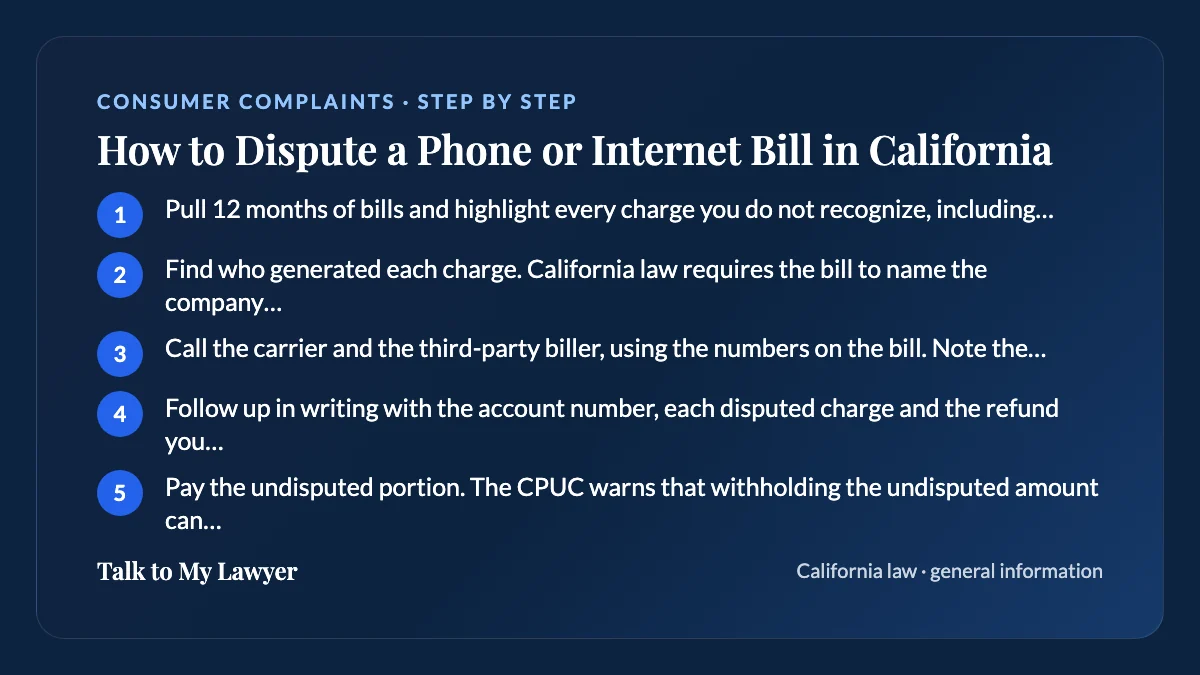
- Pull 12 months of bills and highlight every charge you do not recognize, including small recurring ones.
- Find who generated each charge. California law requires the bill to name the company and give a dispute number.
- Call the carrier and the third-party biller, using the numbers on the bill. Note the date, time and representative's name.
- Follow up in writing with the account number, each disputed charge and the refund you want.
- Pay the undisputed portion. The CPUC warns that withholding the undisputed amount can lead to disconnection of phone service.
- Ask the carrier to block third-party charges on the line if it offers that option.
- Wait 30 days for verification or a resolution, then file with the CPUC or FCC, attaching your letter and the bills.
If the charges came from a subscription you tried to cancel, our guide to subscription cancellation letters covers that situation.
Sample wording for a phone billing dispute
Keep the letter to the facts and the rule. Example (hypothetical): a $9.99 monthly charge from a third-party content service appeared for seven months, plus taxes, for about $74 in total.
Account 0042-118-73 shows a monthly charge of $9.99 for Premium Content Services, billed by a third party, on each statement from March through September 2026. I did not order or authorize this service. Under California Public Utilities Code section 2890, a telephone bill may contain only charges the subscriber authorized, and an unverified charge is presumed unauthorized. Please remove the charge, refund $69.93 plus the related taxes, and confirm in writing within 30 days. I have paid all undisputed charges.
Send it to the carrier's billing dispute address and to the third-party biller named on the bill.
What happens if the carrier will not fix the bill?
File with the regulator that covers the service, and include copies of your letter and bills. For phone service, the CPUC's Consumer Affairs Branch takes informal complaints, and the CPUC can order a utility to take corrective action on formal complaints. For internet and cable billing, use the FCC's consumer complaint center.
For money you are still owed, small claims court hears cases up to $12,500 for individuals. See demand letters ahead of a small claims case, and if you paid the charges by card, compare a chargeback with a demand letter.
When an attorney-written billing dispute letter makes sense
A single crammed $9.99 charge is something you can raise yourself under section 2890. A lawyer-drafted letter fits better when crammed charges ran for months, when a business account has many lines, when a carrier is collecting an early termination fee you believe the contract does not allow, or when the account has been sent to collections.
At Talk to My Lawyer, a licensed California attorney writes your letter from your bills, contract and call notes and sends it on your behalf, with copies for the carrier and any third-party biller. Suing a carrier is a separate decision to talk through with a lawyer first.
Frequently asked questions
Do I have to pay a disputed phone charge while the complaint is open?
You do not have to pay for products or services you did not authorize, according to the CPUC, but you must keep paying the charges you do not dispute. The CPUC warns that withholding the undisputed amount can lead to disconnection of phone service. Note in your letter which amounts you paid and which you dispute.
Can I file a complaint with the CPUC about my internet bill?
Generally not. The CPUC's Consumer Affairs Branch says it does not have jurisdiction over all technologies, and it directs cable and internet disputes to the FCC. For VoIP phone service, the CPUC says it has limited jurisdiction but accepts written complaints. Landline and wireless phone billing complaints go to the CPUC after you try the carrier.
What is cramming on a phone bill?
Cramming is being billed for products or services you did not order, either by your phone company or by a third party that bills through it. California's Public Utilities Code section 2890 says a phone bill may contain only authorized charges, requires each outside biller to be identified, and presumes an unverified charge was not authorized.
How long does a phone company have to respond to a billing dispute in California?
For a complaint that you did not authorize a charge, the company that generated it has 30 days from receiving your complaint to verify your authorization or undertake to resolve the dispute to your satisfaction, under Public Utilities Code section 2890(e). Keep a dated copy of your complaint so you can show when the 30 days started.
Where do I find the early termination fee for my internet plan?
Check your service agreement and the FCC broadband consumer label for the plan, which providers must show at the point of sale. The label fields include contract length and any early termination fee. Because the FCC changed its label rules in 2026, save a copy of the label when you sign up.
Sources
Checked against these official sources on October 18, 2026.
- California Public Utilities Code section 2890 (California Legislative Information)
- Unauthorized service charges (California Public Utilities Commission)
- Consumer Affairs Branch frequently asked questions (California Public Utilities Commission)
- 47 CFR 8.1, Transparency (eCFR, National Archives)
- Empowering Broadband Consumers Through Transparency (FCC 26-48) (Federal Register)
- File a complaint (California Public Utilities Commission)
This guide explains California law in general terms as of October 2026. It is general information, not legal advice for your situation, and local rules can add to it.
Join the email list and get a lawyer letter started
With Talk to My Lawyer, a licensed California attorney writes your letter from your facts and documents and sends it on your behalf. Join the Talk to My Lawyer email list for letter checklists, document prompts, and reminders before you start your letter.