Quick answer
A landlord demand letter for property damage in California asks a former tenant to pay repair costs that exceed the security deposit. Under Civil Code section 1950.5, the landlord first sends an itemized statement within 21 days, with receipts and before-and-after photos, and cannot charge for ordinary wear and tear. The demand then seeks the documented balance, and small claims court can hear claims up to $12,500 for individuals.
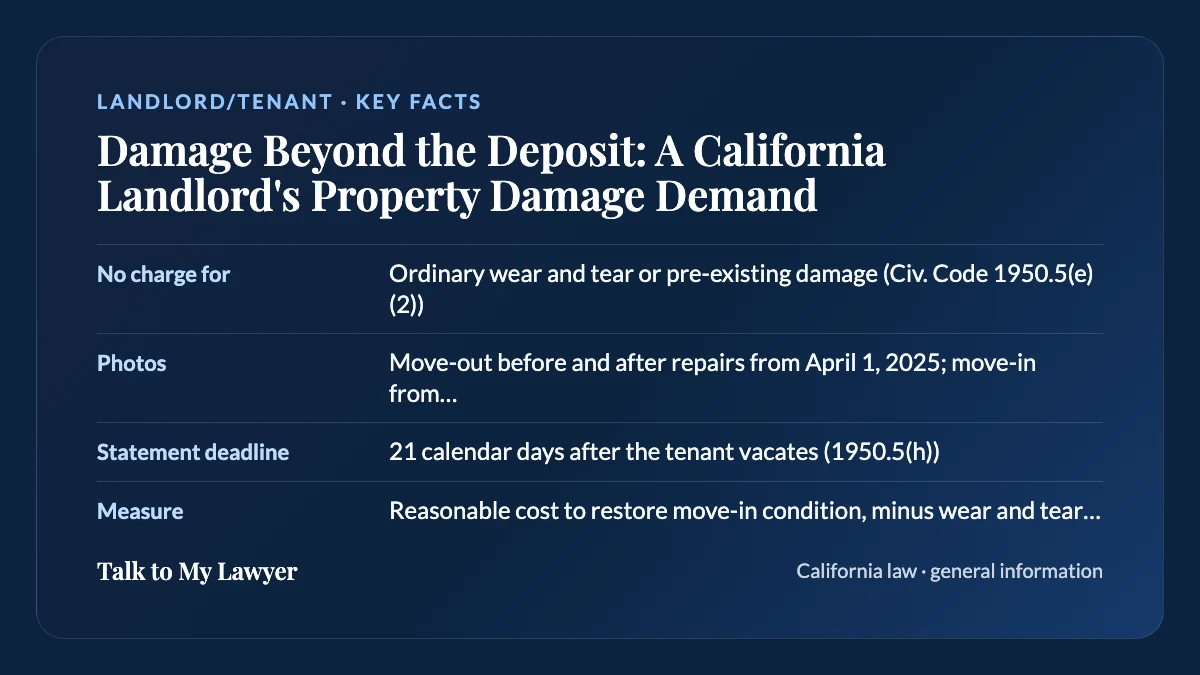
At a glance
- No charge for
- Ordinary wear and tear or pre-existing damage (Civ. Code 1950.5(e)(2))
- Photos
- Move-out before and after repairs from April 1, 2025; move-in from July 1, 2025 (1950.5(g))
- Statement deadline
- 21 calendar days after the tenant vacates (1950.5(h))
- Measure
- Reasonable cost to restore move-in condition, minus wear and tear (1950.5(e)(2)(B))
- Time to sue
- Three years for property damage; four on a written lease (California Courts self-help)
What is the difference between normal wear and tear and tenant damage?
Wear and tear is the deterioration that comes from ordinary living over time; damage is harm beyond that, caused by the tenant or the tenant's guests. California bars any claim against the tenant or the deposit for ordinary wear and tear, its cumulative effects over one or more tenancies, or conditions that existed before the tenancy began (Civil Code section 1950.5(e)(2)(A)).
The statute does not list examples, so the line is drawn case by case. These illustrations show how the distinction is commonly framed:
| Likely wear and tear | Likely damage |
|---|---|
| Faded paint, light scuffs near furniture | Large holes, crayon or marker on walls, unapproved paint colors |
| Carpet matted in walkways after years of use | Burns, pet urine saturation, large stains |
| Loose door handles from regular use | Doors or frames chewed, kicked in or broken |
| Minor countertop wear | Cracked stone from impact, deep knife cuts |
| Worn grout in a shower | Water damage from an unreported, ongoing leak the tenant caused |
The age of the item matters too. Claims are limited to a reasonable amount needed to restore the premises to their condition at the start of the tenancy, exclusive of wear and tear (section 1950.5(e)(2)(B)). A tenant should not end up paying for a brand-new carpet to replace one that was already near the end of its life.
What records does a California landlord need to charge for damage?
AB 2801 added photo requirements to section 1950.5. As of October 2026:
- Move-in photos: for tenancies beginning on or after July 1, 2025, the landlord must photograph the unit immediately before, or at the start of, the tenancy.
- Move-out photos: since April 1, 2025, the landlord must photograph the unit within a reasonable time after getting possession back, before any repairs or cleaning that will be deducted, and again after the work is done.
- Receipts: for work by a contractor, a copy of the bill, invoice or receipt; for work by the landlord or an employee, a description of the work, the time spent and a reasonable hourly rate; for materials, a receipt or vendor document.
- Professional cleaning limits: no charge for professional carpet or other professional cleaning unless reasonably necessary to restore move-in condition, excluding wear and tear.
If repair and cleaning deductions together are $125 or less, the receipts and photos need not accompany the statement, but the tenant can request them within 14 days and the landlord then has 14 days to provide them.
Why the itemized deposit statement must come before the demand
Your demand for damage beyond the deposit rests on the deposit accounting. Within 21 calendar days after the tenant vacates, section 1950.5(h) requires an itemized statement of the deposit's disposition, with receipts and photos, and the return of any balance. If a repair cannot reasonably be finished in that time, you may deduct a good-faith estimate and send the final documents within 14 days after the work is done.
The stakes are real. A landlord who in bad faith fails to comply is not entitled to claim any of the deposit, bad-faith claims or retention can bring statutory damages of up to twice the deposit, and in a deposit dispute the landlord carries the burden of proving that the amounts claimed are reasonable (section 1950.5(m)). A defective statement can hand the tenant a claim of their own.
Example: when the repair bill exceeds the deposit
Example (hypothetical): a tenant paid a $2,000 deposit and moved out on August 31. Move-in photos from July 2025 show clean, intact surfaces. Move-out photos show a cracked quartz countertop section and three chewed door frames.
| Charge | Amount | Support |
|---|---|---|
| Countertop section replacement | $1,850 | Contractor invoice, before and after photos |
| Door frame repair and paint (landlord's own work) | $480 | Description, 8 hours at $60 an hour, photos |
| Materials | $170 | Hardware store receipt |
| Total damage | $2,500 | Itemized statement sent September 18 |
| Less deposit | -$2,000 | |
| Balance demanded | $500 | Demand letter with the statement attached |
Notice what is missing: no charge for repainting walls that simply aged, and no carpet charge, because the carpet was eight years old and the wear was normal.
How to write a demand letter for damage beyond the deposit
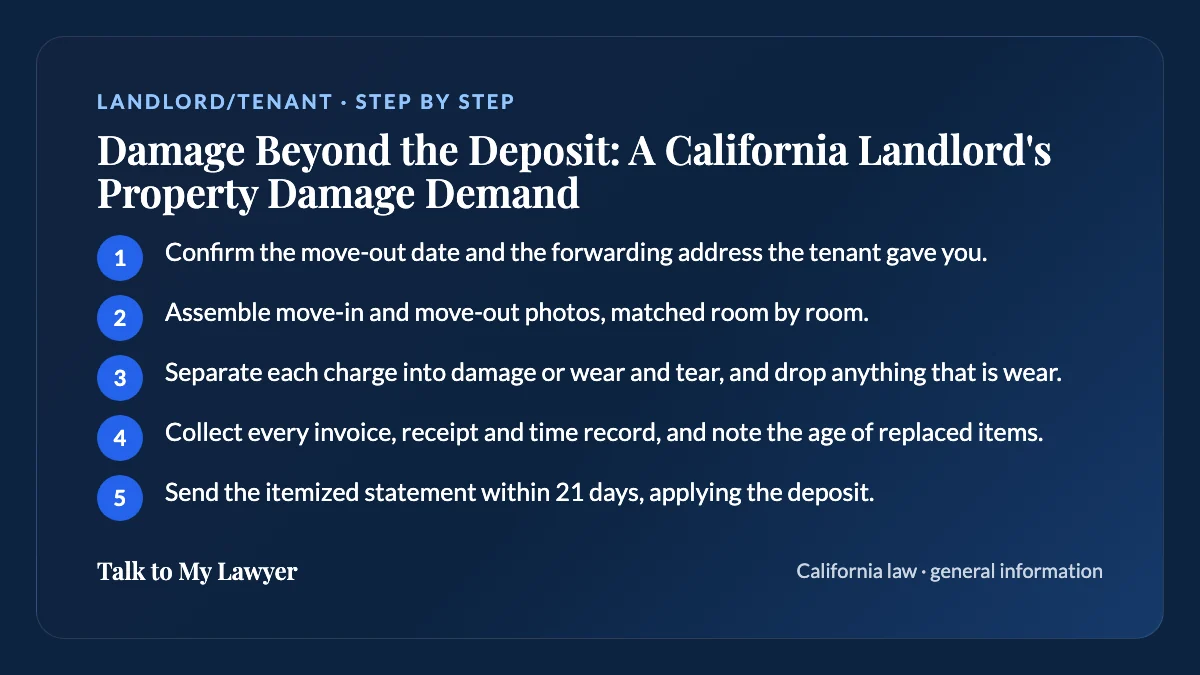
- Confirm the move-out date and the forwarding address the tenant gave you.
- Assemble move-in and move-out photos, matched room by room.
- Separate each charge into damage or wear and tear, and drop anything that is wear.
- Collect every invoice, receipt and time record, and note the age of replaced items.
- Send the itemized statement within 21 days, applying the deposit.
- Send the demand for the balance with a copy of the statement, a short list of charges and a payment deadline.
- Keep proof of mailing or email delivery for both documents.
As shown in the itemized statement sent to you on September 18 under Civil Code section 1950.5, the documented cost to repair damage beyond ordinary wear and tear at 905 Cedar Street, Unit B, is $2,500. After applying your $2,000 security deposit, $500 remains due. Copies of the invoices, receipts and before-and-after photographs are enclosed. Please pay $500 by October 20, or contact me before then if you would like to discuss a payment schedule.
If the tenant also left unpaid rent, both can go in one letter, and our guide to a landlord demand letter for unpaid rent covers that side.
What happens if the former tenant refuses to pay?
Small claims court is designed for balances like these. Individual landlords may sue there for up to $12,500 (Code of Civil Procedure section 116.221), while a landlord organized as an LLC or corporation is capped at $6,250 (section 116.220). A tenant may bring their own photos, and the judge can compare both sets against the move-in condition.
The California Courts self-help guide lists three years to sue for property damage and four years on a written agreement. For the tenant's perspective on the same charges, see our guide to disputing move-out charges, which shows what a well-prepared tenant will challenge.
When to have an attorney write the damage demand
A damage claim against a former tenant rises or falls on its paperwork, and some claims call for a lawyer's letter: when the repair bill is large, the tenant has already pushed back on the statement, you are unsure whether a charge counts as wear or damage, or the tenant's renters insurer may get involved.
When you use Talk to My Lawyer, a licensed California attorney writes your letter from the move-in and move-out photos, invoices and deposit statement, and sends it on your behalf. Before filing in court, get legal advice on which claims and amounts to include.
Frequently asked questions
Can a landlord charge a tenant more than the security deposit for damage?
Yes. The deposit is security, not a cap on what a tenant may owe. If documented damage beyond ordinary wear and tear exceeds the deposit, the landlord can ask for the balance and, if unpaid, sue for it. The landlord should still send the itemized statement within 21 days, applying the deposit, before demanding more.
Does a California landlord need photos to deduct for damage?
Yes, in most cases as of October 2026. Since April 1, 2025, landlords must photograph the unit after getting possession back, before repairs or cleaning, and again afterward. For tenancies starting on or after July 1, 2025, move-in photos are also required. Photos must accompany the itemized statement for repair and cleaning deductions, with an exception when those total $125 or less.
Can a landlord charge for their own labor to fix tenant damage?
Yes. If the landlord or an employee does the work, the itemized statement must reasonably describe the work and include the time spent and a reasonable hourly rate. Materials need a receipt or a vendor document showing the cost. The total must still be a reasonable amount to restore the unit to its move-in condition, not to upgrade it.
How long does a landlord have to sue a former tenant for damages in California?
The California Courts self-help guide lists three years from when property damage occurred, and four years for breach of a written agreement such as a lease. Which period applies can depend on how the claim is framed, so talk to a lawyer if the deadline is close. The 21-day deposit statement deadline is separate and much shorter.
Can I charge a tenant for professional carpet cleaning?
Only when reasonably necessary to return the unit to its move-in condition, excluding ordinary wear and tear. Civil Code section 1950.5 bars requiring a tenant to pay for professional carpet or other professional cleaning otherwise. Photos showing heavy stains or pet damage, compared with move-in photos, help show the cleaning was needed beyond normal use.
Sources
Checked against these official sources on October 18, 2026.
- California Civil Code section 1950.5 (California Legislative Information)
- AB 2801 Tenancy: security deposits (Chapter 280, Statutes of 2024) (California Legislative Information)
- California Code of Civil Procedure section 116.221 (California Legislative Information)
- California Code of Civil Procedure section 116.220 (California Legislative Information)
- Before you start a small claims case (California Courts Self-Help Guide)
This guide explains California law in general terms as of October 2026. It is general information, not legal advice for your situation, and local rules can add to it.
Join the email list and get a lawyer letter started
With Talk to My Lawyer, a licensed California attorney writes your letter from your facts and documents and sends it on your behalf. Join the Talk to My Lawyer email list for letter checklists, document prompts, and reminders before you start your letter.