Quick answer
A California landlord's demand letter for unpaid rent states the rent owed, credits the security deposit, and asks for the balance by a set date. If the tenant has moved out, first send the itemized deposit statement within 21 days (Civil Code section 1950.5). Interest generally runs at the lease rate, or 10 percent a year after breach if the lease is silent (Civil Code section 3289).
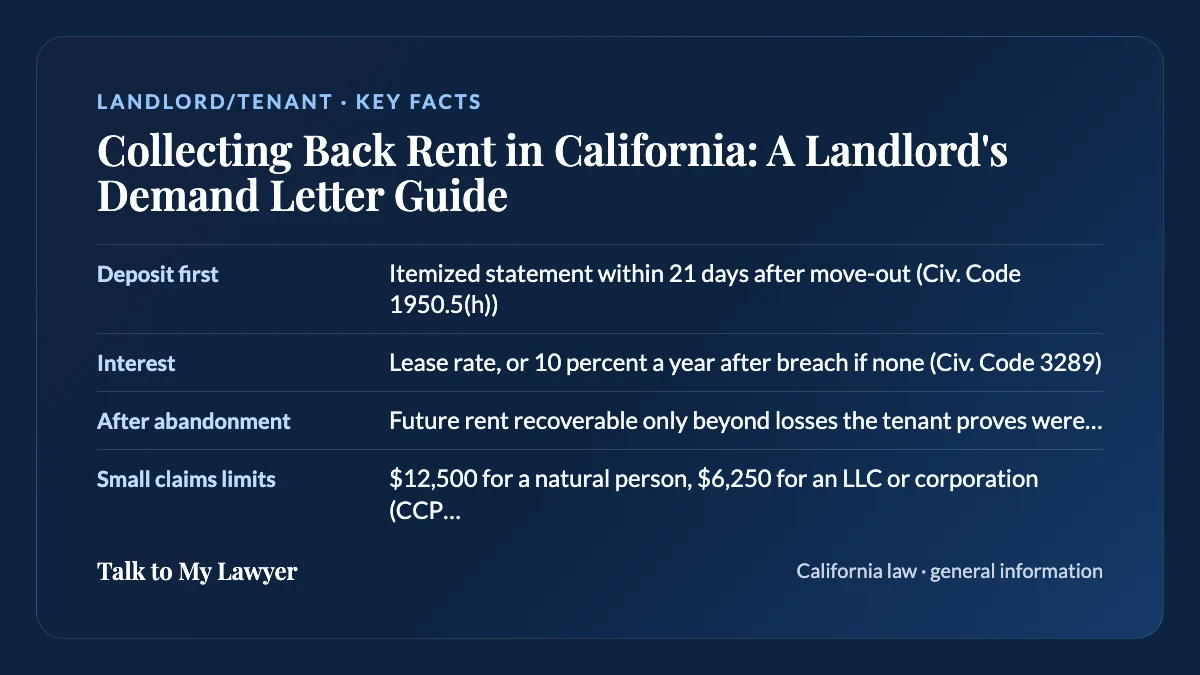
At a glance
- Deposit first
- Itemized statement within 21 days after move-out (Civ. Code 1950.5(h))
- Interest
- Lease rate, or 10 percent a year after breach if none (Civ. Code 3289)
- After abandonment
- Future rent recoverable only beyond losses the tenant proves were avoidable (Civ. Code 1951.2)
- Small claims limits
- $12,500 for a natural person, $6,250 for an LLC or corporation (CCP 116.220, 116.221)
- Time to sue
- Four years on a written lease (CCP 337)
Is a demand letter the same as a 3-day notice to pay rent or quit?
No. A three-day notice is a formal step toward eviction for a tenant who is still in possession. A demand letter is a request for money, most often sent to a tenant who has already left or to settle a balance without an eviction.
| Three-day notice (CCP 1161(2)) | Demand letter | |
|---|---|---|
| Purpose | Pay or give up possession; can lead to an unlawful detainer case | Collect money owed |
| Who gets it | A tenant still living in the unit | A current or former tenant |
| Required contents | Amount due, and the name, phone and address for payment, among other items | No statutory form; accuracy matters |
| Timing | Excludes weekends and court holidays; served within one year after rent is due | Any time before a lawsuit is filed |
If your tenant is still in the unit and you are weighing eviction, our guide to the three-day notice to pay rent or quit covers the strict requirements. A defective notice can derail an eviction case. Tenancies covered by the Tenant Protection Act or a local ordinance may have additional rules.
Should a landlord apply the security deposit to unpaid rent first?
Once the tenant has moved out, yes in practice, because the deposit statute already requires you to account for it. Civil Code section 1950.5 lets a landlord use the deposit to cover a default in rent, and requires an itemized statement and any remaining balance within 21 calendar days after the tenant vacates. Repair and cleaning deductions over $125 need receipts and photographs.
The amount still owed after that statement is what your demand letter seeks. Skipping the statement creates its own risk. Under section 1950.5(h)(7), a landlord who in bad faith does not comply loses the right to claim any part of the deposit, and section 1950.5(m) allows statutory damages of up to twice the deposit for bad-faith retention. A demand that ignores the deposit also invites a counterclaim.
What can a landlord demand from a tenant who left owing rent?
When a tenant breaches a lease and abandons the unit, Civil Code section 1951.2 lets the landlord recover:
- Unpaid rent earned up to the date the lease ended.
- Rent for the period after the lease ended, reduced by whatever amount the tenant proves could reasonably have been avoided, for example by re-renting.
- Other losses caused by the breach, such as reasonable advertising costs to find a new tenant, if you can document them.
- Interest at the rate in the lease, or the legal rate if the lease has none.
The "reasonably avoided" language matters. If you let the unit sit empty for six months without listing it, a tenant can argue much of that rent was avoidable. A record of listing dates, showings and the new lease start date supports your number.
For interest, Civil Code section 3289 provides that a contract entered after January 1, 1986 that does not state a rate bears 10 percent a year after a breach. Late fees should appear in the demand only if the lease provides for them; whether a particular fee is enforceable is a question to ask a lawyer. Our guide to interest and fees in a demand letter explains the math.
Do debt collection laws apply to a landlord collecting rent?
Possibly, and it is worth writing as if they do. The federal Fair Debt Collection Practices Act mainly covers third-party collectors; a creditor collecting its own debt in its own name is generally outside its definition of a debt collector, unless it uses a name suggesting a third party is collecting.
California's Rosenthal Fair Debt Collection Practices Act is broader. Its definition of "debt collector" includes any person who, in the ordinary course of business, regularly collects debts on its own behalf or for others (Civil Code section 1788.2). As of October 2026 the Act reaches "covered debts," which include "consumer debt" from a consumer credit transaction, meaning property, services or money acquired on credit primarily for personal, family or household purposes. Whether unpaid residential rent fits that definition is a legal question to raise with a lawyer, especially for landlords or managers who collect often.
The practical approach is the same either way: state accurate amounts, avoid threats, never suggest criminal consequences, and do not discuss the debt with third parties such as employers or relatives.
Example: building the number in a back-rent demand
Example (hypothetical): rent is $2,400 a month on a written one-year lease with no interest clause. The tenant pays nothing for February and March, then leaves on March 31. The deposit is $2,400. After move-out, the landlord documents $350 in cleaning with a receipt and photos.
| Item | Amount |
|---|---|
| Unpaid rent, February and March | $4,800 |
| Cleaning, documented | $350 |
| Total charges | $5,150 |
| Less deposit applied (itemized statement sent April 15) | -$2,400 |
| Balance demanded | $2,750, plus 10 percent a year interest from the dates each amount fell due |
If the unit was re-rented on May 1 after prompt listing, the landlord might also claim April's lost rent. A lawyer can help assess whether that piece is worth including.
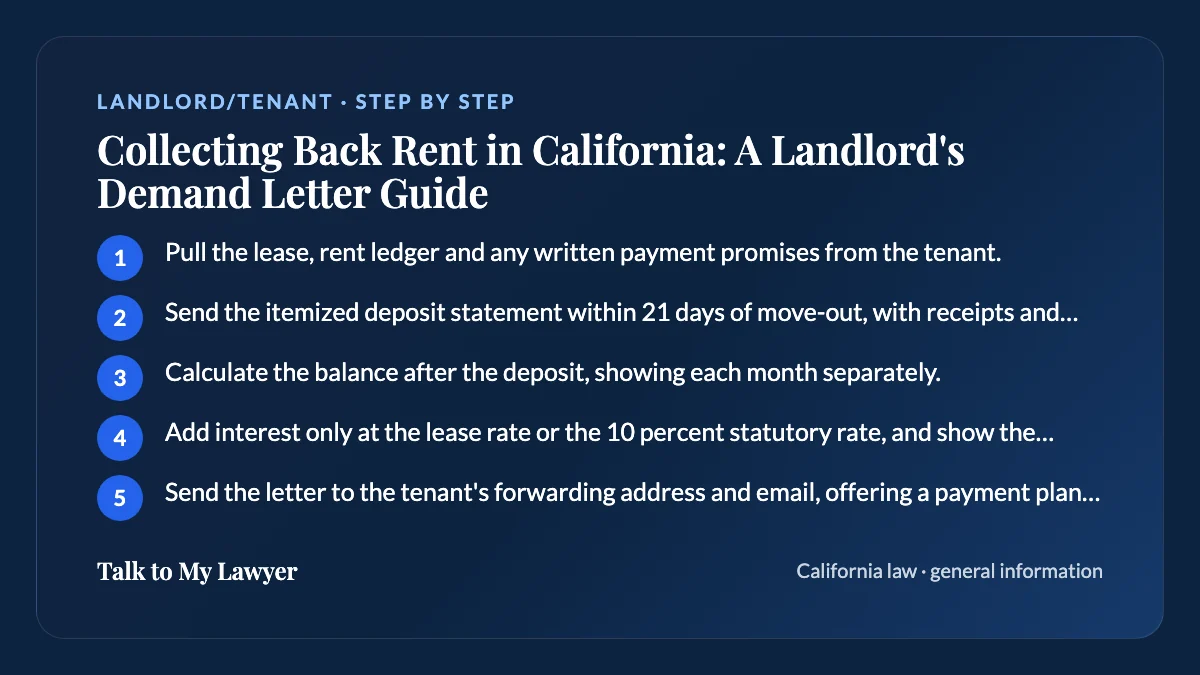
Steps for writing a landlord's demand letter for unpaid rent
- Pull the lease, rent ledger and any written payment promises from the tenant.
- Send the itemized deposit statement within 21 days of move-out, with receipts and photos for any repair or cleaning charges.
- Calculate the balance after the deposit, showing each month separately.
- Add interest only at the lease rate or the 10 percent statutory rate, and show the calculation.
- Send the letter to the tenant's forwarding address and email, offering a payment plan if you are open to one.
- Give a firm, reasonable deadline, such as 14 days.
- Keep a copy and proof of delivery for court.
Under our lease for 18 Willow Court, rent of $2,400 was due on February 1 and March 1, and neither payment was received before you vacated on March 31. On April 15, I sent the itemized statement required by Civil Code section 1950.5 applying your $2,400 deposit. The remaining balance is $2,750. Please pay this amount by May 15, or contact me by that date to propose a written payment schedule.
What happens if the former tenant does not pay?
Small claims court can hear a back-rent claim within its limits. The ceiling is $12,500 for a landlord who is a natural person (Code of Civil Procedure section 116.221) and $6,250 for an LLC or corporation (section 116.220). Section 116.231 caps any filer at two small claims cases per calendar year statewide that demand more than $2,500, which matters if you manage several units.
A claim on a written lease must generally be filed within four years (Code of Civil Procedure section 337); for an oral agreement the California Courts self-help guide lists two years. The court expects you to ask for payment before filing, which your letter does. For filing steps, see our guide to sending a demand letter before small claims.
Having an attorney write the rent demand
Back-rent claims get harder to handle alone when the balance is above the small claims limit, when you are claiming rent for months after move-out under section 1951.2, when the tenant has disputed the deposit accounting, or when you want the collection-law questions handled with care. Those are the cases where a letter from an attorney fits.
Talk to My Lawyer can take this on: a licensed California attorney writes your letter from your lease, rent ledger and deposit statement, and sends it on your behalf. If eviction or a lawsuit is on the table, speak with a lawyer about your specific situation first.
Frequently asked questions
Can a landlord sue a former tenant for unpaid rent in small claims court?
Yes. A landlord who is an individual can claim up to $12,500 in California small claims, and a landlord that is an LLC or corporation up to $6,250. You must ask for payment before filing, and you are limited to two claims over $2,500 per calendar year statewide. A copy of your demand letter helps show the court you asked first.
Can I charge interest on unpaid rent in California?
Generally yes. If the lease sets a lawful interest rate, that rate applies after a breach. If the lease is silent and was signed after January 1, 1986, Civil Code section 3289 sets 10 percent a year from the breach. Show the calculation in your demand so the tenant can follow it, and do not add charges the lease does not support.
Does a landlord have to re-rent the unit after a tenant breaks the lease?
Civil Code section 1951.2 does not force re-renting, but it limits recovery of rent after the lease ends to the amount exceeding what the tenant proves could have been reasonably avoided. Records of prompt listing, showings and the new lease start date are the evidence that answers a tenant's argument that the loss was avoidable.
What is the difference between a 3-day notice and a demand letter for rent?
A three-day notice under Code of Civil Procedure section 1161 is served on a tenant still in possession and is the first step toward eviction. It has strict content rules, including the amount due and payment details. A demand letter asks for money, usually from a former tenant, and has no required form. Sending a demand letter does not replace a valid three-day notice.
Can I report a former tenant's unpaid rent to collections?
You can refer or assign a debt to a collection agency, which then must follow state and federal collection laws. Before doing so, make sure the amount is accurate and the deposit accounting is complete. Talk to a lawyer about credit reporting and collection agency agreements, since errors can lead to disputes or claims against you.
Sources
Checked against these official sources on October 18, 2026.
- California Civil Code section 1950.5 (California Legislative Information)
- California Civil Code section 1951.2 (California Legislative Information)
- California Civil Code section 3289 (California Legislative Information)
- California Civil Code section 1788.2 (California Legislative Information)
- California Code of Civil Procedure section 1161 (California Legislative Information)
- Before you start a small claims case (California Courts Self-Help Guide)
This guide explains California law in general terms as of October 2026. It is general information, not legal advice for your situation, and local rules can add to it.
Join the email list and get a lawyer letter started
With Talk to My Lawyer, a licensed California attorney writes your letter from your facts and documents and sends it on your behalf. Join the Talk to My Lawyer email list for letter checklists, document prompts, and reminders before you start your letter.