Quick answer
A 3 day notice to pay rent or quit in California is a written demand under Code of Civil Procedure section 1161(2) to pay past-due rent within three days, not counting Saturdays, Sundays or court holidays, or move out. It must state the amount due and who to pay, with a name, phone number and address. It is not an eviction: only a court case can lead to removal.
At a glance
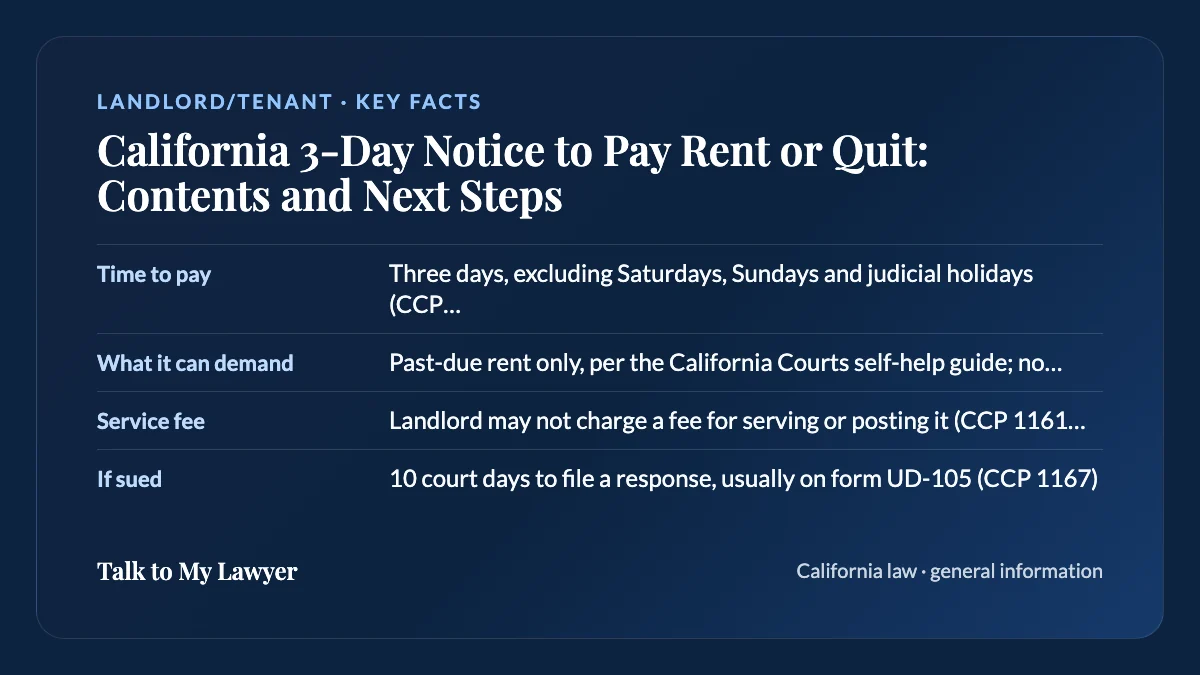
- Time to pay
- Three days, excluding Saturdays, Sundays and judicial holidays (CCP 1161(2))
- What it can demand
- Past-due rent only, per the California Courts self-help guide; no late fees
- Service fee
- Landlord may not charge a fee for serving or posting it (CCP 1161, operative Feb. 1, 2025)
- If sued
- 10 court days to file a response, usually on form UD-105 (CCP 1167)
- Blocked by
- Unfixed cited housing violations after 35 days (Civil Code 1942.4)
What is a 3-day notice to pay rent or quit in California?
It is the written notice a landlord must serve before filing an eviction case for unpaid rent. Code of Civil Procedure section 1161(2) says a tenant who stays after defaulting on rent, and after being served with a proper three-day notice to pay or give up possession, is in "unlawful detainer," the legal name for an eviction case.
The notice does not end your tenancy by itself and does not let anyone change the locks. It starts a short window. If the rent is paid within that window, the landlord has no basis for an eviction on that rent. If it is not, the landlord can file in court.
Under the Tenant Protection Act (Civil Code section 1946.2), unpaid rent is an "at-fault" just cause, so no relocation payment is owed. Some cities have their own eviction ordinances with added requirements, so check local rules as well.
What must a California 3-day notice include?
Section 1161(2) and the California Courts self-help guide set the contents. Check your notice against this list:
- It is in writing.
- It names the tenants and the rental address.
- It states the exact amount of rent that is due.
- It gives the name, telephone number and address of the person to pay.
- If you can pay in person, it lists the usual days and hours that person is available. Alternatively it can give a bank account at an institution within five miles of the rental, or an electronic payment method already set up between you.
- It says you must pay within three days or give up possession.
The self-help guide says this type of notice can only include past-due rent, and lists late fees, bounced-check fees and utilities as things it cannot include. It also says the notice is not valid if it asks for more than you owe. The notice can be served any time within one year after the rent became due.
Does a 3-day notice include weekends?
No. The statute excludes Saturdays, Sundays and other judicial holidays from the three days. The self-help guide says day one is the day after you receive the notice.
Example (hypothetical): a notice is handed to a tenant on a Thursday. Friday is day one. Saturday and Sunday do not count, so Monday is day two and Tuesday is day three. If that Monday were a court holiday, day three would move to Wednesday. The California Courts website publishes the list of court holidays.
How can a landlord serve the notice?
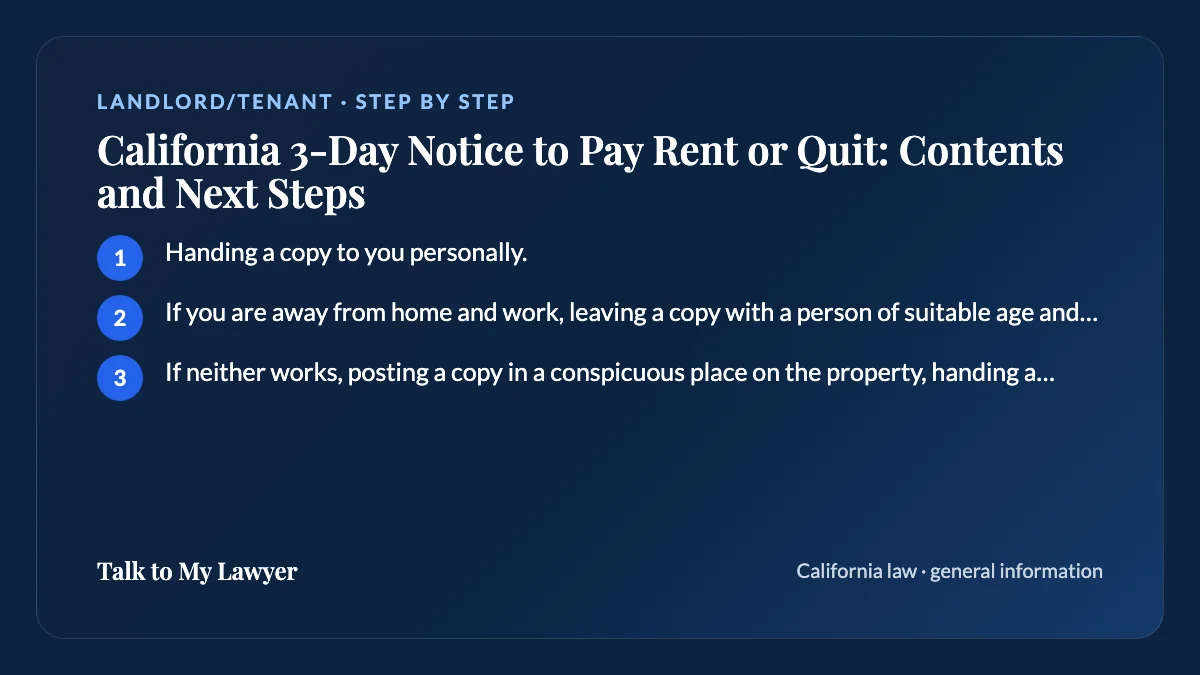
Code of Civil Procedure section 1162 allows three methods for a residential tenant, in this order:
- Handing a copy to you personally.
- If you are away from home and work, leaving a copy with a person of suitable age and discretion at either place, and also mailing a copy to your home.
- If neither works, posting a copy in a conspicuous place on the property, handing a copy to someone living there if anyone can be found, and also mailing a copy to the rental address.
Since February 1, 2025, section 1161 also says a landlord or agent may not charge a tenant a fee for serving, posting or otherwise delivering the notice. Write down exactly how and when the notice reached you, and keep the envelope if one was mailed.
What are your options after receiving a 3-day notice?
The self-help guide lists the choices plainly: pay, move out, talk to your landlord, or do nothing, and says each has risks. A short comparison:
| Option | How it works | Keep in mind |
|---|---|---|
| Pay the amount | Pay by the method and to the person named in the notice, within the three days | Use a traceable method and keep proof; ask for a receipt |
| Dispute the amount | Write to the landlord showing payments made or charges that are not rent | A notice that demands more than is owed is not valid, per the self-help guide |
| Raise a repair citation | Civil Code 1942.4 bars the notice if a housing official cited the unit and the conditions stayed unfixed 35 days without good cause | The tenant must not have caused the conditions |
| Talk or mediate | The self-help guide suggests a mediator if you partly agree | Put any payment plan in writing |
| Do nothing | The landlord can file an eviction case after the notice period | Court deadlines then apply |
What happens if the landlord files an eviction case?
You will be served with a summons and complaint. Since January 1, 2025, Code of Civil Procedure section 1167 gives a tenant 10 days, excluding Saturdays, Sundays and judicial holidays, to file a response after the complaint is served. That change came from AB 2347, which extended the period from five days, so older guides may be out of date.
- The usual response is an Answer on form UD-105, according to the self-help guide.
- If the papers were left with someone else or posted and mailed, the guide says the time is 10 calendar days plus 10 court days after mailing.
- Each person filing pays a fee, listed by the guide as $240 to $450, unless the court grants a fee waiver.
- If you do not respond, the judge can decide the case without you.
If a case is filed, contact a legal aid office, a court self-help center or a lawyer while the response window is still open. This guide explains the notice; it is not eviction defense advice.
Writing back to your landlord after a pay-or-quit notice
A written reply creates a record of what you paid, what you dispute and when. Keep it to the facts, and keep proof that it arrived.
- List the date and method of service, and the amount the notice demands.
- State what you paid for the period, with dates and confirmation numbers.
- Identify any charge in the notice that is not rent, such as a late fee or utility bill.
- If you are paying, say how much, how and when, and ask for written confirmation.
- If a housing inspector has cited the unit, attach the notice and give its date.
- Keep copies of the notice, your reply and the proof of delivery.
On October 6 I received a three-day notice demanding $2,340 for October rent at 15 Bay Street, Apt. 2. My monthly rent is $2,200. The extra $140 appears to be late fees and a water charge, which are not rent. I paid $2,200 today by bank transfer to the account listed in the notice, confirmation number 48211. Please confirm in writing that October rent is paid in full.
If you think the notice followed a repair request or a complaint, our guide to landlord harassment and written responses covers retaliation and harassment rules. If the real dispute is the condition of the unit, see our guide to asking a California landlord for repairs in writing.
When an attorney-written letter to your landlord makes sense
A notice padded with late fees, a rent payment the landlord refused or credited to something else, a pay-or-quit notice that arrived a week after you reported a leak: these are the moments when a letter from an attorney can set the payment record straight before anything is filed.
Through Talk to My Lawyer, a licensed California attorney writes your letter from your notice, lease and payment records, and sends it on your behalf. If an eviction case has already been filed, talk to a lawyer or legal aid about your facts and your deadline.
Frequently asked questions
Can a 3-day notice to pay rent or quit include late fees?
No, according to the California Courts self-help guide, which says this notice can only include past-due rent and lists late fees, bounced-check fees and utilities as items it cannot include. The guide also says a notice that asks for more than what is owed is not valid. A landlord may still try to collect proper fees in other ways allowed by the lease and the law.
Is a 3-day notice the same as an eviction?
No. A notice is a demand, not a court order. A landlord who wants possession must file an unlawful detainer case and win it, and only then can a sheriff remove a tenant, as the California Courts self-help guide explains. Paying the full amount demanded within the notice period ends the basis for an eviction on that rent.
Can my landlord charge me for serving the notice?
No. As of February 1, 2025, Code of Civil Procedure section 1161 says a landlord or agent may not charge a tenant a fee for serving, posting or otherwise delivering a notice under that section. Civil Code section 1946.1 has the same rule for 30-day and 60-day termination notices. If a service fee appears on your ledger, ask in writing for it to be removed.
How long do I have to respond to an eviction lawsuit in California?
Since January 1, 2025, a tenant served with an unlawful detainer summons generally has 10 days, not counting Saturdays, Sundays or judicial holidays, to file a response (Code of Civil Procedure section 1167). Service by other methods can add time, as the self-help guide explains. The usual response is an Answer on form UD-105.
Does the notice period start the day it is posted on my door?
The self-help guide says day one is the day after you receive the notice. If the notice was posted, section 1162 also requires a copy to be mailed, and the method of service can affect the timing. Write down when and how you got the notice, keep any envelope, and ask a self-help center to help you count if the dates are unclear.
Sources
Checked against these official sources on October 18, 2026.
- California Code of Civil Procedure section 1161 (California Legislative Information)
- California Code of Civil Procedure section 1162 (California Legislative Information)
- California Code of Civil Procedure section 1167 (California Legislative Information)
- Types of eviction notices (California Courts Self-Help Guide)
- Respond to an eviction (California Courts Self-Help Guide)
- California Civil Code section 1942.4 (California Legislative Information)
This guide explains California law in general terms as of October 2026. It is general information, not legal advice for your situation, and local rules can add to it.
Join the email list and get a lawyer letter started
With Talk to My Lawyer, a licensed California attorney writes your letter from your facts and documents and sends it on your behalf. Join the Talk to My Lawyer email list for letter checklists, document prompts, and reminders before you start your letter.