Quick answer
How much notice for a rent increase in California depends on its size. Under Civil Code section 827, a landlord must give at least 30 days' written notice if the increase, combined with others in the past 12 months, is 10 percent or less, and at least 90 days if it is more. Notice must be handed to you or mailed, and mailing within California adds five days.
At a glance
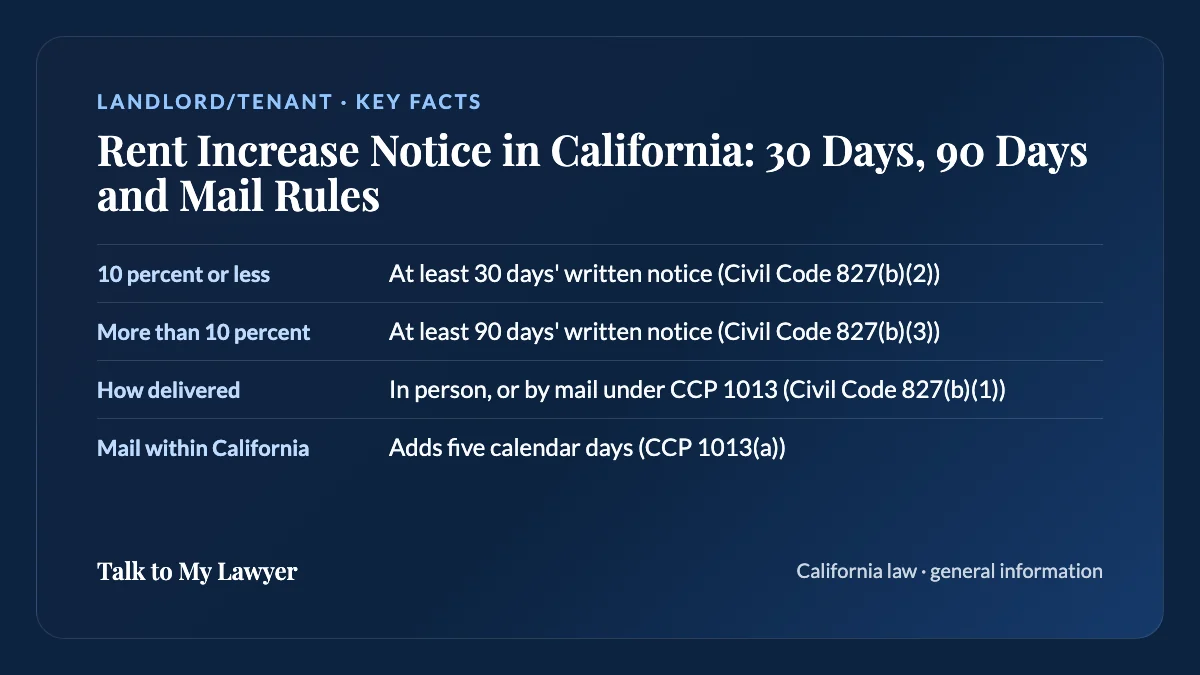
- 10 percent or less
- At least 30 days' written notice (Civil Code 827(b)(2))
- More than 10 percent
- At least 90 days' written notice (Civil Code 827(b)(3))
- How delivered
- In person, or by mail under CCP 1013 (Civil Code 827(b)(1))
- Mail within California
- Adds five calendar days (CCP 1013(a))
- Covers
- Week-to-week, month-to-month and other periods under a month
How much notice does a California landlord need to raise the rent?
At least 30 days for an increase of 10 percent or less, and at least 90 days for an increase of more than 10 percent (Civil Code section 827(b)). The rule applies to residential tenancies that run week to week, month to month or for another period shorter than a month.
The 10 percent test covers more than this one increase. Section 827 compares the new rent with the rental amount charged to you at any time during the 12 months before the effective date, counting this increase together with any others in that period. Two small increases in one year can push the total over the line.
One exception: when a rent increase comes from a required recertification of income or family size in subsidized housing, the 30-day period applies even if the change is larger (section 827(b)(3)(B)). And if another statute, regulation, regulatory agreement or contract calls for a longer notice period, the longer period controls (section 827(c)).
Example: when two increases add up
Example (hypothetical): a month-to-month tenant pays $2,000. The rent rises to $2,100 on February 1 with 30 days' notice. In June the landlord serves notice that rent will rise to $2,220 on August 1.
| Step | Figure | What it means |
|---|---|---|
| Rent charged in the prior 12 months | $2,000 | Section 827 measures against rent charged at any time in that period |
| New rent on August 1 | $2,220 | Includes both increases |
| Combined increase | $220, or 11 percent | More than 10 percent |
| Notice required | At least 90 days | A June notice for August 1 is too short |
There is a second problem. If the unit is covered by the statewide rent cap, an 11 percent increase over 12 months is above the 10 percent ceiling in Civil Code section 1947.12, so the amount itself is not allowed, whatever the notice. Our guide to checking the California rent cap math explains that calculation in detail.
How must a rent increase notice be delivered?
Section 827(b)(1) lists two methods for a residential rent increase: delivering a copy to you personally, or serving it by mail under Code of Civil Procedure section 1013. The section does not list text messages, emails or notes taped to the door.
Mail changes the count. Section 1013(a) says service by mail is complete when the notice is deposited in the mail, but any notice period is extended by five calendar days when the place of mailing and the address are both in California, and by 10 calendar days when either is elsewhere in the United States.
Does the notice rule apply if you have a one-year lease?
Section 827 is written for periodic tenancies, such as month to month. During a fixed-term lease, the rent is set by the lease itself, so whether and how rent can change mid-term depends on what the lease says.
When a fixed-term lease ends and the tenancy continues month to month, later increases follow section 827. The statewide cap in section 1947.12 applies to increases on covered units, and section 1947.12(e) says notice of any increase must follow section 827.
Situations with extra rules
- Rent cap. For covered units, increases over any 12 months are limited to 5 percent plus the regional change in the cost of living, or 10 percent, whichever is lower, and may be taken in no more than two increments (Civil Code section 1947.12). Housing with a certificate of occupancy issued within the past 15 years is exempt, as are some single-family homes and condos.
- Local rent control. Cities with rent stabilization ordinances can set their own limits and notice requirements. Check your city's rent board or housing department.
- Declared emergencies. After a state or local emergency declaration, Penal Code section 396(e) generally bars raising rent by more than 10 percent for 30 days, or longer if the declaration is extended, with limited exceptions.
- After a repair complaint. Civil Code section 1942.5 bars a retaliatory rent increase within 180 days of a good-faith habitability complaint if you are current on rent.
- Unrepaired code violations. Where an inspector has given the landlord written notice of substandard conditions and 35 days pass without abatement or good cause, Civil Code section 1942.4 prohibits a rent increase notice.
- Small commercial tenants. Since January 1, 2025, section 827 also gives notice rights to certain qualified commercial tenants, such as microenterprises.
What to do if your rent increase notice was too short
A notice that gives less time than section 827 requires does not meet the statute. A calm letter can point that out and ask the landlord to confirm a corrected effective date, while you keep paying rent on time.
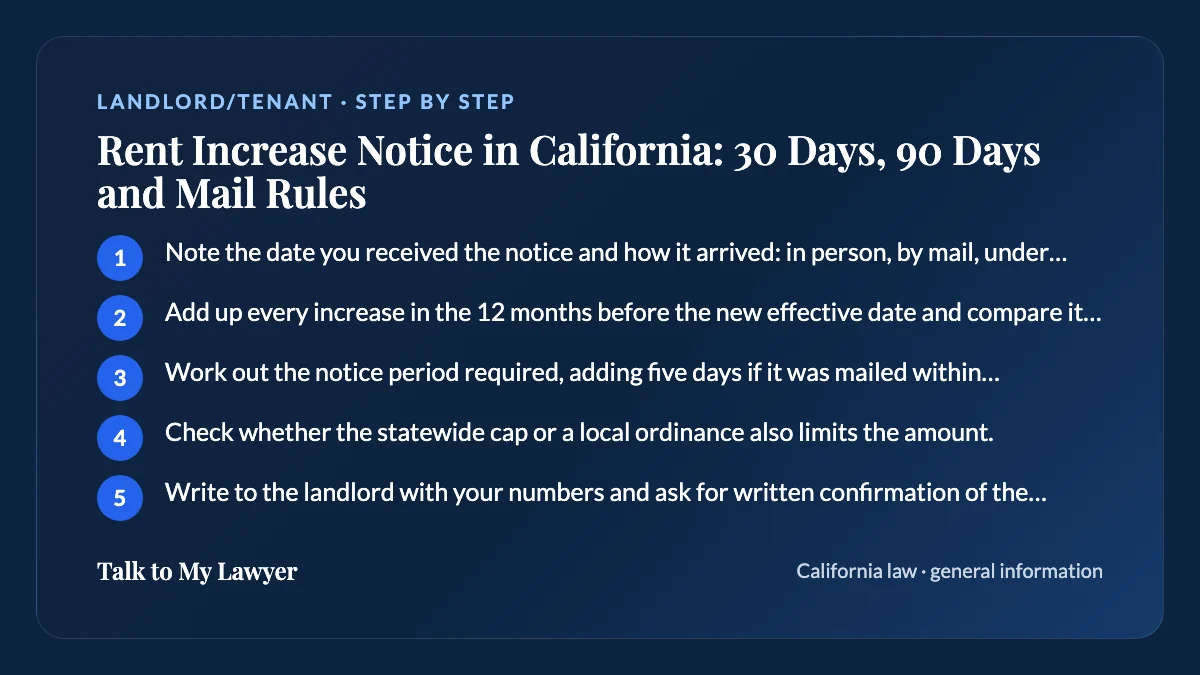
- Note the date you received the notice and how it arrived: in person, by mail, under the door or by text.
- Add up every increase in the 12 months before the new effective date and compare it with the lowest rent in that period.
- Work out the notice period required, adding five days if it was mailed within California.
- Check whether the statewide cap or a local ordinance also limits the amount.
- Write to the landlord with your numbers and ask for written confirmation of the corrected date or amount.
- Keep copies of the notice, the envelope and your letter, with proof of delivery.
On June 12 I received your notice, left under my door, raising my rent at 31 Cypress Way, Unit 6, from $2,100 to $2,220 effective August 1. My rent was $2,000 until February 1, so the combined increase over 12 months is $220, or 11 percent. Civil Code section 827(b)(3) requires at least 90 days' notice for an increase above 10 percent, served in person or by mail. Please confirm in writing the corrected effective date and amount. I will continue paying my current rent of $2,100 on time.
If the increase also followed a repair request, our guide to repair requests and the retaliation rules covers them in more depth.
When an attorney-written rent increase letter makes sense
A notice that came a few days short may be something your own short letter can raise. The picture changes when the increase may break the statewide cap or a city limit, when you have already paid months of an improper increase and want it back, when the increase landed soon after a repair complaint, or when the landlord refuses to correct the notice. Those are the cases where an attorney-written letter can set out the numbers and the rules.
Through Talk to My Lawyer, a licensed California attorney writes your letter from your notice, lease and rent history, explains how the notice periods and the rent cap bear on your increase, and sends it on your behalf. Local rent ordinances differ from city to city, and a lawyer can tell you how they apply to your unit.
Frequently asked questions
Can a landlord raise rent with 30 days' notice in California?
Yes, if the increase is 10 percent or less, counting all increases in the 12 months before it takes effect, and the tenancy is month to month or shorter. For anything above 10 percent, Civil Code section 827 requires at least 90 days. If the notice is mailed within California, five calendar days are added under Code of Civil Procedure section 1013.
Does a rent increase notice by text or email count in California?
Civil Code section 827(b)(1) lists two ways to give a residential rent increase notice: delivering a copy to the tenant personally or serving it by mail under Code of Civil Procedure section 1013. Text messages and emails are not among them. If you receive an increase only by text or email, you can ask the landlord in writing to serve it by one of the listed methods.
How many times a year can a landlord raise rent in California?
For units covered by the statewide rent cap in Civil Code section 1947.12, a landlord may not raise the rent in more than two increments over any 12-month period, and the total is limited to 5 percent plus the cost-of-living change, or 10 percent, whichever is lower. Exempt units and units under local rent control follow different rules.
Can my landlord raise the rent after I asked for repairs?
Not as retaliation. Under Civil Code section 1942.5, a landlord may not raise rent within 180 days after a tenant's good-faith repair notice or complaint to a housing agency, if the tenant is current on rent. An increase with a genuine lawful basis, stated in good faith in the notice, is still allowed. Keep dated copies of your repair requests.
Can rent go up during a state of emergency in California?
Penal Code section 396(e) generally makes it unlawful to raise rent for housing by more than 10 percent for 30 days after a state or local emergency is declared, or for any extension of the declaration. The statute allows a larger increase only if the landlord can prove it is directly attributable to repairs or additions beyond normal maintenance, or that the tenant agreed to it in a contract before the declaration. Violations are a misdemeanor.
Sources
Checked against these official sources on October 18, 2026.
- California Civil Code section 827 (California Legislative Information)
- California Code of Civil Procedure section 1013 (California Legislative Information)
- California Civil Code section 1947.12 (California Legislative Information)
- California Penal Code section 396 (California Legislative Information)
- California Civil Code section 1942.5 (California Legislative Information)
- California Civil Code section 1942.4 (California Legislative Information)
This guide explains California law in general terms as of October 2026. It is general information, not legal advice for your situation, and local rules can add to it.
Join the email list and get a lawyer letter started
With Talk to My Lawyer, a licensed California attorney writes your letter from your facts and documents and sends it on your behalf. Join the Talk to My Lawyer email list for letter checklists, document prompts, and reminders before you start your letter.