Quick answer
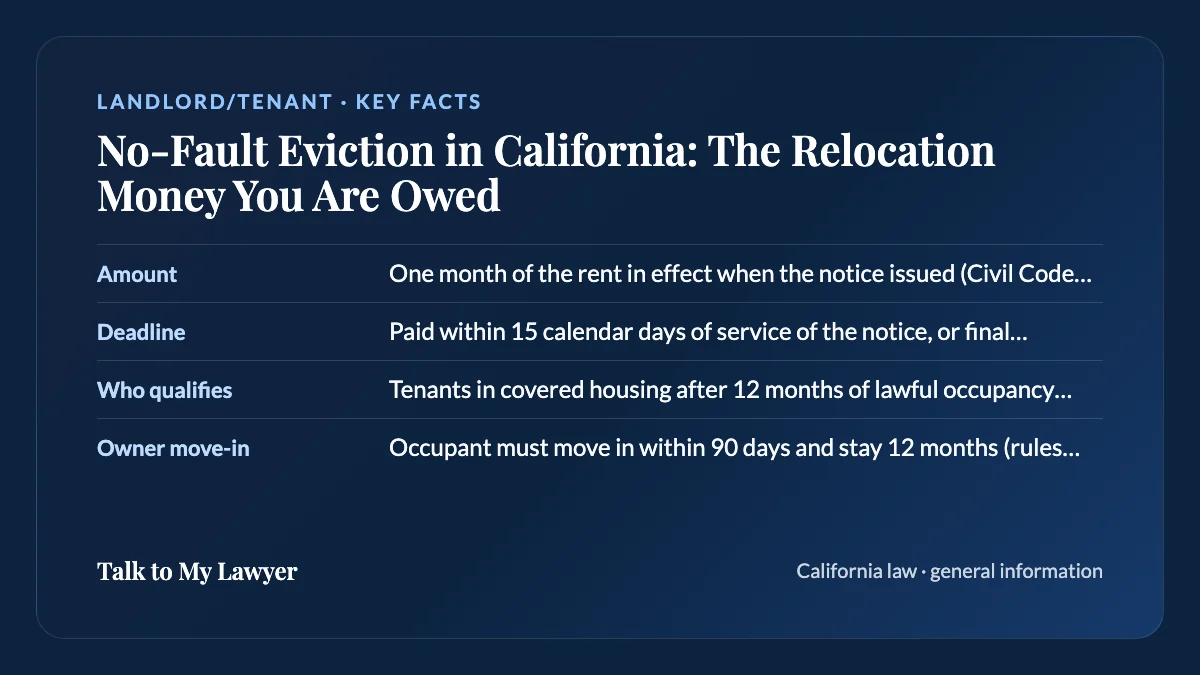
Under California's Tenant Protection Act, a landlord who ends a covered tenancy through a no-fault eviction, such as an owner move-in or a substantial remodel, must either pay relocation assistance equal to one month's rent within 15 calendar days of serving the notice or waive the final month's rent in writing (Civil Code section 1946.2(d)). Failing to strictly comply makes the notice void.
At a glance
- Amount
- One month of the rent in effect when the notice issued (Civil Code 1946.2(d)(3))
- Deadline
- Paid within 15 calendar days of service of the notice, or final month waived in writing
- Who qualifies
- Tenants in covered housing after 12 months of lawful occupancy, regardless of income
- Owner move-in
- Occupant must move in within 90 days and stay 12 months (rules operative April 1, 2024)
- Penalty
- Notice void; actual damages, and up to three times damages for willful violations (1946.2(h))
Do California landlords have to pay relocation assistance for a no-fault eviction?
Yes, for tenancies covered by the Tenant Protection Act. Civil Code section 1946.2(d) says that when an owner ends a covered tenancy for a no-fault just cause, the owner must, regardless of the tenant's income, choose one of two options:
- Pay the tenant directly an amount equal to one month of the rent in effect when the notice was issued, within 15 calendar days of serving the notice.
- Waive in writing the rent for the final month of the tenancy, before that rent comes due.
The termination notice itself must tell you about your right to relocation assistance or a rent waiver. If the owner picks the waiver, the notice must state the amount waived and that no rent is due for the final month. Section 1946.2(d)(4) adds that an owner's failure to strictly comply with these rules makes the notice void.
Which tenancies are covered?
The protections start once a tenant has continuously and lawfully occupied the unit for 12 months. If adult tenants were added before the original tenant reached 24 months, either all tenants need 12 months or at least one needs 24.
Section 1946.2(e) exempts several kinds of housing, including:
- Housing issued a certificate of occupancy within the previous 15 years (mobilehomes excepted).
- Rooms where the tenant shares a bathroom or kitchen with an owner who lives there.
- An owner-occupied duplex where the owner lived in one unit from the start of the tenancy.
- A unit that can be sold separately, such as a single-family home or condo, if the owner is not a corporation, a REIT or an LLC with a corporate member, and the tenant received the exact exemption notice the statute requires.
- Deed-restricted affordable housing and certain dormitories.
If your city has its own just-cause ordinance that meets the statute's conditions, the local ordinance applies instead (section 1946.2(i)). That can change both the reasons allowed and the amount owed.
What counts as a no-fault reason?
Section 1946.2(b)(2) lists four no-fault grounds. Each must be stated in the written notice.
| No-fault reason | Key conditions in the statute |
|---|---|
| Owner or family move-in | Owner, spouse, domestic partner, children, grandchildren, parents or grandparents, as a primary residence for at least 12 months |
| Withdrawal from the rental market | The property is taken off the rental market |
| Government or court order | An order or local ordinance requires the unit to be vacated; no relocation if the tenant caused the condition |
| Demolition or substantial remodel | Permitted work on structural, electrical, plumbing or mechanical systems, or hazardous-material abatement such as mold or asbestos, that requires vacating for at least 30 consecutive days |
Painting, decorating and minor repairs do not qualify as a substantial remodel. A remodel notice must describe the work and how long it should take, attach a copy of the required permits (or, for permit-free hazardous-material abatement, the signed contractor agreement), and tell you that you can re-rent the unit on the same terms if the work is not started or completed.
Owner move-in rules since April 2024
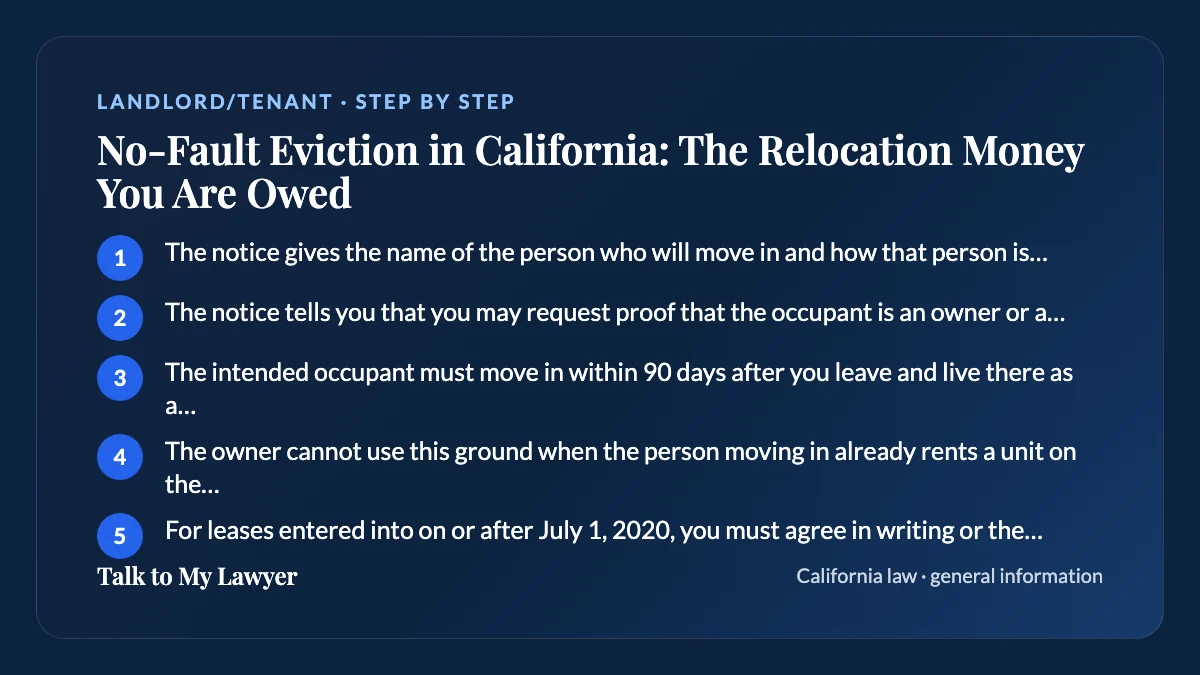
SB 567 tightened owner move-in evictions, and the current version of section 1946.2 has been operative since April 1, 2024. As of October 2026, an owner move-in notice must meet these conditions:
- The notice gives the name of the person who will move in and how that person is related to the owner.
- The notice tells you that you may request proof that the occupant is an owner or a qualifying relative, and the owner must provide it on request.
- The intended occupant must move in within 90 days after you leave and live there as a primary residence for at least 12 consecutive months.
- The owner cannot use this ground when the person moving in already rents a unit on the property, or when a comparable unit on the property is sitting empty.
- For leases entered into on or after July 1, 2020, you must agree in writing or the lease must allow termination for owner move-in.
If the occupant does not move in within 90 days or does not stay 12 months, the owner must offer you the unit back at the same rent and terms and reimburse reasonable moving expenses beyond any relocation already paid. An "owner" for this purpose is generally a natural person with at least a 25 percent recorded ownership interest, with separate rules for property held entirely within one family, family trusts, and interests held through an LLC or partnership.
Example: counting the 15 days and the notice period
Example (hypothetical): a tenant has rented a 1970s fourplex unit for three years at $2,600 a month. On March 3 the owner personally serves a 60-day notice for an owner move-in. The notice names the owner's daughter as the intended occupant.
| Item | What the statute requires | In this example |
|---|---|---|
| Notice period | 60 days for a tenant of a year or more (Civil Code 1946.1) | Tenancy ends no earlier than May 2 |
| Relocation payment | One month's rent within 15 calendar days of service | $2,600 by March 18 |
| Or rent waiver | Final month's rent waived in writing, stated in the notice | Notice says $2,600 waived and no rent due for the final month |
| Proof of owner | Provided on request | Tenant may ask for the deed or other proof |
If March 18 passes with no payment and the notice offered no waiver, the tenant can point to section 1946.2(d)(4), which makes a notice void when the owner fails to strictly comply.
Can a city require more relocation money?
Yes. Section 1946.2(i) lets more protective local ordinances apply, including ones with higher relocation amounts. Any state payment is credited against relocation required by another law, so you do not collect both in full (section 1946.2(d)(3)(C)).
Los Angeles is one example. The Los Angeles Housing Department says units under its Rent Stabilization Ordinance owe relocation for no-fault evictions, that the amount depends on whether the tenant is "eligible" or "qualified" (for example, age 62 or older, disabled, or with minor children), length of tenancy and income, and that payment must be made available within 15 days of service of the notice. LAHD publishes current amounts in its Relocation Assistance Bulletin, and other cities set their own figures. Check your city housing department before you write.
How to demand unpaid relocation assistance
If the 15 days have passed with no payment and no written waiver, a short letter puts the gap on record while you decide on next steps with a lawyer.
- Quote the date and method of service and the no-fault reason stated.
- State your monthly rent and how long you have lived there.
- Cite Civil Code section 1946.2(d) and the 15-day deadline, plus any local ordinance.
- State the amount owed and how you want it paid.
- For an owner move-in, request proof of the intended occupant's ownership or relationship.
- Set a reply date and keep proof of delivery.
On March 3 you served me a 60-day notice terminating my tenancy at 412 Grove Avenue, Unit B, for owner move-in. I have lived here since 2023 at a monthly rent of $2,600. Civil Code section 1946.2(d) required relocation assistance of $2,600 within 15 calendar days of service, or a written waiver of the final month's rent. I have received neither. Please also provide proof that the intended occupant is an owner or a qualifying relative, as the notice states I may request.
Under section 1946.2(h), an owner who tries to recover possession in material violation of the statute can owe actual damages, attorney's fees in the court's discretion, and up to three times actual damages for willful or malicious conduct. If the notice comes with pressure to leave early, see our guide to landlord harassment in California. If the building is being sold, see tenant rights when a building is sold.
When an attorney-written relocation letter makes sense
Day 16 arrives with no payment and no written waiver. The notice never mentions relocation at all. The relative named for the owner move-in already lives elsewhere on the property, or your city's ordinance may set a higher figure than one month's rent. Each of these is a reason to have an attorney make the written demand.
Through Talk to My Lawyer, a licensed California attorney writes your letter from your notice, lease and rent records, cites section 1946.2 and any city ordinance covering your unit, and sends it on your behalf. Whether a defective notice changes your move-out date depends on your facts, so get advice from a lawyer before you rely on it.
Frequently asked questions
How much relocation assistance does a California landlord have to pay?
Under the Tenant Protection Act, one month of the tenant's rent that was in effect when the owner issued the termination notice. The owner can instead waive the final month's rent in writing before it comes due. Cities with more protective just-cause ordinances, such as Los Angeles for rent-stabilized units, can require larger amounts, and the state payment is credited against those.
Do I have to be low income to get relocation assistance?
No. Civil Code section 1946.2(d)(1) says the owner must provide relocation assistance or a rent waiver regardless of the tenant's income. Income can matter under some city ordinances, which may set higher amounts for lower-income tenants, but the state minimum applies to every covered tenant who receives a no-fault termination notice after 12 months of lawful occupancy.
What happens if the owner never moves in after an owner move-in eviction?
If the intended occupant does not move in within 90 days after you leave, or does not live there as a primary residence for 12 consecutive months, section 1946.2 requires the owner to offer you the unit back at the same rent and lease terms and to reimburse reasonable moving expenses beyond any relocation already paid. Other remedies may apply for a material violation.
Is relocation assistance owed if I have lived there less than a year?
Not under the state statute. The just-cause and relocation rules in section 1946.2 apply after the tenant has continuously and lawfully occupied the unit for 12 months, with special rules when tenants are added. A local ordinance may cover shorter tenancies, so check your city's rules. The landlord still has to give proper written notice to end the tenancy.
Can a landlord evict for remodeling without paying relocation?
Not for a covered tenancy. A substantial remodel is a no-fault reason, so the relocation or rent-waiver rule applies. The work must involve permitted structural, electrical, plumbing or mechanical changes, or hazardous-material abatement, and require you to be out for at least 30 consecutive days. Cosmetic work such as painting does not qualify.
Sources
Checked against these official sources on October 18, 2026.
- California Civil Code section 1946.2 (California Legislative Information)
- California Civil Code section 1946.1 (California Legislative Information)
- Relocation Assistance Information (Los Angeles Housing Department)
- Types of eviction notices (California Courts Self-Help Guide)
This guide explains California law in general terms as of October 2026. It is general information, not legal advice for your situation, and local rules can add to it.
Join the email list and get a lawyer letter started
With Talk to My Lawyer, a licensed California attorney writes your letter from your facts and documents and sends it on your behalf. Join the Talk to My Lawyer email list for letter checklists, document prompts, and reminders before you start your letter.