Quick answer
Tenant rights when a house or building is sold in California start with your lease: it generally continues, and the new owner steps into the landlord's role. The seller must transfer your security deposit to the buyer and notify you, or refund it with an accounting (Civil Code section 1950.5(i)). A sale alone gives no just cause to evict under the Tenant Protection Act, and showings need notice.
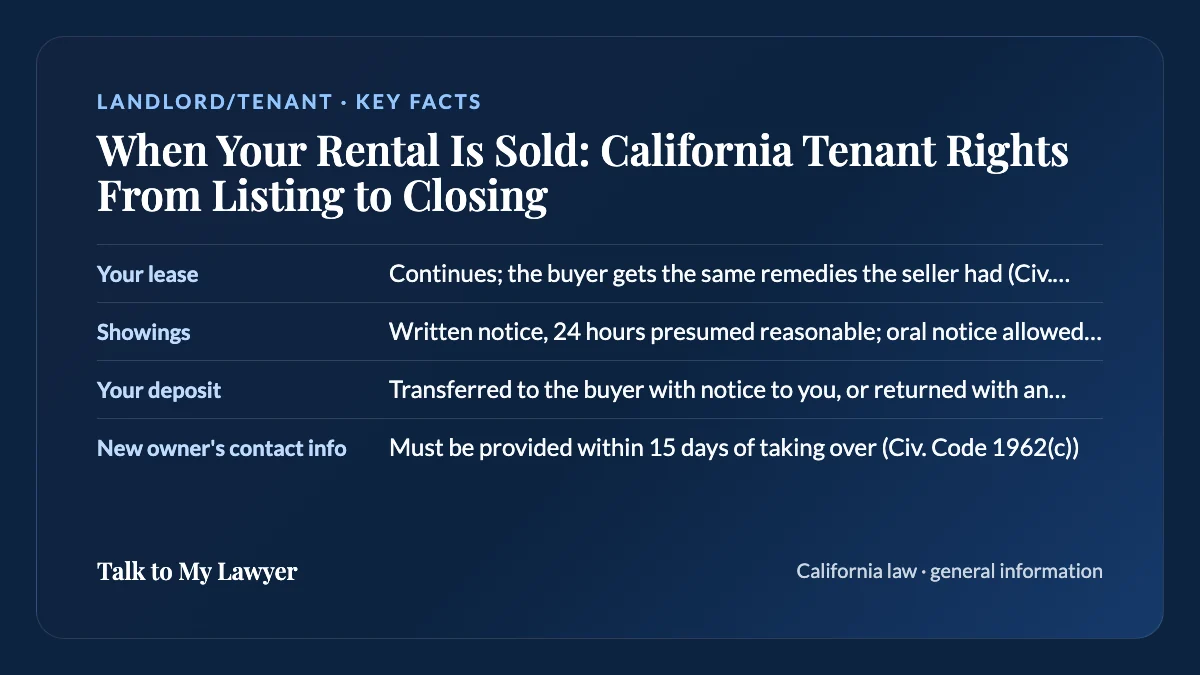
At a glance
- Your lease
- Continues; the buyer gets the same remedies the seller had (Civ. Code 821)
- Showings
- Written notice, 24 hours presumed reasonable; oral notice allowed after a written for-sale notice (Civ. Code 1954)
- Your deposit
- Transferred to the buyer with notice to you, or returned with an accounting (Civ. Code 1950.5(i))
- New owner's contact info
- Must be provided within 15 days of taking over (Civ. Code 1962(c))
- Owner move-in
- Limited by the Tenant Protection Act; one month's rent in relocation help (Civ. Code 1946.2)
Does a sale end your lease in California?
No. A sale changes who your landlord is, not the terms you rent under. The buyer generally takes the property subject to your existing lease or rental agreement, including your rent and lease end date, and California law gives the buyer the same remedies for rent and lease violations that the seller had (Civil Code section 821).
Three statutes protect you during the handover:
- Rent paid before you knew. If you paid rent to the old owner before you were told about the sale, you cannot be made to suffer for it (Civil Code section 1111).
- Contact details. A successor owner or manager must give you the name, phone number and address for notices and rent payments within 15 days of taking over (Civil Code section 1962(c)).
- No eviction over that gap. A successor who has not complied with section 1962 cannot serve a three-day notice or evict you for nonpayment of rent that accrued during the period of noncompliance. You still owe the rent itself.
Rent increase limits that applied before the sale still apply after it. Our guide to rent increase notice rules in California covers caps and notice periods.
How much notice does a landlord need to show your unit to buyers?
Civil Code section 1954 lets a landlord enter to show the unit to prospective or actual purchasers, but only during normal business hours and with reasonable written notice stating the date, approximate time and purpose. Twenty-four hours is presumed reasonable; notice sent by mail is presumed reasonable if mailed at least six days ahead.
Once the landlord or agent has told you in writing that the property is for sale and that you may be contacted orally about showings, notice of a showing may be given orally, in person or by phone, for 120 days after that written notice. Each oral notice still needs the date, time and purpose, 24 hours is still the presumed minimum, and the landlord or agent must leave written evidence of the entry inside the unit.
The landlord may not abuse the right of entry or use it to harass you. If showings have become a weekly disruption, our guide to a tenant privacy and entry demand letter explains how to put limits in writing.
What happens to your security deposit when the building is sold?
The seller has to do one of two things within a reasonable time after the sale (Civil Code section 1950.5(i)):
| Seller's option | What the law requires |
|---|---|
| Transfer to the buyer | Transfer the deposit, less any lawful deductions, then notify you by personal delivery or first-class mail of the transfer, any claims against the deposit, the amount deposited, and the new owners' names, addresses and phone numbers |
| Refund to you | Return the deposit, less lawful deductions, with an itemized accounting like the one owed at move-out |
Before a voluntary sale closes, the seller must also give the buyer a written statement of the deposit remaining, any deductions, and which option the seller chose (section 1950.5(j)).
If the seller skips this step, the buyer can be jointly and severally liable with the seller for returning your deposit when you move out (section 1950.5(k)). In plain terms, you can look to either of them. A buyer who did not receive your deposit also cannot demand a new one from you unless it first refunds or accounts for the original. There is a limited exception for a buyer who, after reasonable investigation, believed in good faith that the deposit had been transferred or returned.
Can the new owner make you move out?
Buying the building is not, on its own, a reason to end your tenancy. Under the Tenant Protection Act, once a tenant has lawfully occupied a covered unit for 12 months, the owner needs just cause stated in a written notice to end the tenancy (Civil Code section 1946.2). A change of ownership is not on the list.
Owner move-in is a no-fault just cause, but with conditions as of October 2026:
- For leases entered on or after July 1, 2020, it applies only if you agree in writing or your lease allows the owner to end it for an owner or family move-in.
- The notice must name the intended occupant and their relationship to the owner, and tell you that you can request proof.
- The new occupant has 90 days after you leave to move in, and must then stay for at least 12 consecutive months as a primary residence. If that does not happen, the owner must offer you the unit back on the same rent and lease terms and reimburse reasonable moving costs beyond any relocation payment.
- Relocation help equals one month of your rent: a direct payment within 15 calendar days of service of the notice or, at the owner's option, a written waiver of the last month's rent before it comes due.
Owner move-in cannot be used when the person moving in already occupies a rental unit at the property, or when a comparable unit there is already vacant. Some properties are exempt from the act, including many single-family homes and condos whose owner is not a corporation, a real estate investment trust or an LLC with a corporate member, where tenants have received the required written exemption notice, and housing with a certificate of occupancy issued within the last 15 years. Many cities have their own just cause ordinances that can be stronger, so local rules may differ. When a separately sellable home or condo is sold to a buyer who intends to live there, section 1946.1(d) can shorten the notice owed to a month-to-month tenant from 60 days to 30 if its conditions are met; just cause rules still apply wherever the Tenant Protection Act or a local ordinance covers the unit. A fixed-term lease generally runs to its end date.
Checklist: records to pull together when your building changes hands
- Your lease or rental agreement and any renewals or addenda.
- Proof of your deposit amount: lease clause, receipt or bank record.
- Rent receipts for the last few months, especially any paid around the sale date.
- Any written notice that the property was for sale, and all showing notices.
- The seller's deposit transfer notice, if you got one.
- The new owner's contact notice, and the date it arrived.
- Move-in photos or inspection checklists.
How to confirm your deposit and lease terms with the new owner
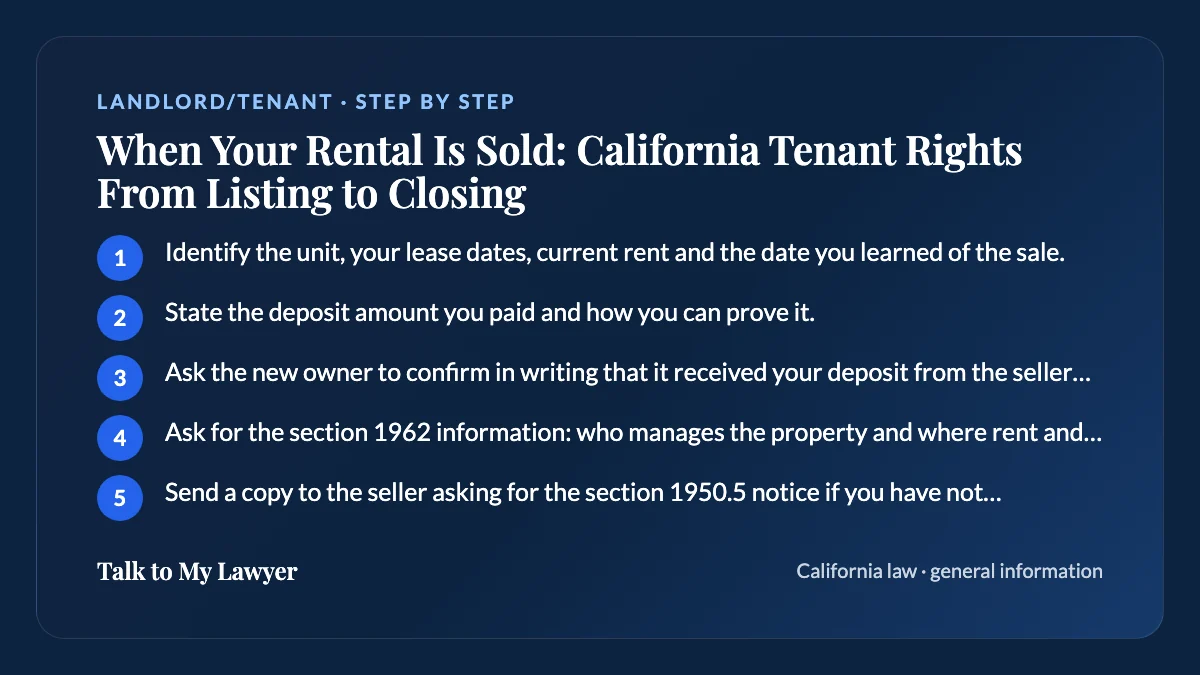
A short letter soon after the sale creates a record while everyone's memory is fresh.
- Identify the unit, your lease dates, current rent and the date you learned of the sale.
- State the deposit amount you paid and how you can prove it.
- Ask the new owner to confirm in writing that it received your deposit from the seller, and the amount.
- Ask for the section 1962 information: who manages the property and where rent and notices go.
- Send a copy to the seller asking for the section 1950.5(i) notice if you have not received it.
- Keep proof of delivery for both letters.
I rent Unit 4 at 220 Laurel Avenue under a lease running through May 31. I paid a $2,200 security deposit at move-in, as shown in section 5 of my lease. I understand you acquired the building on August 15. Please confirm in writing by September 15 that the prior owner transferred my full deposit to you under Civil Code section 1950.5(i), and provide the name, address and phone number for rent payments and notices required by Civil Code section 1962.
Example (hypothetical): a tenant paid a $2,200 deposit. The seller never sent a transfer notice, and the buyer says it received nothing. Under section 1950.5(k), the tenant can seek the deposit from either one at move-out, and the buyer cannot require a replacement deposit without first refunding or accounting for the original.
When an attorney-written letter after a sale makes sense
A change of ownership turns into a dispute when the new owner denies having your deposit, demands a fresh one, serves an owner move-in notice that looks defective, or ignores your requests for contact information while rent questions pile up. Those are the points where a letter from a lawyer to the seller, the buyer or both can make sense.
With Talk to My Lawyer, a licensed California attorney writes your letter from your lease, deposit records and sale notices, cites the provisions of sections 1950.5, 1954 and 1946.2 that match your facts, and sends it on your behalf. If you have received an eviction notice, contact a lawyer promptly, because response deadlines in eviction cases are short.
Frequently asked questions
Do I have to let buyers see my apartment in California?
Generally yes, with proper notice. Civil Code section 1954 allows entry to show the unit to prospective purchasers during normal business hours with reasonable written notice, presumed to be 24 hours. After a written notice that the property is for sale, oral notice can be used for 120 days. The landlord cannot abuse the right of entry or use it to harass you.
Who returns my security deposit after my landlord sells the building?
Usually the new owner. If the seller transferred your deposit, the buyer takes on all the rights and obligations of holding it and must follow the 21-day return rules when you move out. If the seller never transferred it, Civil Code section 1950.5(k) makes the buyer jointly and severally liable with the seller, so you can seek it from either.
Can a new owner raise my rent right after buying?
A sale does not reset your lease. A fixed-term lease's rent stays in place until the term ends, and for month-to-month tenancies the new owner must give proper written notice of any increase. If your unit is covered by the statewide rent cap or a local rent ordinance, those limits continue to apply to the new owner.
Can a new owner evict me to move in?
Sometimes, but under strict conditions if the Tenant Protection Act covers your unit. For leases signed on or after July 1, 2020, owner move-in applies only if you agree in writing or your lease allows it. The notice must name the occupant, who has 90 days to move in and must stay 12 months, and the owner must pay one month's rent in relocation assistance or waive the final month's rent. Local ordinances may add protections.
What if I paid rent to the old owner after the sale?
If you paid before you were told about the sale, Civil Code section 1111 says you should not suffer damage for it. Separately, a new owner who has not provided its contact and payment details under Civil Code section 1962 cannot evict you for rent that accrued during that gap, though the rent is still owed. Keep proof of every payment and when you learned of the sale.
Sources
Checked against these official sources on October 18, 2026.
- California Civil Code section 1950.5 (California Legislative Information)
- California Civil Code section 1954 (California Legislative Information)
- California Civil Code section 1946.2 (California Legislative Information)
- California Civil Code section 1962 (California Legislative Information)
- California Civil Code section 1946.1 (California Legislative Information)
- California Code of Civil Procedure section 1161b (California Legislative Information)
This guide explains California law in general terms as of October 2026. It is general information, not legal advice for your situation, and local rules can add to it.
Join the email list and get a lawyer letter started
With Talk to My Lawyer, a licensed California attorney writes your letter from your facts and documents and sends it on your behalf. Join the Talk to My Lawyer email list for letter checklists, document prompts, and reminders before you start your letter.