Quick answer
If a life insurance claim is denied in California, check the reason against state rules. A policy cannot be contested for misstatements after it has been in force for two years during the insured's lifetime (Insurance Code section 10113.5). A lapse for unpaid premium requires a 60-day grace period and a lapse notice mailed at least 30 days before termination (section 10113.71). Denials must be in writing with every reason.
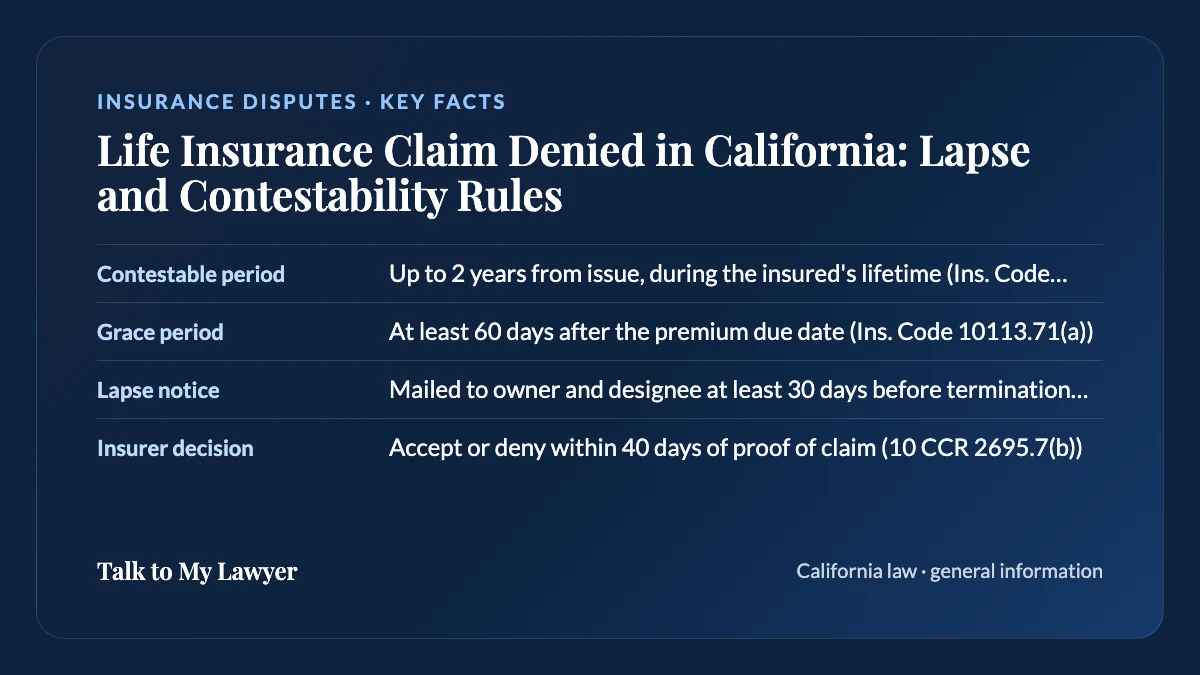
At a glance
- Contestable period
- Up to 2 years from issue, during the insured's lifetime (Ins. Code 10113.5)
- Grace period
- At least 60 days after the premium due date (Ins. Code 10113.71(a))
- Lapse notice
- Mailed to owner and designee at least 30 days before termination (10113.71(b))
- Insurer decision
- Accept or deny within 40 days of proof of claim (10 CCR 2695.7(b))
- Interest
- Owed from the date of death if not paid within 30 days (Ins. Code 10172.5)
Why was the life insurance claim denied?
Start with the insurer's stated reason, because California law sets different rules for each one. A first-party denial must be in writing and list all the bases for it, with the factual and legal grounds for each (California Code of Regulations, title 10, section 2695.7(b)(1)).
| Reason given | The California rule to check |
|---|---|
| The policy lapsed for unpaid premium | 60-day grace period and lapse notice to the owner and any designee (Ins. Code 10113.71, 10113.72) |
| Misstatement on the application | Two-year contestable period (Ins. Code 10113.5); the misstatement must be material (Ins. Code 359) |
| Exclusion in the policy | The exact policy wording and whether the facts fit it |
| Competing beneficiaries | The insurer can ask a court to decide who gets paid (interpleader, CCP 386) |
| Missing paperwork | The insurer must tell you what it needs (10 CCR 2695.5(e), 2695.7(c)(1)) |
Can a life insurer deny a claim after two years in California?
Not for misstatements on the application. An individual life policy delivered in California must become incontestable once it has been in force, during the insured's lifetime, for no more than two years from its issue date, except for nonpayment of premiums and certain supplemental benefits (Insurance Code section 10113.5(a)).
Three details matter:
- During the insured's lifetime. If the insured dies within the first two years, the policy never became incontestable, and the insurer may investigate the application.
- Material misstatements only. Under Insurance Code section 359, a false representation allows rescission when it is false in a material point. Ask the insurer to identify the question, the answer and why it would have changed the underwriting decision.
- Reinstatement. A lapsed policy that was reinstated can be contested for fraud or material misstatements in the reinstatement application, for the same period that follows reinstatement.
Was the policy really lapsed? Grace period and notice rules
California gives life policyholders a cushion before a policy can end for unpaid premium, and a lapse notice is not effective unless the insurer mailed it the way the statute requires.
| Requirement | What the statute says | What to ask the insurer for |
|---|---|---|
| Grace period | At least 60 days from the premium due date; the policy stays in force during it (10113.71(a)) | The premium due date and the date coverage supposedly ended |
| Notice of pending lapse | Mailed to the owner, any designee and any known assignee at least 30 days before termination (10113.71(b)) | Copies of each notice and proof of mailing |
| Timing of the notice | Sent by first-class mail within 30 days after a premium is due and unpaid | Mailing dates |
| Designee | Applicants for individual policies must be offered the right to name another person to receive lapse notices, and owners get an annual reminder (10113.72) | The designation form and annual notices |
Section 10113.71 applies to individual and group life policies, except where the statute says otherwise.
Example (hypothetical): a premium is due June 1 and goes unpaid. The 60-day grace period runs through July 31, and the policy stays in force during it. If the insured dies on July 20, the death falls inside the grace period. If the insurer also never mailed a lapse notice to the owner's named designee, a claimed termination is open to challenge on that ground too.
How long does a life insurer have to decide and pay?
The Fair Claims Settlement Practices Regulations and the Insurance Code set the pace:
- 15 days to acknowledge the claim, send forms and begin investigating (10 CCR 2695.5(e)).
- 40 days after proof of claim to accept or deny it, in whole or in part (10 CCR 2695.7(b)).
- If more time is needed, a written explanation within that period and every 30 days after (10 CCR 2695.7(c)(1)).
- 30 days to pay once the claim is accepted (10 CCR 2695.7(h)).
- Interest from the date of death on proceeds not paid within 30 days after death, at a rate not less than the insurer's rate on death proceeds left on deposit (Insurance Code section 10172.5).
Section 10172.5 also says payment should be made within 30 days after death whenever possible, and when interest becomes payable, the insurer must notify the named beneficiaries that it will be paid from the date of death.
What to do after a life insurance denial letter
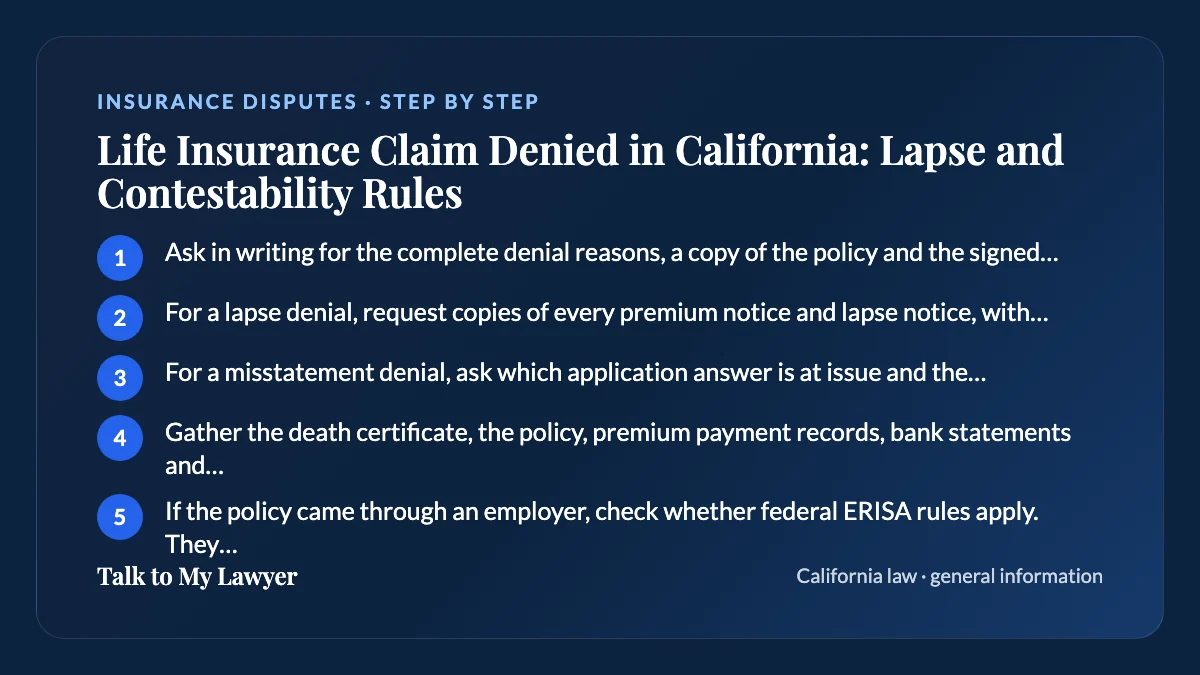
- Ask in writing for the complete denial reasons, a copy of the policy and the signed application, and any records the insurer relied on.
- For a lapse denial, request copies of every premium notice and lapse notice, with mailing dates and recipients.
- For a misstatement denial, ask which application answer is at issue and the underwriting rule it would have changed.
- Gather the death certificate, the policy, premium payment records, bank statements and any beneficiary designation forms.
- If the policy came through an employer, check whether federal ERISA rules apply. They give at least 60 days to appeal a denial and a right to copies of relevant documents at no charge (29 CFR 2560.503-1(h)(2)).
- File a complaint with the California Department of Insurance, online or through the Consumer Hotline at 1-800-927-4357.
- Send a written demand that answers each stated reason with the documents.
Your letter of September 3, 2026 denies the death claim under policy L-2207 on the ground that the policy lapsed on July 1, 2026, for the premium due June 1, 2026. The insured died on July 20, 2026, within the 60-day grace period that Insurance Code section 10113.71(a) requires, and we have no record of any notice of pending lapse sent to the policy owner or to the designee named under section 10113.72. Please provide copies of any such notices with proof of mailing, and pay the death benefit with interest from the date of death under section 10172.5, by October 15, 2026.
For denials on any policy type, see writing an insurance claim denial demand letter, and if the claim is tangled with an estate, see our guide to requesting probate and estate records.
Asking a lawyer to write to the life insurer
A beneficiary can end up arguing about underwriting questions and mailing logs they never saw. A lawyer's letter puts the grace-period, notice and contestability rules next to the insurer's own documents and asks for what is missing.
Through Talk to My Lawyer, a licensed California attorney writes your letter from the policy, the denial letter, premium records and death certificate, and sends it on your behalf to the insurer. For advice on a bad-faith claim or a beneficiary dispute, talk to a lawyer about your facts.
Frequently asked questions
How long does a life insurance company have to pay a claim in California?
After receiving proof of claim, the insurer has 40 days to accept or deny it, and 30 days to pay once it accepts (10 CCR 2695.7). Insurance Code section 10172.5 adds that payment should be made within 30 days after death whenever possible, and if proceeds are not paid within 30 days after death, interest runs from the date of death.
Can a life insurance company deny a claim because of the application after two years?
Generally no. Insurance Code section 10113.5 requires individual life policies to become incontestable after being in force for no more than two years from issue during the insured's lifetime, except for nonpayment of premium and certain supplemental benefits. If the insured died within those two years, the insurer may still investigate and contest a material misstatement.
What if the policy lapsed right before the insured died?
Check the grace period and the notices. California requires at least 60 days of grace after the premium due date, with the policy in force during that time. A termination for nonpayment is not effective unless a lapse notice was mailed to the owner, any designee and any known assignee at least 30 days before it. Ask the insurer for copies and proof of mailing.
Can I complain to the California Department of Insurance about a denied life insurance claim?
Yes. The Department of Insurance accepts complaints about life insurance claims online and through its Consumer Hotline at 1-800-927-4357. A written denial of a first-party claim must tell you that you can have the matter reviewed by the Department. A complaint runs alongside your own demand to the insurer rather than replacing it.
Who gets the money when two people claim the same life insurance policy?
When there are conflicting claims, the insurer can file an interpleader action, which asks a court to decide between the claimants (Code of Civil Procedure section 386). The court then decides who is entitled to the proceeds. Each claimant should gather the beneficiary designation forms and any later change requests, and talk to a lawyer about the facts.
Sources
Checked against these official sources on October 18, 2026.
- California Insurance Code section 10113.5 (California Legislative Information)
- California Insurance Code section 10113.71 (California Legislative Information)
- California Insurance Code section 10113.72 (California Legislative Information)
- California Insurance Code section 10172.5 (California Legislative Information)
- 10 CCR 2695.7 Standards for Prompt, Fair and Equitable Settlements (Legal Information Institute, Cornell Law School (California Code of Regulations text))
- Getting help: Consumer Hotline (California Department of Insurance)
This guide explains California law in general terms as of October 2026. It is general information, not legal advice for your situation, and local rules can add to it.
Join the email list and get a lawyer letter started
With Talk to My Lawyer, a licensed California attorney writes your letter from your facts and documents and sends it on your behalf. Join the Talk to My Lawyer email list for letter checklists, document prompts, and reminders before you start your letter.